-
-
BEACON Logo
-
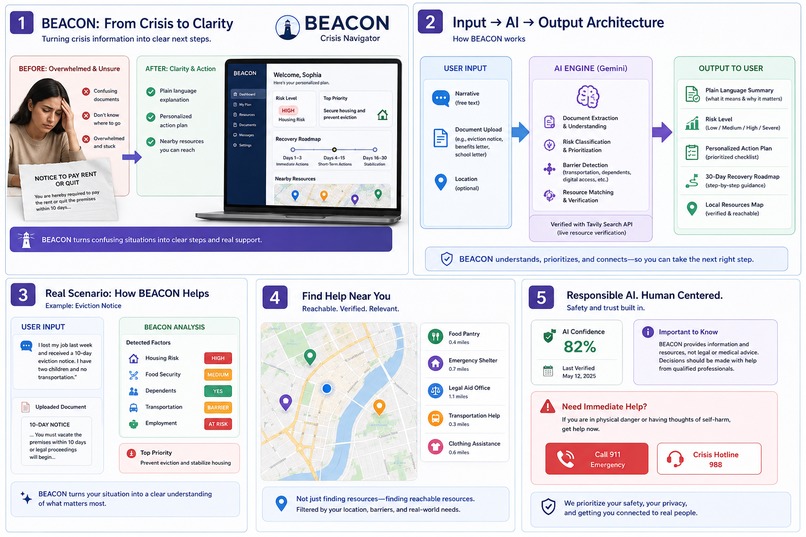
BEACON Summary Map
Inspiration
Millions of people face housing instability, food insecurity, unemployment, mental health challenges, and other hardships every year. Yet one of the biggest barriers is not the absence of support—it is the difficulty of understanding and navigating it.
A parent receiving an eviction notice may not know which deadlines matter, which resources apply to their situation, or what steps should be taken first. Someone struggling to afford food may face dozens of websites, forms, and eligibility requirements while already under significant stress.
Our team was inspired by a simple observation: people in crisis usually start with a story, not a service category.
Existing resource directories and search tools often assume users already know what they need. In reality, people describe situations:
"I lost my job and have two kids."
"I received this notice and don't understand it."
"I'm scared I won't be able to pay rent next month."
We built BEACON to bridge the gap between confusion and action by helping users understand their situation, identify what matters most, and connect with support they can realistically access.
What It Does
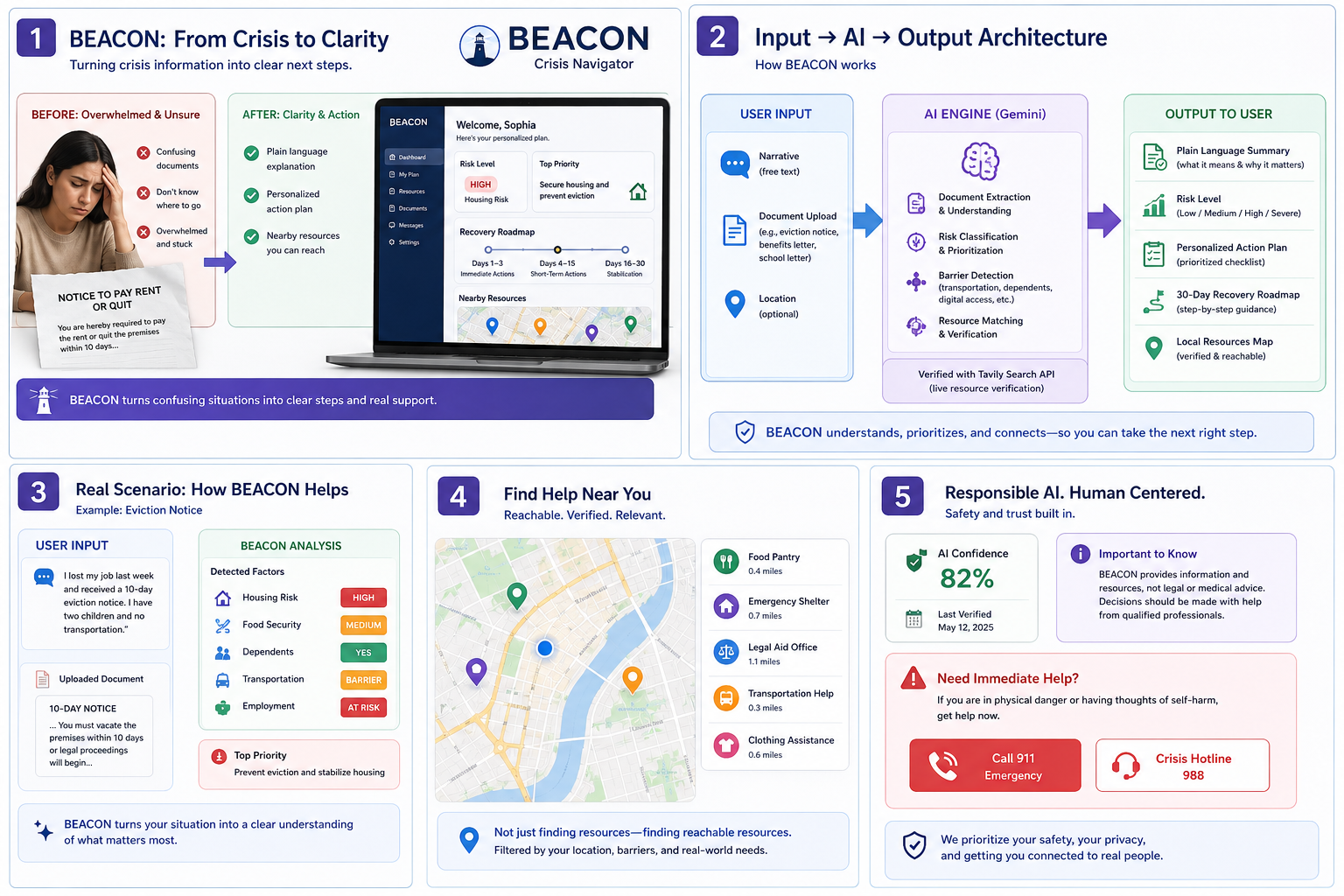
BEACON is an AI-powered support navigation platform that transforms stressful situations into clear explanations, prioritized action plans, and trusted local resources.
Users can either describe their situation in their own words or upload a document such as:
- Housing notices
- Benefits paperwork
- School communications
- Program eligibility letters
- Assistance forms
BEACON then analyzes the information and generates:
Plain-Language Explanations
Complex documents and bureaucratic language are translated into simple, understandable summaries that explain:
- What the document means
- Why it matters
- Important deadlines
- Potential consequences of inaction
Situation Analysis
BEACON identifies important factors affecting the user's situation, including:
- Housing instability
- Food insecurity
- Employment challenges
- Medical concerns
- Household dependents
- Transportation limitations
- Digital access barriers
Risk Prioritization
The system categorizes situations into four levels:
- Level 0: Informational Support
- Level 1: Emerging Need
- Level 2: Significant Risk
- Level 3: Immediate Intervention Recommended
This helps users understand urgency without making legal, medical, or safety decisions on their behalf.
Recovery Roadmap
Rather than presenting a long list of resources, BEACON generates a structured action plan divided into:
- Immediate Actions (Days 1–3)
- Short-Term Actions (Days 4–15)
- Longer-Term Stabilization (Days 16–30)
This helps users focus on the most important next steps first.
Local Resource Navigation
Using location-aware resource matching, BEACON recommends relevant community services and displays them on an interactive map.
Recommendations are adjusted based on real-world barriers such as:
- Transportation access
- Presence of children or dependents
- Internet connectivity limitations
- Physical accessibility concerns
The goal is not simply to identify available support, but to identify support that is realistically reachable.
Why AI?
A traditional directory or keyword search cannot effectively solve this problem.
Most support systems require users to already know:
- What type of assistance they need
- Which program category applies
- Which organization to contact
People in crisis often do not know any of these things.
Instead, they provide narratives:
"I got laid off last month and can't afford groceries."
"My landlord posted this notice on my door."
"My child was suspended and I don't understand this letter."
AI enables BEACON to:
- Understand free-form narratives.
- Interpret complex documents.
- Extract relevant contextual factors.
- Prioritize urgent needs.
- Generate personalized action plans.
- Match users to appropriate support resources.
Without AI, users would need to manually navigate multiple websites, forms, and service directories while already under stress.
AI allows BEACON to transform raw situations into understandable, actionable guidance.
How We Built It
BEACON was developed using a full-stack architecture designed for accessibility, reliability, and transparency.
Frontend
- React
- Vite
- TypeScript
- Tailwind CSS
- Framer Motion
The interface guides users through a structured intake process and presents recommendations in a clear, low-stress format.
AI Processing
We integrated the Google Gemini API to:
- Analyze uploaded documents
- Process user narratives
- Generate plain-language explanations
- Extract key situational indicators
- Produce structured recommendations
The AI outputs standardized JSON objects that drive downstream recommendation and planning workflows.
Resource Mapping
We integrated:
- Leaflet.js
- OpenStreetMap
to visualize nearby support resources and improve accessibility.
Offline Simulation Mode
We developed a deterministic rules-based simulation engine that mirrors the platform's decision structure.
This allows:
- Demonstrations without API calls
- Offline testing
- Consistent validation
- Reduced operating costs
The simulation mode produces identical data structures to the AI-powered workflow, ensuring reliability during demonstrations and development.
Report Generation
We implemented automated PDF generation using jsPDF so users and caseworkers can export recovery plans and summaries for offline use.
Challenges We Faced
The biggest challenge was balancing helpful AI assistance with responsible system design.
In high-stakes situations, inaccurate information can cause real harm.
We addressed this challenge by:
- Providing source transparency
- Using confidence-based recommendations
- Maintaining human oversight boundaries
- Building an offline fallback system
- Separating informational guidance from decision-making
Another challenge involved designing recommendations that account for real-world barriers.
A theoretically available resource may not be useful if a user lacks transportation, internet access, childcare, or physical accessibility accommodations.
We spent significant time designing BEACON to consider these constraints so recommendations remain practical rather than purely informational.
Accomplishments We're Proud Of
We are most proud of BEACON's ability to move beyond simple resource lookup.
Instead of showing users a list of programs, BEACON helps answer:
- What is happening?
- What matters most?
- What should I do first?
- Which resources are realistic for me?
We are also proud of the platform's barrier-aware recommendation system, which adapts guidance based on household circumstances and accessibility constraints.
Finally, we are proud of the integrated dashboard experience that combines document understanding, risk assessment, action planning, and local resource navigation into a single workflow.
What We Learned
Throughout this project, we learned that one of the most valuable roles AI can play in social support systems is reducing confusion.
People experiencing hardship are often overwhelmed by information, paperwork, deadlines, and uncertainty.
The goal is not to replace human judgment or professional support.
Instead, AI can help people better understand their situation before they interact with social workers, nonprofit organizations, legal aid providers, educators, healthcare professionals, or community support services.
We also learned that reliability is an ethical requirement.
Systems designed to support vulnerable populations must continue functioning even when external services fail, which reinforced the importance of our fallback architecture and transparent recommendation process.
Responsible AI
Realistic Risk
A user could receive incomplete, outdated, or incorrect resource recommendations and rely on them during an urgent situation.
Mitigation
BEACON prioritizes verified resources, displays confidence indicators, provides source transparency, and continuously presents emergency support options when relevant.
The system is designed to provide guidance rather than definitive answers.
Human-in-the-Loop
BEACON does not make legal, medical, housing, or safety decisions.
If the system detects indicators of immediate danger, self-harm, violence, or other severe risks, it recommends escalation to qualified professionals and emergency services rather than attempting to resolve the situation autonomously.
Humans remain responsible for all final decisions and interventions.
What's Next for BEACON
We plan to expand BEACON by integrating:
- Real-time transit information
- Expanded nonprofit and community service databases
- Additional document understanding capabilities
- Caseworker collaboration tools
- Resource verification workflows
- Multi-language accessibility support
Our long-term vision is to help people move from:
Uncertainty → Clarity → Action
and make support systems easier to understand, trust, and access during life's most difficult moments.
Built With
- framer
- google-cloud
- google-gemini
- html5
- jspdf
- leaflet.js
- lucidereact
- next.js
- react
- recharts
- tailwind
- tavily
- typescript
- vite

Log in or sign up for Devpost to join the conversation.