-
-
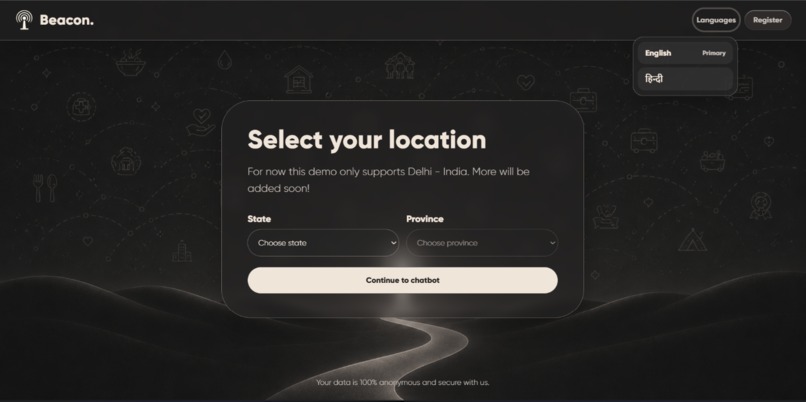
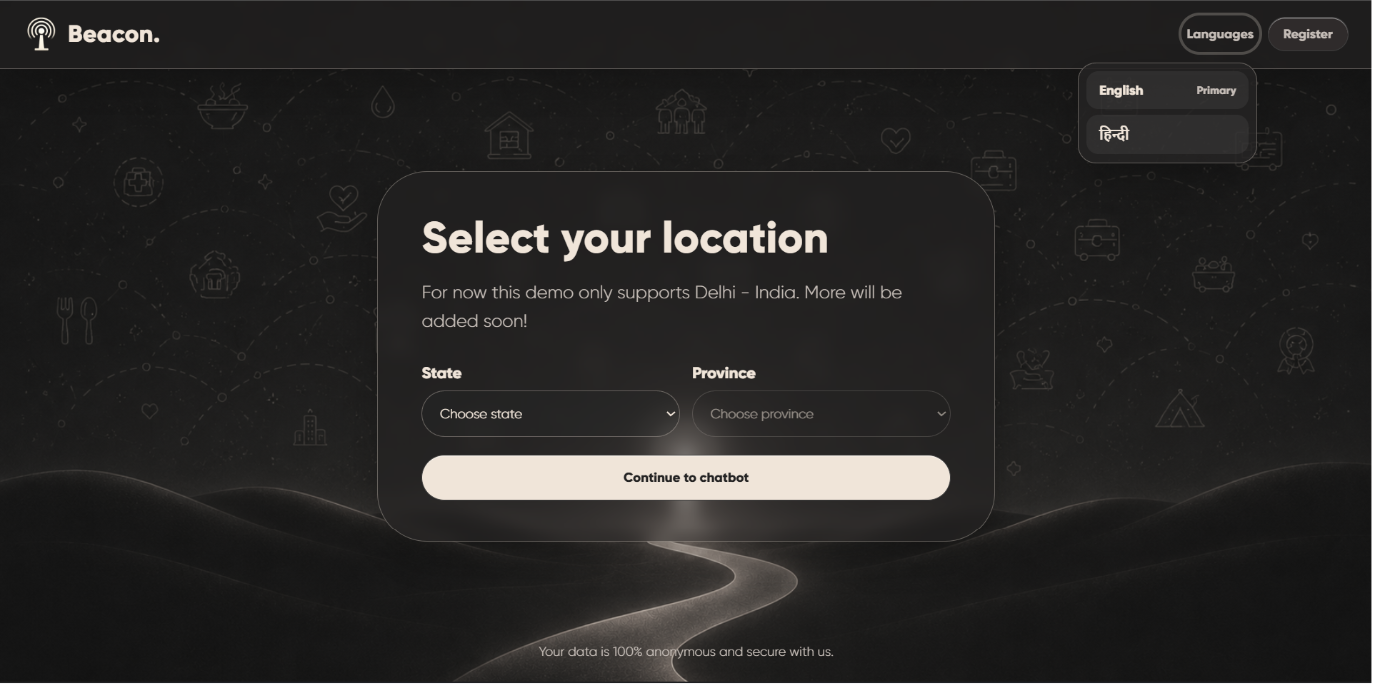
Landing Page
-
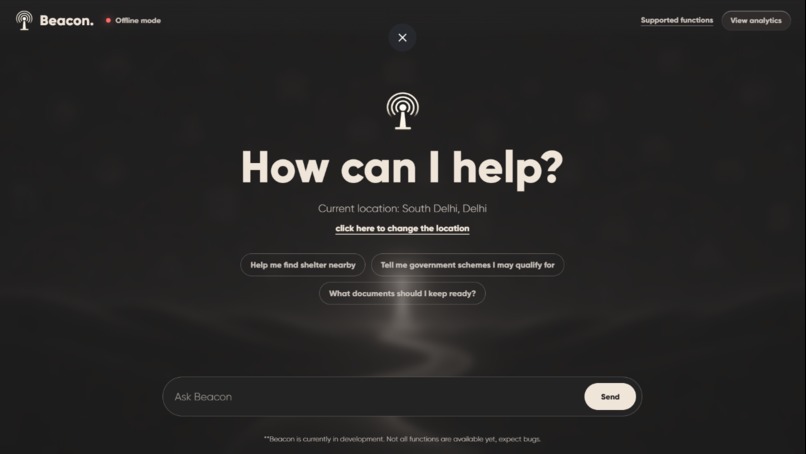
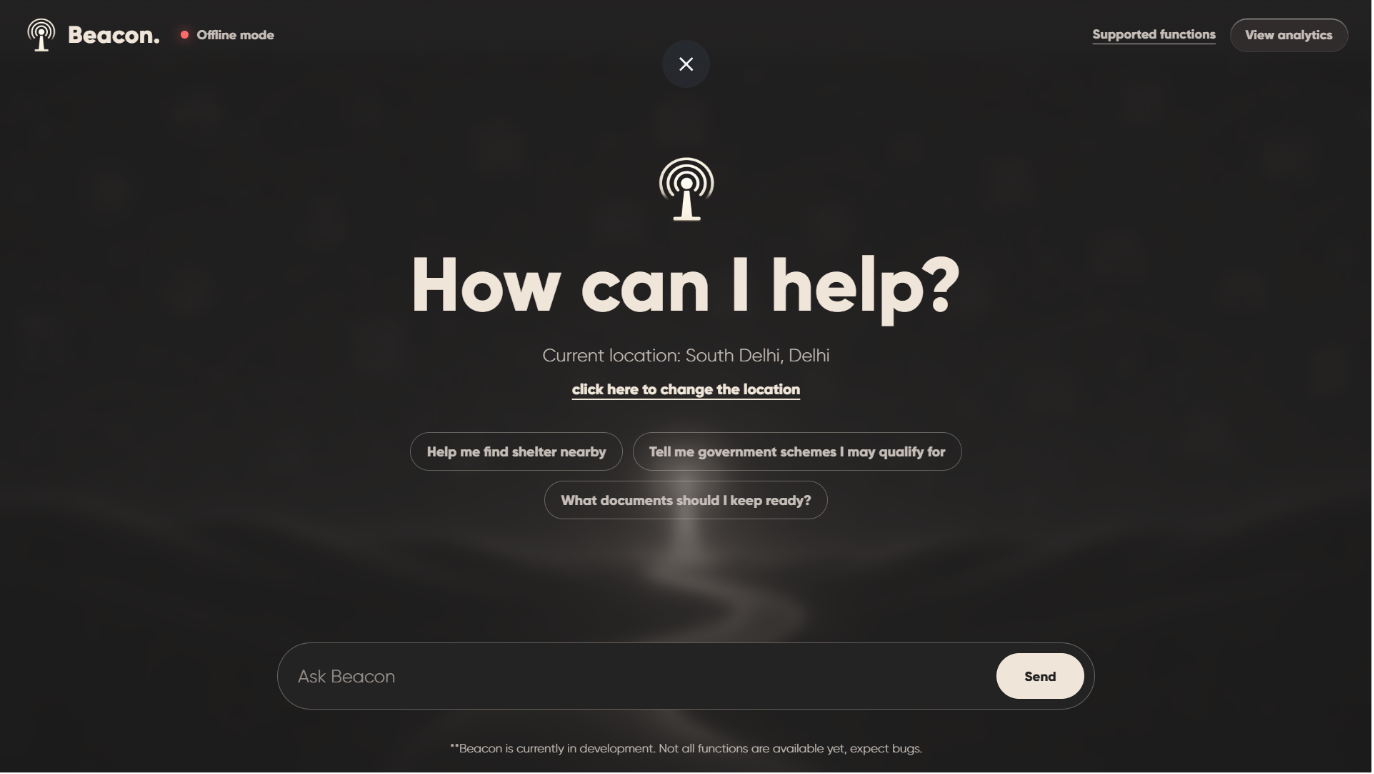
Chatbot Page - Welcome!
-
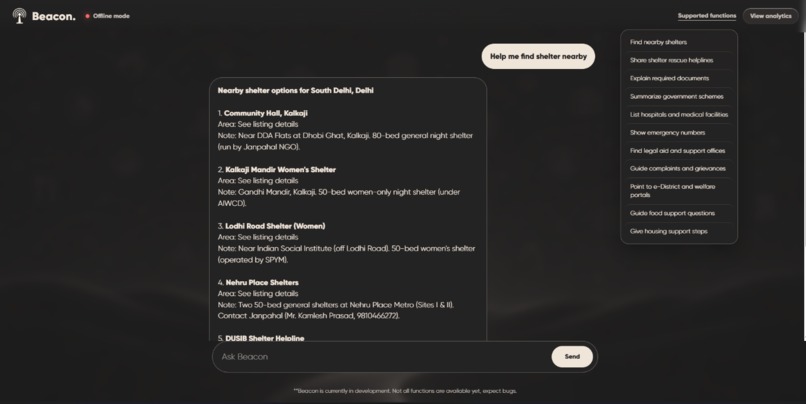
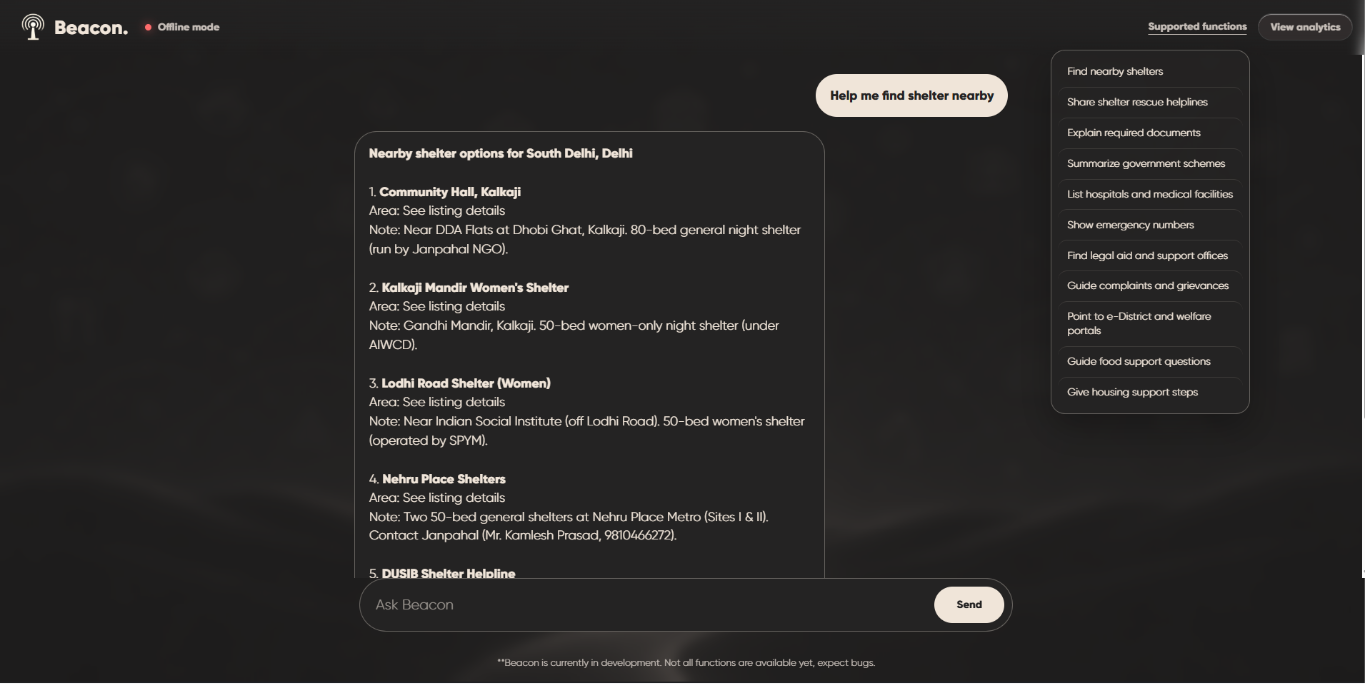
Chatbot Page - English
-
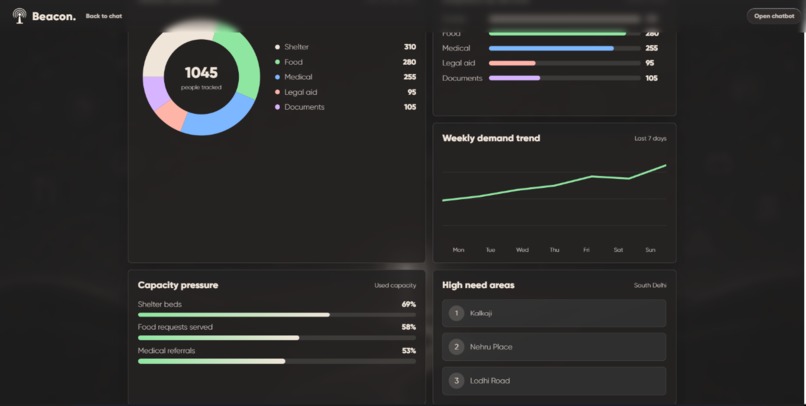
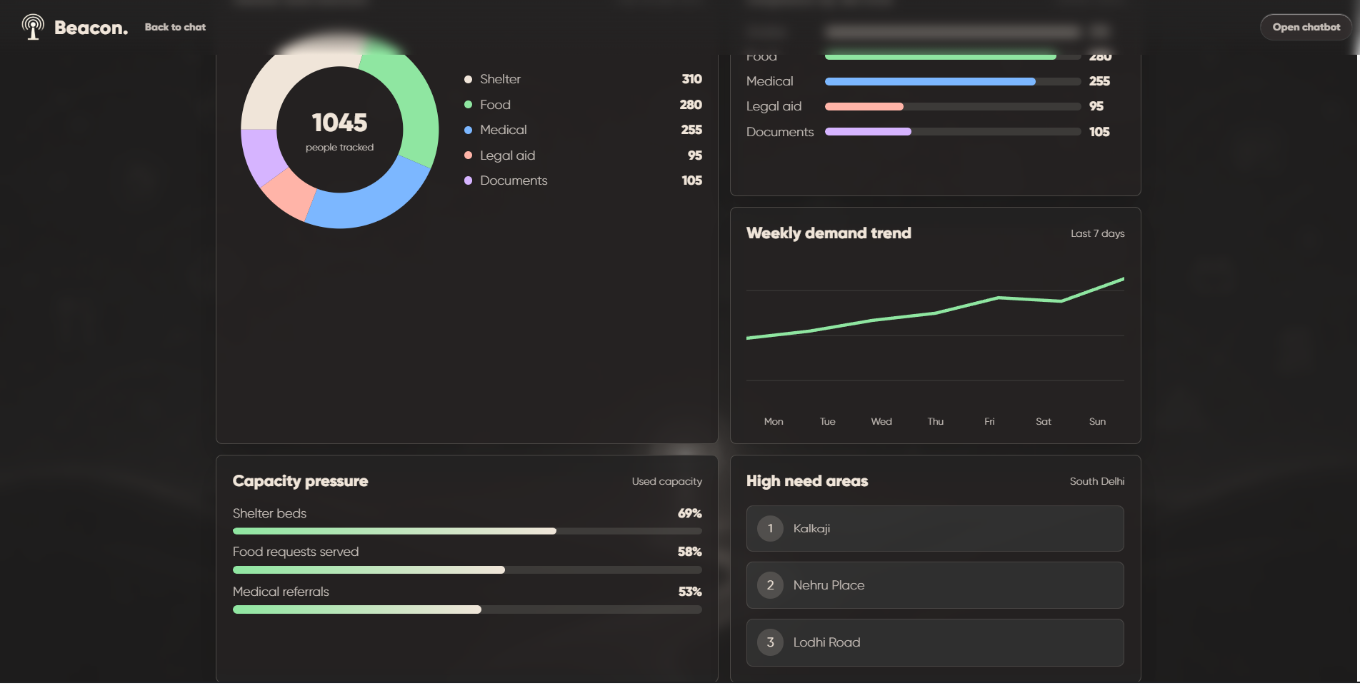
Analytics Page - English
-
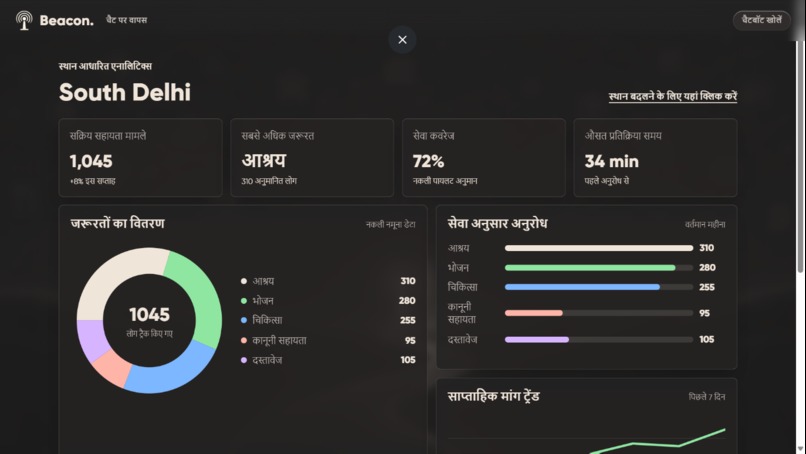
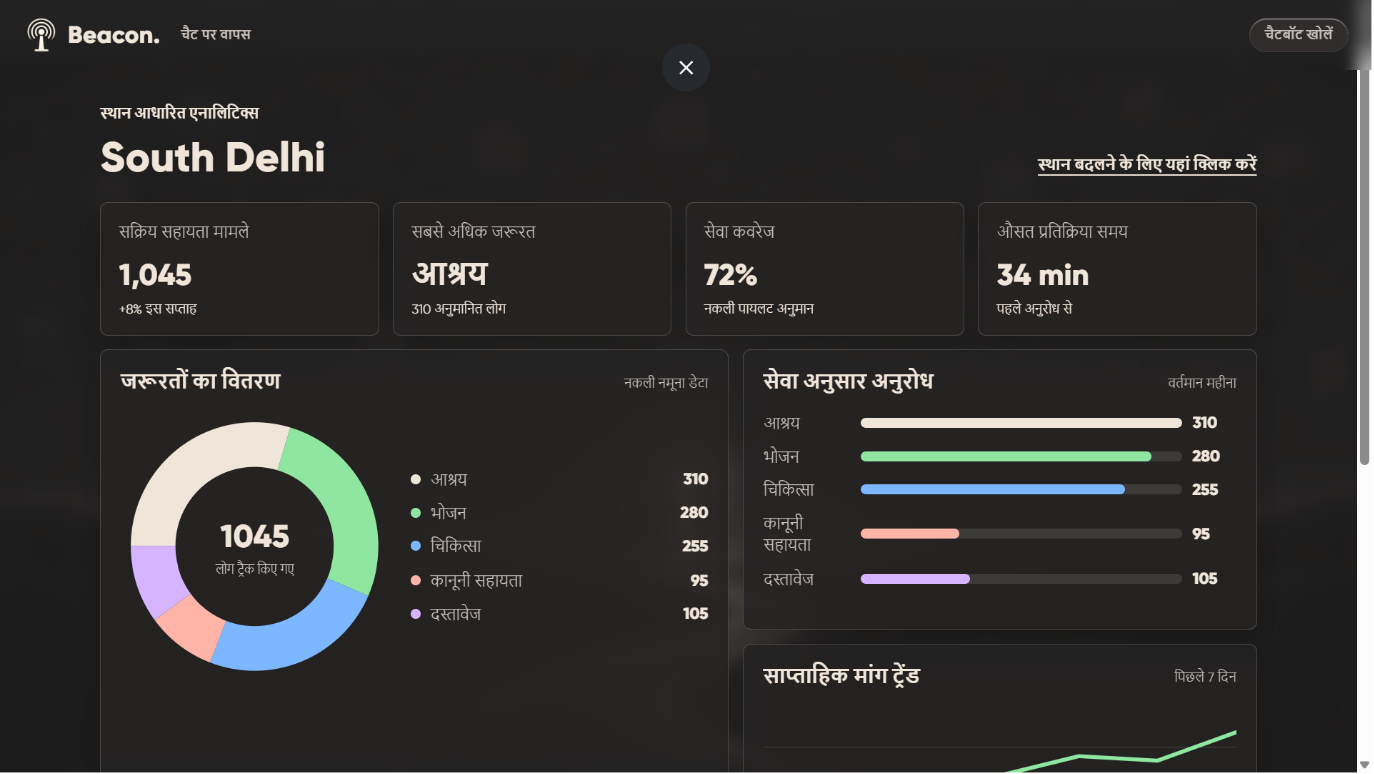
Analytics Page - Hindi
Inspiration
The inspiration for Project Beacon lies in a critical disconnect we call The Centralization Paradox. Today, institutions generate vast amounts of public welfare information, emergency protocols, and support resources across government portals, official directories, and digital databases. Upstream, there is an abundance of information. Yet downstream, where crises, uncertainty, and vulnerability actually occur, this information often fails to reach the people who need it most. When disruption strikes, access to centralized platforms becomes difficult. Networks become unreliable, devices run low on battery, and individuals are often forced to navigate large websites or lengthy documents while already under stress. In these moments, information may exist, but it is not truly accessible. We realized a fundamental truth: Information storage has been solved. Information delivery during disruption has not. Real availability does not equal accessibility. We were inspired to build a system that transforms fragmented public information into clear, actionable local guidance so that access to critical resources does not depend on continuous connectivity, technical literacy, or luck.
What it does
Project Beacon bridges the gap between fragmented public information and the people who need it most. Instead of requiring users to navigate multiple government websites, directories, and lengthy documents, Beacon provides a single interface where individuals can describe their situation in natural language and receive relevant guidance. The platform draws from a structured knowledge base containing government welfare schemes, shelter directories, hospital resources, food assistance programs, legal aid services, emergency contacts, and other forms of public welfare information. When a user submits a query, Beacon identifies their underlying need, retrieves the most relevant information, and analyzes relationships between services, organizations, locations, eligibility requirements, and support programs. To achieve this, Beacon combines Natural Language Processing (NLP), Intent Classification, Semantic Search, Retrieval-Augmented Generation (RAG), GraphRAG, recommendation systems, and Generative AI. These components work together to transform complex institutional information into clear, actionable guidance. Whether a user is looking for shelter, healthcare, food assistance, legal support, emergency contacts, or government benefits, Beacon helps connect them with the resources most relevant to their situation, enabling informed decisions when access to information matters most.
How we built it
We built Beacon using Vite and Node.js, focusing heavily on creating a lightweight, responsive, and standalone platform that handles data processing locally on the client side. We took unstructured public welfare information from multiple sources and organized it into a clean, structured local knowledge base. To make this data useful and context-aware, we implemented an intelligent retrieval pipeline that weaves together intent classification, semantic search, RAG, GraphRAG, and NLP. GraphRAG plays a foundational role in our architecture by mapping connections across separate entities, such as linking a specific night shelter to its corresponding operating organization, geographical location, and legal eligibility rules. This approach allows Beacon to move entirely beyond rigid keyword matching, transforming complex and fragmented information into practical guidance that users can understand and act upon quickly.
Challenges we ran into
One of the biggest challenges we faced was making Beacon work smoothly on devices with limited computing power. Since not every user has access to high-end hardware, we had to focus on keeping the system lightweight and responsive while still handling information retrieval and processing efficiently. Another challenge was finding a way to understand how the platform was being used without compromising user privacy. We wanted meaningful usage insights, but at the same time we did not want to rely on collecting personal information or intrusive tracking methods. We also spent a significant amount of time working with government documents and public welfare resources. These sources often came in different formats and structures, making it difficult to organize, clean, and maintain the information in a consistent and reliable way.
Accomplishments that we're proud of
We are most proud of successfully turning our original idea into a working platform. From the beginning, our goal was to make public welfare information more accessible and actionable, and we were able to build a system that closely reflects that vision. We are also proud that Beacon remains focused on the user. Throughout development, we prioritized simplicity, accessibility, and privacy, ensuring that users can access relevant information without feeling monitored or overwhelmed. Another accomplishment was bringing together diverse public welfare resources, including government schemes, shelters, healthcare resources, food assistance, legal aid, and emergency support, into a unified framework that is easier to navigate and understand. Most importantly, we are proud that Beacon transforms information into action, helping bridge the gap between institutional data and real-world decision-making.
What we learned
Building Beacon taught us a great deal about both software development and intelligent information systems. From a development perspective, we gained practical experience working with Vite and Node.js, learning how to design and structure a responsive application from the ground up. We also learned how GraphRAG can be used to connect different pieces of information through relationships rather than simple keyword matching. This helped us better understand how knowledge graphs can improve the way information is discovered and presented. Beyond that, we gained valuable experience with Natural Language Processing, Retrieval-Augmented Generation, data organization, and the challenges of building AI-assisted systems that provide useful and reliable responses based on real-world information.
What's next for Beacon
Going forward, we want to expand Beacon's resource network by including more public welfare information, support services, and regional datasets. We also hope to improve the way information is updated and maintained so that users can always access relevant and trustworthy guidance.
Our long-term vision is to continue developing Beacon into a platform that transforms important information into meaningful action whenever people need it most.


Log in or sign up for Devpost to join the conversation.