-
-
Beacon | Dashboard
-
Beacon | Compose
-
Beacon | Dashboard
Beacon — RC Announcement Bot
About the project
Beacon is a Telegram-powered outreach dashboard built for Residential College committees and student leaders who have to communicate across multiple house chats at once. That problem sounds manageable until campus life ramps up. The moment there are inter-RC events, college-wide initiatives, welfare drives, elections, or collaborations with multiple student clubs, communication stops being “send a quick message” and becomes a messy chain of copy-pasting, reformatting, reposting, and damage control. One announcement has to be forwarded across several chats. One typo has to be corrected everywhere. One poll turns into fragmented responses spread across multiple groups.
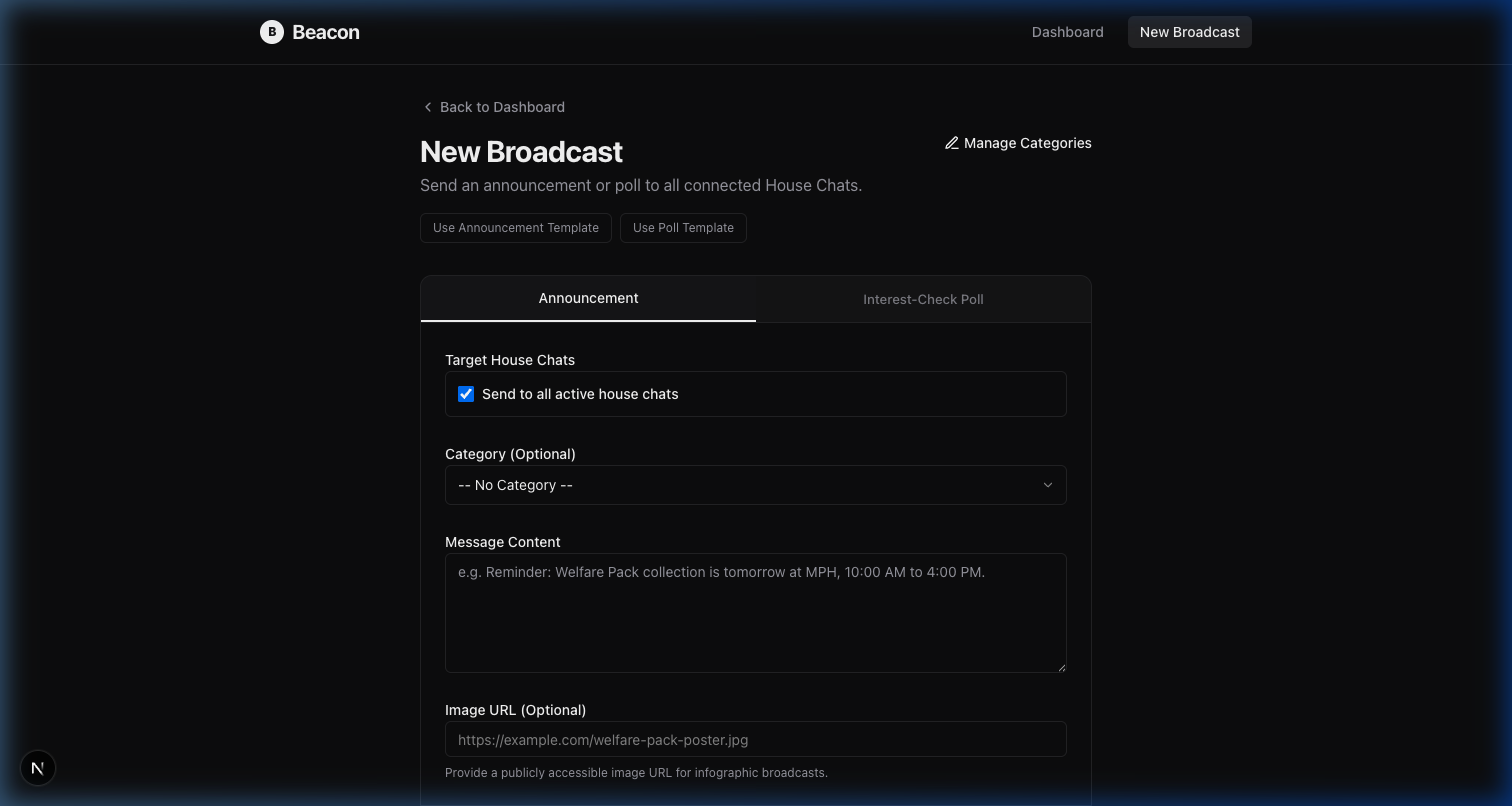
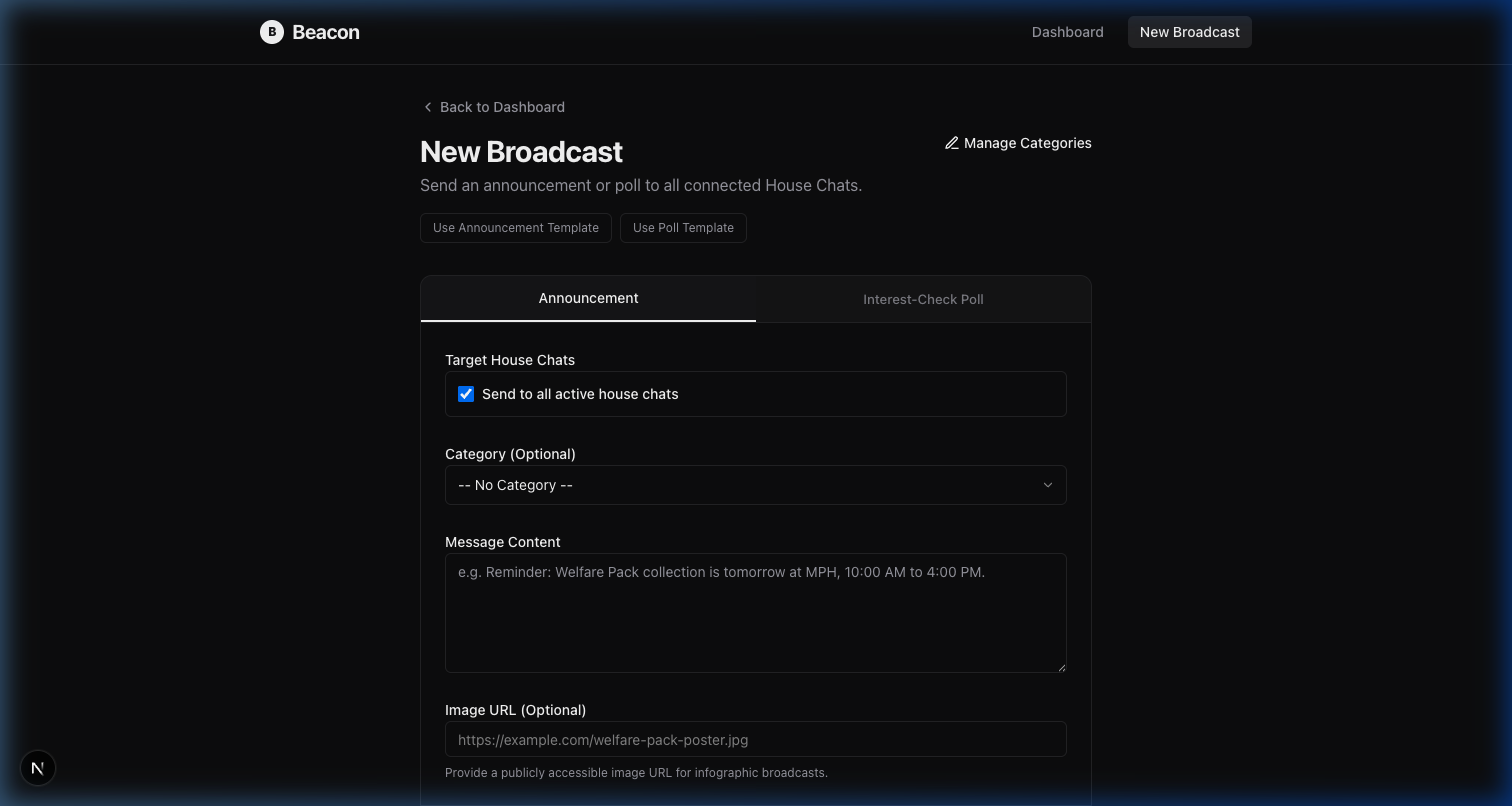
Beacon turns that chaos into a system. Committees invite the bot into each house chat once, then use a single dashboard to send announcements and polls to one or many chats at the same time. Beacon keeps broadcasts organized with categories, supports live edits for announcements, and collates engagement and poll activity across chats into one central view. Instead of chasing messages across Telegram, student leaders get one place to coordinate outreach at scale.
Inspiration
We were inspired by how quickly student communication breaks down when an organization grows beyond a single group chat. In many colleges, committees still rely on manual forwarding to spread updates across houses, clubs, and event groups. That works for a while, but as soon as there are inter-RC programs or multiple student organizations involved, the friction multiplies. Suddenly the same event poster is being reposted in five places, reminders are inconsistent, polls are impossible to track cleanly, and no one really knows who has seen what.
What stood out to us was that the issue was not a lack of communication platforms. Students are already on Telegram. The real problem is that there is no lightweight control layer on top of it for the people doing the organizing. We wanted to build something that fits naturally into existing student workflows while removing the repetitive, error-prone parts of committee communication. Beacon came from that idea: keep the chats, keep the familiarity, but give student leaders a much smarter way to coordinate everything behind the scenes.
What it does
Beacon gives Residential College committees a single dashboard to manage communication across multiple Telegram house chats.
With Beacon, a committee can:
- invite the bot into each house chat once for setup
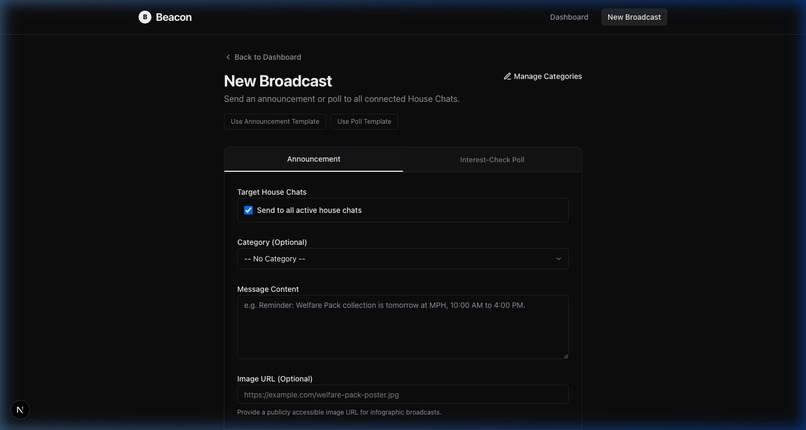
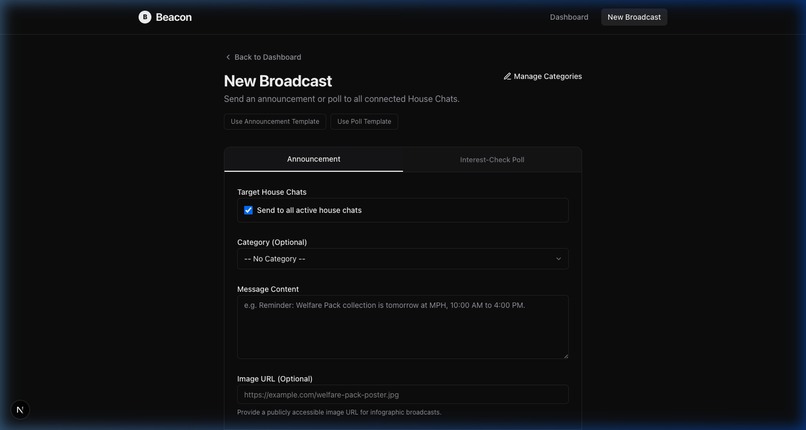
- send announcements to all or selected chats from one interface
- create interest-check polls and distribute them across several groups at the same time
- organize broadcasts with categories like Events, Elections, or Admin
- edit text announcements from the dashboard and sync those changes back to Telegram
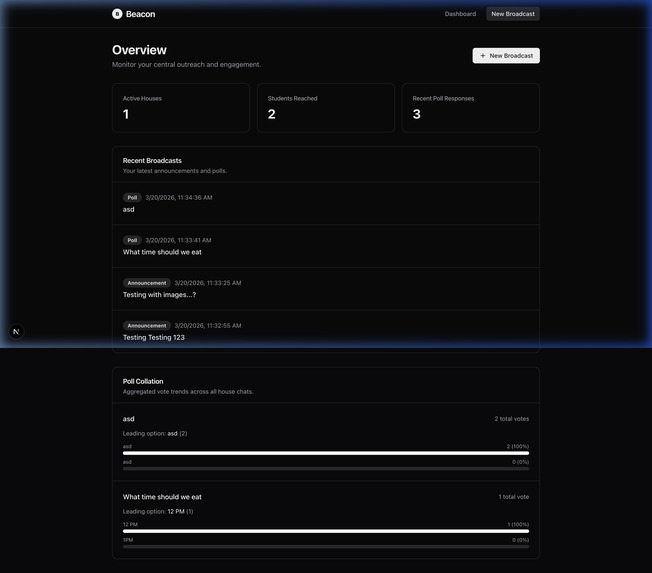
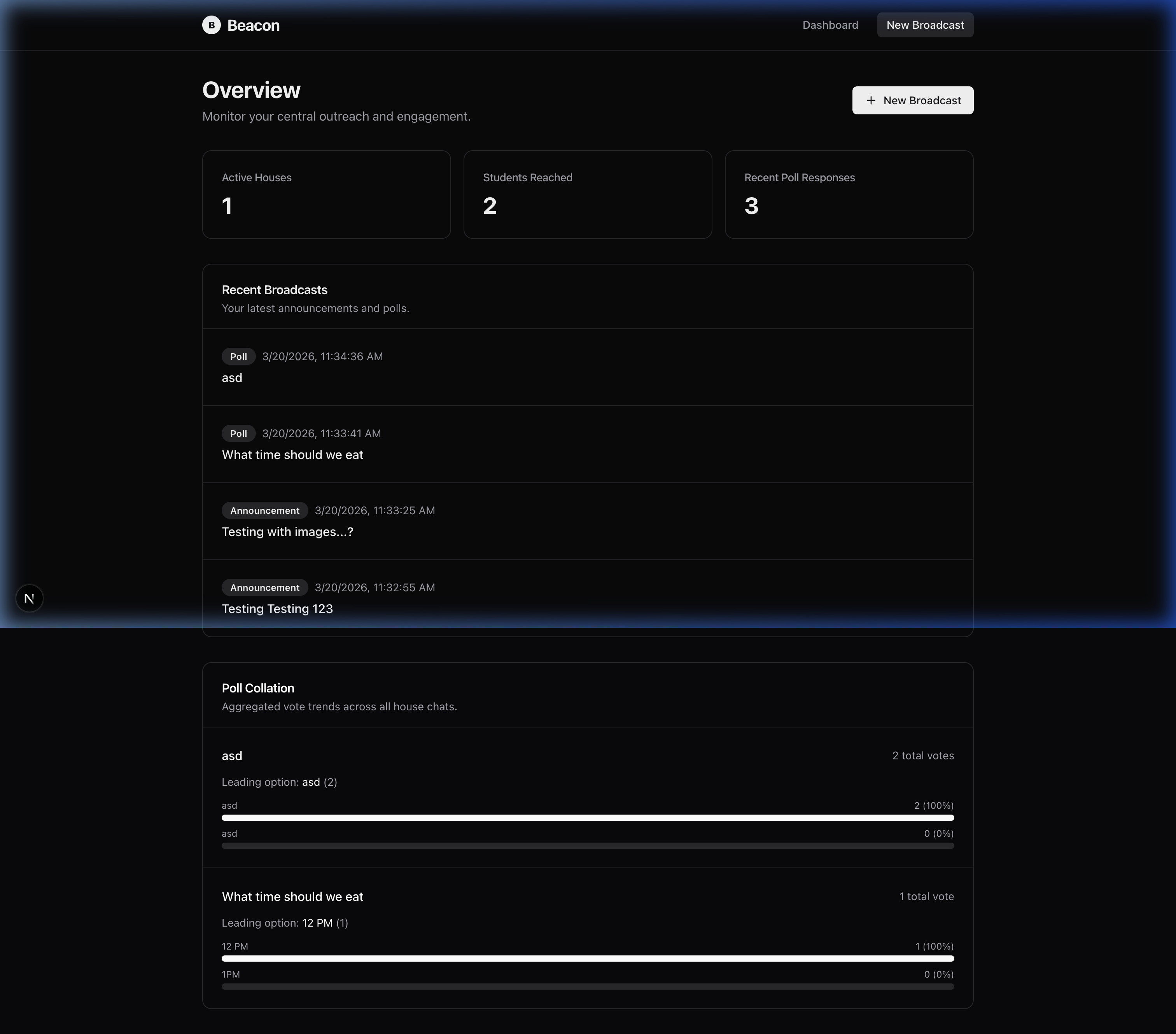
- view centralized activity, recent broadcasts, and poll response summaries across connected chats
Instead of treating each group chat as a separate workflow, Beacon turns them into one connected communication system.
How we built it
We built Beacon as a web dashboard integrated with the Telegram Bot API.
Our stack included:
- Next.js and React for the dashboard and API routes
- Tailwind CSS for the interface
- Supabase for database storage and backend data management
- Telegram Bot API for message delivery, polls, webhook events, and chat integration
The system works in two parts:
- The Telegram bot gets invited into house chats and registers those chats as active communication channels.
- The dashboard lets committee members compose announcements and polls, choose target chats, tag broadcasts, and review engagement data.
When a poll is sent, Beacon maps Telegram poll instances back to a master poll record so responses from multiple chats can be collated into one summary. We also built message logging and editing support so announcements stay manageable even after they’ve been sent.
Challenges we ran into
One big challenge was dealing with Telegram’s constraints while still trying to create a polished admin experience. Not everything that feels easy in a dashboard is easy to reflect in a chat platform. For example, text announcements can be edited after sending, but polls are much more restrictive, so we had to design around what Telegram allows.
Another challenge was aggregating analytics across several chats. A single poll broadcast can create multiple Telegram poll instances, one in each group, so we needed a way to link them back to one source poll and merge responses meaningfully. We also had to think through webhook handling, chat registration, database structure, and how to keep the dashboard state synchronized with Telegram actions.
Finally, we wanted the product to feel useful immediately. That meant designing a setup flow that was simple enough for student leaders: add the bot once, then let the system do the repetitive work from there.
Accomplishments that we're proud of
We’re proud that Beacon solves a genuine operational problem in a way that feels practical, not just impressive on paper. The project goes beyond being “a Telegram bot” by giving committees a real communication workflow with structure, visibility, and scale.
A few highlights we’re especially proud of:
- building a working dashboard that can send to multiple chats from one place
- supporting both announcements and interest-check polls
- collating poll activity across several Telegram chats into one view
- enabling live editing for announcements already sent to Telegram
- creating a product that feels directly relevant to student committee operations
We’re also proud that the idea is easy to understand: one-time bot setup, then centralized outreach forever after.
What we learned
We learned that the hardest part of communication tooling is not sending messages, it’s managing the workflow around them. Reliability, consistency, and visibility matter just as much as raw delivery.
On the technical side, we learned a lot about:
- designing around third-party platform limitations
- structuring webhook-driven systems
- modeling cross-chat poll analytics in a database
- balancing frontend usability with backend messaging logic
On the product side, we learned that small workflow improvements can have outsized impact when they remove repetitive administrative work. For student leaders, saving time and reducing mistakes can matter more than adding flashy features.
What's next for Beacon — RC Announcement Bot
Next, we want to make Beacon more production-ready for real committee use.
Our planned next steps include:
- role-based access control so only authorized committee members can send or edit broadcasts
- message scheduling for timed announcements and campaign planning
- richer analytics, such as participation rates and trends across houses
- better media workflows for posters, infographics, and event assets
- more polished onboarding for bot setup and chat linking
- stronger deployment and reliability for live use beyond development
Longer term, we see Beacon becoming a lightweight communications operating system for student communities, starting with RCs but potentially extending to clubs, councils, orientation groups, and other campus organizations.
Built With
- iloveu
- kumar
- next.js
- nextjs
- postgressql
- prakash
- react
- supabase
- tailwindcss
- telegram-api
- thecollective
- typescript


Log in or sign up for Devpost to join the conversation.