-
-

The car Beachcar found. I bought it.
-
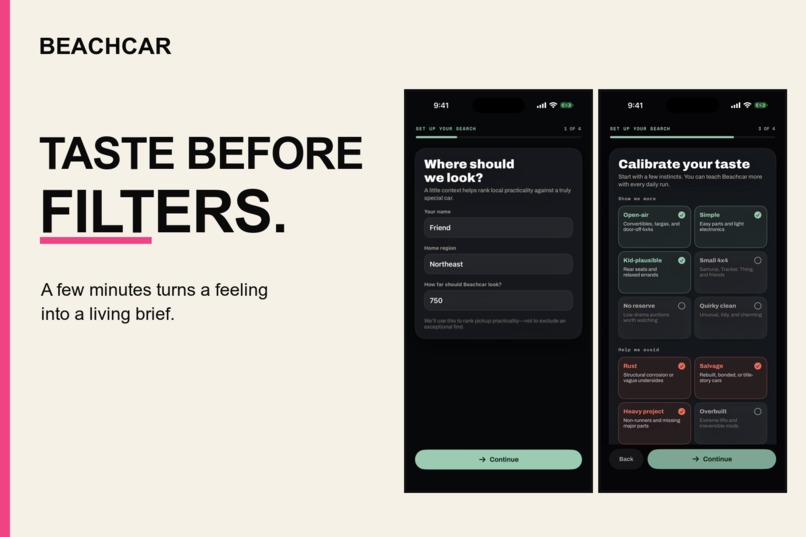
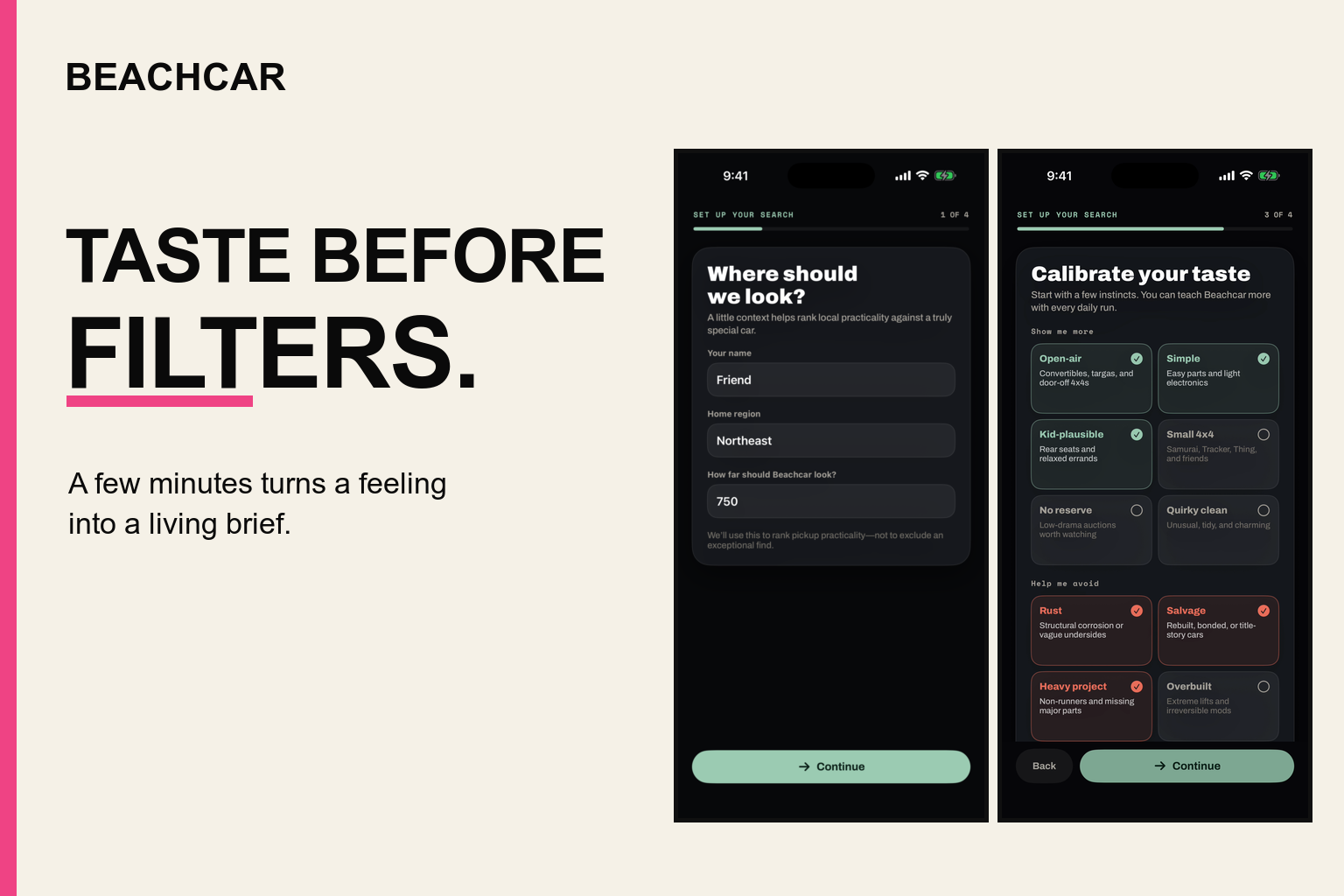
Teach Beachcar your taste—not just your filters.
-
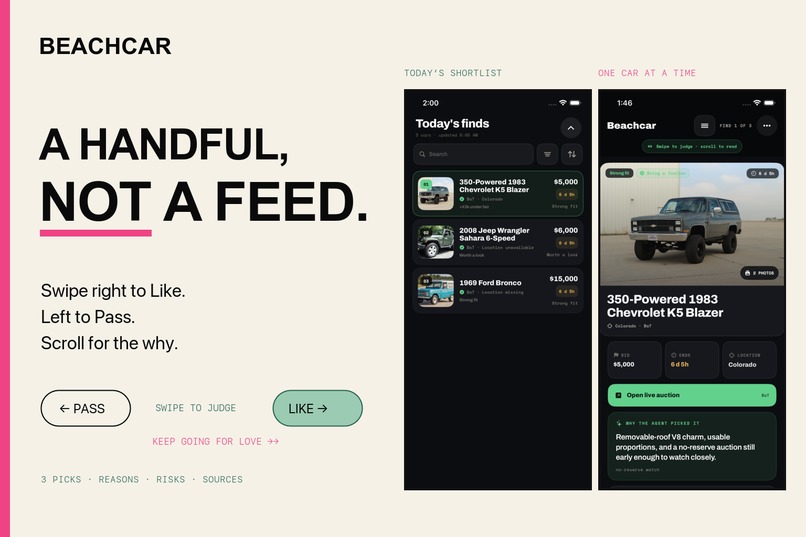
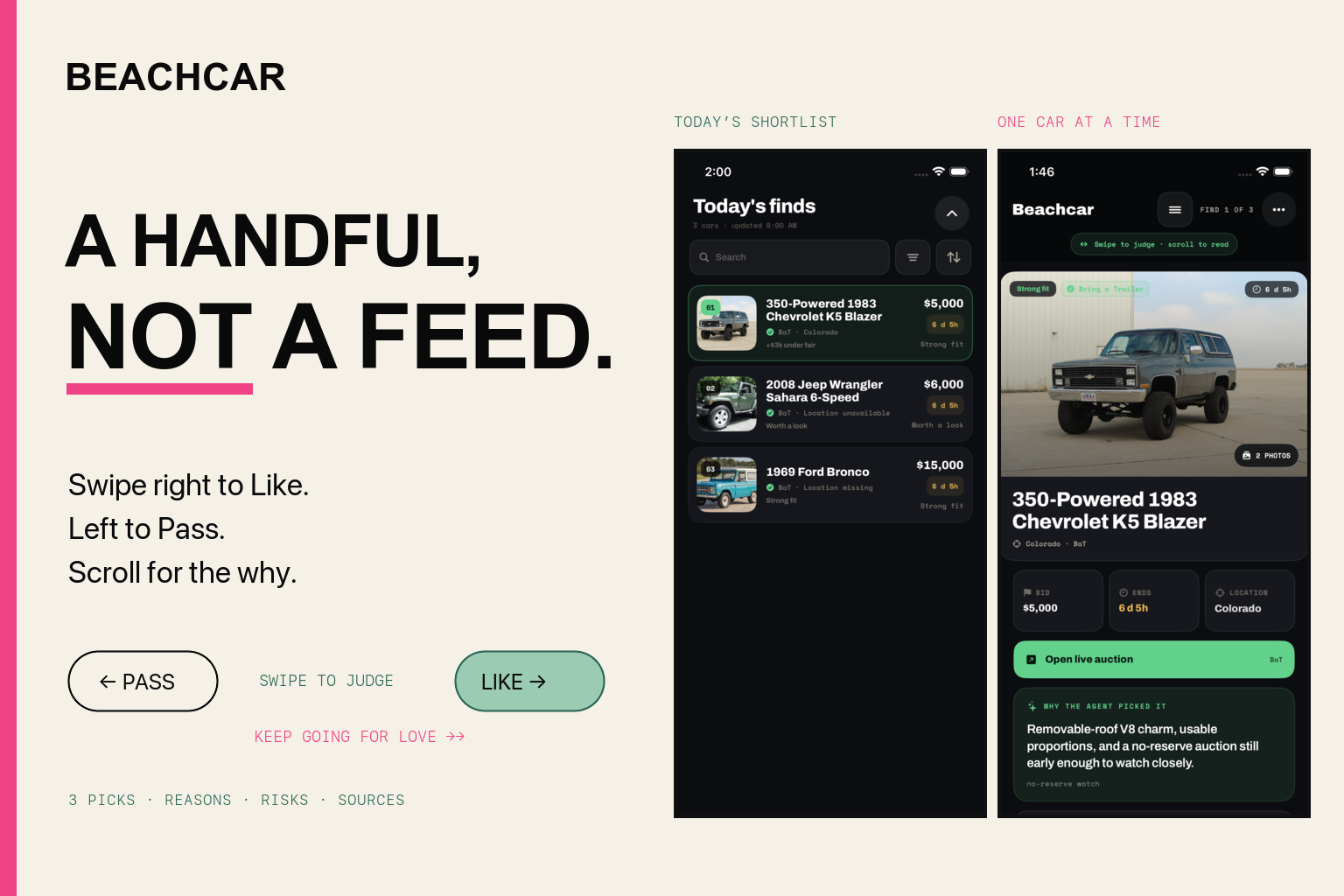
Swipe to judge. Scroll for the why.

I wanted a car I couldn’t name
I live in a small beach town. In summer, most of my driving is one or two miles at a time: the beach, camp, friends, ice cream. I wanted something open, simple, joyful, a little ridiculous, and impossible to confuse with anything else in town.
The problem was that I had no idea what that car was called.
So I built Beachcar.
A couple of weeks later, Beachcar surfaced a two-tone pink 1960 Willys DJ-3A Surrey, a car I did not know existed and could never have thought to search for.
I bought it.
This is actually my car now.
Search should begin before make and model
Most car sites begin with make, model, and year. Beachcar begins one question earlier:
What should the car feel like?
A few minutes on iPhone captures the clues ordinary filters flatten: joyful, not serious; charming, not precious; strange, but in exactly the right way. Together, those clues become a living taste brief.
Then the user’s local Codex does the hunting in a browser session they control. Beachcar supplies the installable skill and hosted MCP; Codex supplies GPT-5.6 and the browser. The MCP holds the scoped product memory—taste, source settings, evidence, feedback, and shortlists—while marketplace and OpenAI credentials stay local.
A handful, not a feed
Beachcar is deliberately stingy.
Instead of another endless scroll, it returns a few cars genuinely worth opening. Each comes with the reason it fits, the reason to hesitate, a point of view about value, and a link to the source.
Love, Pass, and Never again sharpen the next hunt. Beachcar never bids or buys. The user controls the browser, reviews the evidence, and makes every purchase decision.
What changed during Build Week
Beachcar existed before Build Week, and so did the Surrey discovery. That improbable pink car is the real-world proof behind this entry.
During Build Week, I built the extension submitted here: a coached handoff from iPhone to local Codex, an installable Beachcar skill, scoped MCP tools, feedback that changes the next plan, a public no-login replay, and a consent-first Garage Session policy.
Codex helped me turn the idea into a shippable loop. It helped shape the local-agent architecture, coached setup, MCP contract, and browser and iPhone pieces. I made the final calls on the product, privacy boundaries, and claims.
A garage full of collaborators
The strangest Build Week extension may be my favorite.
With explicit opt-in, a user’s Codex can prepare one small, broadly useful Beachcar improvement in an isolated worktree and show the exact change to the user. Nothing is pushed, posted, deployed, filed as an issue, or opened as a pull request without fresh approval.
The people teaching Beachcar what good taste looks like can also help make it better, while remaining its editors rather than its bystanders.
Most search products are optimized to keep you searching.
Beachcar is optimized for one unusually good decision.
Mine is pink.
Built With
- cloudflare-d1
- cloudflare-r2
- cloudflare-workers
- codex
- gpt
- mcp
- swiftui
- typescript

Log in or sign up for Devpost to join the conversation.