
Inspiration
To aid patients with Alzheimer's Disease to keep track of their health. We usually keep track of our illness to know our progress, our symptoms, and remedies. But for Alzheimer’s patients, it is difficult to keep track, as they might forget. We have built a one-stop companion to become a memory for them. And also to predict if they have any common diseases and their possible remedies.
What it does
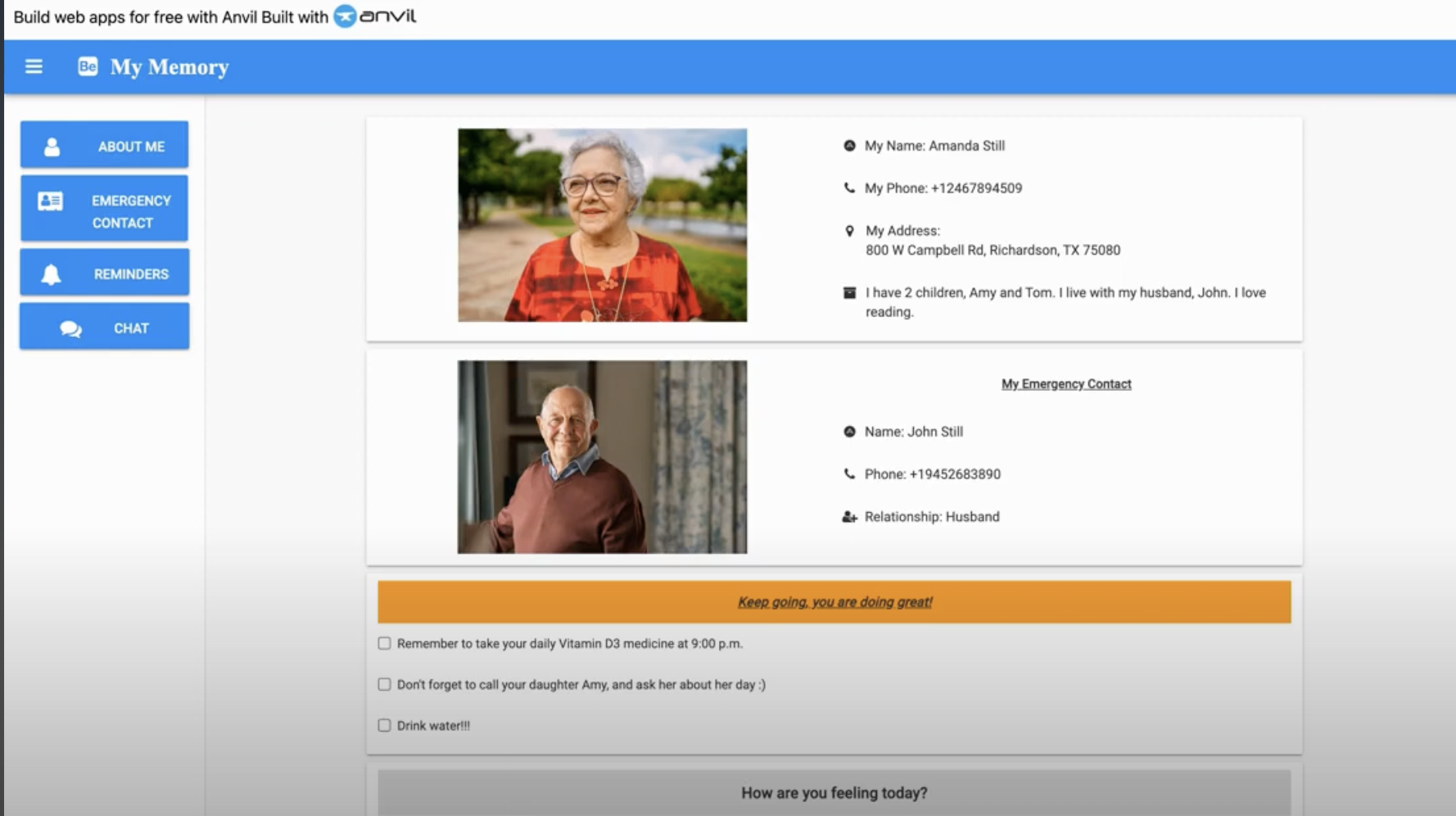
Keeps track of the health symptoms the patient had daily and also provides the most probable disease based upon the symptoms they shared. Apart from this, we also provide a recommendation of the medicines they could take but strongly suggest they visit the doctor. Our inputs are presented in a way that sounds like a true companion. We did not prompt the word ‘Alzheimer’ in the application because we did not want to remind the patient about this incurable disease every time they would log in, rather be there as a companion for them.
How we built it
The front end was built on Anvil using Python and the backend is completely supported by AI models namely, BERT, Gaussian Naive Bayes, Support Vector Machines, K Nearest Neighbors, and Multi-Layer Perceptron. We also built our dataset based on textual data from Kaggle and Huggingface. We further appended this to the tabular dataset which we found on Kaggle.
Challenges we ran into
We planned to use a multi-modal with image input as well to aid the doctors for ease in finding patients with Alzheimer's Disease based on their MRI scan. However, provided the limited CPU and GPU on Google Colab and the problem statement of implementing AI at home we did not implement this. Furthermore, we could not utilize the fine-tuned LLAMA and MISTRAL LLM models due to GPU limitations.
Accomplishments that we're proud of
We were able to successfully deploy a model on the web interface to help the patients powered by AI models. We not only provided the companion-like solution but also went to depths in terms of researching the challenges of currently available applications and made a more personalized healthcare experience.
What we learned
We learned the practical aspect of implementing a User-Interface keeping in mind that it is for Alzheimer's patients, which can be quite sensitive for someone going through it. Apart from all the technical knowledge and methodology we implemented, we learned about what goes into the minds of Alzheimer's patients. We also learned the limitations of current ML-AI Models available and what could be done to improve them.
What's next for Be_My_Memory
Presently we have an equal weight for all the models which will be a weighted average in the future with the weight being learnt by a neural network. To increase the ease of the users of the interface in the future, we plan to integrate home zip code and nearest hospital zip code mapping. We will also deploy it as a mobile app.
Built With
- ai
- anvil
- googlecolab
- huggingface
- kaggle
- natural-language-processing
- python
- pytorch
- tensorflow

Log in or sign up for Devpost to join the conversation.