💡 Inspiration
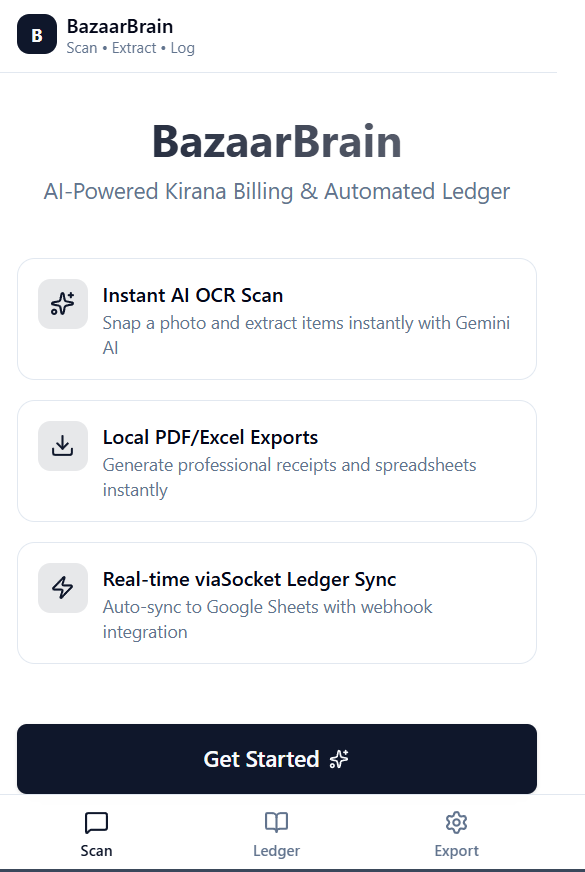
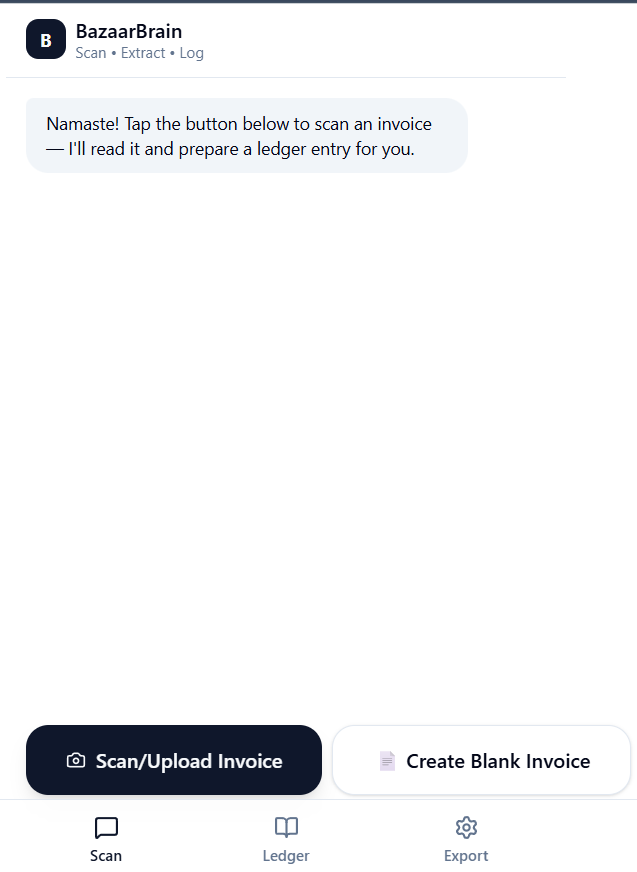
Small Kirana stores and traditional retail shops in India still manage accounts on physical registers (khata), leading to errors, lost bills, and endless hours of manual data entry. We wanted to build a zero-setup solution that allows shopkeepers to simply tap, scan, and completely automate their billing and ledger tracking.
🛠️ How We Built It
We engineered BazaarBrain as a highly responsive, mobile-first web app using:
- Frontend: React, TypeScript, and Tailwind CSS for a fast, clean UI.
- AI Core: Google Gemini 2.0 Flash (
gemini-2.0-flash) via native API integrations for instant receipt reading. - Automation Pipeline: viaSocket Webhook pipelines that capture user-confirmed data strings and dynamically inject them into an automated Google Sheets digital ledger.
- Client-Side Tools: Native browser APIs to build single-click, zero-dependency PDF invoice printers and Excel-compatible CSV downloads.
🚧 Challenges We Faced
Our biggest hurdle was handling live network constraints and Google API rate limits ($429\text{ Too Many Requests}$) due to the heavy network overload at the hackathon venue. To solve this, we designed a resilient offline/mock processing architecture. If the API hits a bottleneck, the app switches to an interactive pre-cached sandbox mode instead of crashing, letting the user proceed seamlessly. Managing Git credential multi-account conflicts right before the submission deadline was another high-pressure challenge we bypassed through strategic deployment.
🧠 What We Learned
We learned how to design fail-safe systems for low-connectivity environments, structure custom prompt wrappers for highly structured JSON extraction from noisy images, and orchestrate webhooks using viaSocket to connect isolated client applications with global productivity platforms.
Built With
- ai
- automation
- css
- gemini
- generative
- react
- sheets
- tailwind
- typescript
- vite
- webhooks


Log in or sign up for Devpost to join the conversation.