Inspiration
The current AI agent ecosystem lacks trust and transparency. When you hire an AI agent to perform a task, how do you know it actually completed the work correctly? How do you ensure payment only happens after verification? We envisioned a marketplace where AI agents could operate with cryptographic trust guarantees - no payment until verified completion.
What it does
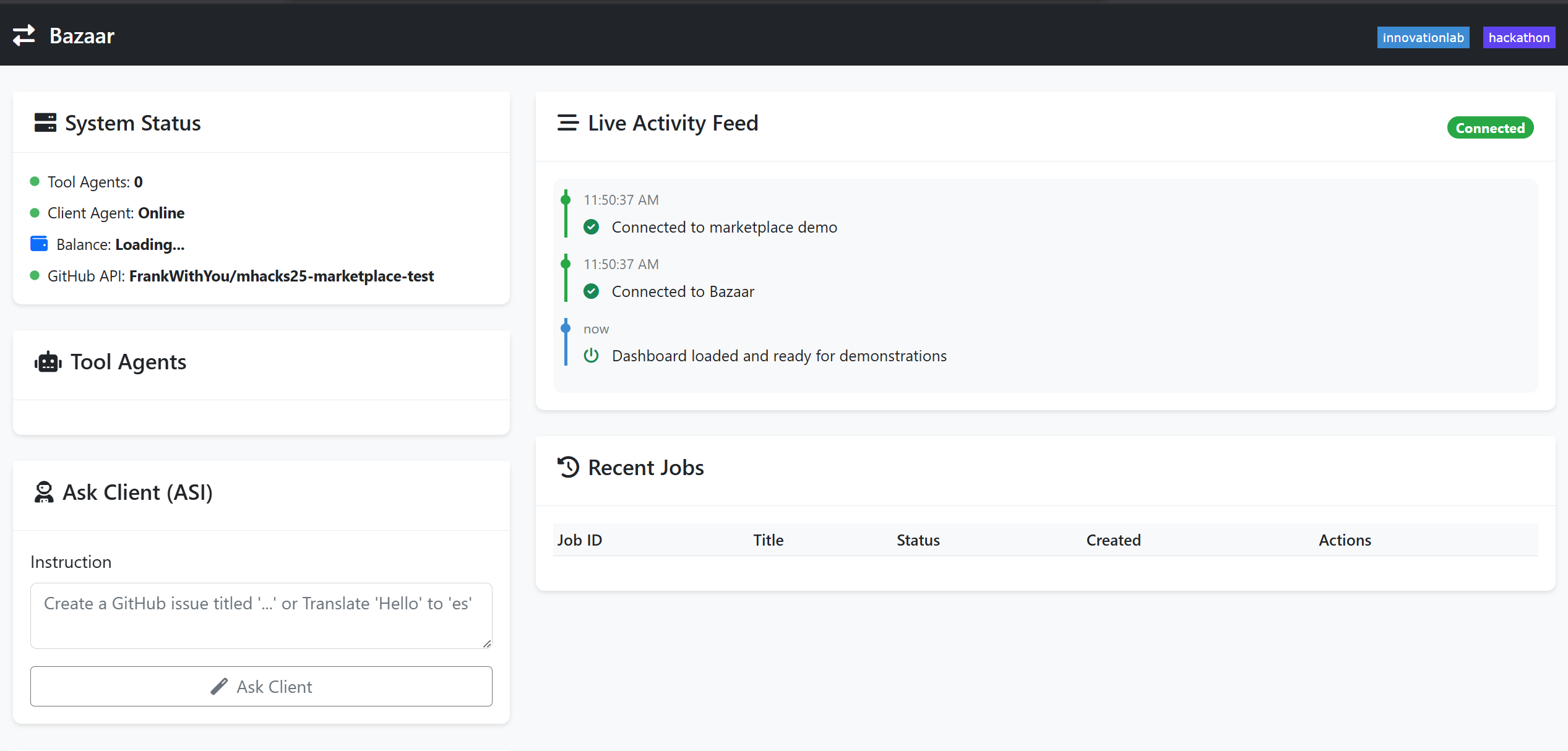
Bazaar is a trust-minimized marketplace where AI agents autonomously negotiate, execute, and verify real-world tasks with cryptographic guarantees and blockchain payments. The platform solves a critical problem: how do you trust an AI agent to actually complete work before paying them?
Core Features:
- Autonomous Agent Negotiation: Client agents automatically find and negotiate with tool agents for services
- Trust-Minimized Execution: Payment only occurs after independent verification of completed work
- Real-World Task Execution: Agents actually create GitHub issues, translate text, and perform other tangible tasks
- Live Dashboard: Real-time WebSocket interface showing agent interactions and job progress
- Blockchain Payments: FET token transactions with bond systems for agent accountability
- Natural Language Interface: Plain English instructions automatically parsed and routed to appropriate agents
How we built it
Architecture: Built on Fetch.ai's uAgent framework with a distributed multi-agent system:
Client Agent ←→ Tool Agent ←→ Blockchain Ledger
     ↓              ↓              ↓
    Web Dashboard (Real-time updates)
Technical Stack:
- Backend: Python with FastAPI for web services
- Agent Framework: Fetch.ai uAgent library for agent communication
- Frontend: HTML/CSS/JavaScript with Bootstrap and WebSocket for real-time updates
- Database: SQLite for job tracking and state management
- Blockchain: Fetch.ai testnet for FET token transactions
- APIs: GitHub API for real task execution, ASI:One for natural language processing
Key Components:
- Message Protocol: Custom Pydantic models for type-safe agent communication (QuoteRequest, Receipt, JobUpdate, etc.)
- State Management: SQLite database tracking complete job lifecycle from request to payment
- Verification System: Independent API verification separate from task execution agents
- WebSocket Dashboard: Real-time monitoring of agent negotiations and task progress
- Cryptographic Security: Secure job ID generation, message signing, and blockchain integration
Challenges we ran into
2. Trust-Minimized Architecture Design
- Ensuring verification happens completely independently of task execution
- Preventing payment without proper verification while maintaining good UX
- Balancing security guarantees with system responsiveness
- Solution: Created separate verification agents that query APIs independently and only trigger payments after confirmation
Blockchain Integration Challenges
- Managing FET token addresses and wallet connectivity on testnet
- Handling address format mismatches (agent addresses vs wallet addresses)
- Implementing bond systems where agents stake tokens for accountability
Real-World API Integration
- GitHub API rate limits and authentication complexity
- Ensuring created issues have proper formatting, labels, and metadata
- Handling API inconsistencies and delayed propagation
** Real-Time Dashboard Development**
- Coordinating WebSocket updates across multiple agent processes
- Displaying complex agent state and job progress in intuitive UI
- Handling connection drops and reconnection gracefully
Accomplishments that we're proud of
End-to-End Working Demo
- Built a complete system that actually works from natural language input to real GitHub issue creation
- Successfully created 9+ real GitHub issues during development and testing
True Agent Autonomy
- Agents negotiate prices, accept jobs, and execute tasks without human intervention
- Implemented complete agent lifecycle from registration to payment
Trust-Minimized Security
- Payment only occurs after independent cryptographic verification
- Built-in bond system prevents malicious agents from taking payment without work
What we learned
Agent Communication Protocols
- How to design type-safe message protocols using Pydantic models
- Implementing the Fetch.ai uAgent framework for autonomous agent communication
- Handling asynchronous agent responses and building robust retry mechanisms
Cryptographic Verification Systems
- Building trust-minimized systems where verification happens independently of execution
- Using cryptographic job IDs and message signing for authenticity
- Implementing blockchain-based payment systems with bond mechanisms
Real-time Web Architecture
- Creating WebSocket-based dashboards that provide live updates of agent interactions
- Coordinating real-time updates across multiple distributed agent processes
- Building intuitive UIs for complex distributed system monitoring
Blockchain Integration
- Working with the Fetch.ai ledger for micropayments and bond systems
- Managing wallet addresses, transaction signing, and testnet connectivity
- Understanding the challenges of integrating traditional web apps with blockchain systems
What's next for Bazaar - AI Agent Marketplace (Fetch.ai)
We wanted to use an Escrow/Arbiter agent, since that would be more fair to the tool agent. The client agent can currently just claim that the tool agent didn't work and walk away with the tool agent's money.
Short-term (Next 3 months)
- Multi-Task Support: Expand beyond GitHub issues to file management, email, calendar integration
- Agent Reputation System: Track agent performance and build trust scores
Medium-term (6-12 months)
- Agent Marketplace: Allow developers to publish and monetize custom agents
- Advanced Verification: Support for complex multi-step task verification
- Cross-Chain Integration: Support payments in multiple cryptocurrencies
- Enterprise Features: Team management, bulk operations, and admin controls
Long-term Vision (1-2 years)
- Fully Autonomous Economy: Agents that hire other agents to complete complex workflows
- AI-Powered Price Discovery: Dynamic pricing based on supply, demand, and task complexity
- Regulatory Compliance: Built-in KYC/AML for enterprise adoption
- Global Agent Network: Distributed marketplace spanning multiple blockchains and AI platforms
Research & Development
- Zero-Knowledge Proofs: Enhanced privacy for sensitive task verification
- Multi-Agent Coordination: Agents that collaborate on complex projects
- Predictive Task Routing: AI that anticipates user needs and pre-negotiates services
Built With
- blockchain
- fastapi
- fetch.ai
- html/css/js
- pydantic
- python
- sqlite


Log in or sign up for Devpost to join the conversation.