Inspiration
Houston doesn't lack weather alerts—what it often lacks is support after the storm.
Hurricane Harvey in 2017. The 2021 winter freeze. Hurricane Beryl in 2024. We've seen how quickly a disaster can turn everyday life upside down. But even after the rain stops and the power comes back, recovery can take months or even years. Families are left sorting through FEMA letters, insurance emails, repair estimates, damage photos, and countless forms to prove what happened to their homes.
For our team, this isn't just another problem we found online. When Harvey hit Houston, our teammate Aaron's home was flooded, and the entire first floor was lost. The storm itself lasted days, but rebuilding took much longer. It meant documenting damage, gathering records, and piecing together everything needed to move forward.
The research reflects what many Houston families have experienced. A 2024 Rice Kinder Institute survey of more than 5,350 Houston-area residents found that only 32% had a household emergency plan. Nearly 18 months after Beryl, 6% of residents were still struggling, with many dealing with property damage and repairs. A University of Houston study found that five years after Harvey, only 39.4% of residents who applied for FEMA assistance had received any.
Researchers call part of this problem administrative burden: the paperwork, documentation, and follow-ups that can make accessing assistance incredibly difficult.
We also realized that families aren't always navigating this process alone. Caseworkers and volunteers at nonprofits, churches, and community resilience hubs help people work through it every day. They're often juggling dozens of households, hundreds of documents, and information in both English and Spanish.
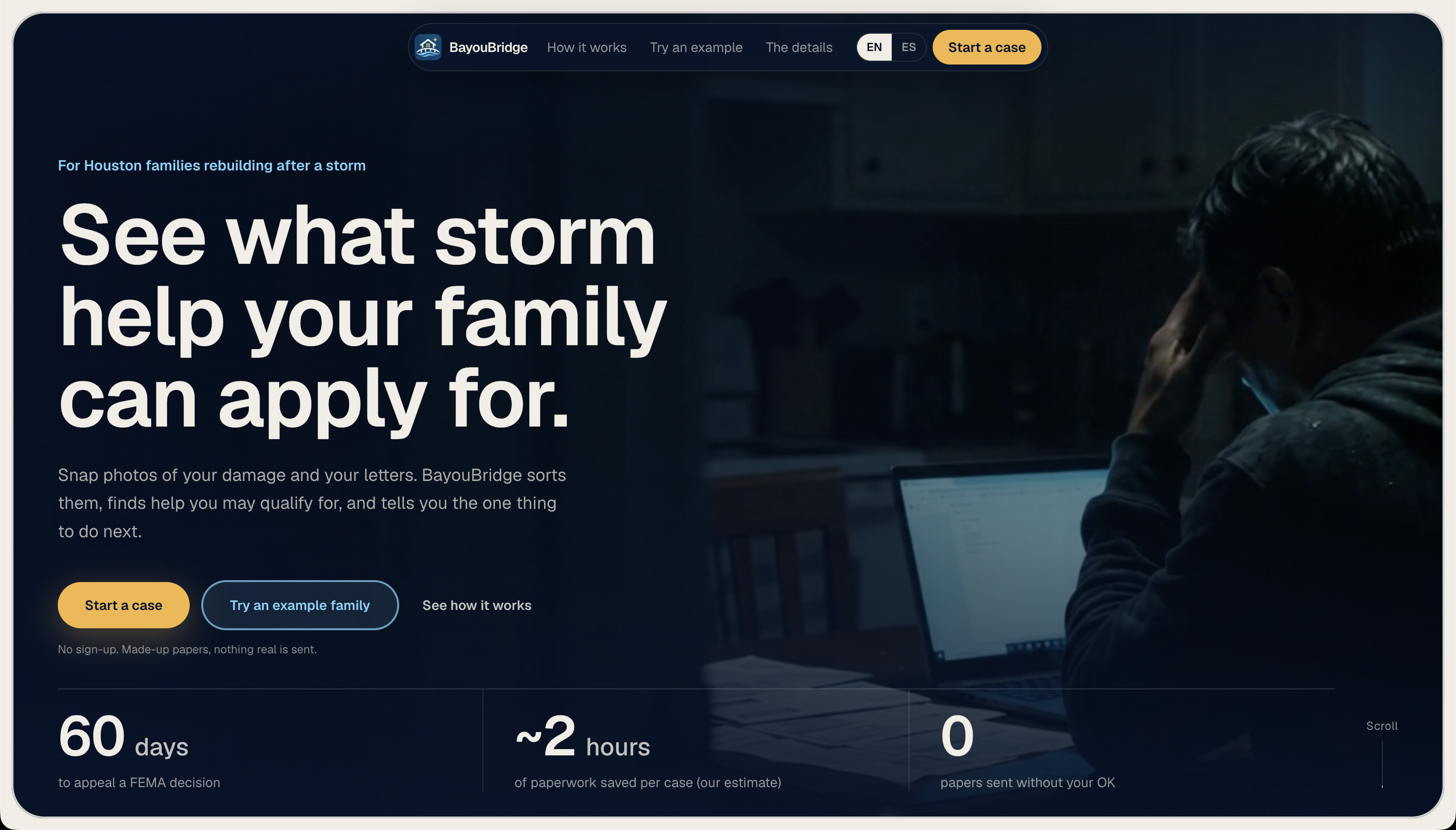
That's why we built BayouBridge: a recovery assistant designed to help caseworkers spend less time sorting through paperwork and more time helping people. It's also simple enough for families to use themselves.
What it does
BayouBridge takes all the scattered information a family has after a disaster and turns it into an organized recovery plan, with every extracted detail tied back to its source.
Here's what it can do:
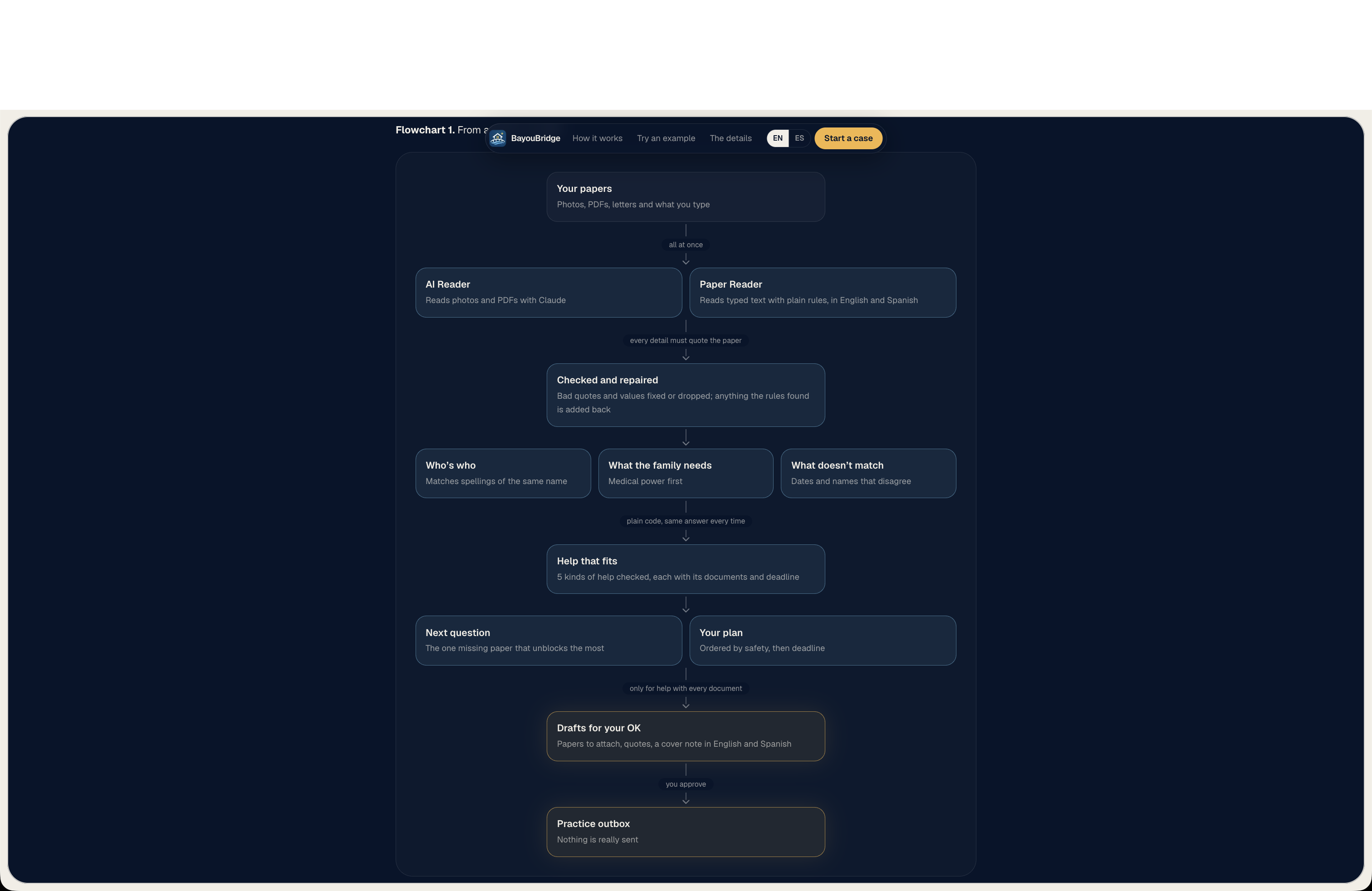
Read documents in different formats. Upload photos, PDFs, typed notes, or voice-note transcripts in English or Spanish. BayouBridge extracts key information and keeps the exact quote supporting each fact, so users can see where everything came from.
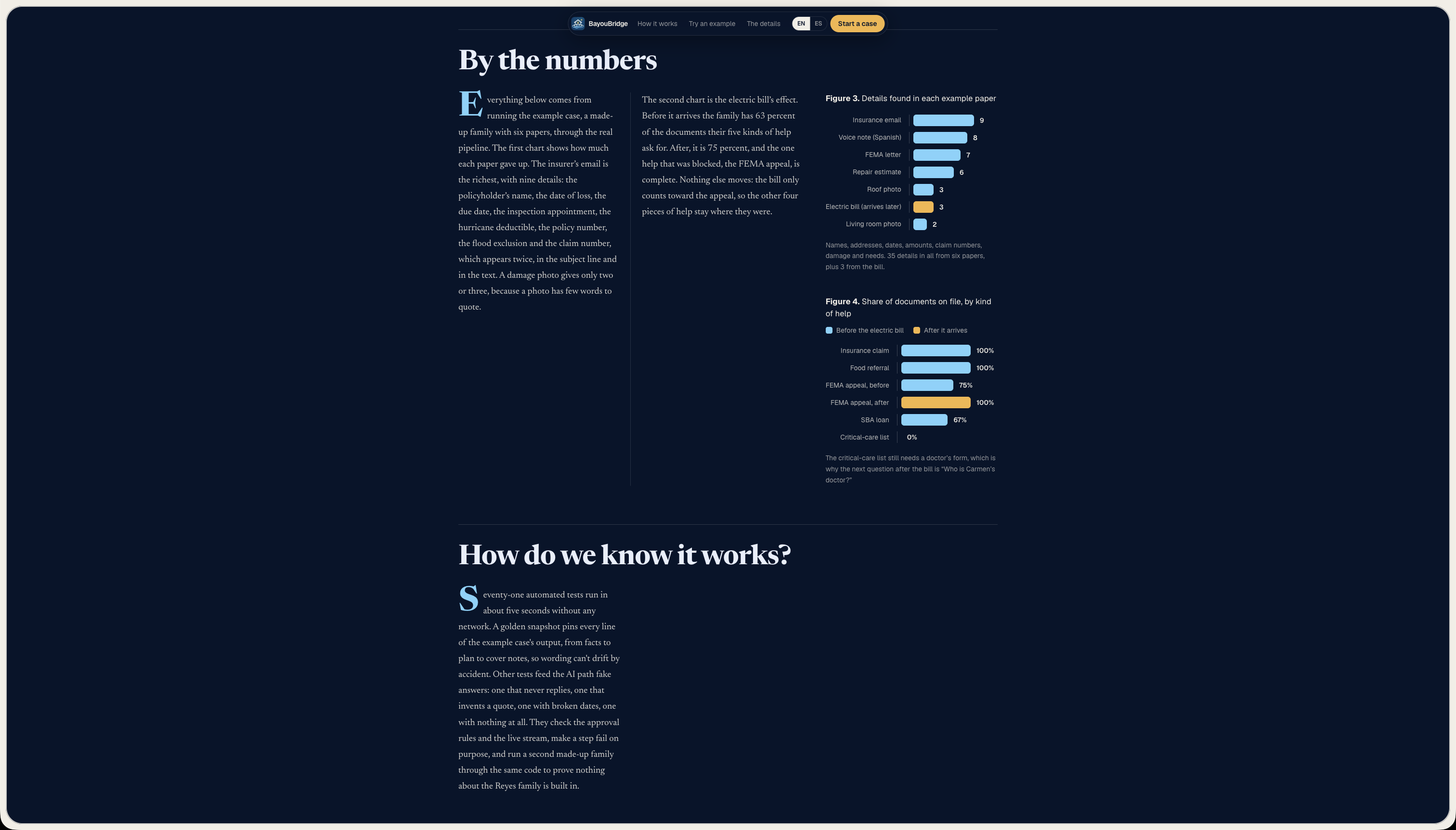
Build a picture of each household. It identifies who lives in the home, what their needs are, and where information doesn't match. For example, a FEMA letter might list October 9 as the date of loss while an insurance document says October 10. Instead of ignoring the difference, BayouBridge flags it for clarification.
Find possible assistance programs. It checks a curated list of five programs, including FEMA appeals, insurance claims, SBA loans, critical-care power designations, and food assistance referrals. Each recommendation links to its official source. Importantly, BayouBridge never promises that someone qualifies. It only identifies possible matches.
Explain what's missing. Rather than simply telling someone to upload more documents, it explains what's already on file, what's missing, and why that information matters. It then asks the most useful next question in plain language, including Spanish.
Prepare paperwork for review. For example, it can draft a FEMA appeal letter with relevant registration information, disaster numbers, deadlines, supporting documents, and a signature line. It can also prepare a draft occupancy declaration. The documents differ depending on whether someone owns or rents their home, so renters aren't incorrectly directed toward homeowner assistance.
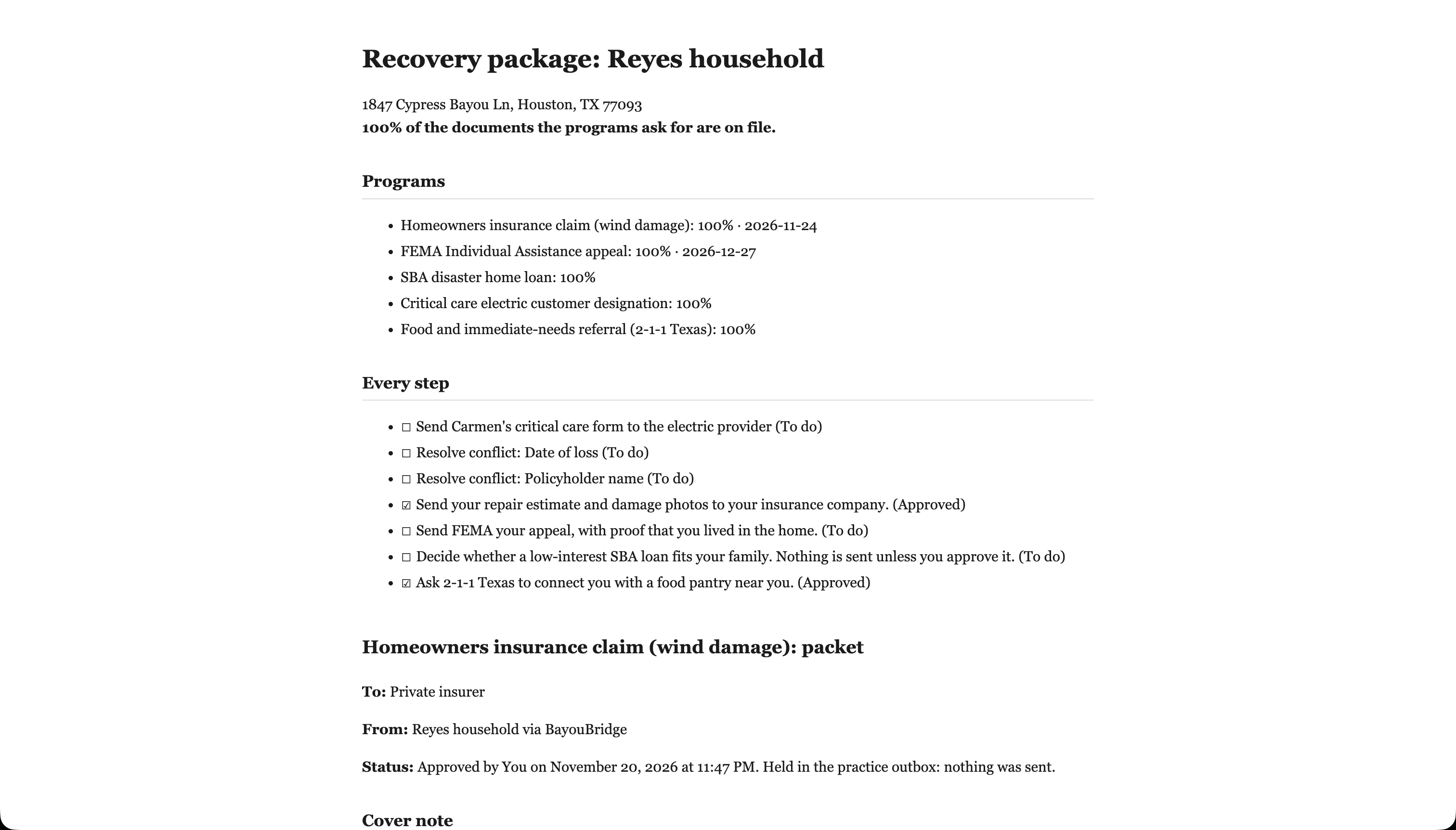
Keep people in control. Nothing gets sent automatically. Every document requires human approval first. Approved drafts go into a practice outbox, where users can open them and save them as PDFs or Markdown files. Once the case is complete, users can download the entire recovery package.
To demonstrate this, we created three fictional Houston households:
Denise Johnson is a single mother of three who rents her home. Her daughter needs a nebulizer. The Reyes family has a grandmother who depends on oxygen, while the Nguyen family consists of retired homeowners dealing with a tree that damaged their garage.
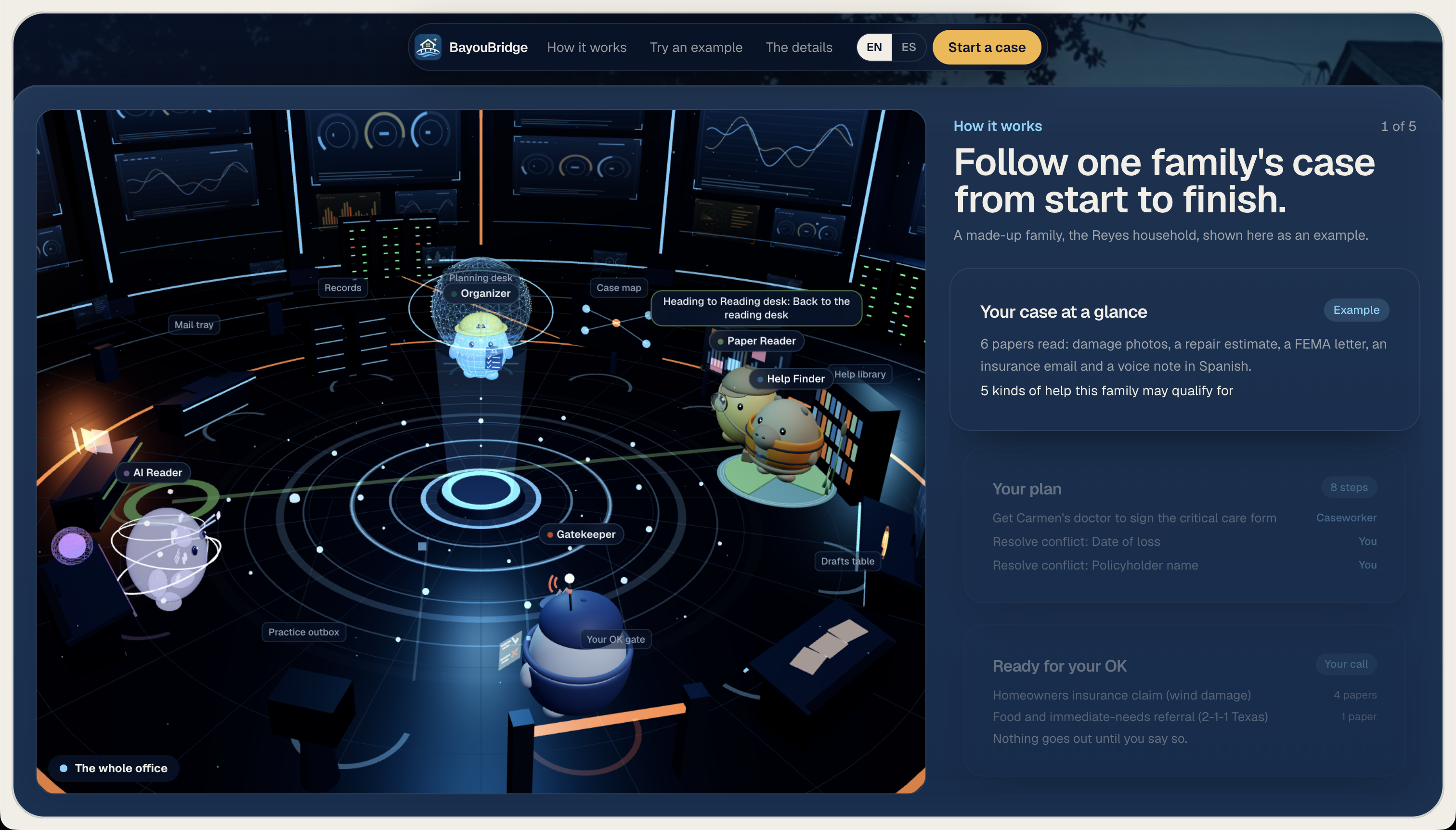
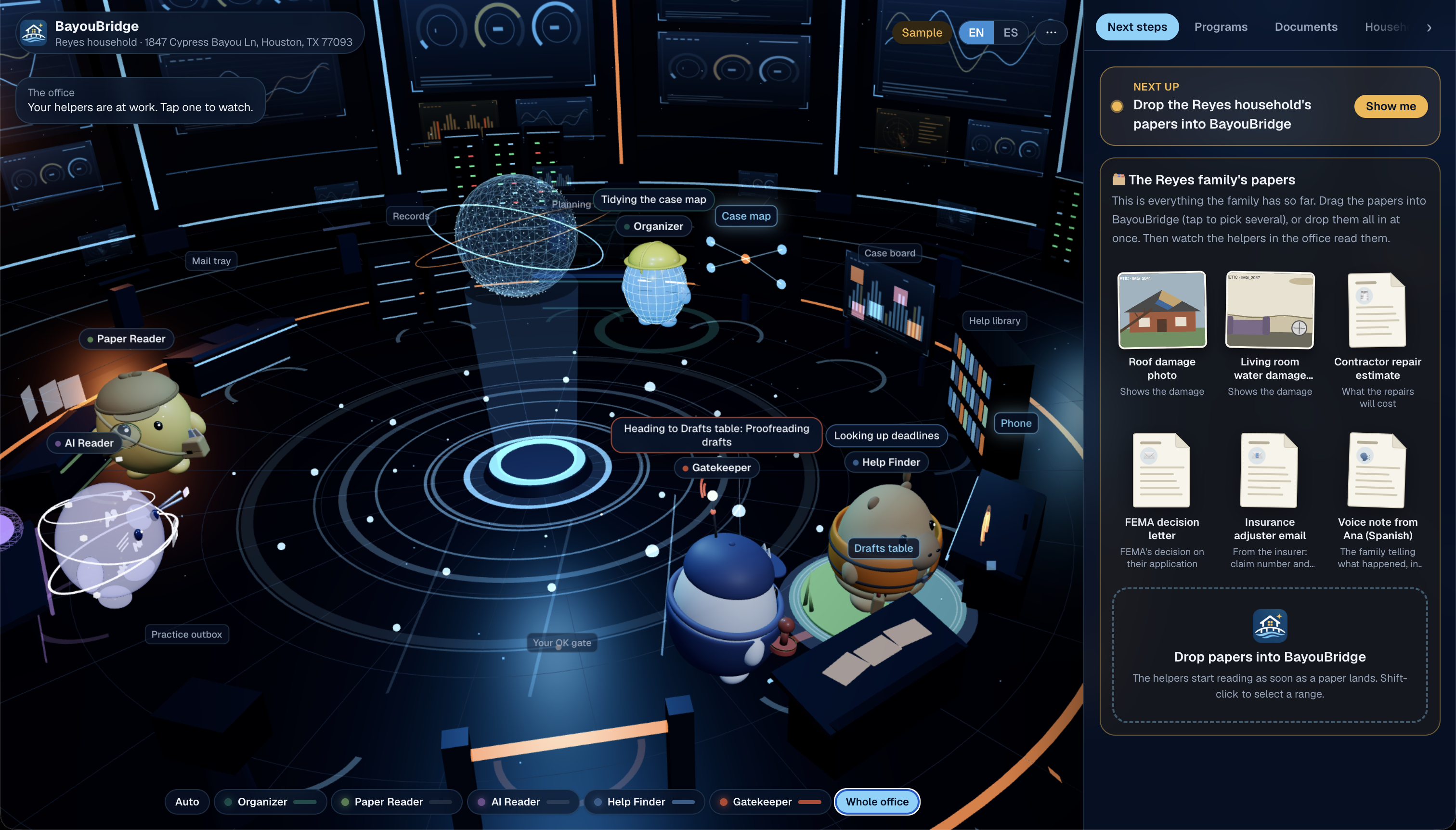
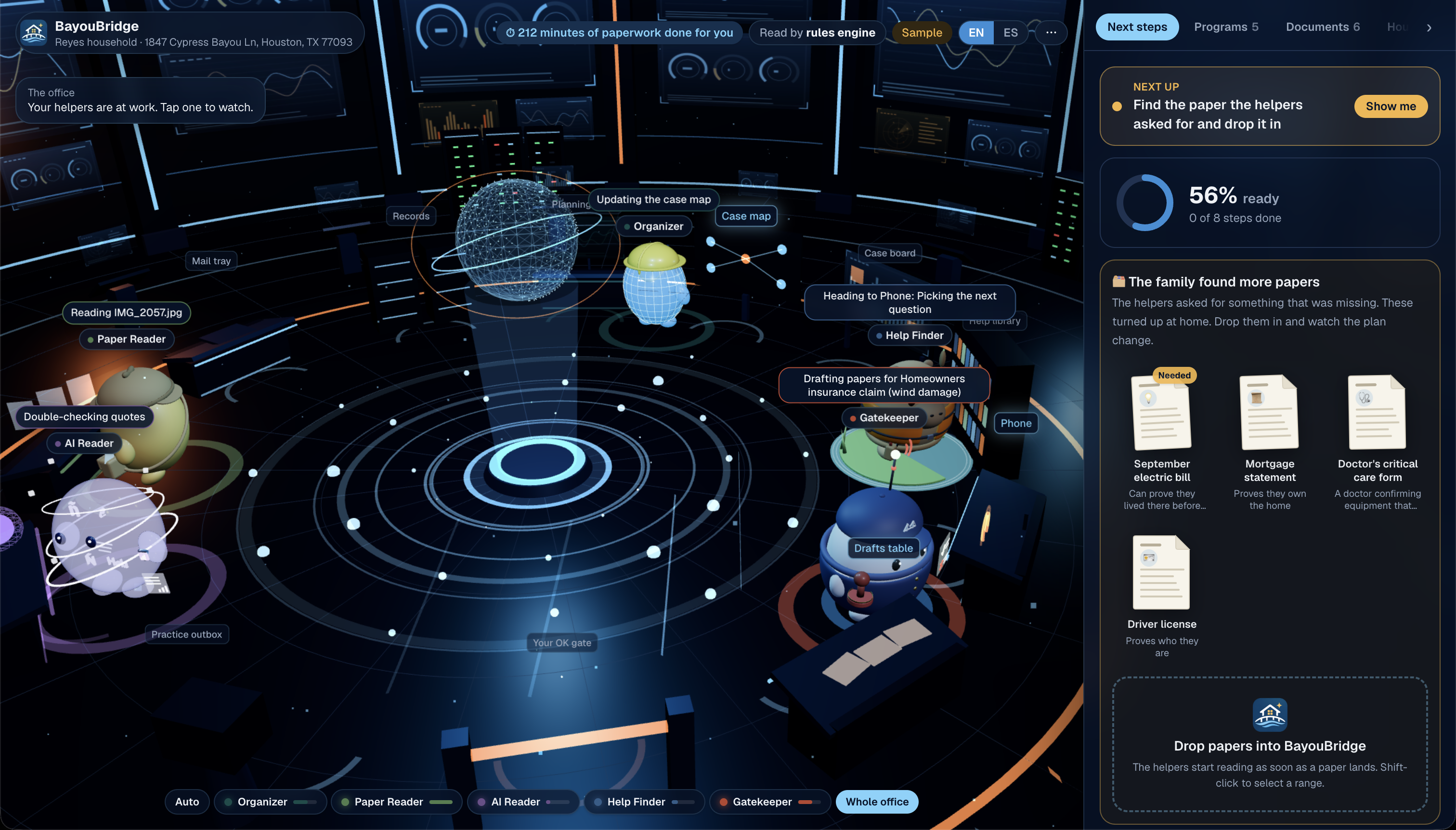
Users can drag documents from a pile into BayouBridge and watch a 3D office as each AI agent moves to its workstation and completes its task. As the case progresses, users answer questions about conflicting information and approve the documents being prepared.
You can also create your own case by describing what happened, uploading files, or typing out the contents of a letter.
We wanted Spanish support to be part of the experience, not just a translation button. Both languages work throughout the application, and we even built automated tests that fail if any screen displays untranslated text.
How we built it
We wanted BayouBridge to work like an actual coordinated system, not just another chatbot with a few tools attached.
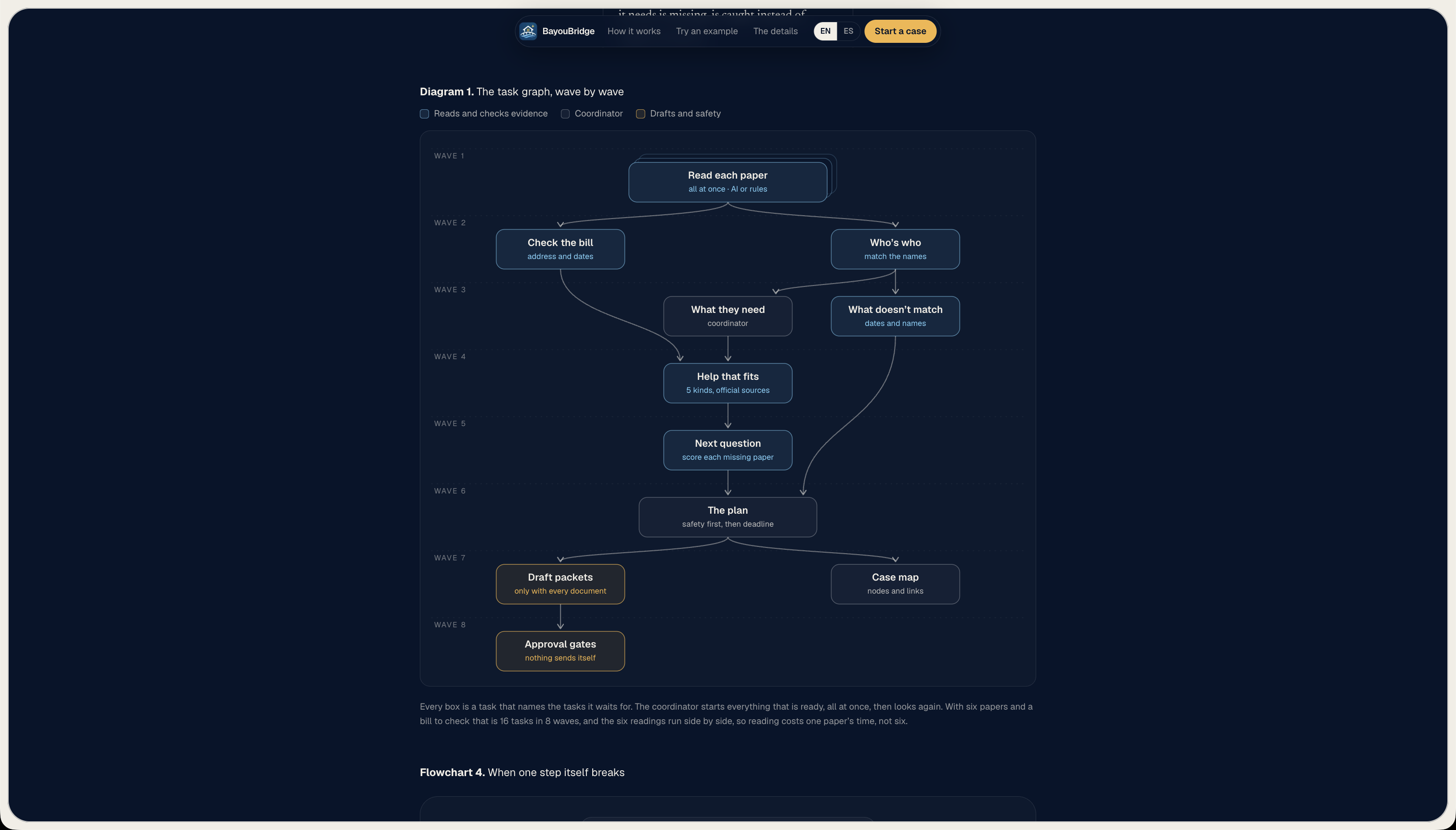
It's built around a dependency graph of specialized agents, each responsible for a different part of the recovery process.
Evidence Agent: Uses Claude to read uploaded documents and extract structured facts. Every fact must include an exact quote from its source. We built a validator that checks those quotes, removes unsupported information, repairs close matches, and uses a separate rules-based extractor to catch anything the model misses.
Recovery-Match, Follow-up, Packet, and Safety agents: These run on deterministic code rather than generative AI. Once information has been extracted, the remaining decisions follow consistent rules. This makes the results easier to test, explain, and trace back to their sources.
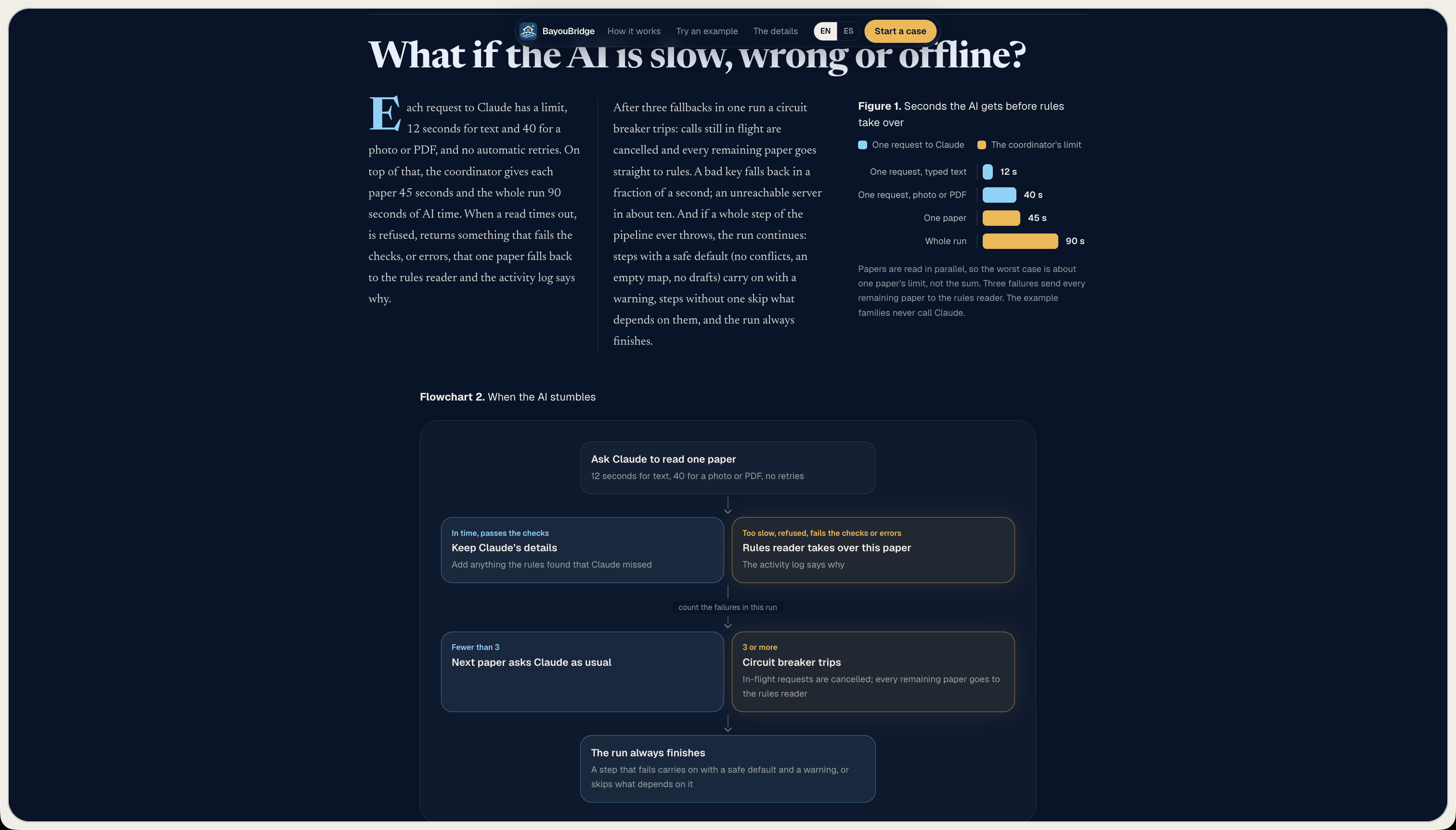
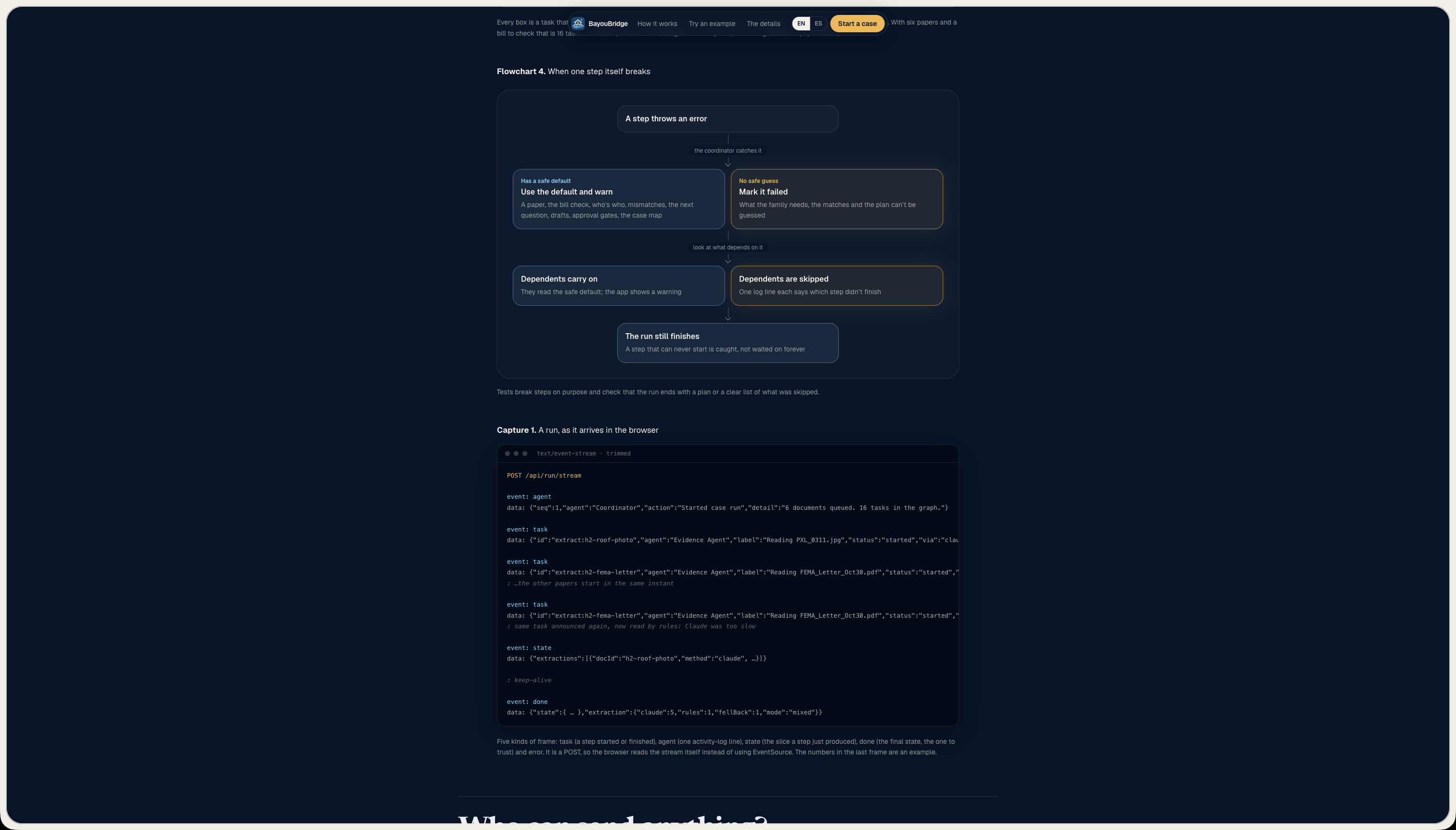
Coordinator: Manages the entire process as a task graph. Each document has its own timeout, and if Claude takes too long, refuses, or encounters an error, the document falls back to our rules engine instead of stopping the entire case. The interface also shows users which system processed their documents.
Rules engine: We didn't want the application to depend entirely on AI. Our rules engine can independently read free-form household descriptions in both English and Spanish. It recognizes details such as storm dates, property damage, FEMA denials, renting versus owning, insurance status, household members, medical equipment, and power outage duration.
Approval system: We implemented the approval gate on the server, not just in the interface. Blocked tasks return a 409 response, and users cannot bypass approval simply by modifying browser requests.
Frontend: We built the application with Next.js and React Three Fiber. The interface includes a 3D office, progress indicators, a deadline timeline, a live activity feed, and a guide showing users what needs to happen next.
We also made sure our demo wouldn't depend on a live AI model. Sample households are processed entirely by the rules engine, meaning the demonstration won't hang or incur model costs. We currently have 79 automated tests, including a golden snapshot of the complete processing pipeline.
Challenges we ran into
One of our biggest challenges was figuring out how to make AI trustworthy enough for something as important as disaster recovery.
A model that slightly changes a sentence might seem harmless in an ordinary chatbot. In a recovery application, that difference could matter. We spent a lot of time building quote validation so that every extracted fact could be checked against the original document.
Another challenge was making the rules engine understand how people actually describe their situations.
Our first version worked with the synthetic documents we had written ourselves. But when we tested more natural descriptions, it struggled. A sentence like "the wind ripped shingles off our roof and rain came into the kitchen" wasn't being interpreted correctly. Worse, an early version incorrectly associated a CPAP machine with an eight-year-old child.
We had to rethink how we extracted information from everyday language instead of relying on rigid templates.
Spanish support brought its own challenges. We didn't want to translate only the buttons and headings while leaving important instructions in English. Since our agents primarily generate English output, we built a phrasebook with patterns for names, dates, and numbers, along with automated tests that check rendered screens for untranslated text.
We also had to be careful about representing FEMA requirements accurately. We initially included a contractor estimate as a document requirement, but after reviewing the process, we replaced that assumption with more appropriate documentation for homeowners and renters. We also made sure our occupancy declaration was clearly labeled as a draft, not an official FEMA form.
Finally, we had to work around serverless storage limitations. Cases currently live in memory, which means a server restart can erase them. Sample cases rebuild automatically, but cases containing personal uploads must be started again. Encrypted, persistent storage is one of our biggest future priorities.
Accomplishments we're proud of
We're proud that BayouBridge is more than a prototype that looks good in a demo.
All three sample households can move through the entire recovery process and reach 100% readiness without using a generative AI model. Both the English and Spanish experiences work, and the application has a functioning task engine, an audit trail, and server-enforced approval requirements.
We're especially proud of the work we put into making the system explain itself. Instead of asking families to trust an AI-generated recommendation unquestioningly, we show them the evidence, the missing information, and the reason behind each next step.
What we learned
One of the biggest things we learned is that building an AI agent isn't necessarily about giving it as much freedom as possible.
In a situation involving someone's home, finances, or access to assistance, getting something wrong can have real consequences. We realized that the system should automate the repetitive work but leave important decisions to people.
Sometimes the most useful thing BayouBridge can do is stop, explain what's missing, and ask someone to confirm a detail.
We also learned that there's a big difference between telling someone they qualify for assistance and showing them a pathway worth exploring. We chose the latter because accuracy and trust matter more than making impressive promises.
What's next
BayouBridge is still a starting point, and we have a lot to improve.
Our next steps include:
- Working directly with Houston recovery navigators and caseworkers to understand what actually helps them and what gets in their way.
- Adding encrypted, persistent storage so families don't lose their cases.
- Integrating real speech-to-text for voice notes, with a focus on Spanish.
- Building a sandbox inbox where responses from insurance companies or agencies can update a case and create the next task.
- Developing a navigator dashboard to manage multiple households at once.
- Expanding our program database to include more resources from Harris County, the Texas General Land Office, the Red Cross, and other organizations.
Ultimately, we don't expect BayouBridge to replace caseworkers, government agencies, or the people making recovery decisions. We want it to make the process a little less overwhelming for the families going through it and the people trying to help them.
Every household, document, company, and storm used in BayouBridge is fictional. Hurricane Delfina and DR-9999-TX are made-up examples. BayouBridge identifies possible assistance pathways, but only the relevant agency can determine eligibility.
AI Use Disclosure
In the product. BayouBridge can use Claude (Anthropic) to read uploaded photos and PDFs and to pull out facts such as dates, names, and needs. Every extracted fact must be backed by a quote from the source document, and if the quote isn't there, the fact is dropped. Without an API key, or if Claude is slow or fails, a rules-based engine reads the case instead. The demo uses prepared sample data with no live AI call. Matching to programs, deadlines, missing-document checks, questions, and the plan are regular code, not AI decisions. The AI never decides eligibility and never sends anything. The user reviews and approves every step.
In building it. Our team used Claude (Anthropic) as a coding and writing assistant to help write and debug code, plan the backend, and draft and edit our video script and Devpost text. The team came up with the idea, made the design and product decisions, tested the app, and reviewed the code and writing before submitting.
Data. All households in the demo (Johnson, Reyes, Nguyen) and the hurricane scenario are fictional, generated example data. No real families' records were used.
Built With
- anthropic-api
- claude
- framer-motion
- multi-agent
- nextjs
- node.js
- orchestration
- react
- react-three-fiber
- tailwindcss
- three.js
- typescript
- vercel
- zod

