Inspiration
A Friendly Chat. A Hidden Risk.
Imagine a child logging into Roblox after school. They join a game, meet someone who seems friendly, and start chatting. At first, it’s just a conversation about games. Then, slowly, the questions change. The stranger asks them to keep their conversations secret, share personal information, or move to a private chat.
Nothing looks dangerous at first. And that’s exactly the problem.
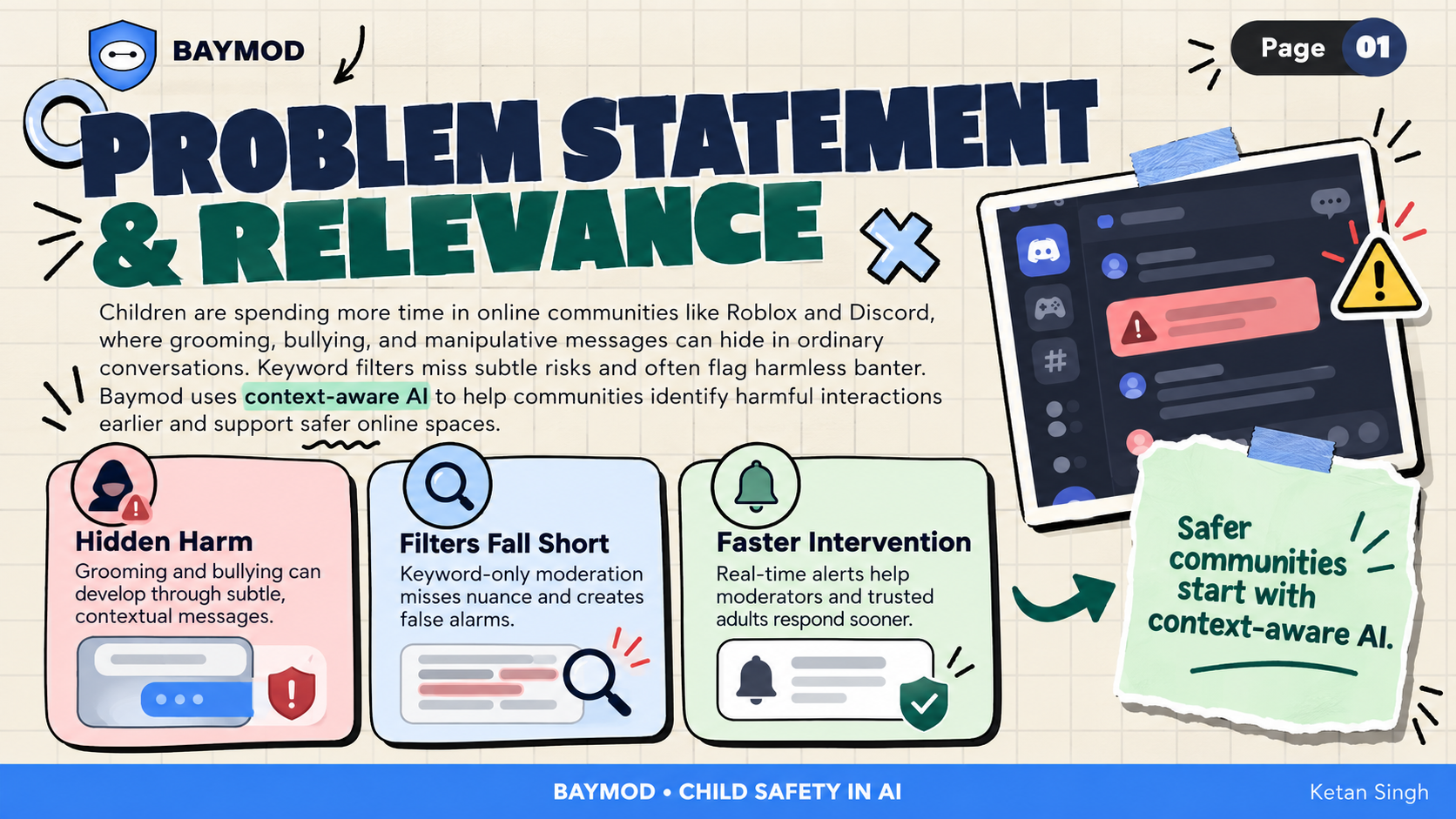
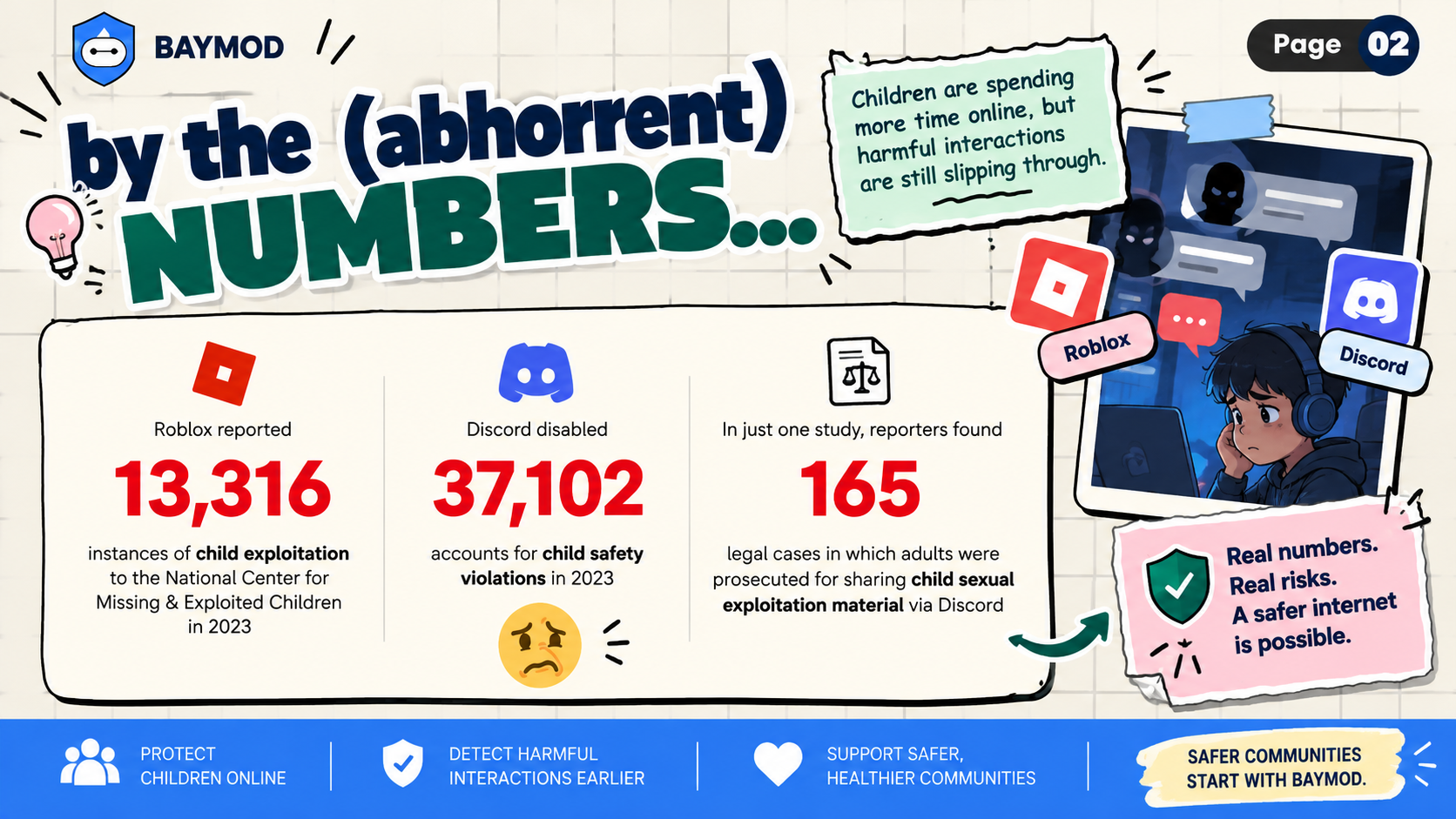
Every day, children build friendships and explore communities on platforms like Roblox and Discord. But alongside these positive experiences, malicious individuals can exploit that same trust to groom, manipulate, bully, or threaten young users.
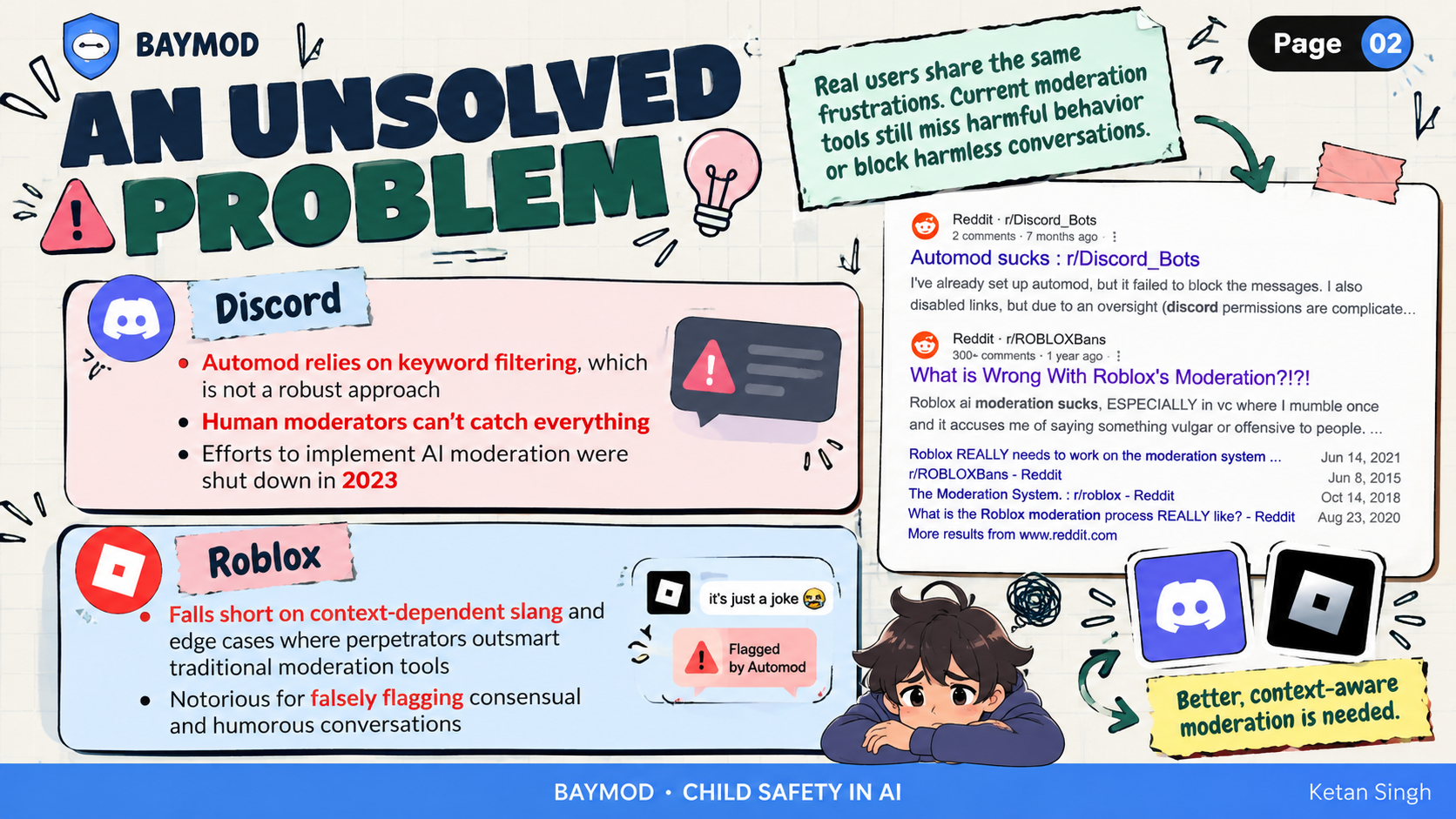
Now imagine a moderator trying to catch this interaction. A keyword filter might ignore the warning signs because no obviously harmful words have been used. Another system might flag an innocent joke while missing a conversation that becomes dangerous over time. Human moderators, meanwhile, cannot manually review every message across millions of interactions.
The danger isn’t always in a single message. It’s in the pattern, the context, and what happens next.
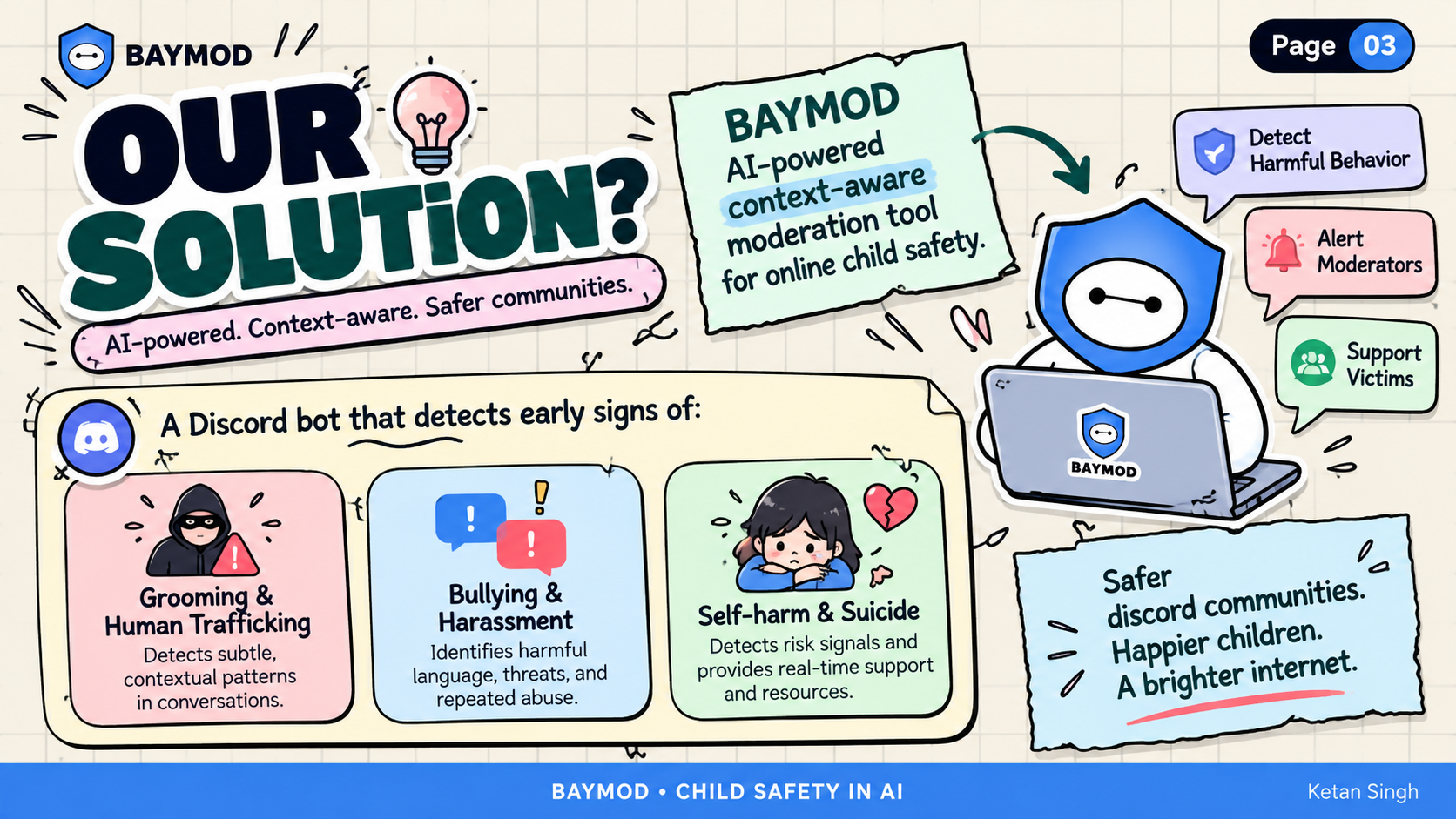
That’s why we built Baymod—an AI-powered, context-aware moderation tool designed to identify concerning behavior earlier, alert moderators when intervention may be needed, and offer supportive guidance to potential victims.
Because protecting children online shouldn’t depend on spotting the right keyword. It should depend on understanding when a conversation starts to go wrong.
What it does
Meet Baymod: From Suspicion to Protection
Imagine that same conversation again. This time, something is watching for the warning signs—not just individual words, but how the conversation evolves.
- Detect — Recognize what others miss.
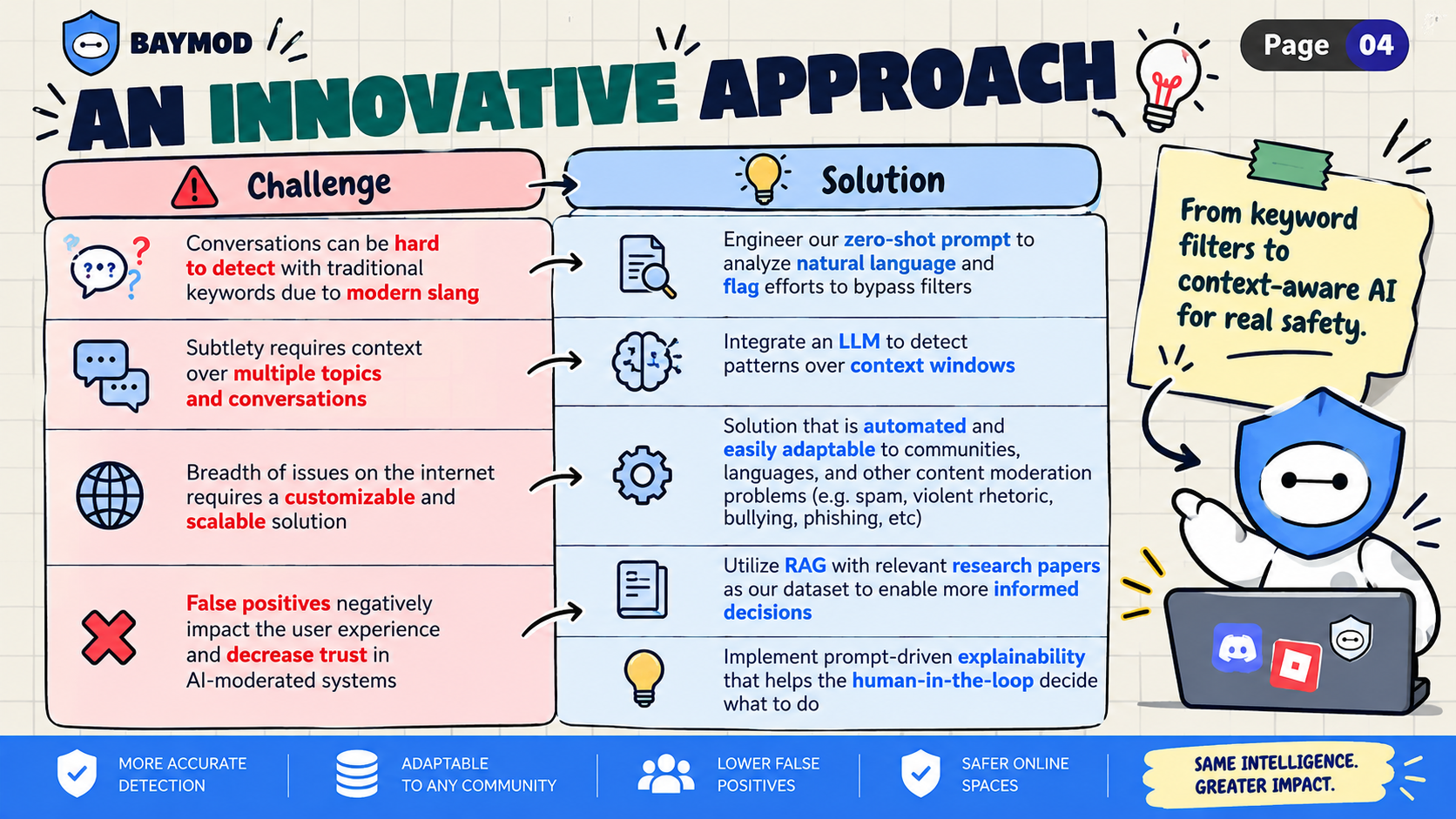
Baymod uses Large Language Models (LLMs) to analyze messages, language patterns, and available conversation history. When a friendly exchange begins to show signs of grooming, bullying, manipulation, or harassment, Baymod evaluates the context to help distinguish harmless banter from potentially harmful behavior.
- Intervene — Turn warning signs into action.
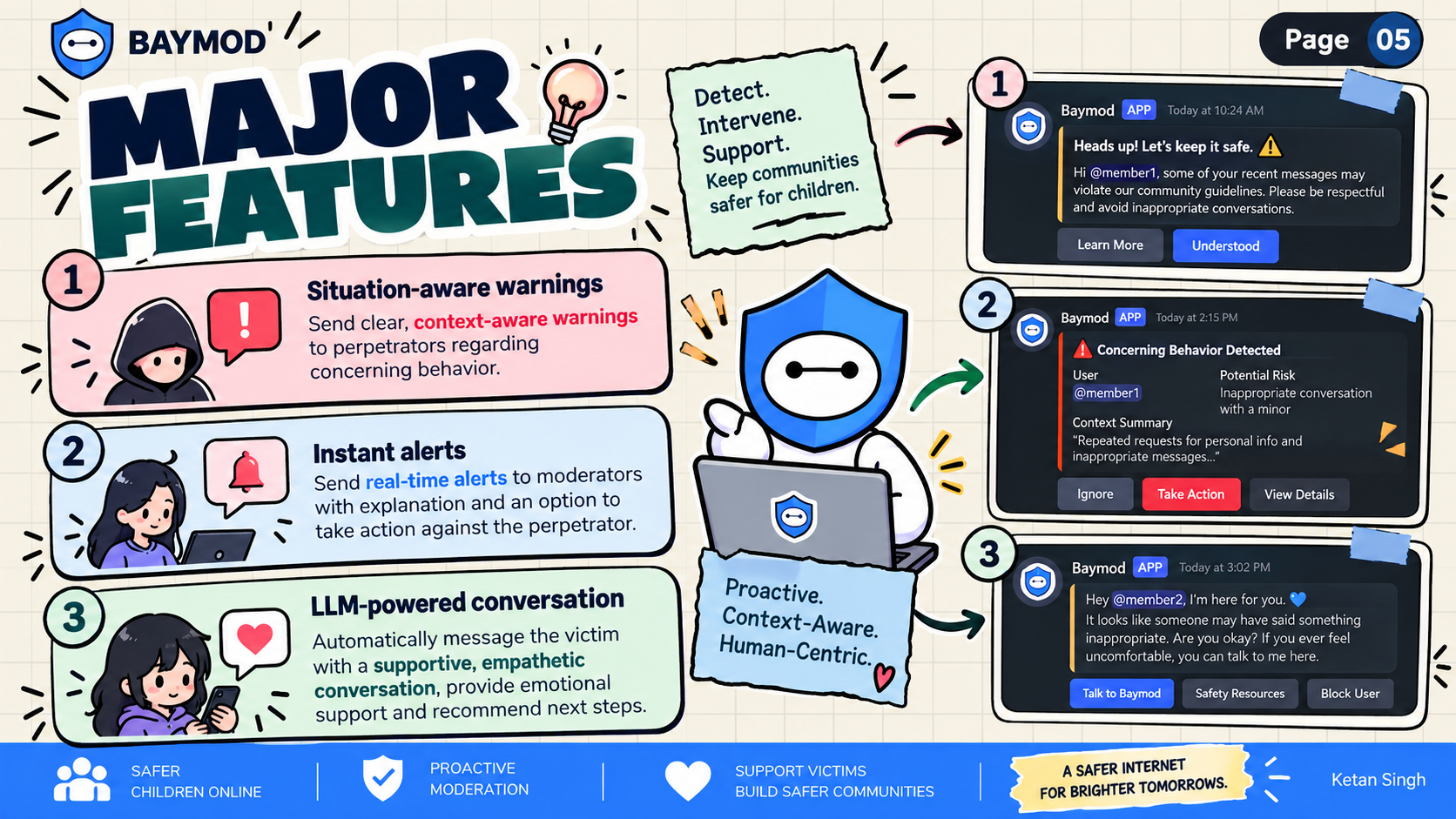
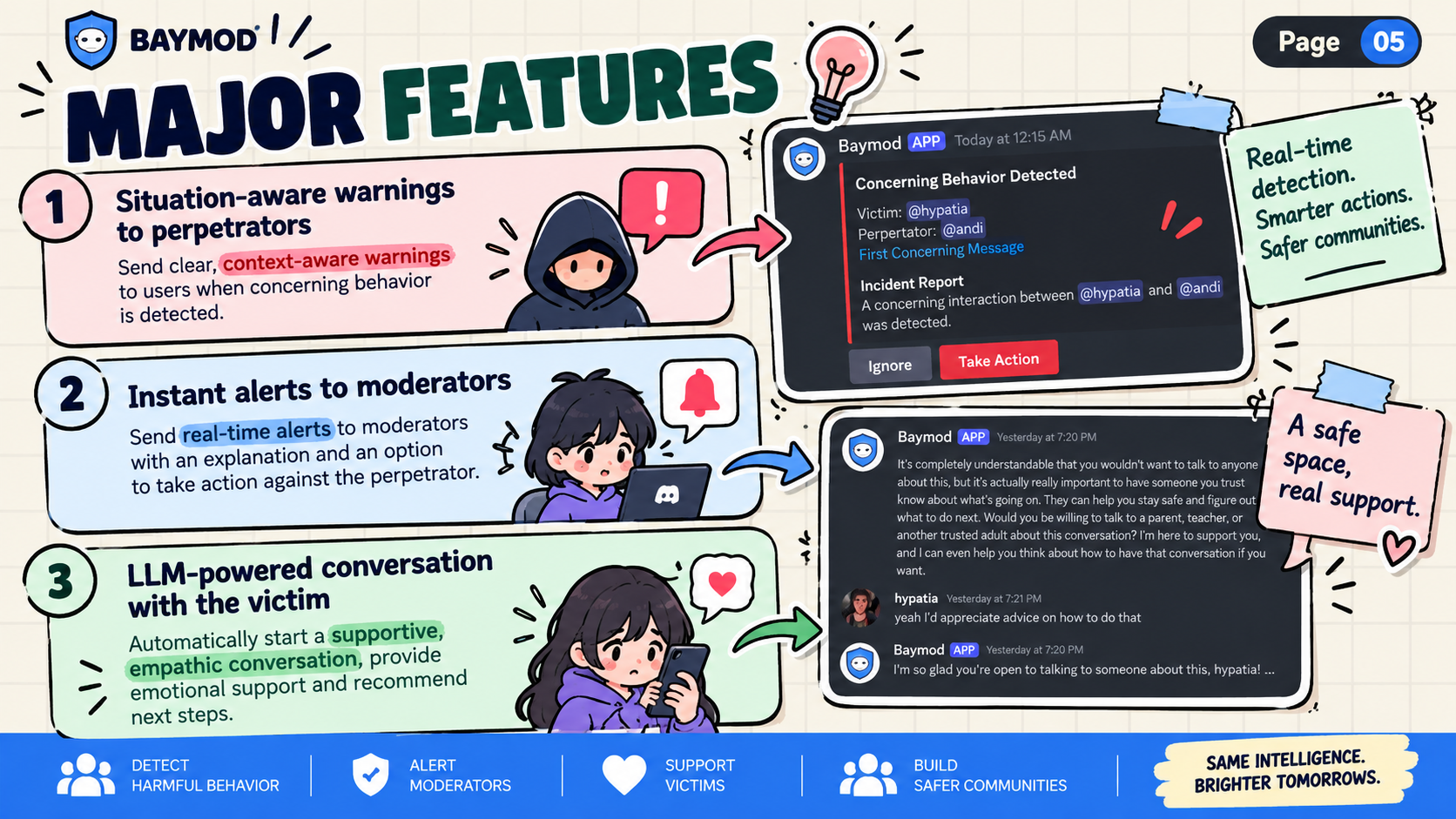
When Baymod identifies a concerning interaction, it alerts moderators with an explanation of the potential risk and gives them the option to review and take action. It can also send appropriate warnings to users who may be violating community guidelines. For potential victims, Baymod offers supportive, age-appropriate guidance and relevant safety resources, encouraging them to seek help from a trusted adult when necessary.
- Scale — Protect communities as they grow.
A safer online community cannot depend on manually reviewing every conversation. Baymod is designed to support large communities by automating initial risk detection and prioritizing interactions for human review. Its Retrieval-Augmented Generation (RAG) system draws on relevant research papers and moderation guidance to inform its responses, while customizable policies help communities adapt moderation to their own rules and needs.
The result
A suspicious conversation can become an opportunity for early intervention rather than a risk that goes unnoticed.
Baymod doesn't just flag messages. It helps communities understand risk, respond sooner, and create safer spaces for children.
How we built it
How We Built Baymod: Turning AI into Action
We wanted to solve a problem that traditional moderation tools struggle with: understanding when an ordinary conversation starts becoming dangerous. To do that, we built Baymod as an AI-powered Discord bot that brings context-aware moderation directly into the community where conversations happen.
- Connect — Bringing safety into Discord
We used the Discord API to build an interactive bot that works within Discord servers. This gives moderators a familiar interface to receive alerts, review concerning interactions, and decide what action to take without leaving the platform.
- Understand — Giving conversations context
At the heart of Baymod is Llama 3, accessed through the Kindo API and integrated using LangChain. Instead of relying entirely on predefined keywords, the model analyzes language and available conversational context to identify patterns that may indicate grooming, bullying, or other harmful behavior.
- Ground — Making AI decisions more informed
We integrated Retrieval-Augmented Generation (RAG) using LangChain to retrieve relevant information from a curated collection of research papers on online safety and harmful interaction patterns. This provides additional context for moderation decisions and helps make Baymod adaptable to different community policies.
- Respond — Turning detection into support
Detection is only the beginning. When a conversation raises concerns, Baymod can generate a moderation alert and provide context for human review. We also used Llama 3 through Kindo to power a supportive chatbot experience that offers potential victims appropriate guidance and relevant safety resources.
The technology behind the mission
Discord API → LangChain + Kindo API → Llama 3 → RAG-powered context → Moderation alerts and victim support
By combining platform integration, language understanding, research-grounded retrieval, and supportive responses, we built an MVP that demonstrates how AI can help online communities move beyond keyword filtering toward more context-aware child safety.
Challenges we ran into
Building Baymod in a hackathon meant solving problems quickly without compromising our core goal: safer online communities.
- Connecting Kindo API with LangChain
The challenge: Kindo’s API did not integrate directly with LangChain’s expected LLM interface, creating a roadblock in connecting our language model to the moderation pipeline.
Our action: We extended LangChain’s base LLM class and built a custom wrapper around Kindo API calls, adapting the request-and-response flow to work with LangChain.
The outcome: We connected Llama 3 through Kindo to Baymod’s language-processing pipeline.
- Making RAG Work Reliably
The challenge: Generating embeddings and connecting retrieved research to the moderation workflow proved more complicated than expected. Debugging the retrieval pipeline was one of our most demanding technical tasks.
Our action: We investigated embedding-related issues and debugged the RAG integration to improve how research information could be retrieved and supplied to the model.
The outcome: We established the foundation for research-informed moderation responses and a more customizable system.
What We Learned
The biggest lesson was that building an AI product is not just about choosing a powerful model. It is about making APIs, frameworks, retrieval systems, and real-world workflows work together reliably.
We didn't just connect AI components. We learned how to engineer them into a working solution under hackathon pressure.
Accomplishments that we're proud of
We reached our project MVP in <12 hours! This is the fastest any of our team members have ever worked in a hackathon, so we're really proud of being able to collaborate and ship code so quickly.
What we learned
We learned a lot about how to use LLMs to build a product. Specifically, we learned how to leverage AI-as-a-service platforms like Kindo API and common LLM tools like Langchain.
What's next for Baymod
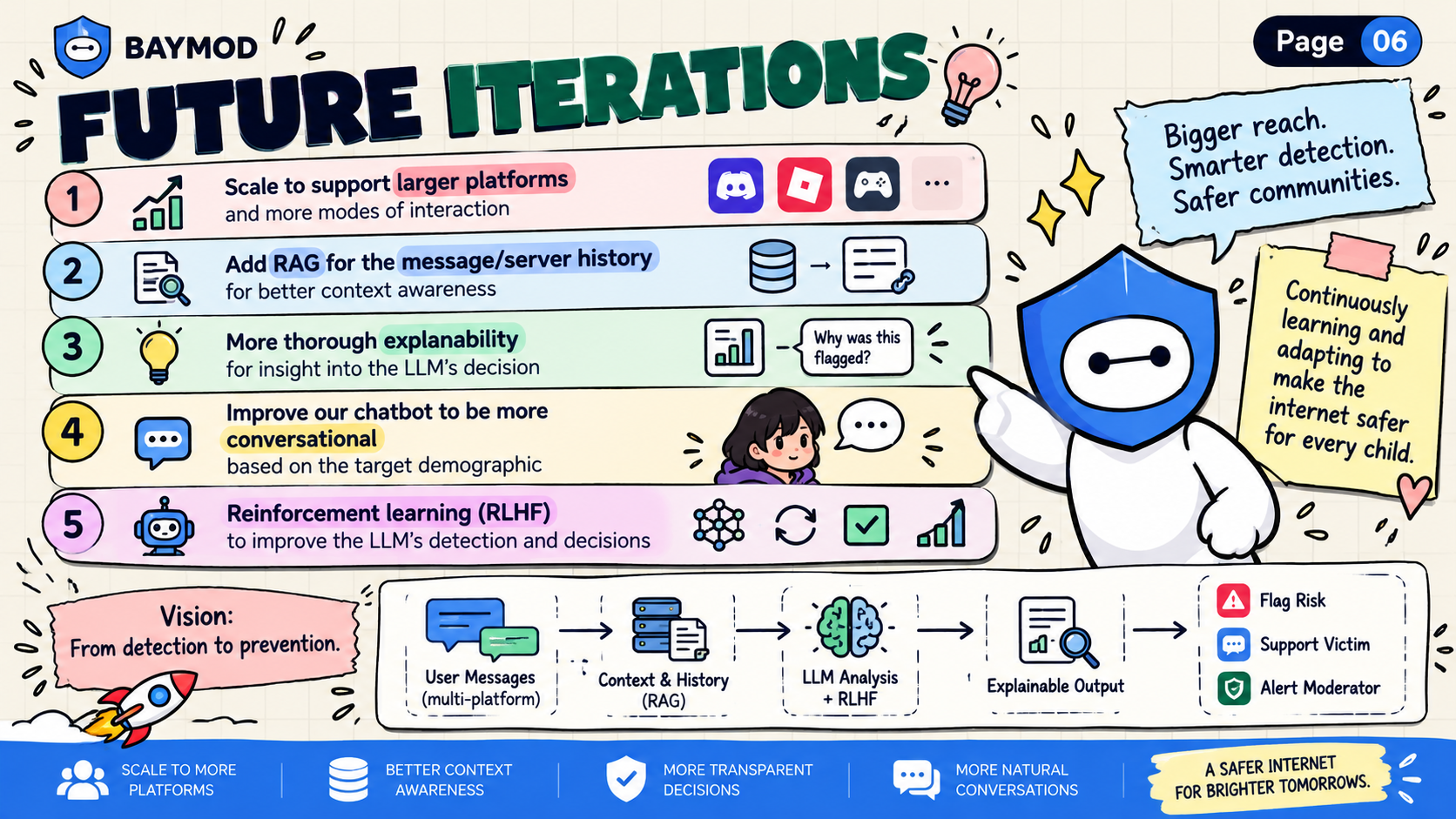
Scale to support larger platforms and more modes of interaction Add RAG for the message/server history for better context awareness More thorough explainability for insight into the LLM’s decision Improve our chatbot to be more conversational based on the target demographic Reinforcement learning (RLHF) to improve the LLM’s detection and decisions
Built With
- discord
- langchain
- python
