
Baymax Health Companion – Our Story Inspiration
One evening at my home, a small accident changed everything.
A child in my family got a cut on his hand. We quickly went to a doctor, and after a very short treatment, we were charged 40 dollars just for basic first aid. I felt frustrated. It was only a small injury, but many people cannot afford medical help even for simple emergencies.
That moment reminded me of Baymax from the movie Big Hero 6 — a friendly healthcare robot that helps people immediately when they are hurt.
I started thinking:
“What if I could build something like Baymax in real life?”
I also remembered the emotional moment when Tadashi created Baymax to help and protect people. I honestly felt the same kind of motivation — not to create a machine, but to create a caring companion that could help someone before things become dangerous.
That was the beginning of the Baymax Health Companion.
What it does
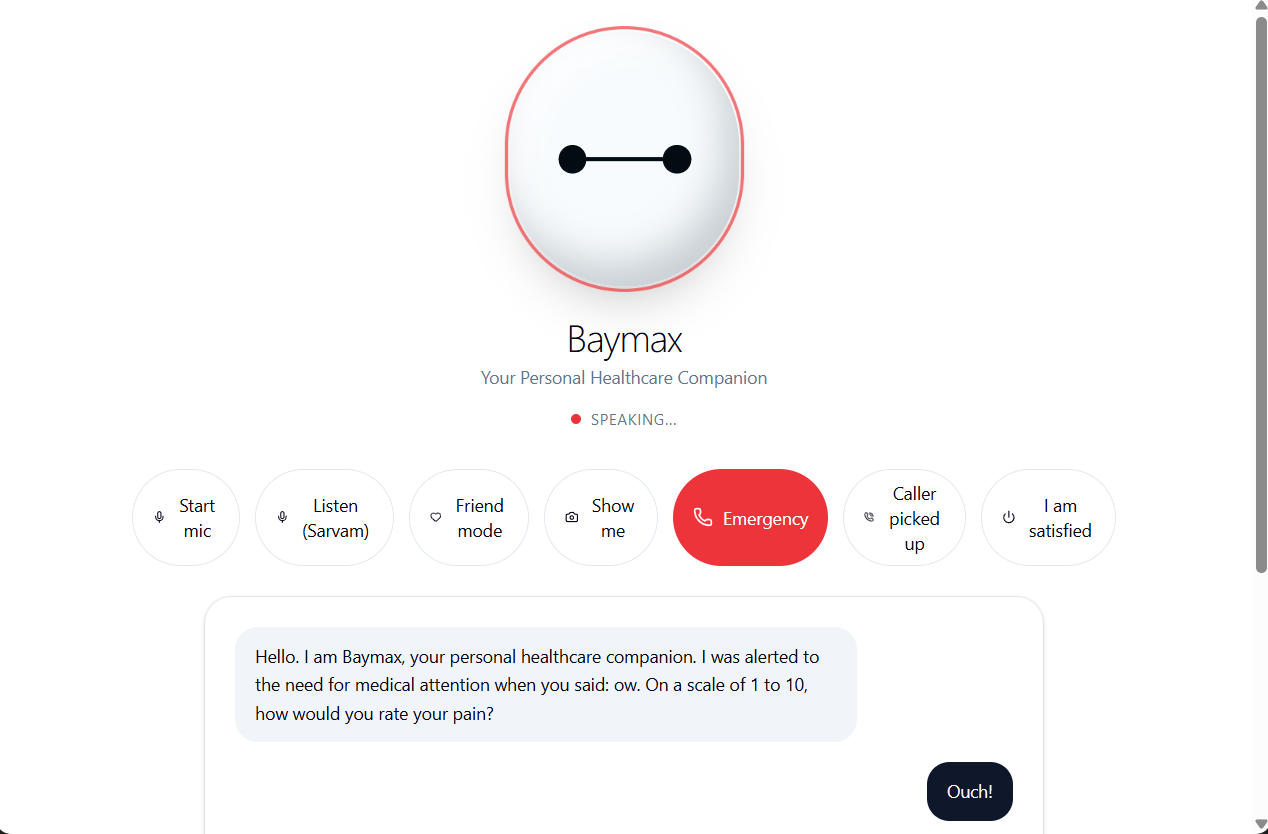
The Baymax Health Companion is an AI-powered healthcare assistant designed to help people during injuries and emergencies.
The system can:
Detect and scan injuries using a camera Analyze the seriousness of wounds Give instant first-aid suggestions Talk in a friendly and comforting way like a real companion Guide users step-by-step during emergencies Automatically call emergency contacts or services if the injury is serious Continuously monitor the person’s condition in real time
The goal is to make healthcare support faster, friendlier, and more accessible at home.
How we built it
We combined AI software and hardware systems to create the project.
The project was built using:
AI models for injury analysis and conversation Camera modules for real-time injury detection Speech-to-text and text-to-speech systems for natural communication Emergency response logic for alert systems ESP32-based hardware integration for future robotic movement and control A web interface for interaction and monitoring
The AI was trained to communicate calmly and naturally so users feel comfortable while talking to it — similar to how Baymax speaks gently and supportively.
We are now transforming the assistant from a software system into a physical robot companion.
Challenges we ran into
Building a healthcare AI companion was not easy.
Some major challenges included:
Making the AI understand injuries accurately Creating natural human-like conversations Reducing false emergency alerts Integrating camera analysis in real time Making the system respond quickly during emergencies Connecting hardware and AI systems smoothly Designing the robot to feel friendly instead of intimidating
Another difficult part was balancing emotional interaction with technical accuracy. We wanted the robot to feel caring, not robotic.
Accomplishments that we're proud of
We are proud that we successfully created a working healthcare companion prototype inspired by Baymax.
Some achievements include:
Real-time injury scanning AI-generated first-aid guidance Emergency alert functionality Friendly conversational interaction Early robotic integration A system focused on helping people emotionally as well as medically
Most importantly, we turned a personal frustration into an innovation that could genuinely help others.
What we learned
This project taught us much more than programming and electronics.
We learned:
AI can be used to support human health and safety Technology becomes more powerful when combined with empathy Real-world problems create the best innovations Building healthcare systems requires responsibility and accuracy Teamwork between software and hardware is extremely important
We also learned that people feel safer when technology communicates in a calm and caring way.
What's next for Baymax Health Companion
This is only the beginning.
Next, we plan to:
Build a full physical robot version Add advanced health monitoring sensors Improve injury detection accuracy Add multilingual voice support Enable medicine reminders and health tracking Integrate hospital and ambulance communication Make the robot mobile so it can move toward patients automatically
Our dream is to create a real-life Baymax — a healthcare companion that can assist, protect, and comfort people whenever they need help.
Built With
- audio
- css
- elvenlabs
- etc
- fish
- gemma3
- html
- javascript
- php
- sarvam


Log in or sign up for Devpost to join the conversation.