-
-
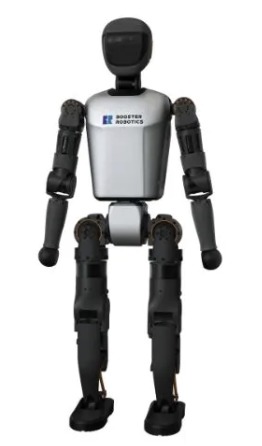
t1 Robot
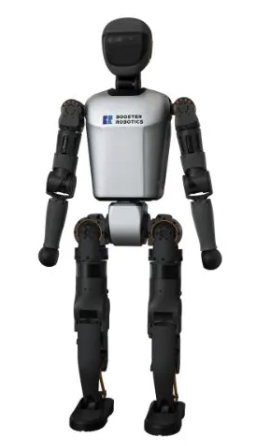
Inspiration
Humanoid robots have two arms, two legs, and a torso but almost every demo treats the whole body as one unit controlled by one script. We wanted to build a robot where every body part has its own AI agent, its own reasoning, and its own ability to act independently at the same time. A nervous system for a robot, not a remote control. We chose assistive guidance for the blind as our first application because it perfectly demonstrates the core idea: one arm guides a person while the other scans the environment completely independently.
##What it does
Baymax is a multi-agent architecture for humanoid robots where every part of the robot thinks and acts independently at the same time. As a first application, the robot guides visually impaired people by holding their hand with one arm and communicating direction through touch, while the other arm sweeps for obstacles, raises as a barrier, or halts palm-out in an emergency. Eight specialized agents each control a different part of the robot in parallel over Band's multi-agent platform.
##How we built it
We modeled the system after the human nervous system. A Vision Agent reads the camera via LiveKit and generates scene descriptions with Gemini 2.5 Flash. A Threat Agent watches for hazards in parallel and fires an emergency reflex that bypasses the normal decision loop. A Conductor makes navigation decisions and dispatches tasks to three motor agents simultaneously controlling each arm and the legs independently. A Safety Agent vetoes unsafe plans before any command reaches the robot. A Spine Agent can halt everything in under 100ms. All agents communicate over Band and drive the robot via the Booster SDK.
##Challenges we ran into
Coordinating eight AI agents without deadlocking or desynchronizing was the core challenge. LangGraph's recursion limit crashed the conductor mid-cycle. The reflex path had to stay fast enough to be useful. Booster Studio required a licensed account we didn't have so we pivoted to open source Webots. Band silently rejected messages without an @mention which broke command delivery for hours.
##Accomplishments that we're proud of
The reflex arc actually works, halting the robot in under 100ms before the conscious decision loop finishes. The two arms genuinely operate independently with separate agents doing separate reasoning simultaneously. That is not a demo trick, it is the actual architecture. The end to end pipeline closes the full loop: camera sees the world, agents think, robot moves, repeat.
What we learned
Distributed AI systems fail in ways monolithic scripts never do. Timing, ordering, and deduplication matter enormously. The human nervous system turned out to be a surprisingly accurate model for robotics. We also learned that the gap between sim and hardware is mostly just a network address. The hard part is the intelligence layer, not the hardware interface.
##What's next for BAYMAX
Baymax is a foundation, not a finished product. The same architecture that lets one arm guide a person while the other sweeps for obstacles can let a robot cook while monitoring a patient or carry objects while navigating a crowd. Any task that benefits from a body doing two things at once with independent reasoning is a candidate. Near term: integrating GR00T N1.7 for natural language understanding and training a proper locomotion policy via Isaac Lab. The codebase is ready, it just needs GPU time.
Built With
- band-multi-agent-platform
- booster-robotics
- booster-robotics-sdk
- fast-dds
- fastapi
- google-gemini-2.5-flash
- langgraph
- livekit
- markdown
- microsoft-band
- mujoco
- nebius
- nvidia
- python
- uc-berkeley-ai-hackathon-2026-booster-k1-humanoid-robot
- webots


Log in or sign up for Devpost to join the conversation.