-
BayClean: Microplastic Filtration inspired by Baleen Whale Feeding Systems
-
How I Built It
-
What it Does
-
Final Design
Inspiration
The inspiration for BayClean came from a plot twist in the beloved Disney Pixar animation, Finding Nemo. In one riveting scene, Marlin and Dory get swept into the mouth of a blue whale, yet Dory insisted and reassured that these whales only feed on krill. That took me by surprise. How does the world's largest animal survive on small fish and krill as it's primary food source? If that were true, why were their mouths lined with what seemed to be as thousands of sharp, impermeable teeth? Isn't that over-krill? Pun intended. Something felt fishy and it wasn't just the ocean.
As I researched, I quickly learned that these rows of "sharp and impermeable teeth" were not teeth at all. Blue whales are filter feeders; they are aquatic animals that extract small pieces of food and nutrients by sifting though the water. Instead of teeth, they are equipped with hundreds of keratin-rich baleen plates. You can imagine this as a narrow tooth comb, each tooth lined on one side with a fringe of hairy bristle. Larger whale species like humpbacks, bowheads and grays generally rely on baleen because it provides an efficient, energy-conserving method for filtering vast quantities of small food sources rather than hunting for individual prey. Wouldn't this design system be useful in filtering our oceans from microplastic contaminants?
Alike the fate of many marine creatures, baleen whales are unfortunately not immune to the growing threat of microplastic pollution. Despite their highly specialized filtration system, it was found that these whales consume millions of microplastics everyday. But how is this possible? Is their filter-feeding design inefficient? No, that is not the case. A whopping 99%, nearly all microplastics ingested occur via trophic transfer. These microplastics only enter the whales' systems because they were already inside their prey to begin with. Here are some of the world's most enormous creatures, with optimal intricacies for survival yet they could not prevent tiny microplastics from entering their bodies.
This is what inspired me to design BayClean. What if we mimicked the natural processes of baleen whales and other filter feeding marine life to capture particle pollutants before they enter our food chain?
What it does
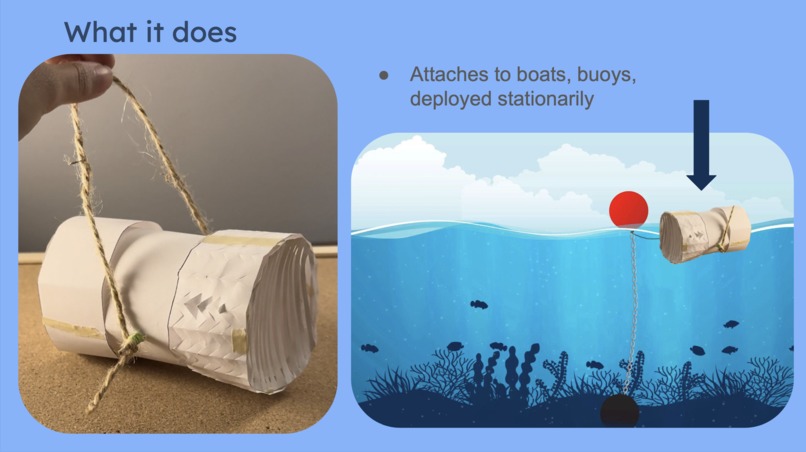
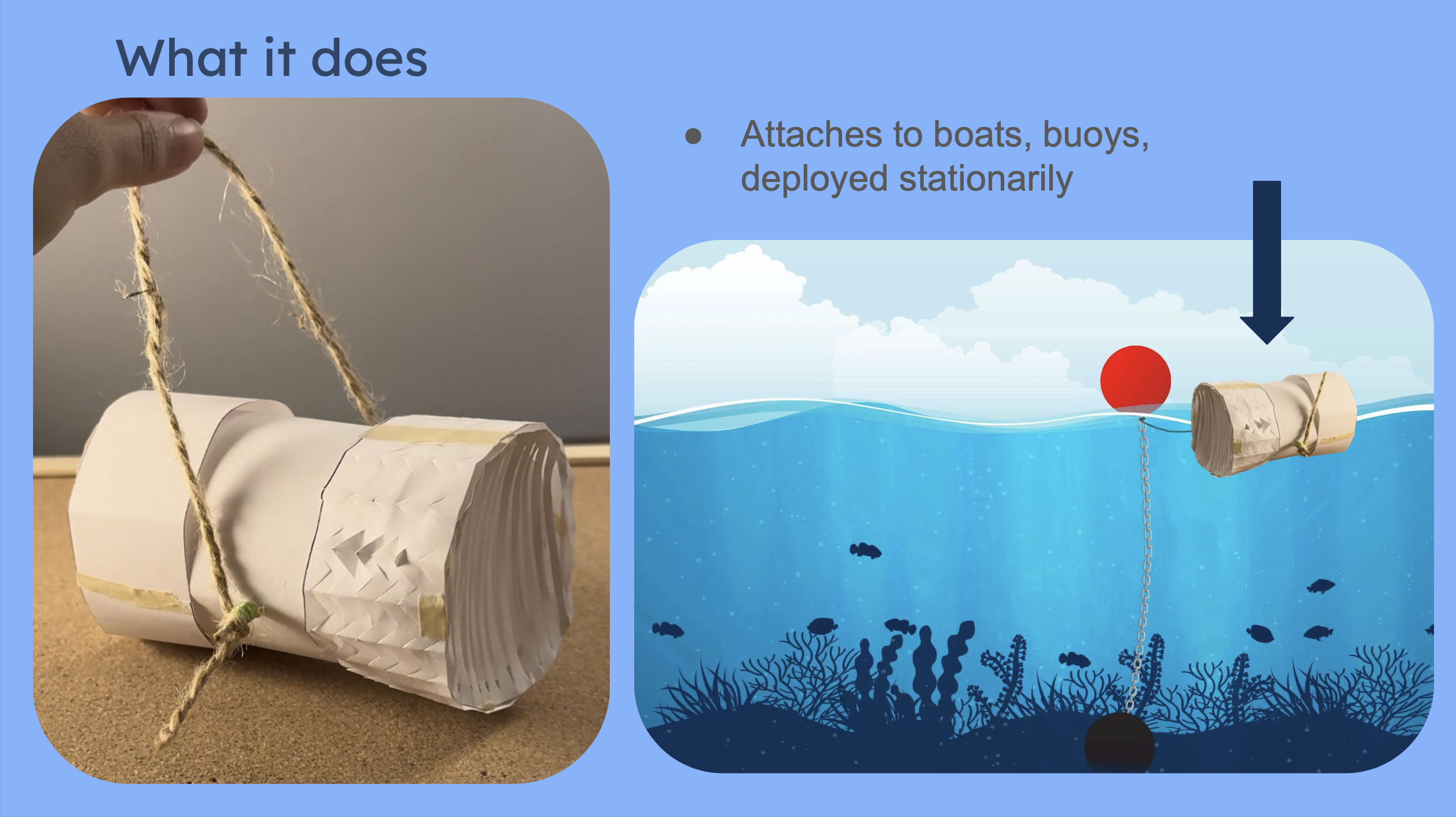
BayClean is a low-cost, multi-use marine filtration system designed to collect microplastic waste from our oceans. Inspired by filter feeding animals like baleen whales and manta rays, BayClean is a cylindrical device that can be attached to boats, buoys or deployed stationarily. As water passes through the system, microplastics become ensnared among the range of filtration methods implemented. This includes mock baleen plates, gill rakers, rotating sieve and baleen bristles.
How we built it
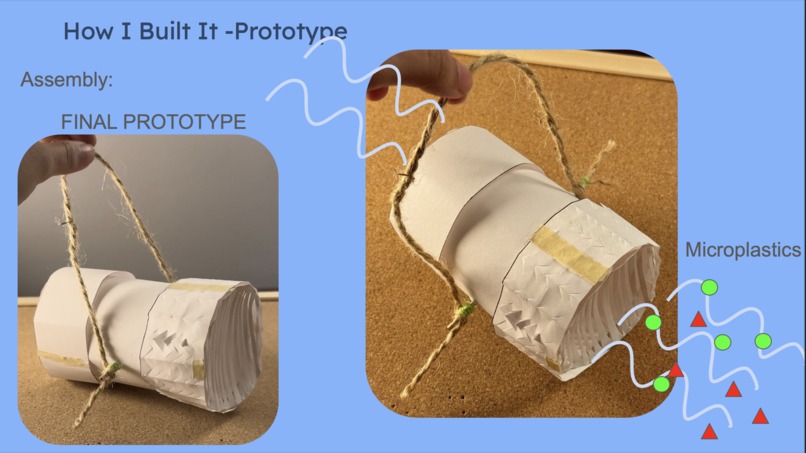
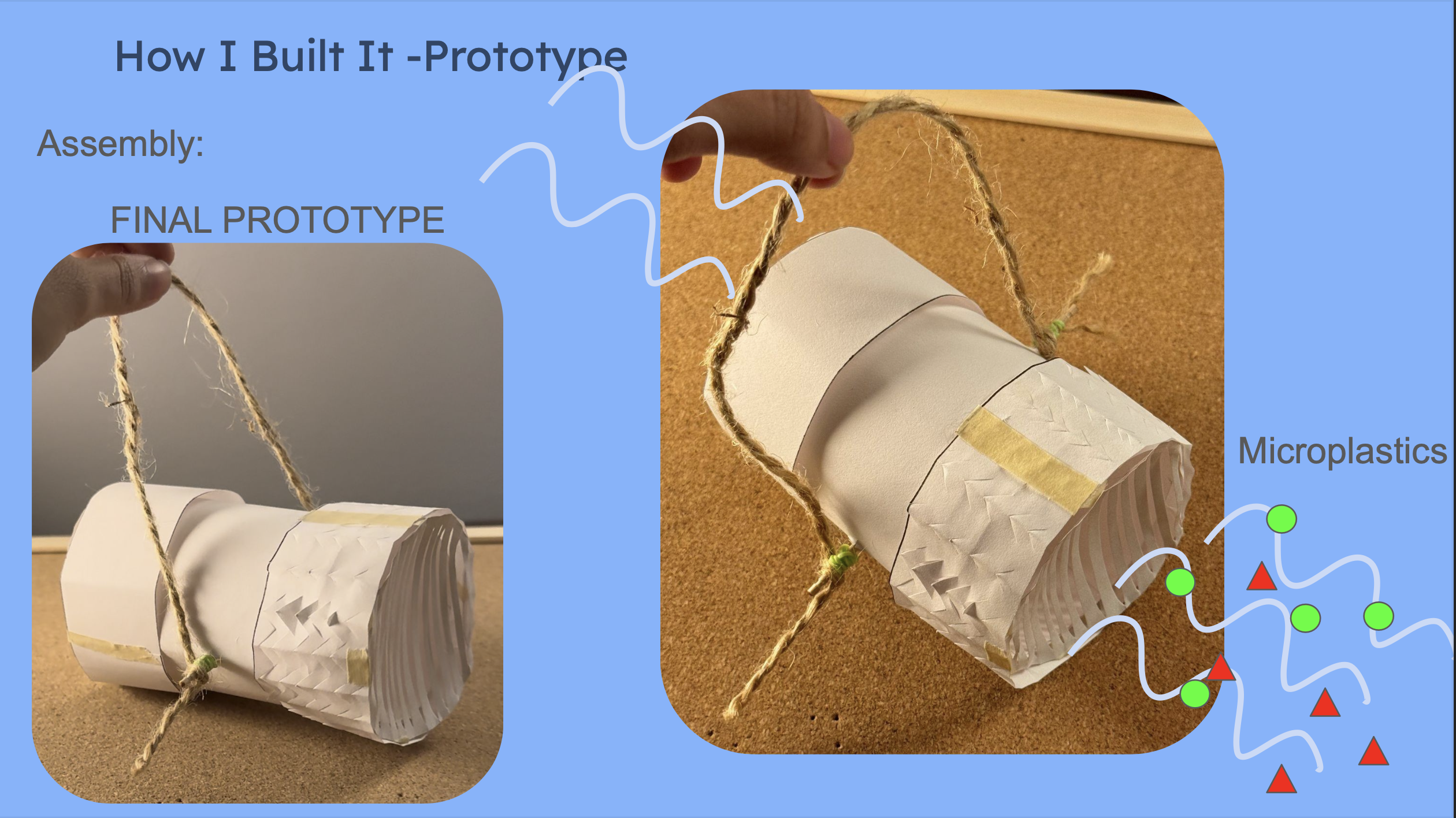
BayClean was designed with three main detachable components, each serving a unique purpose.
Components
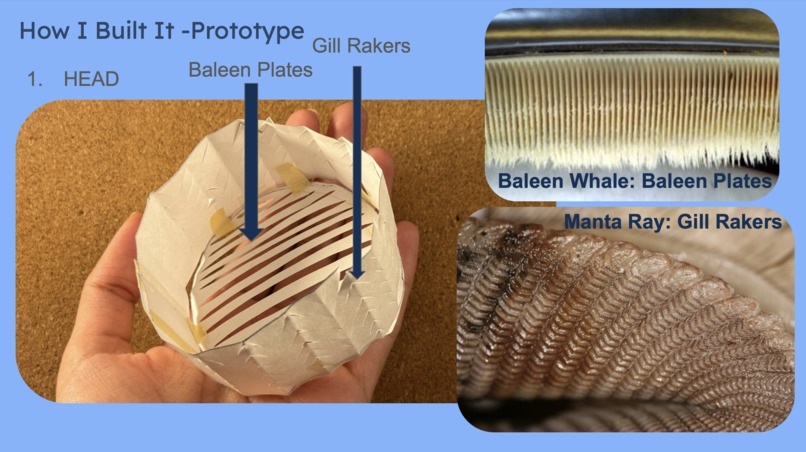
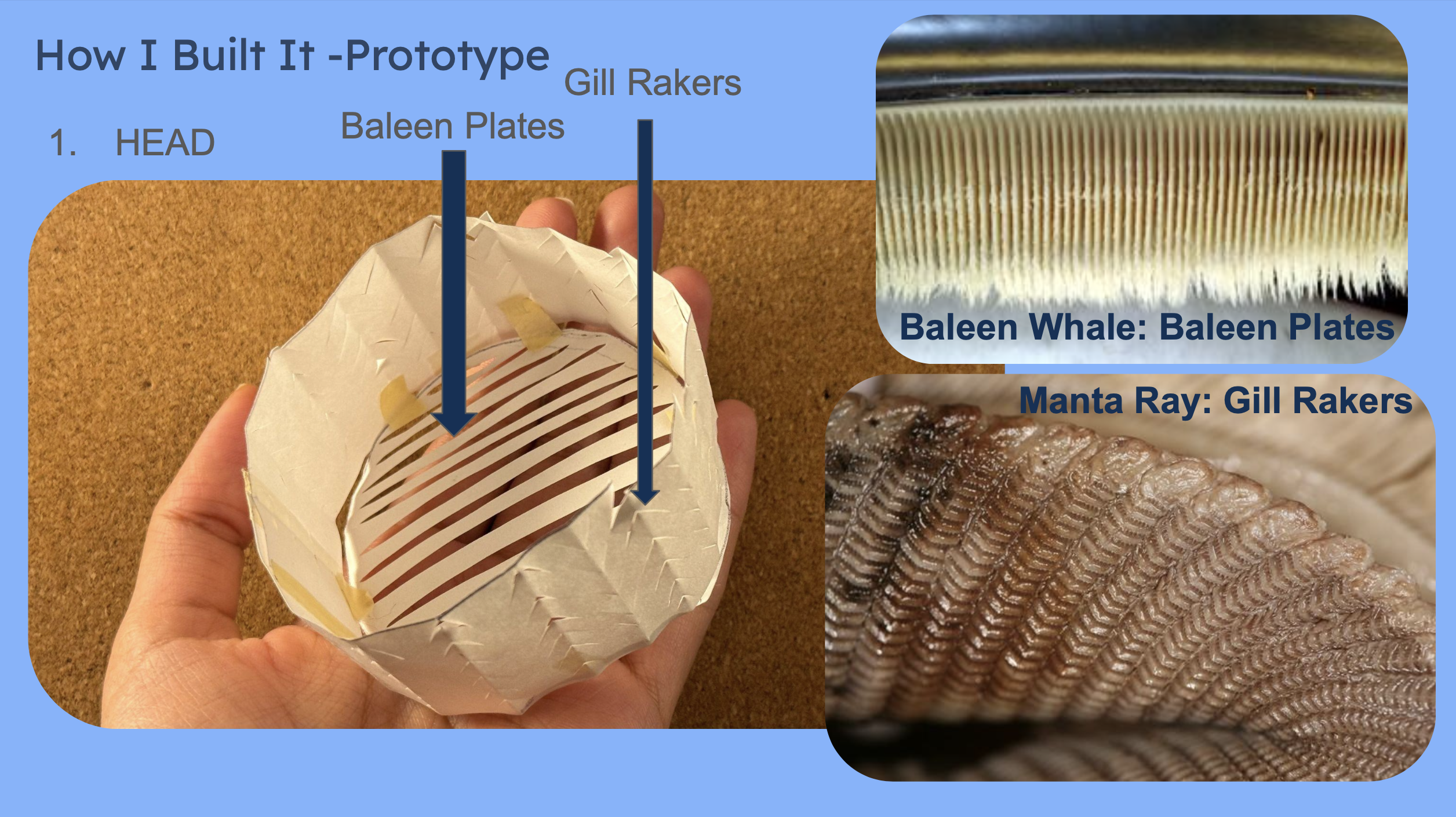
Head: The head of the device is comprised of two methods of filtration - mock baleen plates and gill rakers. As water enters the system through the head, it is sifted by the narrow, comb-like baleen plates. This prevents any marine life from accidentally entering the device. Once the water is inside, the edges of the cylindrical contraption are lined by slanted protrusions. It is these protrusions which mimic manta ray gill rakers, ricocheting solid particles to the body of the device while allowing water currents to pass through. This prevents the system from clogging up.
Body: The body of the device is designed with one method of filtration - spherical rotating sieve. The sphere rotates as the water propelled towards the body passes through its perforations. This effectively traps larger microplastic particles and prevents clogging while allowing the filtered water to pass through the rest of the system. The collection mechanism is designed for easy maintenance and removal of accumulated microplastics after use, similar to a vacuum.
Tail: The tail of the device is designed with two methods of filtration - mock baleen bristles and plates. The final stage of filtration uses these elements to capture the smallest microplastics which bypassed the earlier sections. I propose using coconut husk as mock bristles, as it closely mimics the function of baleen fringe, yet offers a more sustainable, eco-friendly alternative. Coconut husk is naturally resilient and able to withstand saltwater conditions. Additionally, the largest producers of coconut husk - India, Indonesia and the Philippines - also maintain a large stake in the global fishing industry. I witnessed this first-hand in South India where coconut is a staple in cooking, hydration and popular among tourists. By incorporating this low-cost material into the design, this not only enhances filtration but it also supports local industries by promoting a more circular economy and waste reduction. The filtered water skims through the coconut husk bristles and through the final mock baleen plates.
Challenges I ran into
I ran into two main challenges during BayClean's design process.
Challenges
Minimizing Impact on Existing Marine Life: It was imperative that my solution did not cause further collateral damage in the ecosystem. I had to consider whether BayClean could effectively filter microplastics without accidentally trapping smaller creatures. Luckily, the device is gently powered only by ocean currents and the baleen whale inspired plates keep wildlife out. The type of material used to build the device is also a critical consideration because while durability is important, it should not come at the cost of environmental impact due to material degradation or production. Plastics and nets are certainly off limits.
Design and Filter Efficiency: It took me some time to combine the different mechanisms used by filter feeders into one cohesive design. I went through a few concepts before settling on BayClean's final form which optimizes both filtration and water flow. I had to keep in mind that the product should be simple for cost-efficiency and scalability, hence its only made up of three basic, detachable parts. This way, if the product breaks or is faulty, instead of contributing to mass production and buying a whole new piece, simply detach and replace the necessary section only.
Accomplishments that we're proud of
This was a difficult challenge, yet I am incredibly proud of myself for being inspired by the natural world and successfully developing a simple yet cost-effective solution to a rapidly growing global threat. What started as an average movie night quickly turned into a creative challenge and final product. What I love most about my design is how versatile and sustainable it is. BayClean utilizing naturally occurring materials, reducing waste, overconsumption and integrating into existing marine practices like fishing, farming and buoyancy systems is what I am most proud of.
What we learned
Through this challenge, I learned that many of the seemingly ordinary household items we use today can be attributed to biomimicry. I certainly have a deeper appreciation for innovations as small as velcro and as big as airplanes. What I found most interesting during this challenge was just how efficient and intelligently intricate our natural world is. The smallest survival processes and mechanisms fit so carefully and perfectly together. My favourite learning takeaway from studying baleen whales is despite their size and massive daily food intake, their 99% efficiency in straining out pollution is just remarkable even if the contaminated food chain eventually effects them as well.
What's next for BayClean
Using BayClean's filter feeding inspired technology, I would like to expand the product line to appeal to a wider target audience to effectively combat plastic pollution in our oceans at a larger scale. Imagine a small sifter device that attaches onto surfboards and jetskis. Wouldn't it be neat to have an app corresponding to the weight of the rotating sieve, letting you know when to empty it out and how many units of microplastics you've collected over time with leaderboards? Additionally, I'd like to incorporate new methods of filtration or design principles that might prove to be more effective. There is research to support that microplastics get ensnared in algae, specifically the mucous-like membranes. Recently there have been more developments suggesting that okra, tamarind and fenugreek mucilage attracts microplastics due to their rich polysaccharide structure and static charges. Although there has not been any research to support, I would like to test whether flax seed gel has a similar effect as it seems promising.
Built With
- design
- prototype

Log in or sign up for Devpost to join the conversation.