
About the project
Inspiration
I built Baxtori because I was getting an uncomfortable feeling from my own workflow. Coding agents were helping me ship changes across several repositories, and I could follow each task while it was happening. A few days later, I would open one of those projects and realize that I remembered the ticket or the pull request but had lost the larger shape of the system.
That felt like a real limit on agent-assisted development. More code was landing, yet the person responsible for it had less time to absorb what changed. I wanted a recurring review that could look across repositories, decide which changes actually affected my mental model, and give me a short reading session with the code attached.
What Baxtori does
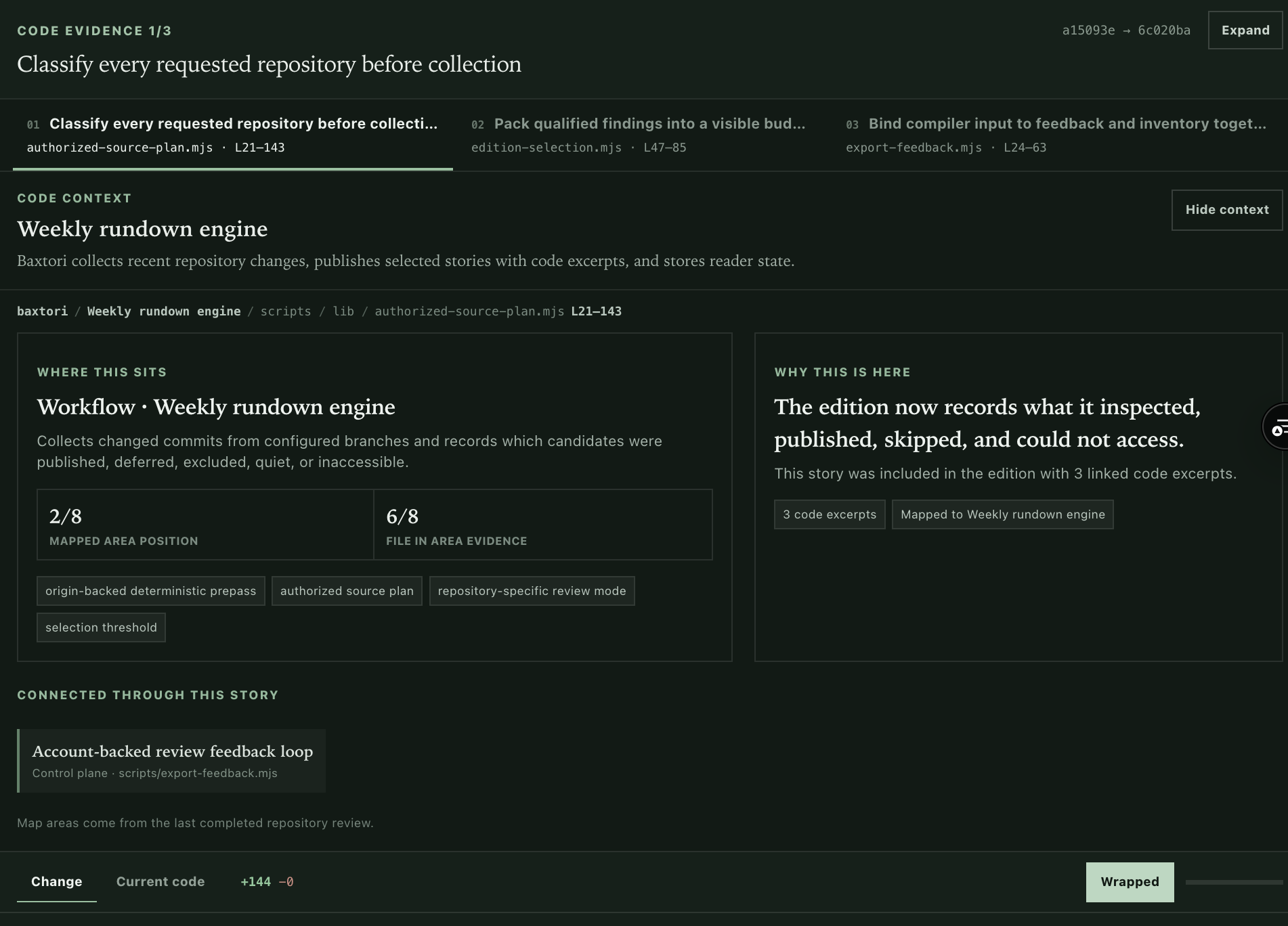
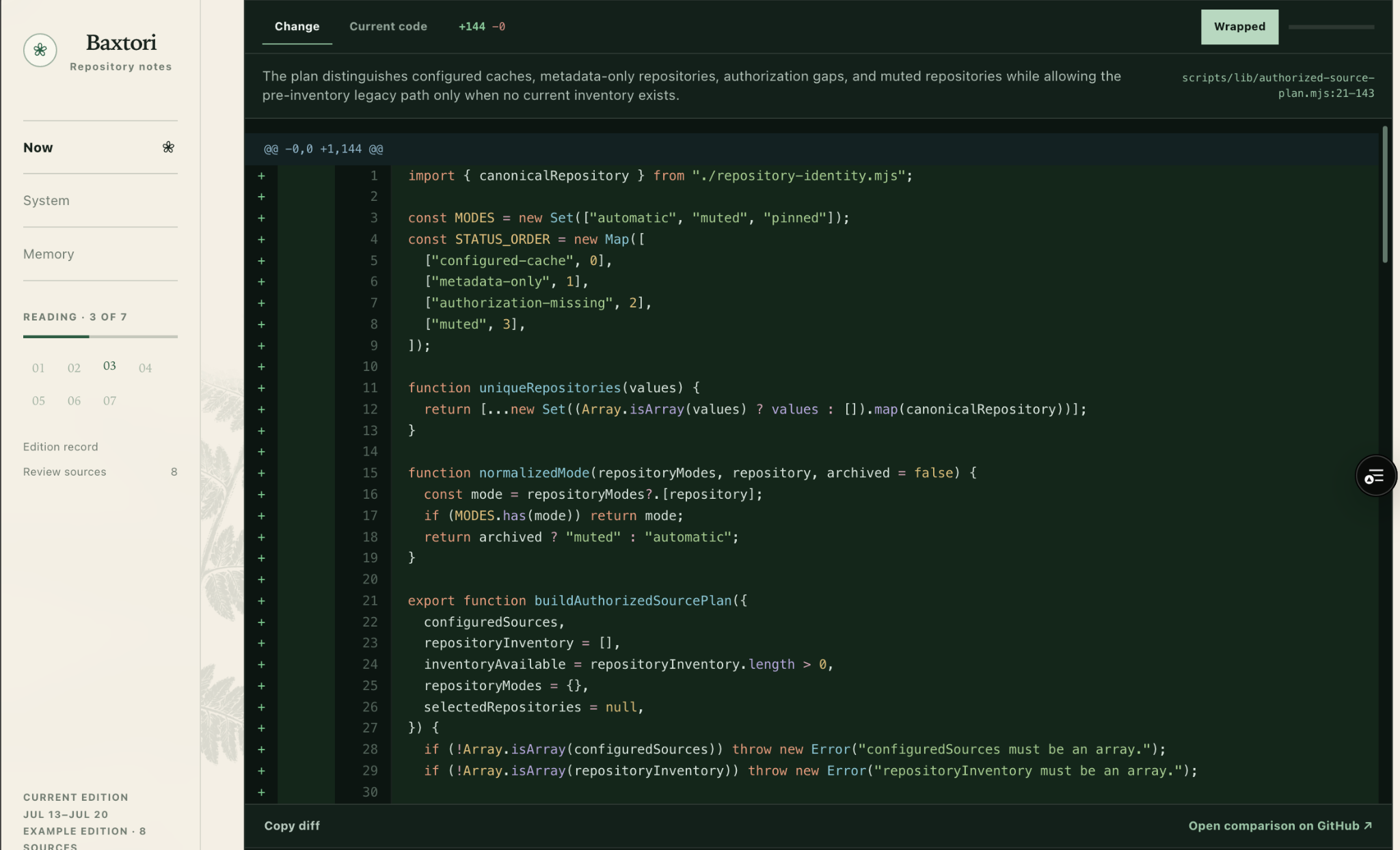
Baxtori turns recent merged work into an evidence-backed reading edition. Codex reviews the collected changes and selects the ones that have a meaningful effect on architecture, behavior, security, operations, or an ongoing concern from an earlier edition. Each published story explains the change, why it matters, what to verify, and the tradeoff. The evidence panel links that explanation to the exact repository, base commit, head commit, file, and line range.
The product has three main views. Now contains the current edition and gives the reader a finite path through it. System organizes reviewed areas, source files, walkthroughs, and open questions by repository. Memory keeps earlier editions, watched topics, code questions, and the reader's own understanding available over time.
The public link opens the complete example edition. A GitHub connection adds a read-only source library and synchronized reading state. Connected users can choose which repositories belong in the review scope and set each one to Pinned, Automatic, or Muted. The current journal remains the public example while personalized compilation is being built.
How I built it
I built Baxtori with Codex and GPT-5.6. I used Codex throughout the project to inspect the repository, work through the product model, implement features, trace authentication and persistence flows, review security decisions, and run the application through its builds and tests. GPT-5.6 was especially useful when the work required judgment across several files or concerns at once. It helped me catch places where the interface implied more capability than the backend could support, and it pushed the source, account, and evidence boundaries into much clearer shapes.
The review pipeline gives scripts and Codex separate jobs. Node.js scripts collect bounded Git evidence from configured branches. They resume from the last reviewed commit, record history rewrites, and use a limited date range when a cursor is no longer usable. A versioned instruction contract then gives Codex the candidates, repository maps, earlier selection history, and explicit reader feedback. Codex clusters related work, chooses the changes that deserve a story, and writes the structured edition data.
Finalization runs strict checks over the result. The validators confirm commit existence, ancestry, changed paths, file contents, line bounds, selection records, archives, and repository maps. A receipt protocol can record the input and instruction hashes, source heads, model/runtime metadata, processed feedback, human edits, output hash, and validator results for each completed run. An edition with zero stories is also valid; its selection ledger still records what the review inspected and why each repository produced no story.
The reader is a responsive Next.js and React application written in TypeScript. It uses a read-only GitHub App for authentication and requested evidence, Convex for account-scoped state, encrypted HttpOnly cookies for session material, and same-origin checks for mutations. Vercel hosts the public application. The same repository also builds through Vinext, and Playwright runs the reader on desktop Chromium and a Pixel 7 mobile profile.
Challenges
Selection took the most thought. A summary of every commit would still leave me with a pile of material to process. The compiler needed a real publication threshold, a reading-time budget, and a record of every included, deferred, excluded, inaccessible, or story-free repository. That made omission part of the review result and gave me a way to inspect the model's editorial choices.
Evidence was the second hard problem. A good explanation can become misleading as soon as its code reference drifts. I ended up treating every claim as a bounded Git address and validating that address during publication. The browser uses the same boundaries when it fetches source or diff data, so the explanation and the code stay connected.
The account boundary required just as much care. GitHub authorization, reader memory, and scheduled compilation have different privacy and cost implications. The current build supports real account-isolated source choices and memory. The owner's scheduled Codex task covers the configured public example. A future per-account compiler will need installation tokens, isolated source caches, scheduling, consent, and usage limits before it can process each reader's private repositories.
The interface also had to make dense material readable. I worked through several dashboard-style versions before the field-journal structure clicked. The final reader uses a finite scroll path, progressive evidence disclosure, keyboard navigation, and an editorial visual system that gives the code room to breathe.
What I learned
The main lesson was that models work well here when the surrounding program gives them a precise job. Git establishes the facts, Codex makes the editorial decision, and validators enforce the publication contract. That division made the output more useful and made failures easier to understand.
I also learned that developer memory can be treated as structured product input. An “Understood” mark, a watched topic, or a question on a code range can guide a later review. Once those signals persist across editions, each review can build on the last one and develop a working relationship with the reader.
The project also made me more candid about incomplete coverage. Baxtori records inaccessible repositories, unmapped areas, deferred findings, and repositories that produced no story. Those states tell the reader exactly how far the review reached.
What works today
The public application includes a complete example with five stories and sixteen Git-validated excerpts. Readers can inspect exact source and diffs, mark stories understood, watch topics, ask questions on code ranges, browse repository maps, and search four editions of memory. The GitHub App provides real read-only account connection, source modes, and synchronized reader state. The repository currently passes 165 unit and validation tests plus 14 desktop/mobile browser tests.
What's next
The next milestone is a complete personalized cycle: a connected repository changes, Codex selects one consequence, the reader responds to it, and the next edition visibly uses that response. I plan to build the installation-token collector, isolated temporary caches, and per-account scheduler required for that cycle. After people use it repeatedly, I will have enough evidence to make the right decisions about teams, hosted usage, and pricing.


Log in or sign up for Devpost to join the conversation.