BatteryForge AI
Inspiration
Battery failures cost industries billions annually and pose serious safety risks, from Samsung's Galaxy Note 7 recalls to Tesla's thermal runaway incidents. Traditional battery quality control relies on manual inspection, destructive testing, and reactive maintenance—all slow, expensive, and error-prone. We envisioned an AI-powered platform that could:
- Detect defects visually before they escalate to catastrophic failures
- Optimize charging strategies using physics-based simulation to extend battery life
- Predict failures proactively using multimodal AI analysis
- Coordinate specialist AI agents to handle the complexity of battery manufacturing and fleet management
The breakthrough came from Google's Gemini 3 API & Agent Development Kit (ADK), which enabled building a multi-agent orchestration system where specialized AI "experts" collaborate seamlessly—just like a real battery engineering team.
What it does
BatteryForge AI is a comprehensive battery intelligence platform powered by Gemini 3 and ADK multi-agent orchestration. It provides:
🎯 Core Features
1. AI Commander (ADK Multi-Agent Orchestration)
- BatteryForgeCommander: Root agent that routes requests to 5 specialist agents
- DefectAnalysisAgent: Visual inspection expert using Gemini Vision
- ChargingOptimizationAgent: Electrochemistry and EIS analysis specialist
- FleetCommanderAgent: Strategic fleet management and scenario simulation
- SafetyGuardianAgent: Emergency response with Human-in-the-Loop (HITL) controls
- PredictiveMaintenanceAgent: Lifecycle prediction and maintenance scheduling
2. Visual Intelligence
- Real-time thermal runaway detection via webcam, screen share, or YouTube video analysis
- "Detect-Locate-Describe" methodology for precise defect classification
- PCB/BMS manufacturing defect detection (open circuits, shorts, solder mask issues)
- Live streaming analysis with persistent audit trails
3. Charging Analysis & Physics Simulation
- PyBaMM integration for Doyle-Fuller-Newman (DFN) physics-based battery simulation
- Interactive multi-plot visualization with Recharts (voltage, current, temperature curves)
- EIS (Electrochemical Impedance Spectroscopy) analysis with layer-by-layer diagnosis
- Universal CSV parser that auto-detects data types (cycling, impedance, telemetry)
4. Fleet Monitor
- Real-time monitoring of 100+ battery packs
- Scenario simulation (heat waves, cold snaps, fast charging stress tests)
- Strategic risk assessment with thermal spread analytics
- Pack-level drill-down with maintenance recommendations
5. PCB Manufacturing Automation
- Gerber file analysis for CAM validation
- Adaptive etching control (conveyor speed, spray pressure optimization)
- Lamination scaling prediction for multi-layer boards
- Automated compliance certificate generation
6. RAG Knowledge Assistant
- ChromaDB vector store with Gemini text embeddings
- Ingests PDF manuals and technical documentation
- Context-aware responses in chat interface
- Semantic search across battery safety standards
How We built it
Architecture
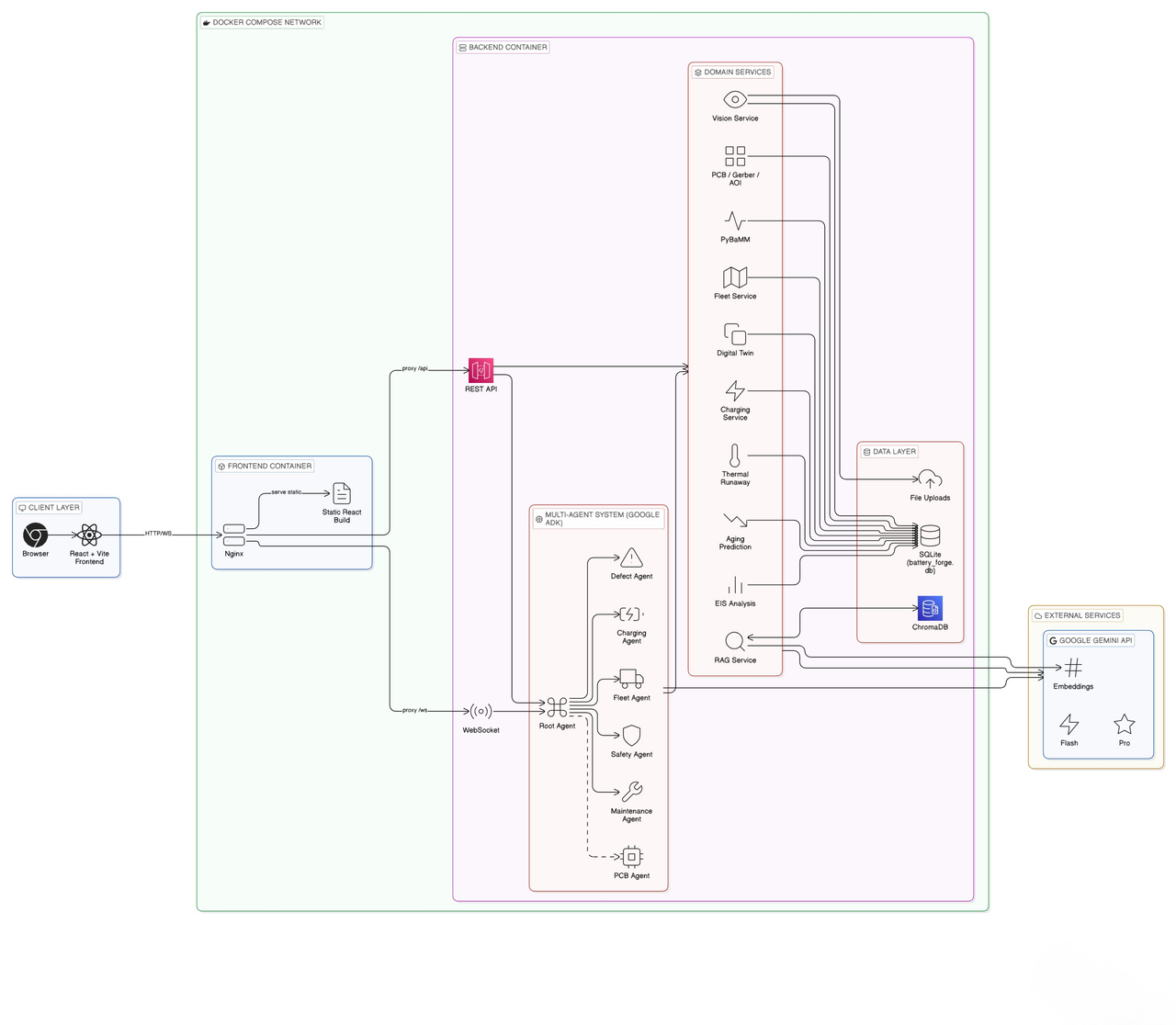
Backend (Python + FastAPI)
- ADK Integration: Multi-agent orchestration with Runner.run_async event streaming
- Services Layer: Modular services for vision, simulation, RAG, fleet management
- Tools: 20+ specialized tools for agents (vision analysis, PyBaMM simulation, EIS processing)
- Database: SQLite for analysis history, ChromaDB for vector embeddings
Frontend (React + Vite)
- Modern UI: Framer Motion animations, glassmorphism, dark mode
- Interactive Charts: Recharts for scientific data visualization
- Real-time Features: WebSocket for live agent trace, streaming analysis logs
- Components: 10+ specialized components (VisualScout, ChargingAnalysis, FleetMonitor, etc.)
Key Technologies
AI/ML Stack
- Google Gemini 3 Flash Preview (multi-agent orchestration)
- Google ADK (Agent Development Kit) for workflow coordination
- Gemini Vision for multimodal defect detection
- ChromaDB + Gemini Embeddings for RAG
Physics & Simulation
- PyBaMM (Python Battery Mathematical Modeling) for DFN simulations
- NumPy/Pandas for data processing
- Custom EIS analysis engine following IEST standards
Frontend Stack
- React 18 + Vite (fast development)
- Recharts for scientific plotting
- Framer Motion for premium animations
- React Player for video analysis
Development Process
- Phase 1: Built core defect detection using Gemini Vision with "Detect-Locate-Describe" methodology
- Phase 2: Integrated PyBaMM for physics-based simulations and universal CSV parsing
- Phase 3: Developed Visual Scout with real-time webcam/screen share analysis
- Phase 4: Created PCB manufacturing workflows (Gerber analysis, etching control, plating optimization)
- Phase 5: Implemented RAG knowledge base with ChromaDB
- Phase 6: ADK Multi-Agent System—Migrated to full agentic architecture with 5 specialist agents
Challenges We ran into
1. ADK Tool Schema Generation
Problem: The ADK framework generates JSON schemas from Python function signatures. List parameters without proper type hints caused 400 INVALID_ARGUMENT errors:
GenerateContentRequest.tools[0].function_declarations[3].parameters.properties[video_frames].items: missing field
Solution: Standardized all function signatures to use List[str] from the typing module and ensured docstrings matched the type hints exactly. Updated all 20+ tool functions across the codebase.
2. Event Streaming Architecture
Problem: ADK's Runner.run_async returns an async generator of events, not a simple response object. The initial implementation tried to treat it like a synchronous API call.
Solution: Implemented proper async iteration with event collection:
async for event in self.runner.run_async(...):
    if event.actions.transfer_to_agent:
        # Collect agent transfers
    for fc in event.get_function_calls():
        # Collect tool calls
    if event.content and event.content.parts:
        # Collect streaming response text
3. Model Availability
Problem: Initially used gemini-3-pro-preview which wasn't available in the v1beta API, causing 404 NOT_FOUND errors.
Solution: Discovered gemini-3-flash-preview was available and optimized for tool calling. Migrated all 6 agents to use this model after verification.
4. PyBaMM Threading
Problem: PyBaMM's DFN solver is CPU-intensive and would block the FastAPI event loop, causing the entire backend to freeze during simulations.
Solution: Wrapped all PyBaMM calls in ThreadPoolExecutor with asyncio.run_in_executor() to offload physics calculations to worker threads.
5. Screen Share Video Analysis
Problem: YouTube videos can't be analyzed directly due to CORS. ReactPlayer can display them but can't provide raw frames for canvas capture.
Solution: Implemented getDisplayMedia() screen recording. When a user selects a URL video, the app prompts for screen share permission and analyzes the visible tab instead—a genius workaround for external video analysis!
6. Universal CSV Parsing
Problem: Battery research data comes in countless formats (Arbin cyclers, BioLogic EIS, Tesla telemetry). No single parser could handle them all.
Solution: Built a two-stage system:
- Gemini-based semantic mapper: Analyzes headers and sample data to identify column meanings
- Adaptive parser: Uses Gemini's mapping to standardize any CSV into canonical format
Accomplishments that we are proud of
🏆 Technical Achievements
First Fully Agentic Battery Platform: Successfully orchestrated 5 specialist AI agents using Google ADK, demonstrating real-world multi-agent coordination beyond simple chatbots.
Physics-Integrated AI: Bridged machine learning with electrochemistry by combining Gemini's reasoning with PyBaMM's physics-based DFN simulations—achieving both accuracy and explainability.
Real-Time Thermal Runaway Detection: Built a production-ready system that analyzes webcam/video feeds at 1 FPS for battery safety monitoring—potentially life-saving technology.
Universal Data Ingestion: Created a Gemini-powered intelligent parser that can understand and process any battery dataset format without manual configuration.
Zero-Shot PCB Defect Detection: Achieved reliable open circuit and short circuit detection using only Gemini Vision, no custom training required.
💡 Innovation Highlights
- Screen Share Analysis: Novel approach to analyze YouTube thermal runaway videos by recording the browser tab
- Interactive EIS Analysis: Layer-by-layer impedance diagnosis (Ohmic, Kinetics, Diffusion) following industry standards
- Agent Trace Visualization: Real-time display of agent transfers and tool calls for transparency
- Scenario Simulation: Fleet-level stress testing (heat waves, cold snaps) with physics-based degradation
📊 Scale Achieved
- 20+ AI Tools across 5 specialist agents
- 10+ React Components with premium UI/UX
- 100+ Battery Packs simulated in fleet monitor
- 6 Analysis Modes: Visual, Charging, Fleet, Logs, Aging, PCB
What We learned
Technical Learnings
Agent Architecture Patterns: Building scalable multi-agent systems requires careful separation of concerns. Each agent needs clear responsibilities and well-defined tool sets.
Event-Driven AI: Moving from request-response to event streaming fundamentally changes how you structure async code. ADK's event model is powerful but requires rethinking traditional API patterns.
Physics-AI Hybrid Systems: The best battery intelligence comes from combining data-driven AI (Gemini) with first-principles physics (PyBaMM). Neither alone is sufficient.
Type System Importance: Python type hints aren't just for IDE autocomplete—they're critical for automatic schema generation in frameworks like ADK.
Real-Time Vision Challenges: Analyzing live video at acceptable frame rates while maintaining accuracy requires careful optimization (canvas rendering, async processing, result caching).
Domain Knowledge
- Battery Failure Modes: Deep understanding of lithium-ion degradation mechanisms (SEI growth, lithium plating, thermal runaway propagation)
- EIS Interpretation: How to diagnose battery health from impedance spectra using frequency-domain analysis
- PyBaMM Ecosystem: The DFN model's power and limitations, parameter sensitivity, computational costs
- PCB Manufacturing: CAM workflows, Gerber file structure, etching chemistry, lamination physics
Product Design
- Context-Aware AI: The best agent experiences provide workspace context (active tab, current data) automatically
- Progressive Disclosure: Start with simple interfaces, reveal complexity on demand (e.g., multi-plot analysis)
- Visual Feedback: Real-time status indicators and live traces build trust in AI systems
What's next for BatteryForgeAI
Short Term (1-3 months)
1. Enhanced Agent Capabilities
- Add DataAnalystAgent for statistical trend analysis
- Implement ComplianceAgent for UL/IEC standard verification
- Add SupplyChainAgent for material sourcing optimization
2. Advanced Workflows
- Marathon agents for long-running tasks (24-hour pack audits, continuous monitoring loops)
- Workflow branching based on severity detection
- Automated report generation for compliance
3. Hardware Integration
- Direct BMS connection for live telemetry ingestion
- Integration with thermal cameras for IR analysis
- Support for EIS hardware (Gamry, BioLogic)
Medium Term (3-6 months)
1. Production Deployment
- Multi-tenant architecture with enterprise auth
- Cloud deployment (GCP with Cloud Run + Firestore)
- REST API for third-party integrations
2. Advanced Analytics
- Predictive maintenance scheduling with calendar integration
- Anomaly detection using statistical process control
- Fleet-level optimization (charging scheduling, load balancing)
3. Expanded Modalities
- Audio analysis for battery cell venting detection
- X-ray/CT scan analysis for internal defect detection
- Acoustic emission monitoring for mechanical failures
Long Term (6-12 months)
1. Industry Adoption
- Partnership with battery manufacturers for pilot deployment
- Integration with fleet management platforms (Tesla, Rivian)
- Certification for safety-critical applications
2. Research Extensions
- Custom PyBaMM parameter fitting from experimental data
- Physics-informed neural networks for hybrid modeling
- Reinforcement learning for optimal charging policies
3. Ecosystem Growth
- Open-source the agent framework for battery research community
- Build marketplace for custom agents and workflows
- Create educational platform for battery engineering training
Technical Stack Summary
- AI & ML: Gemini 3 Flash Preview, Google ADK, ChromaDB, Gemini Embeddings
- Physics: PyBaMM (DFN), NumPy, Custom EIS Engine
- Backend: FastAPI, SQLite, Pydantic, ThreadPoolExecutor
- Frontend: React 18, Vite, Recharts, Framer Motion, React Player
- Deployment: Local (uvicorn + npm dev), Docker-ready
Lines of Code: ~15,000+
Development Time: 72 hours (hackathon sprint)
Powered By: Google Gemini 3 & ADK


Log in or sign up for Devpost to join the conversation.