BatteryBridge
Inspiration
As electric vehicles become more widespread, conversations around sustainability often stop at adoption. What happens after an EV battery reaches the end of its first life is far less visible, yet critically important. We were inspired by research showing that many EV batteries are discarded too early or improperly, leading to serious environmental risks such as landfill fires, toxic chemical leaks, and wasted embedded energy.
At the same time, we noticed a disconnect: batteries that are no longer optimal for vehicles can still be extremely valuable for second-life applications such as energy storage, community infrastructure, and renewable integration. The lack of a clear, trusted pathway between EV owners, dealerships, recyclers, and community initiatives motivated us to build BatteryBridge.
Our goal was to create a system that not only prevents harm, but actively enables better environmental decisions.
What it does
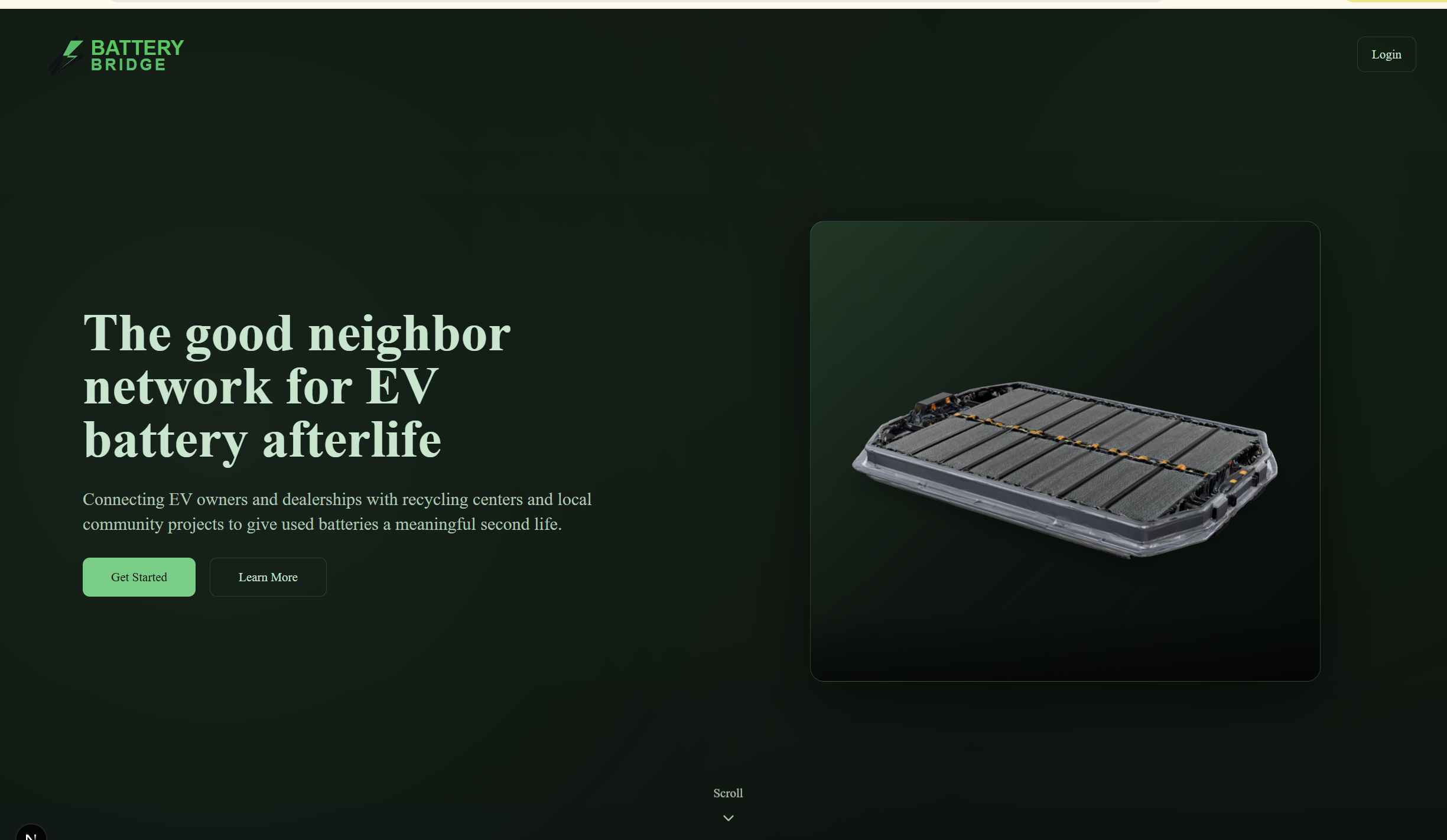
BatteryBridge is a web application that connects EV owners and dealerships with recycling centers and local community projects to give used EV batteries a responsible second life.
The platform:
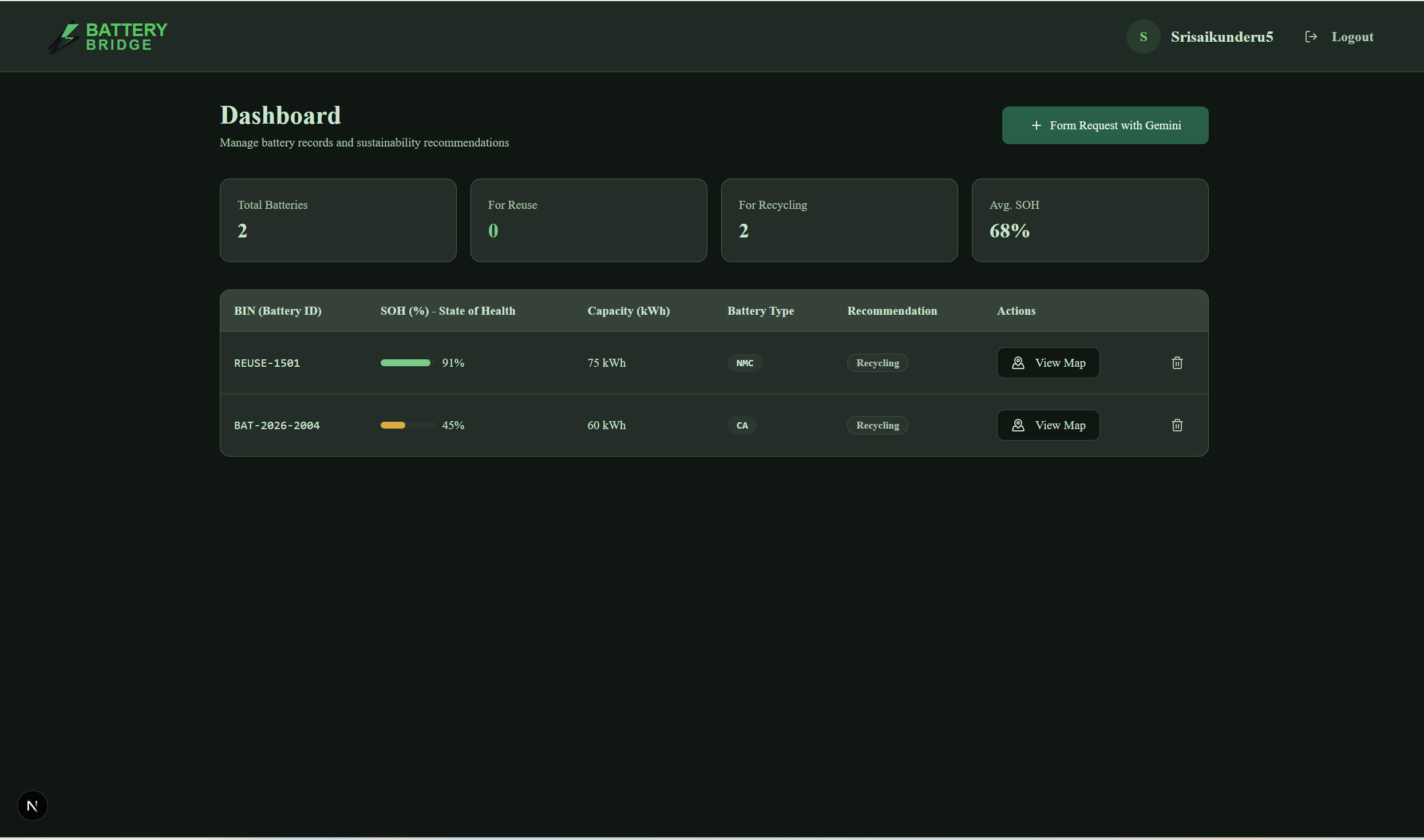
- Collects battery data such as State of Health (SOH), capacity, chemistry, and location
- Uses AI-driven logic to determine whether a battery is better suited for reuse or recycling
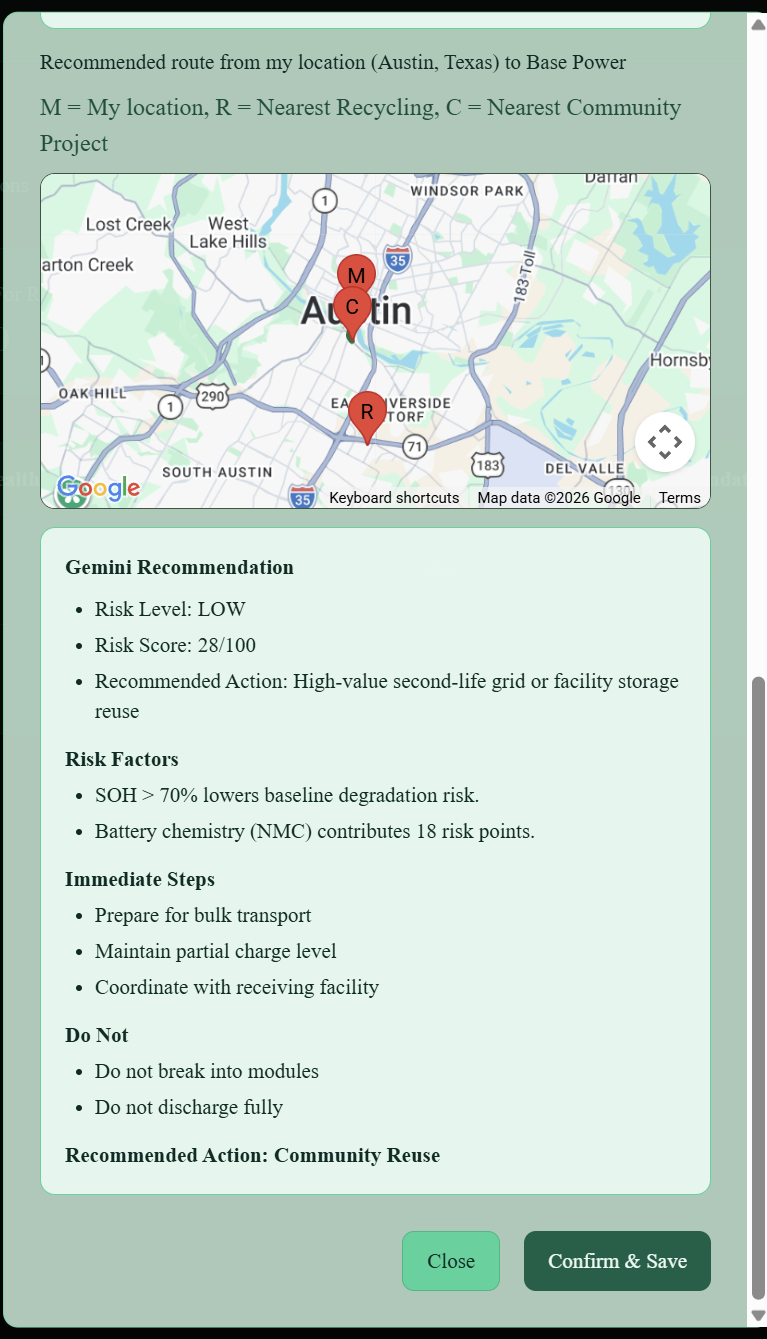
- Matches eligible batteries with nearby recycling facilities or community projects such as schools, emergency relief programs, or solar energy storage initiatives
- Provides transparent reasoning behind each recommendation
A key feature of BatteryBridge is its two-layer sustainability model:
- Battery preservation – preventing premature or improper disposal
- System-level optimization – minimizing overall environmental impact by considering transportation distance and associated carbon emissions, even when reuse is technically possible
How we built it
We designed BatteryBridge as a modern, modular web application with a strong emphasis on clarity, usability, and transparency.
Frontend
- Built with React and Next.js using the App Router
- Styled with Tailwind CSS for a clean, climate-tech aesthetic
- Interactive landing page with scroll-based storytelling
- Dashboard-driven experience with modal-based workflows to reduce friction
- Slider-based authentication flow combining sign-in and sign-up into a single, intuitive interface
Core UX Flow
- Users submit battery data through a dashboard pop-up modal
- An AI logic layer (currently mocked) evaluates battery health and suitability
- Results are presented in a second modal explaining both the recommendation and the sustainability tradeoffs
- Decisions are saved back to the dashboard for tracking and repeat use
AI Logic (Prototype)
- Battery eligibility based on SOH and battery type
- Location-aware comparison between reuse and recycling options
- Environmental reasoning surfaced directly in the UI
Challenges we ran into
One of the biggest challenges was avoiding overly simplistic sustainability logic. While reuse is often better than recycling, this is not always true when transportation distance and emissions are considered. Designing a system that could communicate these tradeoffs clearly—without overwhelming or confusing users—required careful UX and language decisions.
We also had to balance:
- Technical accuracy vs. accessibility
- Transparency vs. decision fatigue
- Flexibility for multiple user types (individual owners vs. dealerships)
Finally, designing a frontend that felt both data-driven and human-centered required multiple iterations, especially around the dashboard and results explanations.
Accomplishments that we're proud of
- Designing a two-layer sustainability decision model that goes beyond binary reuse vs. recycle logic
- Creating a smooth, modal-based dashboard workflow that supports repeated, real-world usage
- Building a clear and defensible explanation system that shows why a recommendation was made
- Aligning UX, environmental ethics, and technical feasibility into a cohesive product vision
What we learned
Through this project, we learned that sustainability software is as much about communication and trust as it is about data and optimization. Users are more likely to make environmentally responsible decisions when they understand the reasoning behind them.
We also learned the importance of:
- Designing for system-wide impact, not just component-level optimization
- Treating UX as a critical part of ethical decision-making
- Building flexible foundations that can evolve with better data and more advanced AI models
What's next for BatteryBridge
Next steps for BatteryBridge include:
- Integrating live data from recycling centers and community partners
- Enhancing the AI decision engine with lifecycle analysis and carbon estimation models
- Adding an environmental impact score to quantify outcomes
- Expanding support for fleet operators and municipal partners
- Include a broader list of battery types for a farther market reach. *Facilitate partnerships with EV dealerships, offering incentives like trade-in credits or discounts on new battery technology.
BatteryBridge is designed to scale—from individual EV owners to city-wide sustainability infrastructure—while keeping environmental responsibility at its core.
Built With
- css3
- gemini
- html5
- map-google
- next.js
- postgresql
- react
- solar
- tailwindcss
- typescript

Log in or sign up for Devpost to join the conversation.