The Journey of Building a Legal RAG Model: A Blend of Law and Tech
Inspiration
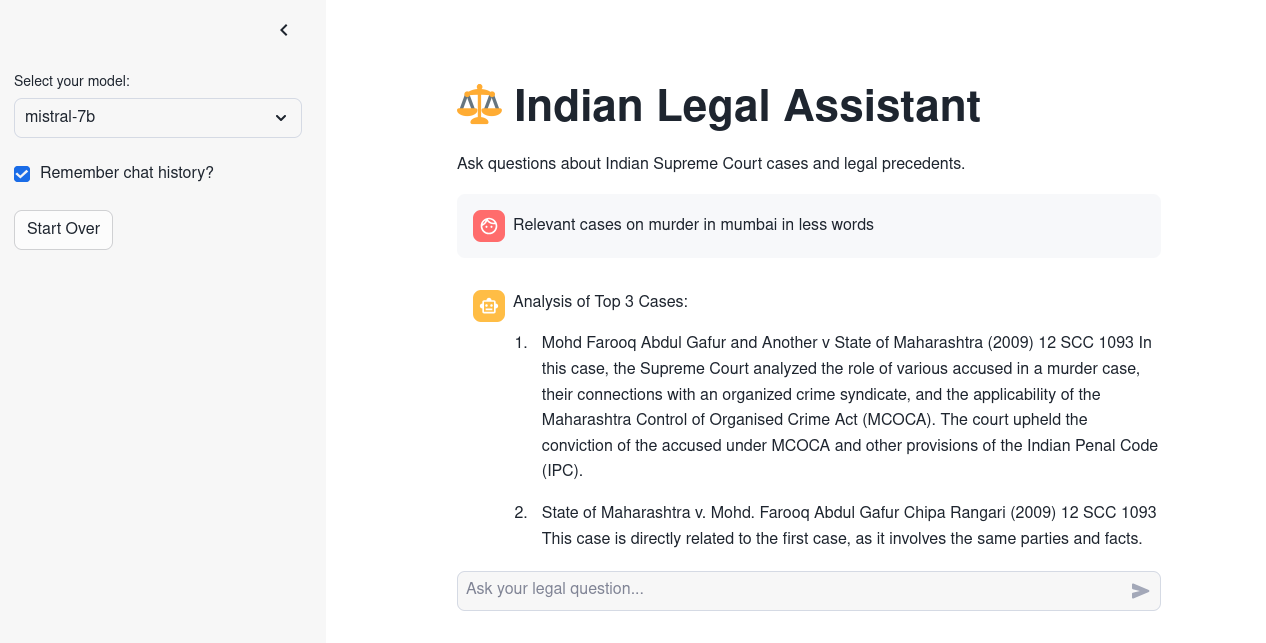
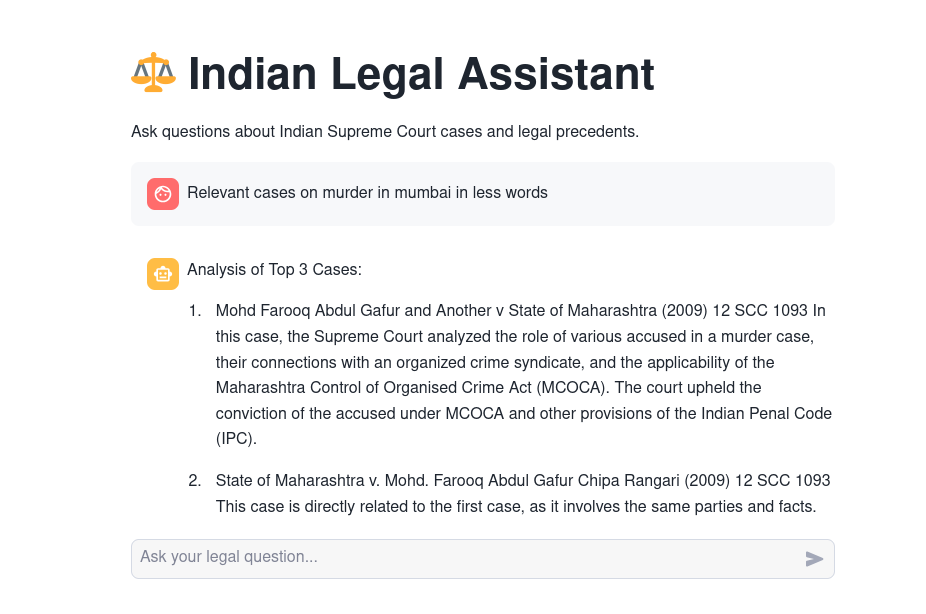
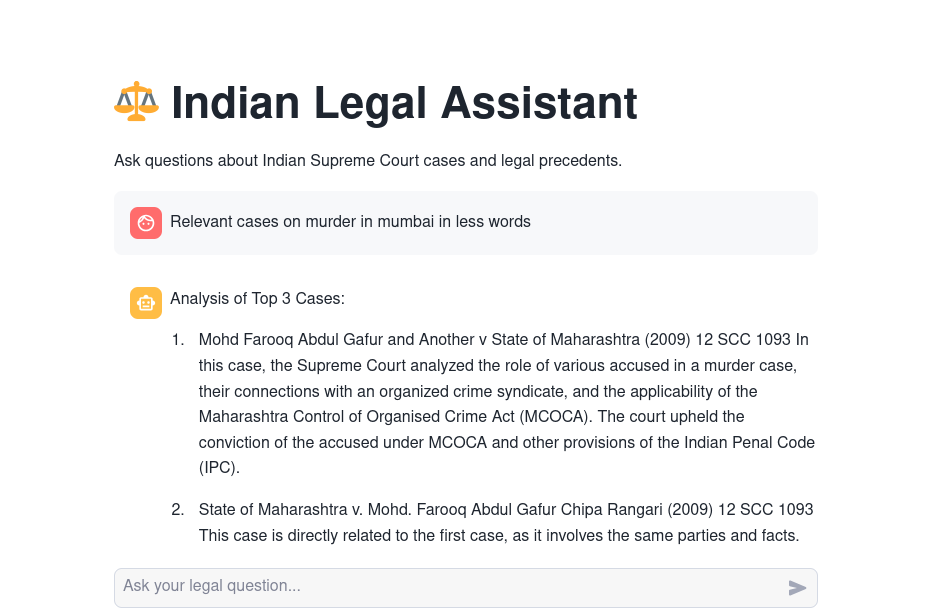
The idea for Lawgorithm came from the realization that legal knowledge in India is often difficult to access and understand. For most people—whether they are legal professionals, students, or everyday citizens—finding relevant legal judgments is a time-consuming and overwhelming process. The legal language in India can be dense and filled with complex terms that can be hard to interpret. The vast number of judgments and legal documents makes the search for specific information an even bigger challenge. Inspired by this need for accessibility and clarity, Lawgorithm was born. Our goal was simple: use technology to help anyone easily access and understand legal judgments and answers to their legal queries from India's vast legal database.
What We Learned
While building this project, we learned that combining law with technology is more than just about automating processes—it’s about making complex legal language accessible to all. We discovered that legal texts, especially in India, are packed with nuances and contextual meaning that machines must learn to interpret properly. Using technology is not enough; the system needs to understand the context behind the judgments, the terms used, and how they relate to one another. We also realized that in India, where laws and judgments can differ from state to state, ensuring that the information is both accurate and comprehensive was crucial. Our challenge was not just making the legal data accessible but also ensuring it made sense to anyone, even those without a legal background.
How We Built Our Project
To create Lawgorithm, we used a Retrieval-Augmented Generation (RAG) model, which allows us to combine advanced search capabilities with the power of natural language generation. Here’s how we built it:
Gathering and Cleaning Data: Our journey started with a massive dataset of around 40,000 legal PDFs, all containing judgments from various courts in India. The data was messy—many documents were invalid, and others were scanned images that required OCR (optical character recognition) to convert them into readable text. OCR technology isn’t perfect, so the process of extracting clean, usable text took significant time and effort. We had to address errors from the OCR scans and ensure that the extracted text was accurate enough for legal purposes.
Storing Data in Snowflake: To manage this enormous dataset and ensure smooth retrieval, we used Snowflake, a cloud-based data platform. Snowflake allowed us to store and organize the legal data efficiently while maintaining scalability. With a dataset of this size, it was important to have a robust storage and querying system that would handle large amounts of data from multiple courts and jurisdictions.
Searching for Relevant Information: Once we had the data cleaned and organized, we turned to Cortex—an advanced search tool—to help us search through the data quickly and accurately. Cortex helped ensure that when a user asked a question, the system could find the most relevant legal judgments and excerpts that answered the query. This was crucial, especially since legal queries could be very specific and required precise results.
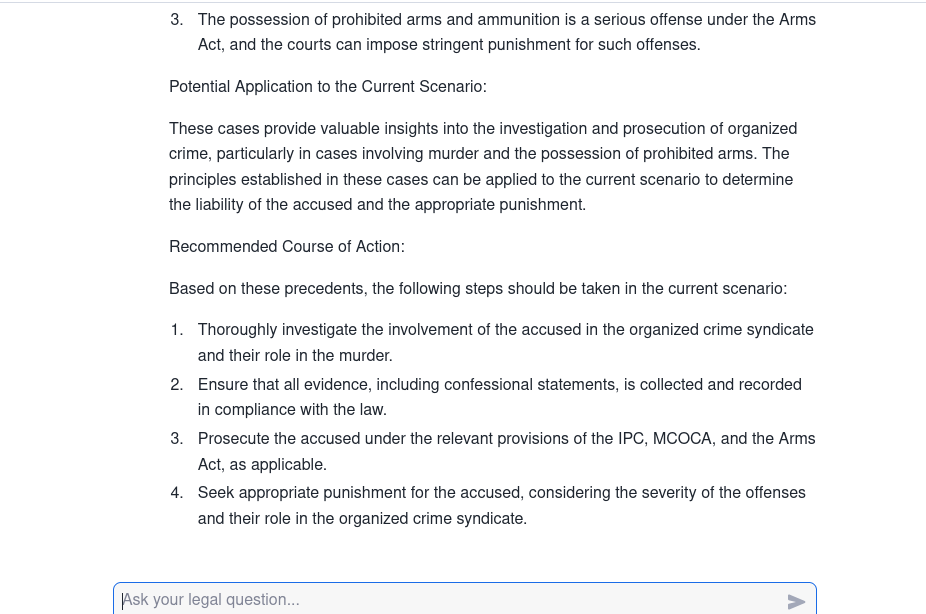
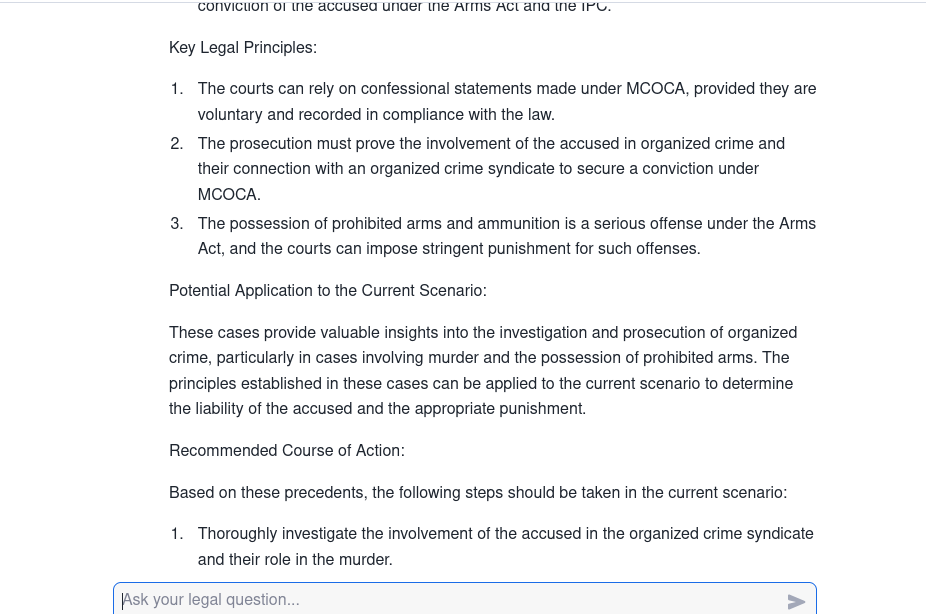
Improving the Answers: After retrieving the relevant information, we used Mistral to enhance the clarity and readability of the responses. Legal language is often formal and technical, and our goal was to simplify it without losing its meaning. Mistral allowed us to transform dense legal text into language that is easier to understand, making the system more accessible to anyone, regardless of their legal background.
Delivering the Answer: Finally, the simplified and clear answer was delivered back to the user. The response was concise, accurate, and easy to follow, ensuring that the user could understand the legal judgment or law being referenced without getting bogged down by complex terms.
Challenges We Faced
Data Extraction: One of our biggest challenges was the extraction of data from over 40,000 PDFs. Many of these PDFs were scanned images, meaning we had to rely on OCR to extract text. OCR isn’t perfect, and many times the text was distorted or incomplete, requiring additional effort to clean and fix errors. This process was both time-consuming and prone to errors, making it one of the most difficult aspects of the project.
Data Quality: The quality of the PDFs varied greatly. Some were corrupt or in poor condition, while others were not formatted in a way that could be easily parsed. This required extensive manual checking and fixing before the data could even be used for searching.
Legal Language: Legal documents are packed with intricate details and specific language. Understanding how different parts of a judgment connect and ensuring that the model could interpret these correctly was a major challenge. Indian law has a unique structure, and each state can have its own set of judgments, so we needed to account for these regional differences as well.
Making Complex Information Simple: Indian legal language can be extremely complex, and simplifying it without losing important details was a delicate balance. We had to make sure the answers were both accurate and understandable for the average person, without oversimplifying the law. This was especially important in India, where many legal concepts are not commonly understood by the general public.
Handling Regional Differences: India’s legal system is diverse, with different state laws and jurisdictions. We had to ensure that our model could handle this diversity and give accurate answers that applied across various regions of the country.
Conclusion
Building Lawgorithm was a challenging but rewarding journey. We set out to make legal information in India more accessible, and along the way, we learned the importance of understanding legal context, handling complex data, and making sure the system is both accurate and user-friendly. By combining tools like Snowflake, Cortex, and Mistral, we were able to create a platform that simplifies the process of finding legal answers. Despite the challenges with data extraction, OCR errors, and legal nuances, we’re proud of what we’ve achieved. We’re excited to see how Lawgorithm can help make Indian law more understandable and accessible to everyone.


Log in or sign up for Devpost to join the conversation.