-
-
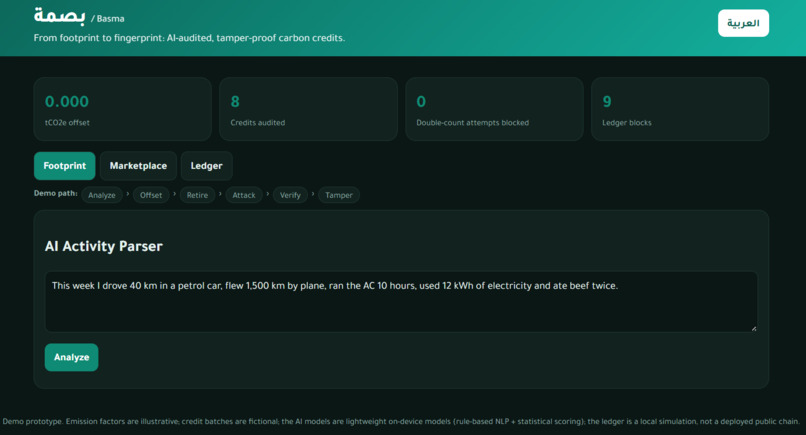
Main
-
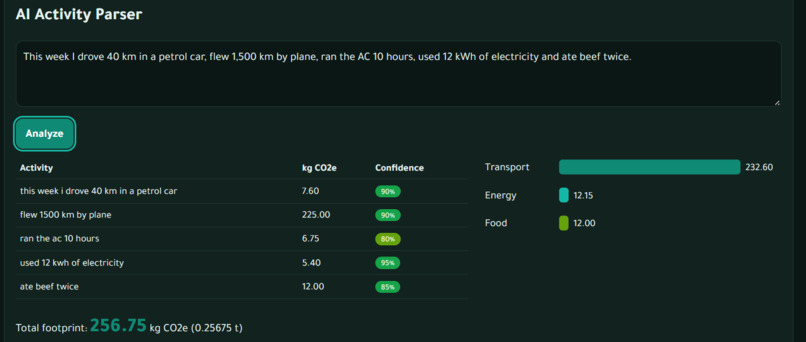
Analyze
-
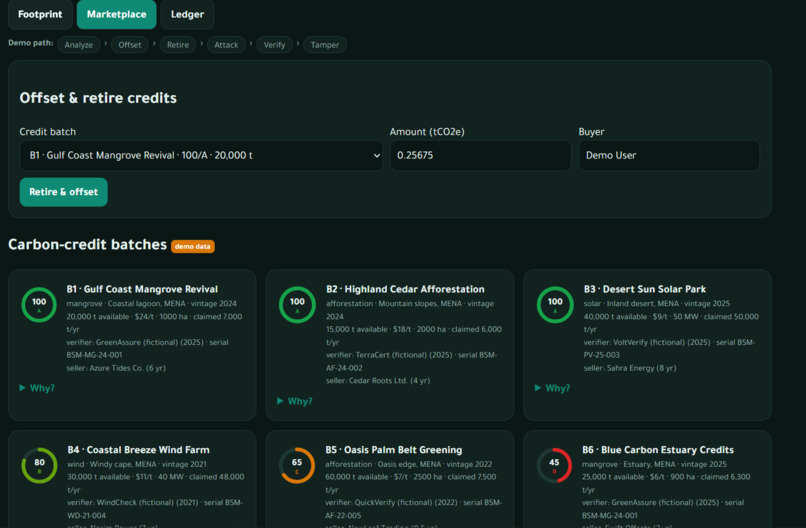
MarketPlace
-
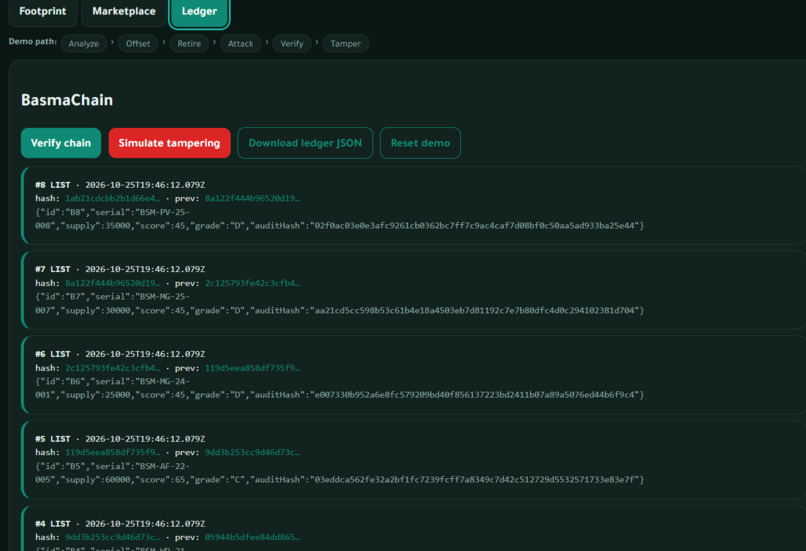
Ledger
Inspiration
Carbon markets only work if people trust them, and today that trust is fragile. Credits can be issued twice, claimed twice, or backed by sequestration numbers that are physically implausible, and verification is slow and opaque. We picked the Arabic name بصمة (Basma) because it means both footprint and fingerprint: we want to turn every carbon footprint into a verified fingerprint.
What it does
Basma is a bilingual (English/Arabic, full RTL) web app with four parts:
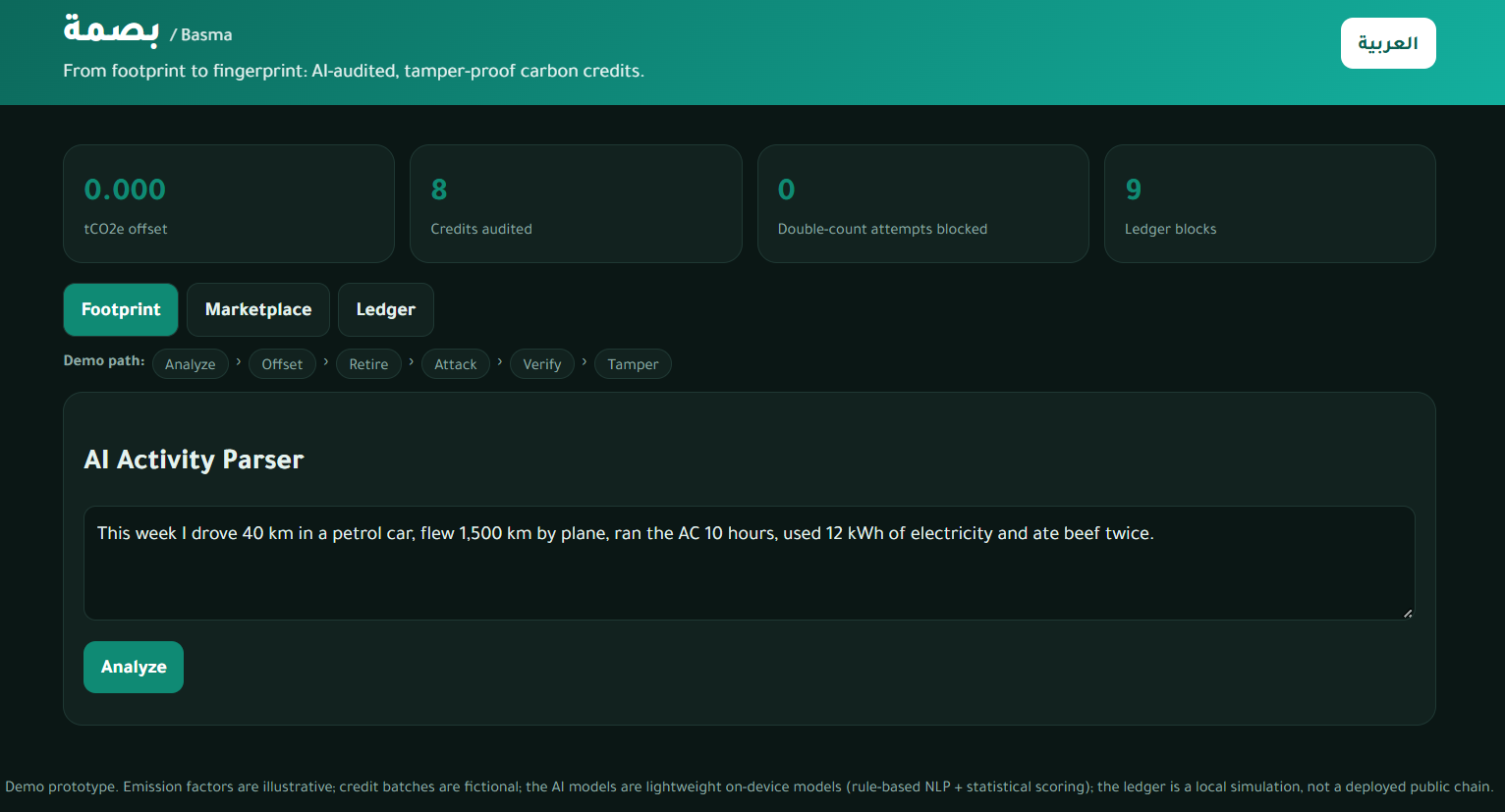
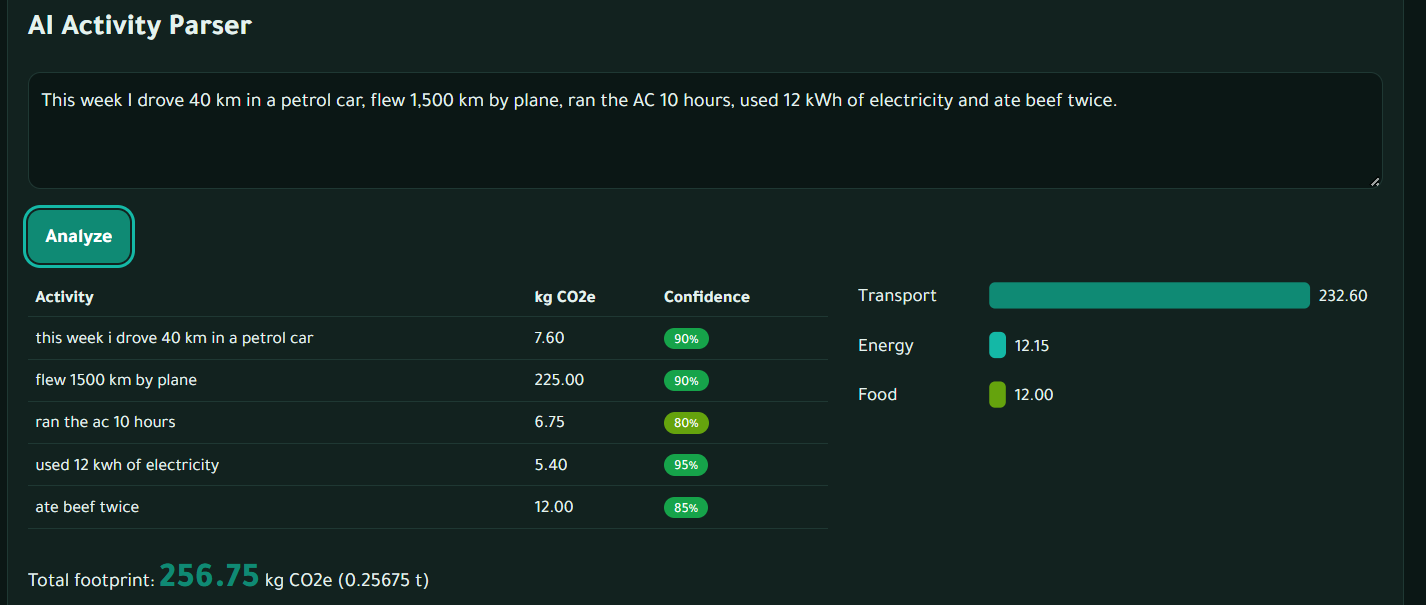
- AI Activity Parser. Type something like "I drove 40 km, flew 1,500 km and ate beef twice" and get a per-item and total footprint in kg CO₂e, with confidence badges and a list of phrases it needs clarified.
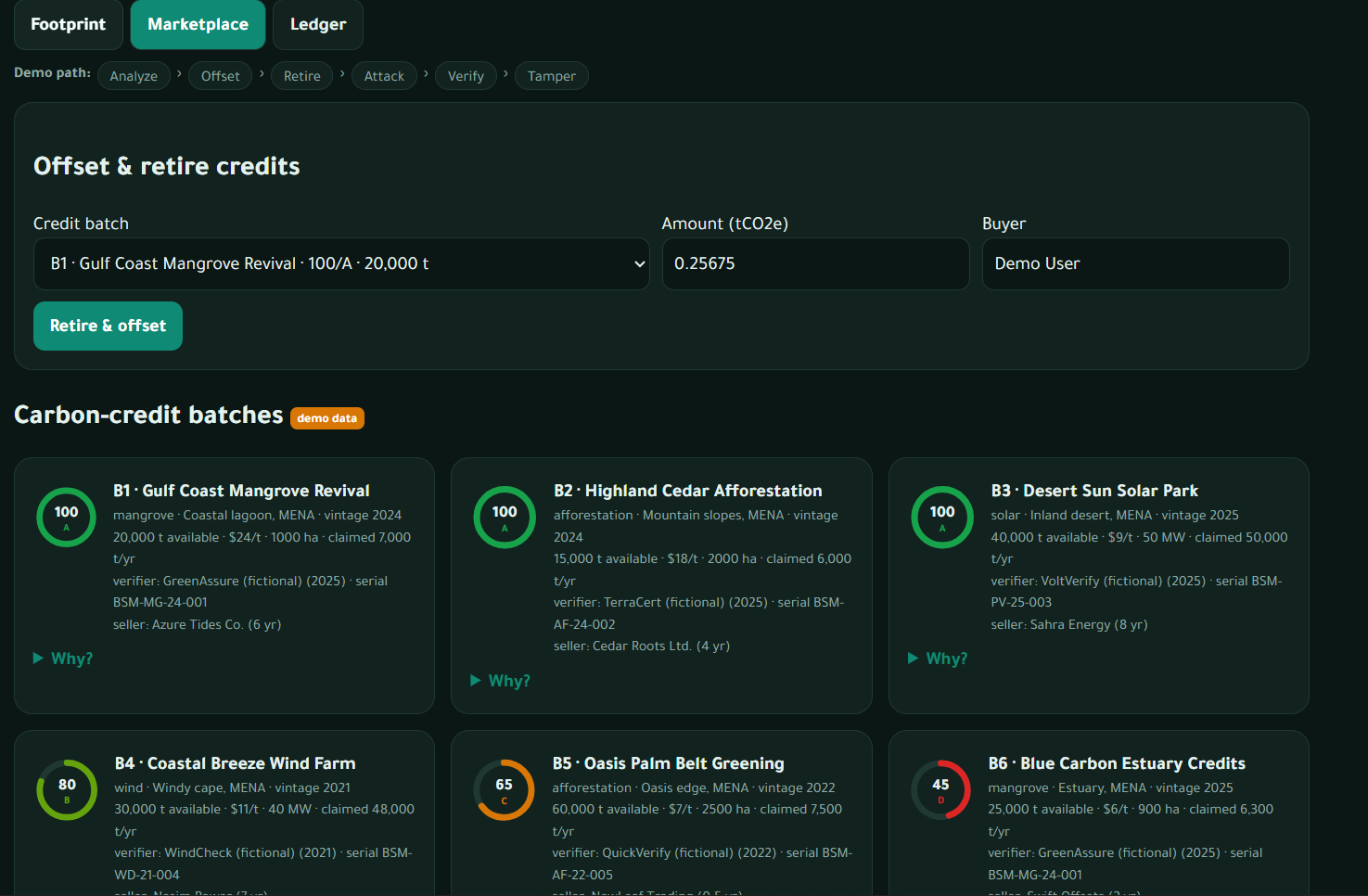
- AI Integrity Auditor. Every carbon-credit batch gets a 0-100 score and an A-D grade. It checks yield plausibility (z-score against project-type norms), duplicate serials, geographic overlap, verification age, missing third-party verifier, and new sellers with large volumes. A "Why?" panel shows each flag and its contribution, so the AI is explainable.
- Smart-contract-style offsetting.
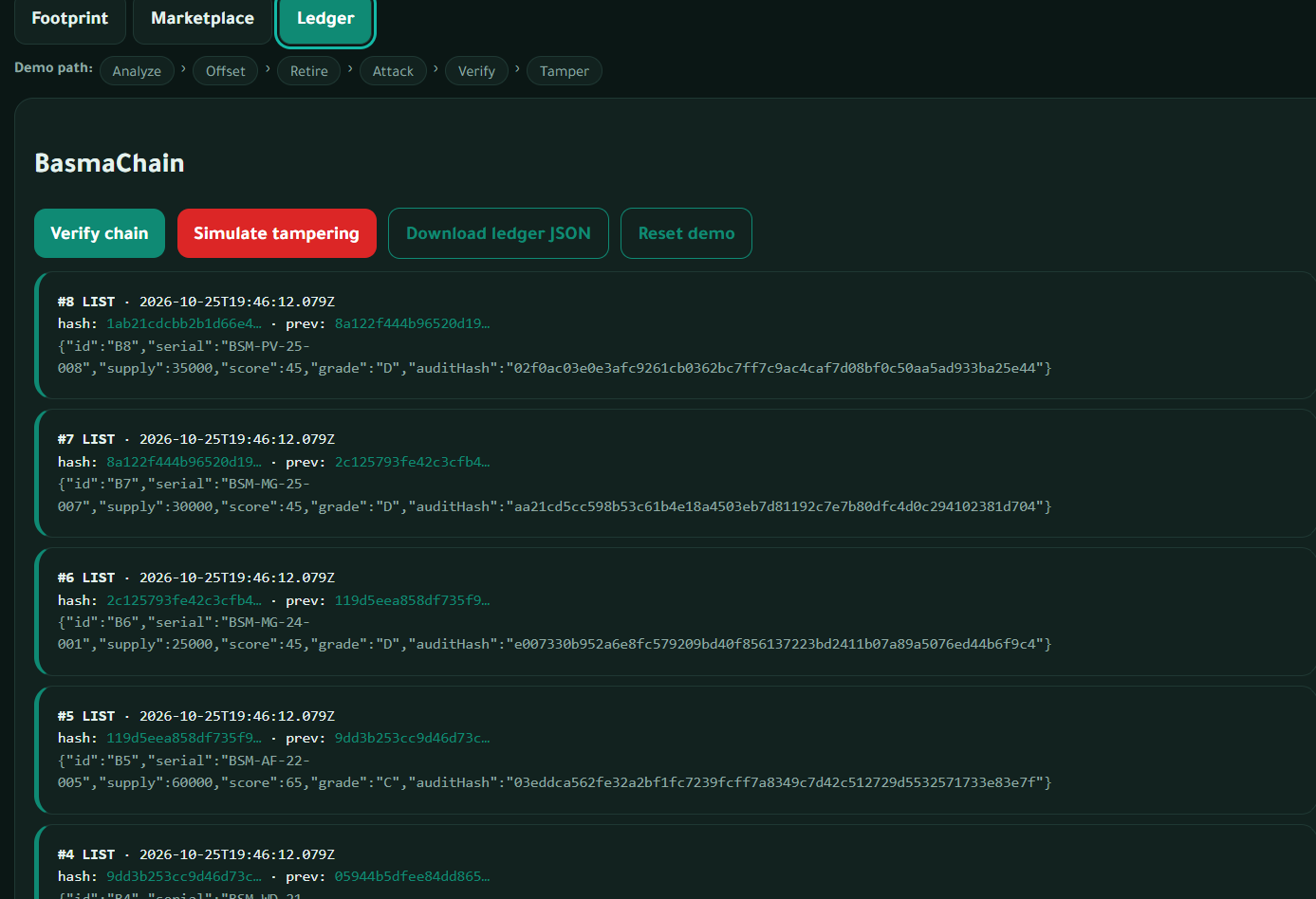
retire()uses Solidity-stylerequirerules and reverts on duplicate serials, integrity below 70, insufficient supply, and double claims. Success issues a retirement certificate. - BasmaChain ledger. A SHA-256 hash-linked ledger records every listing and retirement. The AI audit report hash is anchored in each listing, so even the AI verdict is tamper-evident. Users can verify the chain or simulate tampering and watch verification fail.
Target users: individuals and SMEs who want to offset credibly, carbon-market auditors and registries, and ESG teams that need defensible claims.
How we built it
Basma is a self-contained front-end app (HTML, CSS, vanilla JavaScript) with no backend or API keys, so it runs anywhere with zero install and no wallet. The footprint is computed as
$$\text{CO}_2\text{e} = \sum_i q_i \cdot f_i$$
where $q_i$ is the parsed quantity and $f_i$ the emission factor. The yield check uses
$$z = \frac{\text{yield} - \mu_{\text{type}}}{\sigma_{\text{type}}}$$
with penalties as $z$ grows, and a critical flag caps the score at 45. Hashing uses the browser's Web Crypto API (SHA-256). The prototype was built with Lovable and refined by hand.
Challenges we ran into
- Making the AI auditor explainable, not just a number.
- Keeping the whole app lightweight, bilingual and RTL-correct within a very short hackathon window.
- Designing the revert rules so each failure gives a clear, distinct reason.
- Staying honest about what is simulated.
Accomplishments that we're proud of
- A complete end-to-end flow in one app: analyze, audit, offset, certificate, attack, verify, tamper.
- The AI audit verdict is itself anchored in the ledger.
- Full Arabic/English support with RTL.
- It works offline with no wallet or API key.
What we learned
Trust in climate markets comes from combining three things: explainable AI to flag problems, deterministic rules to prevent them, and an immutable record to prove what happened. We also learned how much faster a clear scoring model plus a small ledger can make a trust problem tangible for non-technical users.
What's next for Basma
- Deploy the registry contract on an EVM L2 testnet (illustrative contract drafted).
- Connect to real registry APIs and satellite/IoT data to verify project claims.
- Add an LLM-assisted auditor for project documents.
- Use verified emission factors from published datasets.
- Add Arabic voice input and more MENA-region project types.
Honest limitations: the ledger is a local simulation, not a deployed public chain; emission factors are illustrative; all credit batches are fictional demo data; the AI is lightweight and runs on-device.
Built With
- blockchain
- css3
- explainable-ai
- github
- html5
- javascript
- lovable
- natural-language-processing
- sha-256
- smart-contracts
- solidity
- svg
- web-crypto-api

Log in or sign up for Devpost to join the conversation.