Inspiration
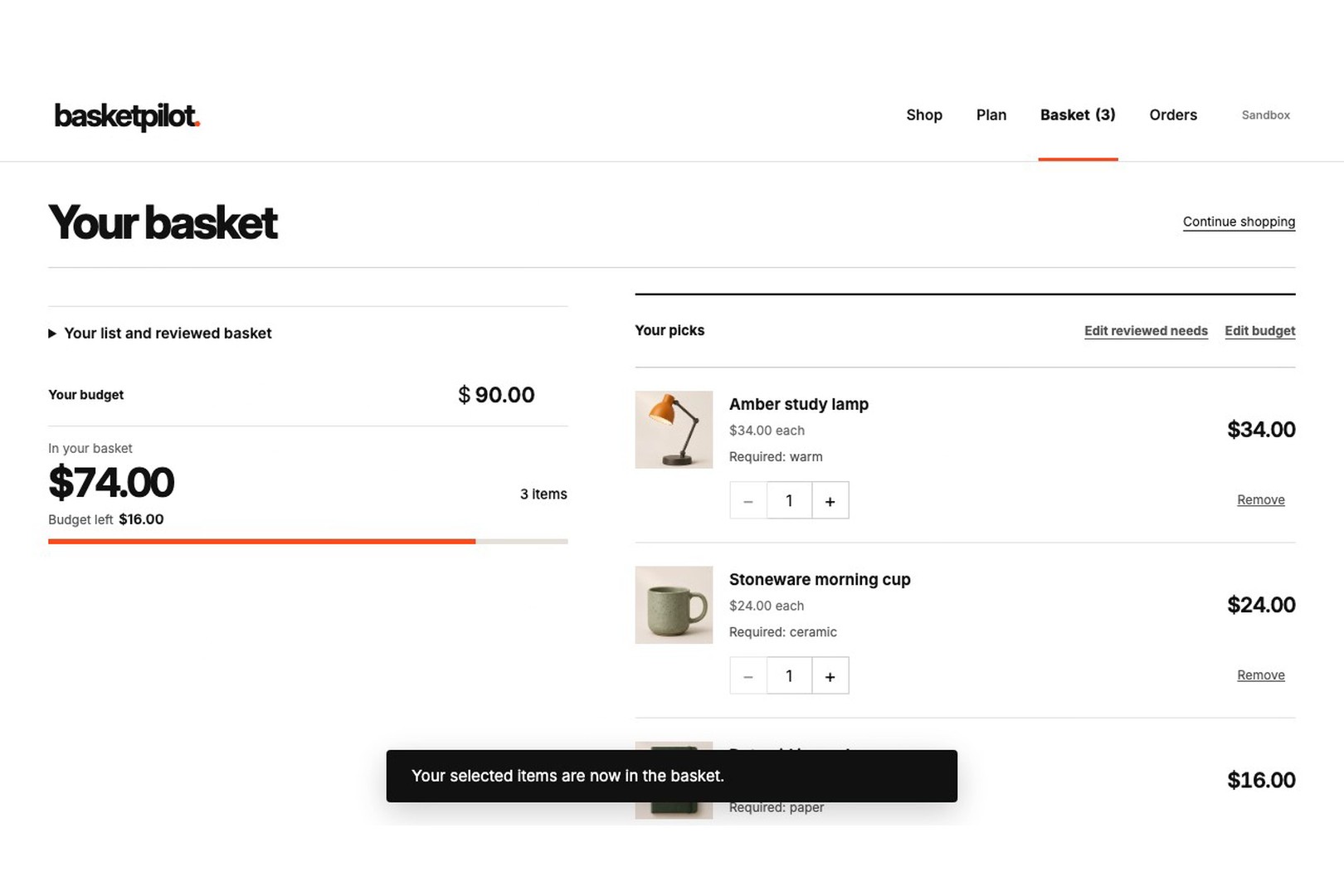
"Agentic shopping" usually means handing a model your wallet. We wanted the opposite: let the model do the tedious reading, and keep every decision that costs money with the buyer. A gift buyer with ninety dollars should be able to say what they need, see exactly how it was understood, and never be surprised at checkout.
What it does
- New: Start page: draft a basket from a photo of a handwritten list, a photo of the desk, or one sentence. Flick each card between cheaper, better and the usual, watch the budget bar, and correct it in words ("cheaper lamp", "under $60"). Past baskets have one-tap same again.
- You write what you need in your own words, with a hard budget.
- A local AI model turns the sentence into a structured shopping contract: item types, quantities, and required properties (a warm lamp, a paper journal, a ceramic cup).
- Anything the model cannot prove against the catalogue stays marked "unverified", quoted in your original wording, until you confirm or change it.
- A deterministic search, counted in integer cents, finds the cheapest basket that meets every requirement. If nothing fits the budget, it says so; it never raises the budget for you.
- Nothing enters your basket until you accept the suggestion.
- Checkout creates a real PayPal Sandbox order (Orders v2), sends you to PayPal's hosted approval page, and only captures when you press Pay. Approval and capture are separate, deliberate actions, and the receipt keeps the reviewed quantities and the PayPal order reference.
How we built it
A single Python server with no runtime dependencies, plain HTML/CSS/JavaScript in the browser, and SQLite for durable baskets, orders and receipts. The model is any OpenAI-compatible local endpoint (we ran qwen2.5:7b through Ollama) asked for a JSON-schema-constrained reply. Source-grounded checks compare every interpreted requirement with the buyer's sentence before it is used. Prices and affordability are never decided by the model: a bounded exact-cent enumeration does that. PayPal is Sandbox Orders v2: create, hosted approval, capture, then a status read to confirm.
Challenges we ran into
Small local models misread ordinary sentences. Early versions silently dropped a requirement or invented one. The fix was structural: the model proposes, a checker verifies against the original words, and unresolved text is shown to the buyer instead of being guessed. Payments had their own failure modes: a lost response after capture, a stale tab trying to pay for a replaced order, a reload in the middle of approval. Each order has a durable identity so an interrupted checkout resumes instead of duplicating.
Accomplishments that we're proud of
- A real end-to-end run: natural-language brief, local model interpretation, exact-cent basket, PayPal Sandbox order, buyer approval, explicit capture, receipt.
- The buyer can see and correct exactly how they were understood before a cent moves.
- An unaffordable request stays visibly unaffordable.
What we learned
The useful job for AI in commerce is reading, not deciding. Once the model's output is a contract a person can check, a small local model is enough, and the money path can stay fully deterministic and auditable.
What's next
Real merchant catalogues instead of a demo catalogue, saved repeat baskets, shared baskets for group gifts, and a hosted deployment with PayPal live credentials behind the same approve-then-capture flow.
Built With
- css
- html
- javascript
- json-schema
- ollama
- openai-compatible-api
- paypal-orders-v2
- paypal-sandbox
- python
- qwen2.5
- sqlite
