-
-
ARkit
Inspiration
We learn 3D math on flat paper. iPhone Duo has two physical planes, a hinge where they meet, and a live angle between them. We realized the phone could be the math, not just display it.
What it does
Basis turns iPhone Duo into a coordinate system you can hold. Each half becomes a direction, a and b, while the hinge becomes a third direction, h. Folding the phone physically reshapes the basis, with the angle coming directly from the hinge rather than an on-screen slider.
The experience is built as a guided five-act demo:
- Directions: A tracer walks along a, b, then h to reach a point P. Coordinates become literal travel instructions.
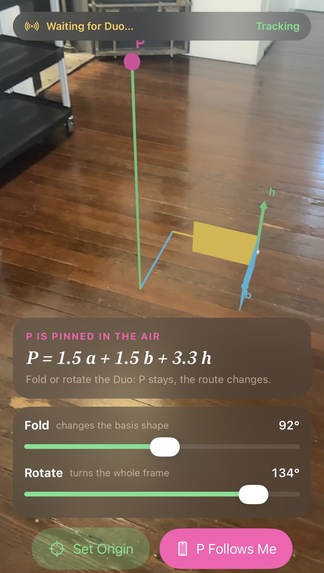
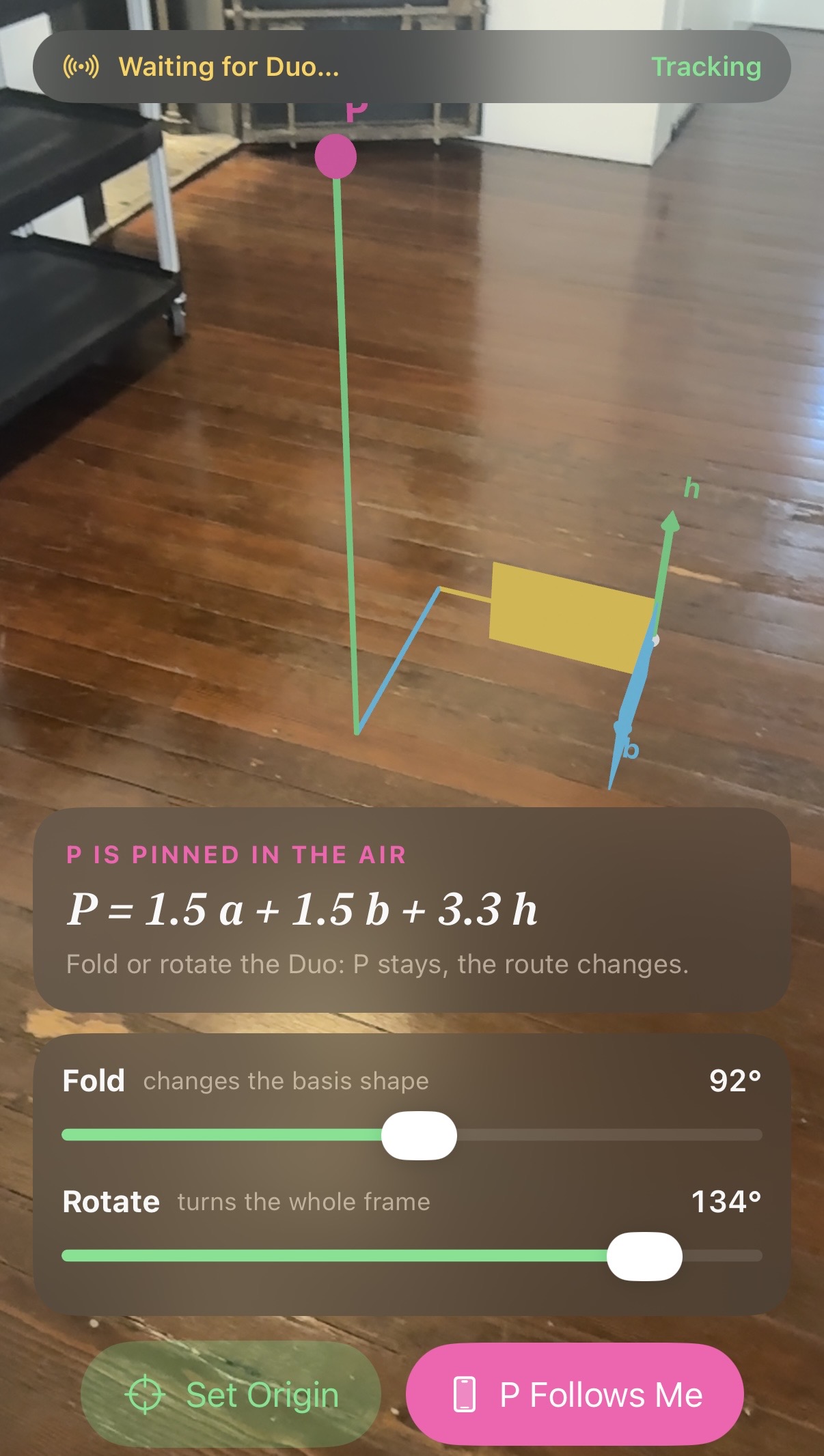
- Hold the point: P stays fixed while the coordinate frame rotates around it, showing that the point can stay the same even while its coordinates change.
- Break the basis: Fold a and b toward each other and the route required to reach P grows dramatically. As the basis approaches singularity, one dimension is eventually lost.
- Rulers: The dual basis becomes a set of measuring rulers that crowd together and become increasingly sensitive near singularity.
- Quantum: The screen normals become qubit measurement axes. Aligned axes give a 100/0 outcome distribution, while perpendicular axes give 50/50.
The inner and outer displays run simultaneously: the inside shows the mathematical construction, while the outside shows its consequence.
An AR probe turns a regular iPhone into the point P. A hologram of the Duo basis appears in the room, showing the basis, the route to P, and live geometric changes, with haptic ticks as the probe crosses ruler lines.
How we built it
- Built in SwiftUI on iOS 27 and tested using the iPhone Duo simulator.
- Read the live hinge geometry using
UIHingeInteractionandonHingeChange. - Split the interface precisely around the physical fold.
- Used a scene accessory to drive the outer display simultaneously with the inner display.
- Built the AR probe with ARKit and RealityKit.
- Created a pure-Swift math engine with unit tests for coordinates, determinants, SVD, condition numbers, dual bases, and qubit probabilities.
- Followed a 3Blue1Brown-inspired design principle: geometry first, equations last.
Challenges we ran into
- Making sure the fold was never just a replacement for a slider.
- Working with pre-release Duo APIs across multiple SDK versions.
- Getting coordinate systems, orientations, and sign conventions correct.
- Turning dense mathematical dashboards into guided, one-concept-at-a-time interactions.
Accomplishments that we're proud of
You can physically see the determinant approach zero as two independent directions merge into one.
A point can remain pinned in space while the coordinate frame moves around it, making change of basis tangible.
One screen can construct a vector while the other measures or transforms it.
Most importantly, the hardware itself becomes part of the explanation rather than simply displaying it.
What we learned
Physical interaction works best when it mirrors the structure of the concept itself.
While building Basis, we also realized that conditioning, determinants, SVD, linear independence, and duality are not isolated ideas. They are different views of the same underlying geometry.
What's next for Basis
Next, we want to add:
- AR anchoring directly to the physical Duo
- sensed full-device rotation on hardware
- multiple simultaneous probe phones
- a classroom mode for shared demonstrations
- additional lessons covering robotics coordinate frames, symmetry, eigenvectors, and Fourier duality
The long-term goal is to make abstract mathematics something students can physically hold, manipulate, and understand.
Built With
- ar
- bitrig
- swift

Log in or sign up for Devpost to join the conversation.