-
-
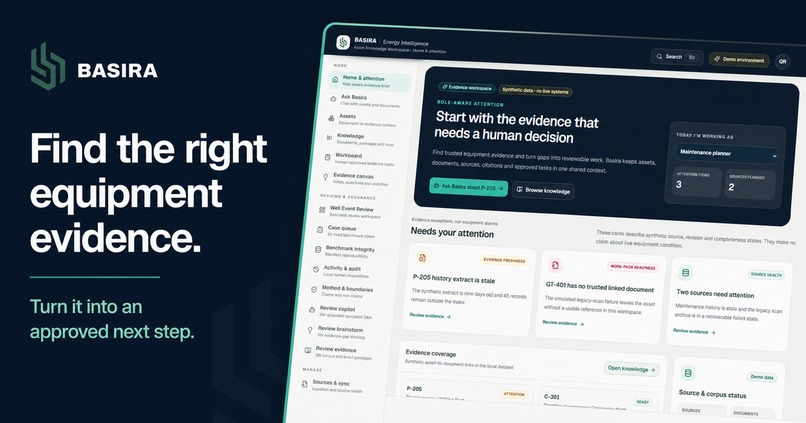
Synthetic P-205 evidence workflow: validated citations, exact passages and a human-approved local task.
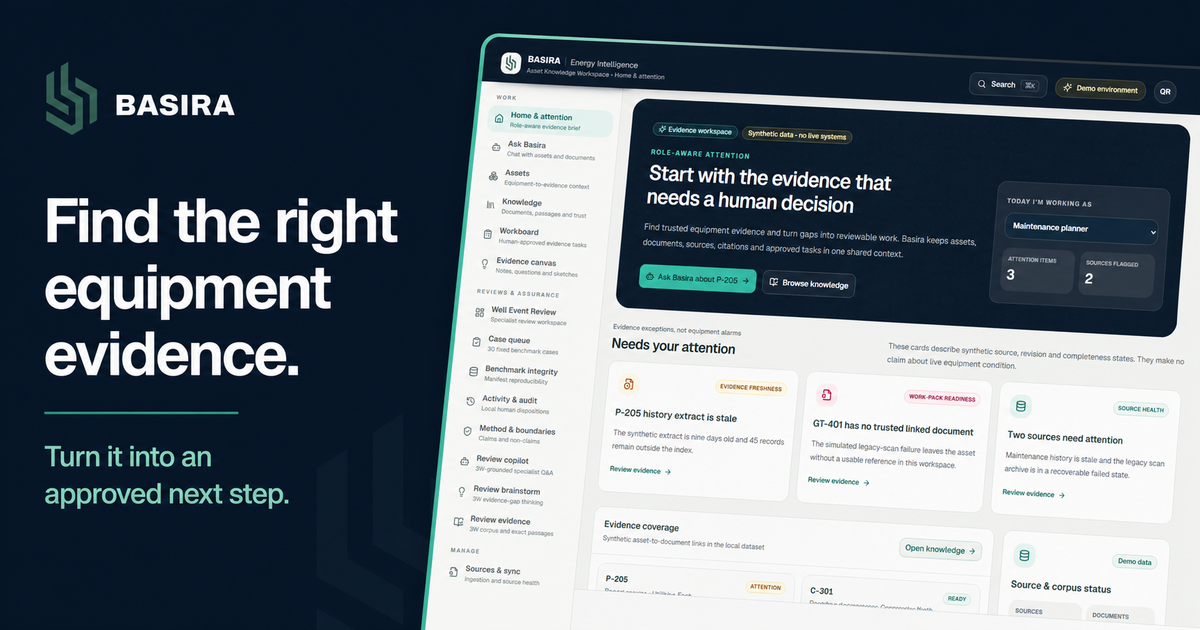
Inspiration
Industrial knowledge work is rarely blocked by a complete absence of information. The harder problem is that equipment context, controlled documents, revision status and review work are fragmented across different surfaces. Teams need a fast way to assemble the relevant evidence without losing source trust, inventing certainty or letting an assistant turn a draft into an operational action.
We built Basira around one observable workflow: open a synthetic asset, inspect its linked controlled knowledge, ask a bounded evidence question, open the exact cited passage, review a structured task draft and explicitly approve it onto a local workboard with provenance retained.
What it does
- Provides an operator-neutral, role-aware workspace for synthetic equipment, documents, sources and evidence.
- Shows document control and revision context before a source is used.
- Uses a genuine server-side GPT-5.6 Responses API path to assemble a typed grounded answer over an allowlisted synthetic/public corpus.
- Validates citation IDs, passage IDs and quoted text on the server; unknown or non-verbatim evidence fails closed to abstention.
- Produces structured smart cards and an optional review-task draft.
- Refuses safety, operating, diagnosis, prediction, live-state and autonomous-action requests before calling the model.
- Requires a separate explicit human approval before any task reaches the browser-local workboard.
- Preserves an honestly labelled deterministic fallback for local/test reliability without presenting it as GPT-5.6.
- Includes an evidence canvas and a specialist Well Event Review module based on a fixed public-data benchmark.
How we built it
The product is a Next.js/React application with a server-side OpenAI integration and a browser-local review workflow. The GPT path uses the OpenAI Responses API and strict Structured Outputs. The model receives only allowlisted synthetic/public evidence passages. The server treats schema adherence as necessary but insufficient: it independently checks every returned document and passage identifier and confirms the cited quote is verbatim corpus text. Any validation failure becomes an explicit abstention.
A deterministic guard handles disallowed intent before the provider boundary. The model can assemble evidence and draft review work, but it cannot diagnose, recommend an operating action, create an external work order or bypass approval. Safe provider/model/mode metadata is exposed so the judge can distinguish a real GPT-5.6 response from the disclosed fallback without seeing an API key or sensitive header.
Codex was our implementation and verification collaborator. It helped inventory the historical repository, translate Roshan's product direction into bounded slices, build the evidence-to-approved-work journey, maintain responsive browser regressions, structure the GPT-5.6 validation boundary, and prepare the submission evidence. Roshan made the key product and safety decisions: Work & Productivity track, operator-neutral scope, synthetic/public data only, exact citations, fail-closed abstention, no safety or operating advice, no autonomous execution and mandatory human approval.
Meaningful Build Week extension
This is a pre-existing project with a clear, dated boundary.
- Excluded historical baseline:
d94afa04d5169a1b7ac8e215b23cdd148ac5ad53, dated 30 March 2026. - First Build Week publish commit:
10e7bff55a28a57f12c10e61e14707b37181c94d, dated 17 July 2026. - Verified Build Week range:
d94afa..10e7bff— 49 files changed, 9,745 additions and 218 deletions. - Additional D-030 Build Week implementation commit:
32c195e689668c96995442906f35cf49b7551fb5, dated 18 July 2026 at 11:50 Asia/Muscat;10e7bff..32c195econtains 21 changed files, 2,946 additions and 30 deletions.
The July extension added the operator-neutral Asset Knowledge Workspace, synthetic asset/document/evidence corpus, exact-citation journeys, local approval/workboard, evidence canvas, specialist review module, responsive tests, landing page and live demo surface. D-030 adds the real GPT-5.6 answer path, strict structured output and citation validation, deterministic refusal, abstention, visible provider proof and focused API/E2E coverage.
The uncommitted accelerator reference is not part of the clean product repository or the eligibility claim.
Challenges
The central engineering challenge was not generating fluent text. It was defining a contract under which a model response is safe to display as grounded evidence. Structured Outputs constrains shape, but it does not prove that a citation exists or that a quoted passage is exact. We therefore added an independent server-side allowlist and verbatim citation validator and made failure an abstention, not a best-effort answer.
The second challenge was preserving human agency. A task draft can look actionable before it is trustworthy. We kept drafting and task creation as separate events: model output remains a draft until a person explicitly approves it, and even approved demo work remains browser-local with no EAM or OT writeback.
The third challenge was proving new work on a pre-existing project. We fixed the March-to-July commit boundary, recorded exact diff statistics and separated the historical baseline, July product extension and D-030 GPT-5.6 tranche.
Accomplishments
- A coherent asset-to-evidence-to-exact-citation-to-approved-task product journey, rather than a standalone chatbot.
- A strict typed model contract plus independent citation validation and fail-closed abstention.
- A public judge-demo guard that limits real-provider calls to three documented synthetic P-205 prompts, with hashed warm-process rate, concurrency and failure-circuit controls; other prompts use the disclosed deterministic/policy path.
- Visible separation of live GPT-5.6, refusal, abstention and deterministic fallback modes.
- A human approval gate that keeps task drafting separate from task creation.
- Post-hardening verification passed 42/42 focused unit/API checks, 14/14 Build Week E2E checks, and preserved the platform and specialist browser expectations at 29/29 and 44/44 on 18 July 2026.
- A live, no-auth synthetic-data product surface at https://assets.basira.tech.
What we learned
Grounding is an application property, not a model label. A schema can guarantee fields while still carrying an invalid source, so corpus allowlisting and exact passage checks must happen outside the model. Refusal and abstention also solve different problems: a safety or operating request should be stopped before the provider call, while an ordinary question with insufficient evidence should be answered with a transparent abstention after validation.
We also learned that human approval must be a technical state transition, not a sentence in a prompt. The workboard changes only after a separate user action, and no external system is available to receive a write.
What's next
This is a synthetic/public-data demonstration, not a production system or operator deployment. Any next phase would require a qualified workflow owner, authorised data, security and privacy review, accountable engineering review, acceptance criteria and a new explicit decision. Live connectors, EAM/OT writeback, safety decisions and autonomous execution remain outside scope.
Judging criteria mapping
The official rules apply a pass/fail theme/API viability gate, then evaluate the following four criteria with equal weight.
Technological implementation
Codex-supported implementation, server-side GPT-5.6 Responses API, strict Structured Outputs, independent citation validation, deterministic pre-model refusal, post-validation abstention, visible provider metadata, focused API/E2E tests and preserved browser regressions.
Design
A complete role-aware product journey joins Asset 360, source/revision trust, evidence chat, exact passage inspection, task review, local workboard and evidence canvas across desktop, tablet and mobile.
Potential impact
The product addresses a specific knowledge-work problem for maintenance, reliability, integrity and document-control teams: assembling trustworthy asset evidence and preparing review work while preserving source provenance and human accountability. It does not claim validated ROI, a customer deployment or production readiness.
Quality of the idea
Basira treats evidence trust, citation validation, abstention and approval as first-class product states. The differentiator is not generic industrial chat; it is the inspectable transition from governed evidence to a human-controlled review action.
Technology
Next.js, React, TypeScript, OpenAI Responses API, GPT-5.6, Structured Outputs, Zod, Playwright/browser acceptance checks, Vercel, synthetic fixtures and a fixed public 3W evidence benchmark.
Safety and data statement
The demonstration uses synthetic or public authorised evidence only and has no live EAM, EDMS, historian, sensor or OT connection. It does not provide root cause, diagnosis, severity, remaining life, operating instructions, safety decisions, permits, work-order approval, autonomous execution, operator endorsement, ROI or production-readiness claims. Model-produced work requires explicit human approval and remains local to the browser.
Built With
- codex
- gpt-5.6
- next.js
- openai
- playwright
- react
- responsesapi
- structuredoutputs
- syntheticdata
- typescript
- vercel
- zod

Log in or sign up for Devpost to join the conversation.