-
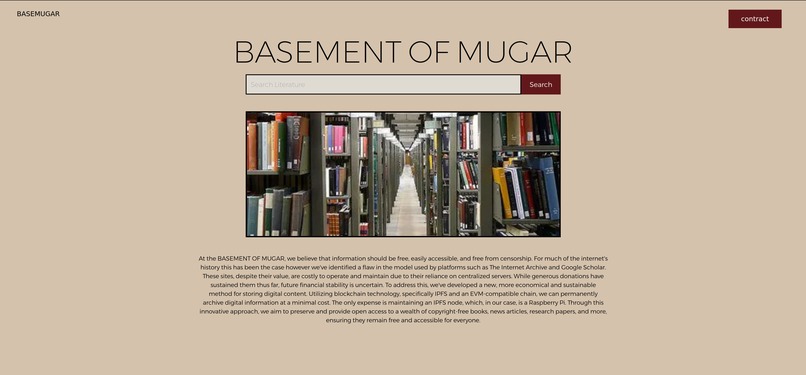
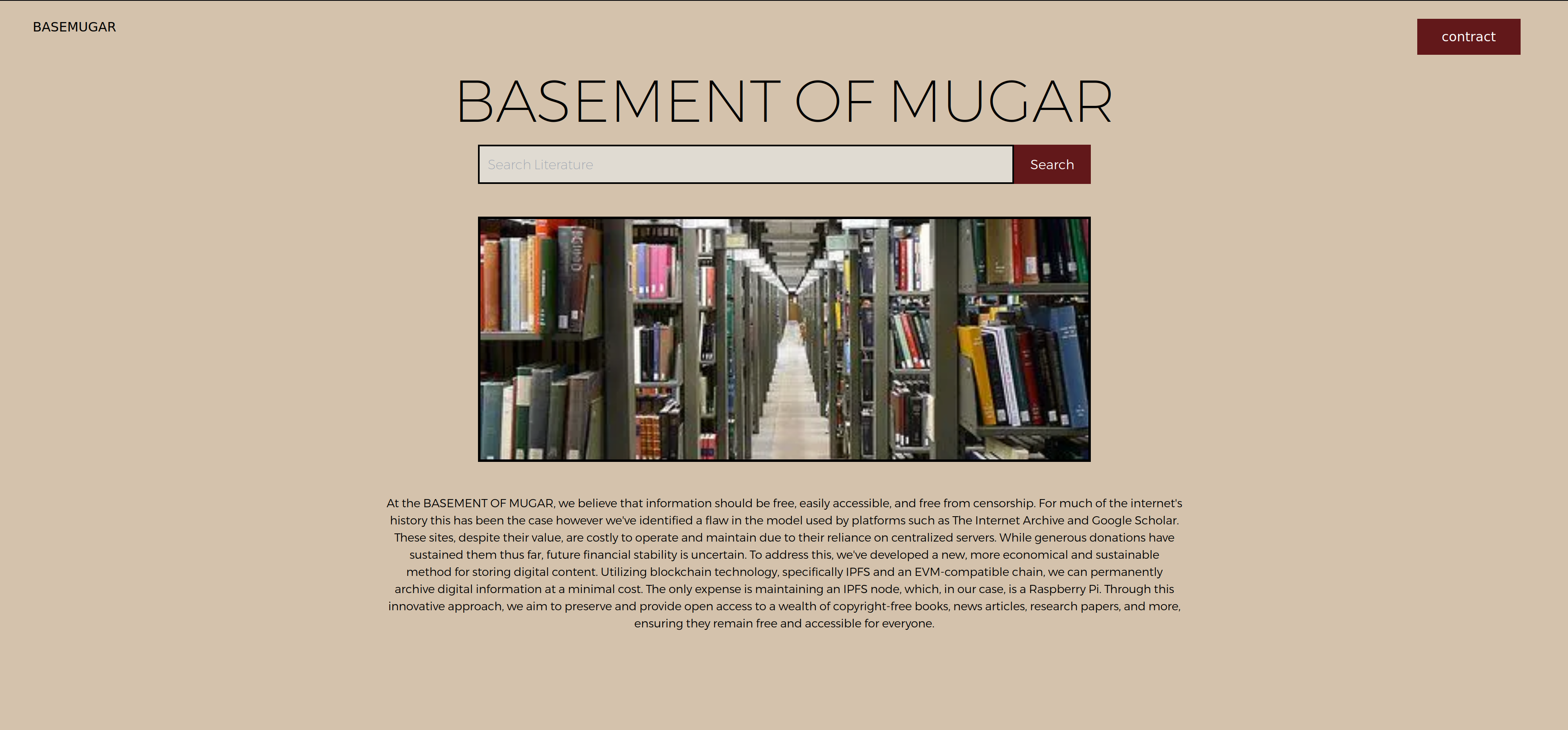
the basements home page
-
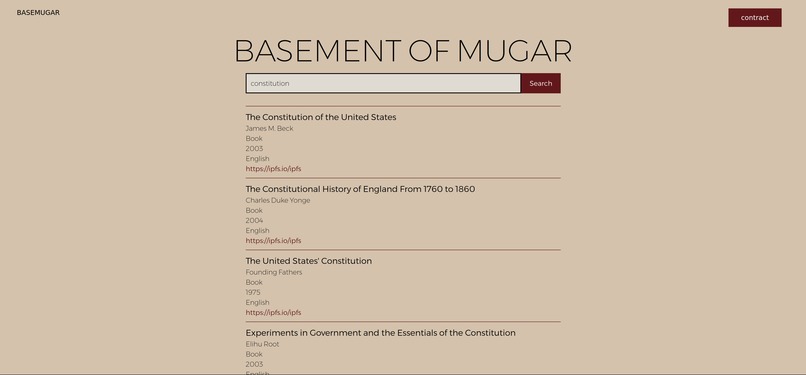
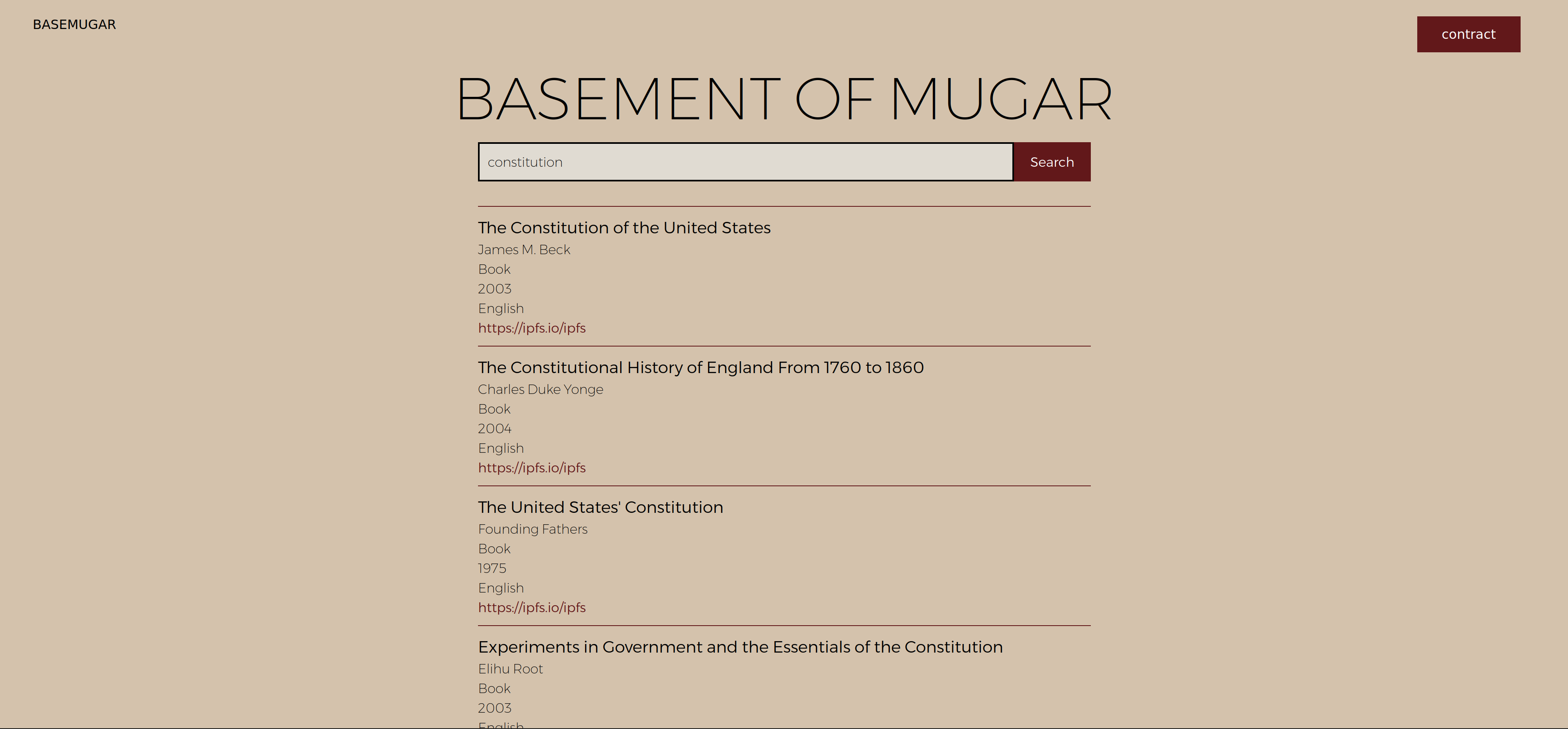
the basements archive
The Project
The Basement of Mugar, tackles a fundamental challenge in the digital age: ensuring perpetual, non-destructible, cost-effective access to copyright-free literature, scholarly articles, and news.
Traditional platforms like Project Gutenberg, Google Scholar, Open Library, and arXiv are invaluable resources but rely heavily on continuous funding and substantial server infrastructure to operate. This not only incurs significant costs but also places the longevity of access at the mercy of financial and operational sustainability.
By leveraging the InterPlanetary File System (IPFS) for storage, the blockchain for decentralization, and an intermediary vector database for indexing, Basemugar revolutionizes content accessibility. Once content (such as books, poems, etc) is uploaded to IPFS, the content can be proposed by the Basemugar DAO (think a system like wikipedia), and the proposal can be agreed on by the majority. It is then eternally indexed on the blockchain built, incurring minimal ongoing costs. The content is then dumped to a vector database that can serve as a search tool to find any content you many need.
How we built it
- Next.js + Typescript + SASS for the frontend client.
- Express.js + Node for the database uploader.
- mongodb atlas search for the searching of content
- Solidity & Ethereum for the smart contracts.
Inspiration
We we're inspired by, https://www.uncensoredlibrary.com/en, which is a library of uncensored news articles that are banned in certain countries. By putting it in a Minecraft map they are able to bypass censorship and are able to easily spread information worldwide. Knowing Web3 technology we both recognized that using Web3 technology could have the same effect of being able to bypass censorship and barriers.
Challenges we ran into
It was difficult to use Web3 technology and still make it easy to use and accessible for everyone. For example when you search through our database using the smart contract you have to match the title or author exactly or it wont return the listing because we are storing them in a mapping. Because of this we had to implement a MongoDB database for our front end that will sync with our contract whenever the database is updated. So theoretically if our website is ever taken down you can still search the contract and find the entry you are looking for but it makes it significantly easier to find if you can access our website.
Accomplishments that we're proud of
We are proud we were able to download and process through 500+ files given the time constraints of the hackathon.
What we learned
We learned a lot more about how IPFS and distributed systems work.
What's next for The Basement of Mugar
We hope to keep expanding the library and turn it into the largest decentralized open source library that can be a wealth of knowledge for the future secured by the security of blockchain
Built With
- blockchain
- ipfs
- mongodb
- next
- nextjs
- raspberry-pi
- solidity
- typescript
- vector-search


Log in or sign up for Devpost to join the conversation.