-
-
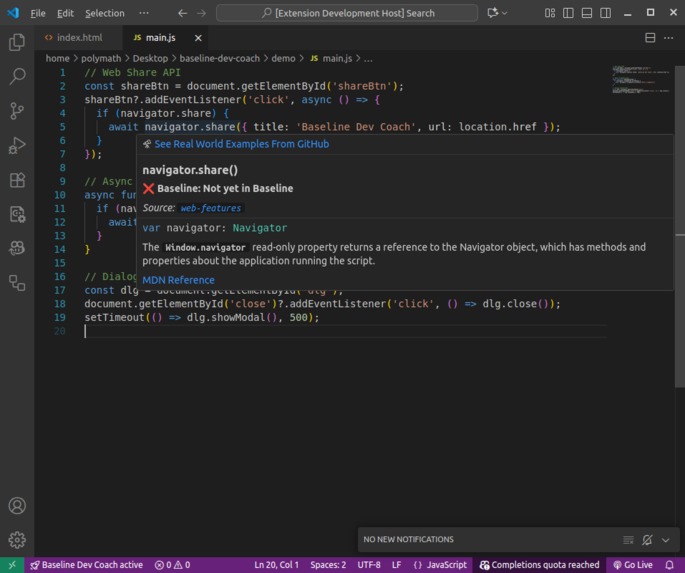
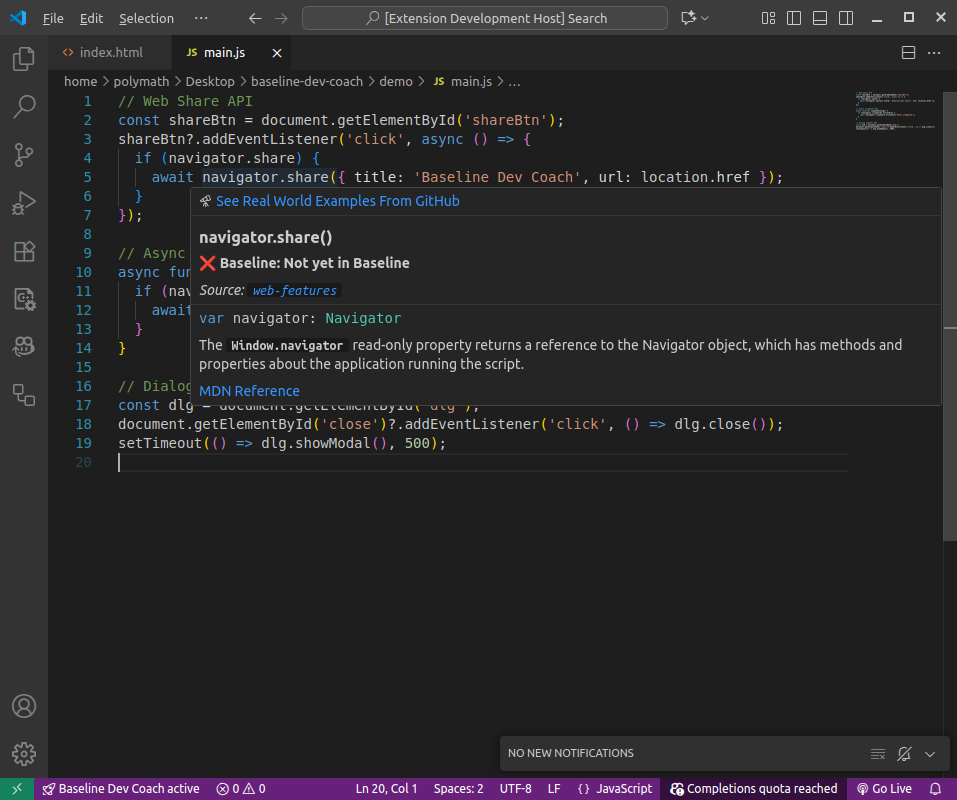
screenshot showing Baseline Dev Coach providing info on a feature used in demo file alongside MDN reference
🔹 Inspiration
Web developers often want to use modern features like :has(), <dialog>, or the Clipboard API but the real question is: “Can I use this today without breaking users?”
Right now, most people leave their editor, Google MDN or CanIUse, and try to interpret compatibility tables. That slows development and introduces risk.
I wanted to make this instant and trustworthy, by putting Baseline compatibility data directly into the tools developers already use.
🔹 What it does
Baseline Dev Coach is a developer companion that:
- CLI — scans your codebase for modern features and flags risky ones.
- VS Code extension — shows Baseline support status on hover, right inside your editor.
- GitHub Action — runs automatically on pull requests and comments findings for reviewers.
It uses the official web-features dataset, maintained by the W3C WebDX group, so results are authoritative and reliable.
🔹 How I built it
- Dataset integration: I pulled structured compatibility data from
web-features(Baseline dataset). - CLI: Built with TypeScript + Node.js, parsing CSS/HTML/JS files using regex scanners.
- VS Code extension: Registered hover providers that match modern web features and display Baseline status via Markdown tooltips.
- GitHub Action: Wrapped the CLI into a CI step, piping results into sticky pull request comments for reviewers.
🔹 What I learned
- How the Baseline dataset is structured and how it differs from traditional “Can I Use” data.
- How to build and debug a VS Code extension with hover providers.
- How to run Node.js workspaces inside GitHub Actions.
- How to demo a project in a way that’s clear, concise, and useful for judges.
🔹 Challenges I ran into
- Integrating the dataset:
web-featuresis still evolving, so mapping IDs to real-world code patterns required iteration. - VS Code hover conflicts: At first, MDN reference hovers overshadowed mine , i had to carefully register providers so our tooltips actually appeared.
- CI feedback: Getting GitHub Actions to not just run but also comment directly on PRs required digging into community actions like
sticky-pull-request-comment. - Balance: I had to build a project that was functional and useful but still small enough to finish in hackathon time.
🔹 What’s next
- Add AST-based scanning for deeper code analysis.
- Expand feature coverage (e.g. Web APIs beyond the demo).
- Ship as a published VS Code extension on the marketplace.
- Provide config options so teams can enforce stricter Baseline policies in CI.
Built With
- baselinedatasets
- git
- github
- githubactions
- markdown
- node.js
- npmworkspace
- typescript
- vscodeapi
- yaml


Log in or sign up for Devpost to join the conversation.