Inspiration
Trading agents today are either advisors that can't act, or bots you hand a strategy and hope for the best. Neither fits how people actually trade: something happens (a breakout, a dip, earnings), you want to act on that event for a few hours, and you want to stay in charge of the money.
So we made the event the unit. A Play is a short mission with a trigger, a window, an order and hard limits. It lives in the iPhone's Dynamic Island from start to finish, so you see it think and you approve with a long-press. The agent pays a few cents over x402 for the evidence it needs at the moment it decides, instead of a monthly data subscription.
What it does
Baseland turns a market event into a Play: a short mission with a trigger, a window, an order, exits and a Leash of hard limits. You arm one by saying it ("buy $3 of ETH now, take profit at 3%"), by swiping a card the agent dealt from live prices, or from Claude Code. Then it lives in your Dynamic Island:
- Watch. Plain code watches Coinbase's live prices. There's no AI in the loop while it waits.
- Decide. When the trigger fires, Claude decides once. It can buy evidence (news, on-chain flows) over x402 within the Play's budget, and it returns act / skip / wait with its reasons.
- Approve. The Island asks "Buy $3 of ETH?" Long-press to approve or skip, from the Island or the lock screen.
- Trade. The engine checks the Leash, previews the order, then places it, with take-profit and stop-loss attached so Coinbase holds the exits.
- The Tape. Everything the agent saw, bought, decided and did is on a timeline, with a receipt on each paid step.
Ghost mode runs the same thing on real prices with pretend money, labelled GHOST everywhere. The Rig (advanced mode) lets you swap the Brain (Sonnet / Opus / Haiku / rules), the Senses (which x402 sources it may buy), Instincts, Hands (assets) and the Leash, live. Replay runs any Play against real past prices. Bring your own agent: the Baseland MCP lets Claude Code draft, replay and arm Plays that land on your Island.
What ran with real money (Oct 25, 2026). We switched live trading on for one test, capped at $3:
- A LIVE Play bought 0.0012749 ETH at $2,329.58 ($2.97 + $0.027 fee), approved from the Dynamic Island. Coinbase order
a16a3d1a…was filled, with a take-profit / stop-loss bracket attached ($2,399.22 / $2,259.46). - The Tape's preview, order and fill match Coinbase's own
orders get. The portfolio went from $4.00 USDC to 1.00 USDC + 0.0012749 ETH. - x402 evidence was attempted live but didn't pay. Coinbase rejected both attempts before any payment (details under Builder feedback). In Ghost, evidence purchases are simulated at the real catalog prices. Live trading is switched off again on the hosted engine.
How we built it
Baseland is three pieces: a native iPhone app, a hosted engine that runs the agent, and an MCP server so other agents can author Plays.
| Piece | Built with | What it does |
|---|---|---|
| iPhone app | Swift, SwiftUI (iOS 26), ActivityKit, App Intents | The Deck, Plays, the Rig, Replay; the Live Activity in the Dynamic Island and on the lock screen; Approve / Skip / Pause as Live Activity intents; a Control Center kill switch |
| Engine | TypeScript, Node 22, Fastify, zod; hosted on Render, deployed by GitHub Actions after tests pass | The Play state machine, price watchers, the Brain, the Leash, Ghost and Coinbase trading gateways, Replay |
| Brain | Claude Sonnet 5.5 decides (Opus / Haiku selectable); Claude Haiku 5.5 drafts Plays from words and deals the Deck | Runs once per Play, when the trigger fires; returns a structured decision |
| Coinbase | coinbase CLI (Advanced Trade) with a CDP key scoped to one dedicated portfolio; public ticker WebSocket and candles; x402 catalog paid in USDC on Base |
Orders (preview → create, exits attached), live prices, paid evidence |
| State | Supabase Postgres + Realtime + anonymous Auth | Plays and the Tape; Realtime drives the Live Activity (no APNs on a free Apple account) |
| Baseland MCP | MCP TypeScript SDK, stdio, plus a Claude Code skill | Draft, replay, arm and stop Ghost Plays from any agent |
Controls, enforced in code rather than asked of the model:
- The model never holds an order tool. Claude's tools are free market context and budgeted evidence purchases; it returns act / skip / wait. The engine checks the Leash, previews, and places the order itself.
- The Leash: per-order and per-Play caps, an evidence budget, allowed assets, and an engine-wide ceiling on any live order (set to $3 for our live test). Every live order goes Leash → preview → create with a persisted
client_order_id. - x402 spend: each payment's
max_amountis the lower of the catalog price and the Play's remaining budget, with an idempotency key re-derivable after a restart. - You approve. Plays ask before trading by default; approval is a long-press in the Dynamic Island or on the lock screen.
- Ghost is unmistakable. Simulated Plays, fills, receipts and Live Activities are labelled GHOST everywhere; live ones say LIVE.
- Kill switch in the app, Control Center and Siri. Harness tokens (for Claude Code) can create only Ghost Plays and can never approve.
- One user, one key, one portfolio. The key is verified to reach exactly one non-default portfolio, encrypted at rest, and never leaves the engine.
Architecture and known limitations
One Play, start to fill: plain code watches the market, Claude is asked once when the trigger fires and returns a decision, the person holding the phone approves, and the engine checks the Leash and places the order.
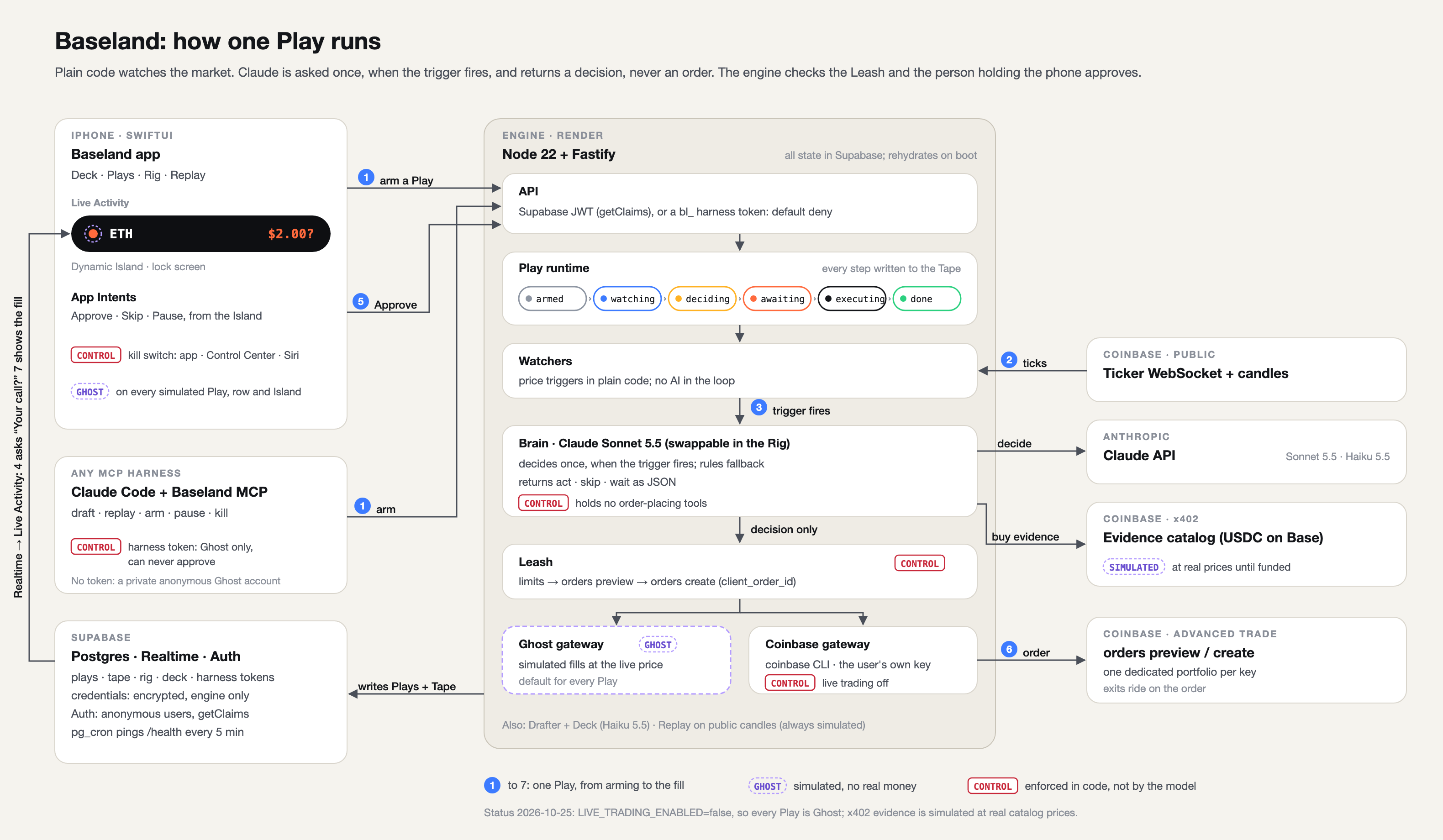
Full size: architecture diagram on GitHub
Known limitations
- No push notifications. There's no paid Apple account, so no APNs: the Live Activity is fed by Supabase Realtime while the app is alive, kept alive by a hackathon-only background mode.
- Stocks on weekends. Coinbase returns no equity prices or previews while markets are closed, so stock Plays run in Ghost and Replay.
- x402 budgets are ours, not Coinbase's. Coinbase caps a single payment at 5 USDC; per-Play budgets are enforced by the engine. Payments are irreversible.
- No fill webhooks. The engine polls order status.
- Free hosting sleeps. Render's free tier is kept awake by a 5-minute Supabase cron ping; a cold start pauses watchers for about a minute.
- One portfolio per key. Futures only work in the default portfolio, so they're out of scope.
- Judges can't install the app without TestFlight. The reuse path is the Baseland MCP + skill (no phone needed) and building the app from source.
Builder feedback for Coinbase
Biggest blocker: a third-party app can't sign users in to Coinbase. The hosted Coinbase MCP (agents.coinbase.com/mcp) uses OAuth, but only allowlisted harnesses (ChatGPT, Claude, Grok, …) can use it. An iPhone app can't.
How we worked around it. Each user creates a CDP API key scoped to one dedicated portfolio and pastes the key file into the app. The engine verifies the key reaches exactly one non-default portfolio, encrypts it at rest, and drives the coinbase CLI with it, one child process per call. It works, but pasting an API key is a non-starter for real consumers.
The one capability we want most: scoped OAuth for third-party apps, with scopes for a single portfolio, trade-only, and a server-enforced x402 spending budget. That would remove key pasting and our own budget bookkeeping in one go.
Other friction, logged as it happened:
| What | What happened | Ask |
|---|---|---|
| x402 with a portfolio-scoped key | x402 fetch returned 400 "portfolio_id is required because multiple accessible portfolios are available", although the key is denied the Default portfolio (403). With portfolio_id it returned 412 "the payment attempt was rejected and no payment was created", with no reason. |
Default x402 to the key's portfolio; say why a payment was rejected |
| No x402 budget | Only a 5 USDC per-payment cap exists; a session budget "is not server-enforced" | A per-key x402 budget |
| Sandbox | The Advanced Trade sandbox accepts any key, returns canned balances, has no market data and no x402 | A sandbox that checks keys and has a test x402 catalog |
| Fills | No webhook or push for fills; agents must poll | Fill webhooks |
| Weekends | Equity products return no price at all outside market hours | Last close + market status |
balance |
Rejects the key's own portfolio (400) while portfolios get accepts it |
Default to the key's scope; explain the failure |
What worked well: attached take-profit / stop-loss on a market buy (Coinbase holds the exits even if our engine sleeps), orders preview, and the x402 catalog's discovery with input schemas, which made a great menu of Senses for the agent.
Challenges we ran into
- No paid Apple account, so no push notifications. Live Activities are driven over Supabase Realtime, and the Island buttons are Live Activity intents that run inside the app with its session.
- The agent and real money. We kept the model away from order tools entirely and put every live order behind Leash → preview → create with a persisted idempotency key, an engine-wide $3 ceiling for the test, and an off-by-default live switch.
- Getting the agent to use its evidence. In a rehearsal, Sonnet acted without buying the data the Play asked for. The fix: the person's own words and the Play's sources now go to the Brain, and buying one listed source is a rule, not a suggestion.
- x402 from a scoped key never completed a payment (see Builder feedback). Every failed attempt is now written on the Tape instead of disappearing.
Accomplishments we're proud of
- A real ETH trade approved with a long-press in the Dynamic Island, with the exits held by Coinbase and a Tape that matches Coinbase's own order record.
- One sentence to an armed Play in seconds, and an agent that explains every decision in one line on the Island.
- Bring your own agent: Claude Code creates Plays that land on your phone, through tokens that can never approve or go live.
- Ghost mode that can't be mistaken for real money, on every screen.
What we learned
- The right unit for an agent is an event, not a strategy: it's bounded in time, money and attention, which makes it safe to hand over.
- Paying per decision over x402 is far cheaper than subscriptions for an agent that only needs data at the moment it decides.
- Labelling simulated actions everywhere costs little and builds a lot of trust.
What's next
- Scoped OAuth instead of API keys, as soon as Coinbase offers it.
- Push-started Live Activities (APNs) so Plays start without the app open.
- Stock Plays during market hours, with paid stock data over x402.
- A shared library of Play cartridges, with Replay results attached.
Built With
- activitykit
- anthropic
- app-intents
- base
- claude
- coinbase-advanced-trade
- coinbase-cli
- fastify
- github-actions
- model-context-protocol
- node.js
- postgresql
- render
- supabase
- swift
- swiftui
- typescript
- usdc
- x402
- zod


Log in or sign up for Devpost to join the conversation.