Inspiration
A shelf drawing tells a student woodworker how long the parts should be. At the timber rack, the question changes: can the last brace fit beside an upright once the blade takes its share? We wanted that answer before anyone bought the stock.
What it does
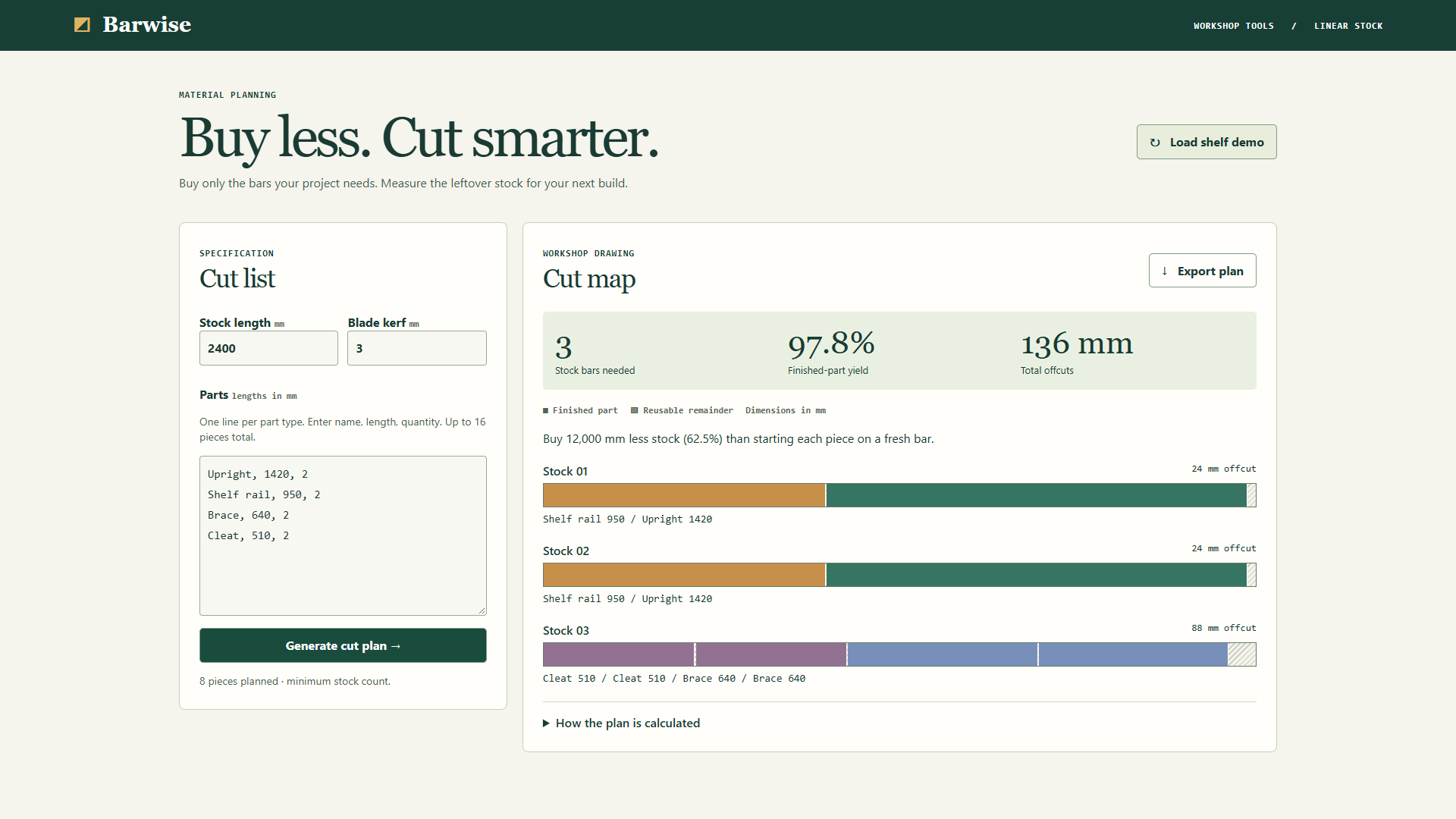
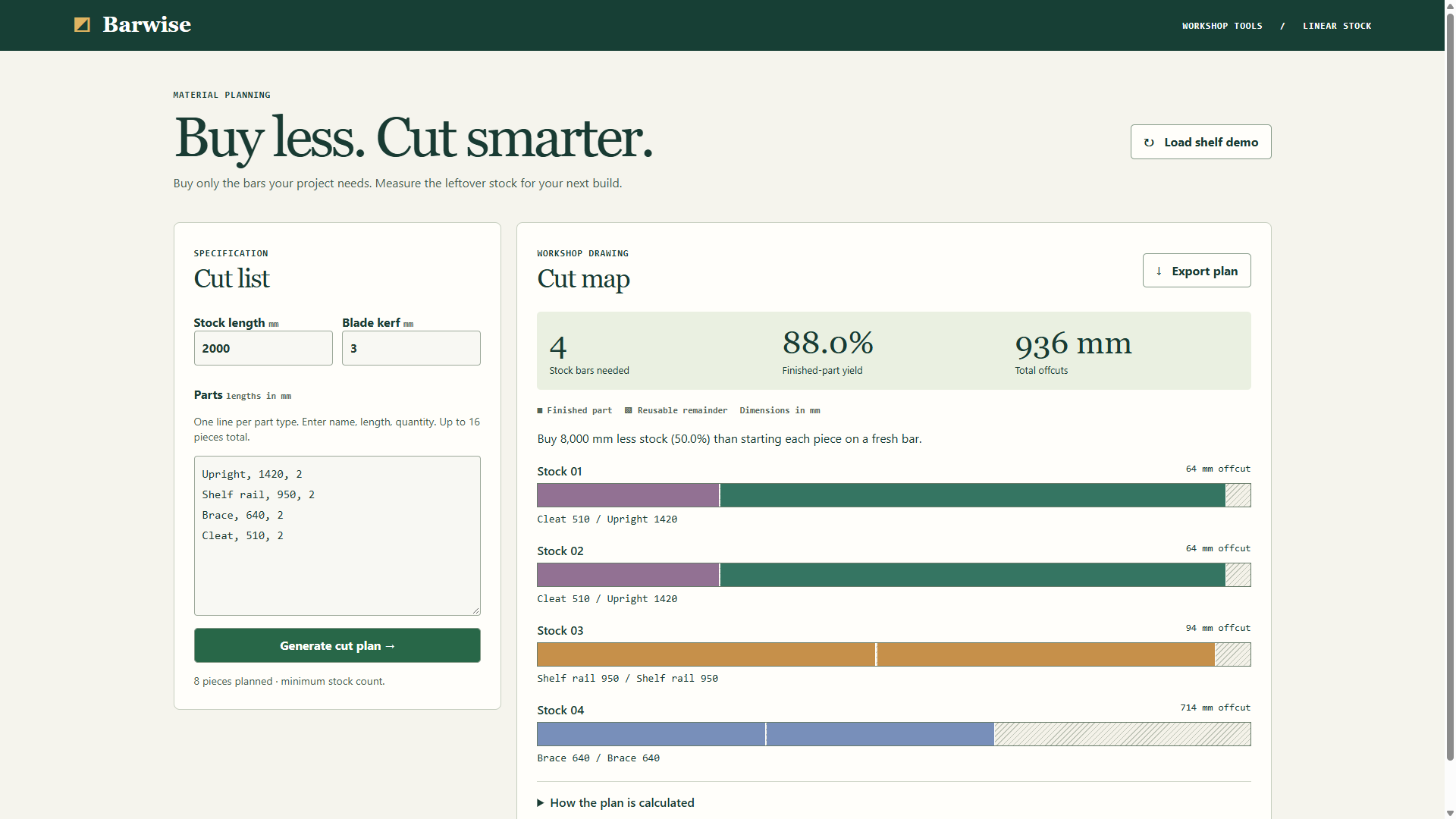
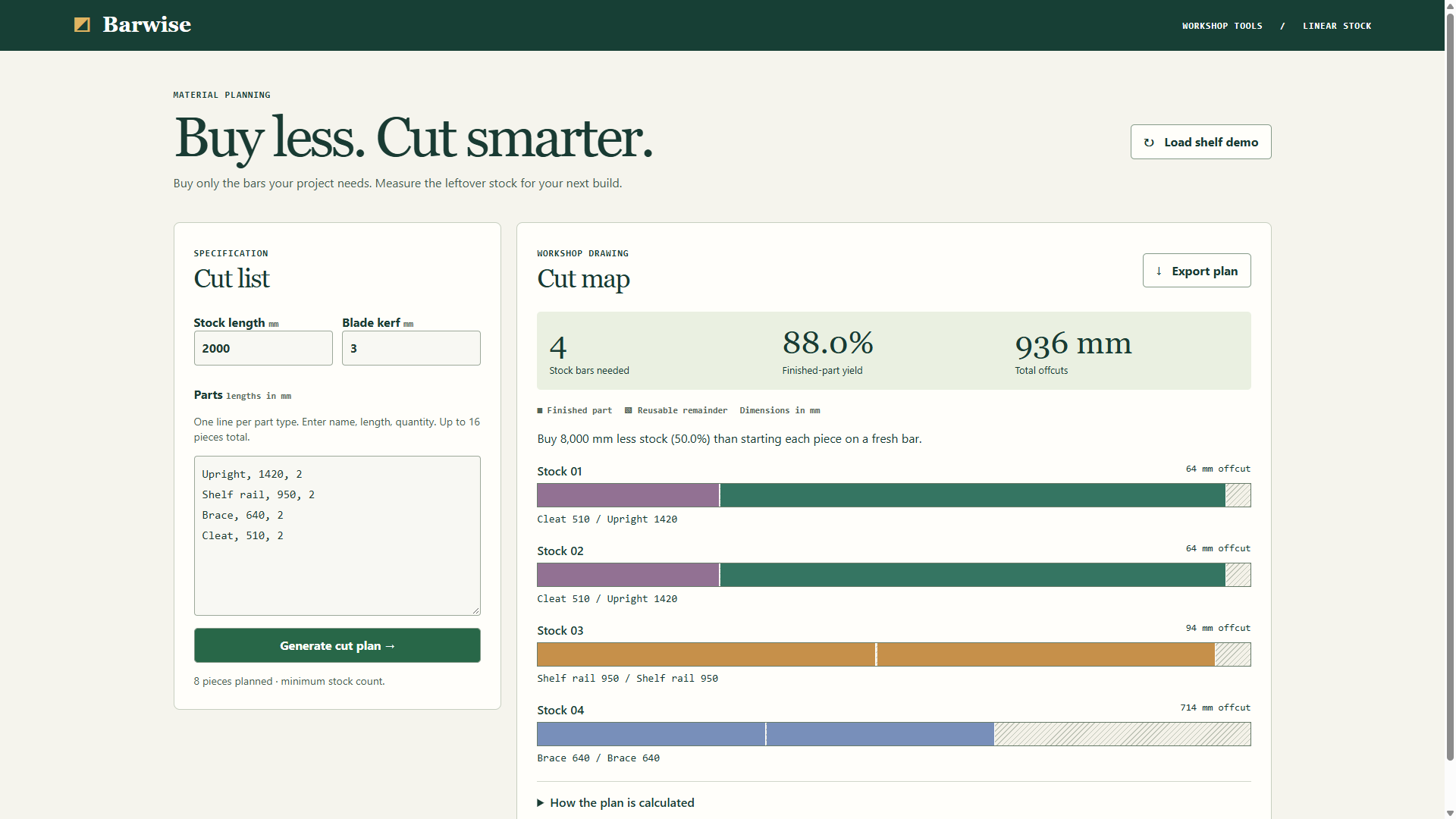
Open Barwise and eight shelf pieces are already laid out on three 2,400 mm bars. Switch to 2,000 mm stock and recalculate: you now need four. Buying the longer bars uses 7,200 mm instead of 8,000 mm for the same shelf, saving 800 mm (10%) and leaving 800 mm less material outside the finished parts. The live savings figure compares the plan with starting each piece on a fresh bar. Edit part names, lengths and quantities, account for blade width, then export the workshop list. Finished-part yield, blade loss and reusable offcuts are distinct in the calculation.
How we built it
We wrote a static HTML, CSS and JavaScript app during GenHacks. A subset dynamic program finds the minimum bar count for up to sixteen pieces of one profile. It records the last piece and whether it opened a new bar, so we can reconstruct the actual layout. Node.js builds the site and runs tests. Playwright drove Chrome for browser checks and video capture. FFmpeg encoded the MP4 using the existing SLAY HACKS recording utility.
Challenges
Charging every part for a full blade width would reject a part that matches the stock exactly. We count the gaps between pieces when testing whether they fit, then account for the final cut when reporting the offcut.
Accomplishments
The shelf example yields a purchase count and a dimensioned plan immediately. The same solver handles exact fits and zero-width cuts. An independent exhaustive search checks its answer across small generated jobs.
What we learned
Minimum bar count alone is a poor workshop instruction. Recording the choices inside the solver lets the person making the cuts trace each requested part to a position on a specific bar.
What's next
Support a rack of mixed-length remnants so a workshop can plan around material it already owns.
AI disclosure
OpenAI Codex, an AI coding agent, wrote the application code and copy under human direction. All planning runs locally with a deterministic solver. The demo uses synthetic shelf dimensions.
Links
- Try it: https://barwise.pages.dev/
- Source: https://github.com/ryan930704/barwise
- Demo video: VIDEO
Required extras
- Selected track: Healthcare & Environmental
- Team members: add the sole entrant's Devpost profile at submission.
- Demo: upload video/demo.mp4 to YouTube or Vimeo, enable embedding and enter its URL.
- Code: supply a publicly accessible link to the Barwise source.
- Gallery: use the PNGs in shots/. Public instructions do not specify a mandatory software file upload.
- Optional Best Use of Deployxa prize: do not opt in.
- Additional private form questions or mandatory upload controls: 送件時依畫面
Built With
- chromium
- css
- ffmpeg
- html
- javascript
- node.js
- openai-codex
- playwright
