-
-
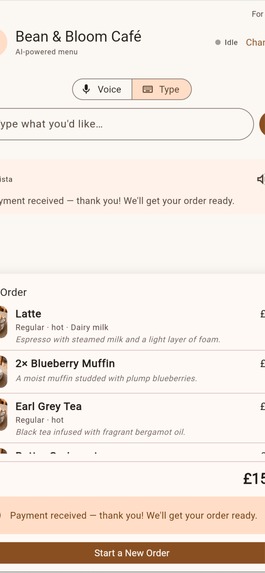
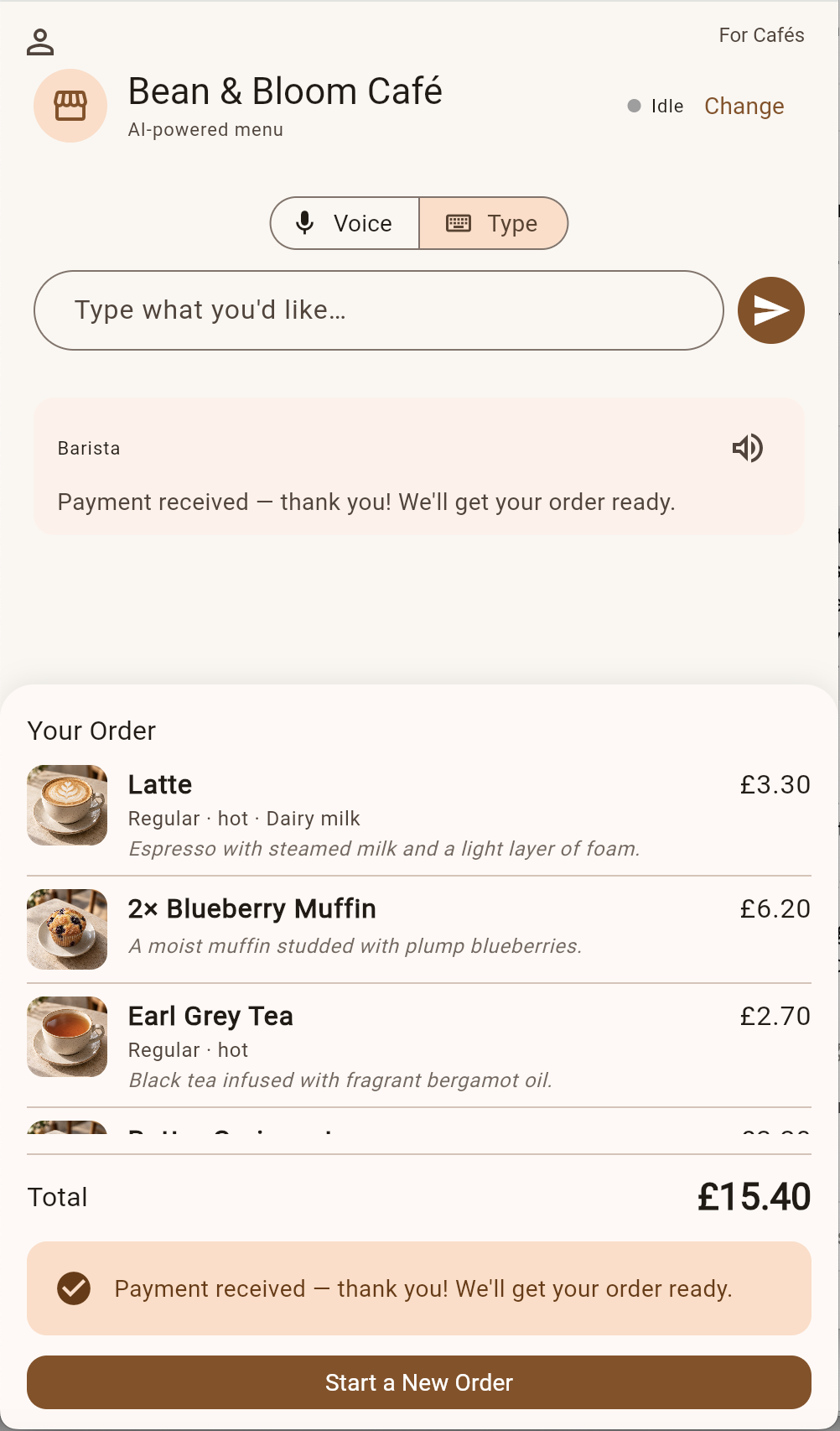
Required Resolution Screenshot, Ordering (Voice and Type)
-
App Icon (1024x1024)
-
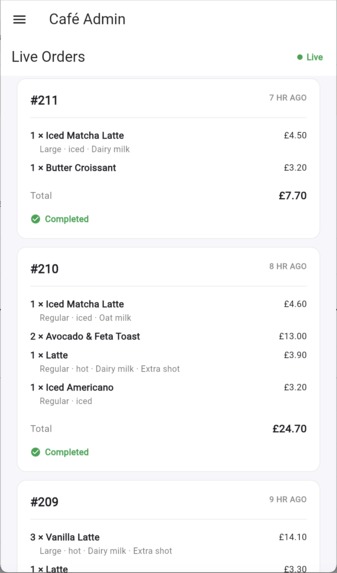
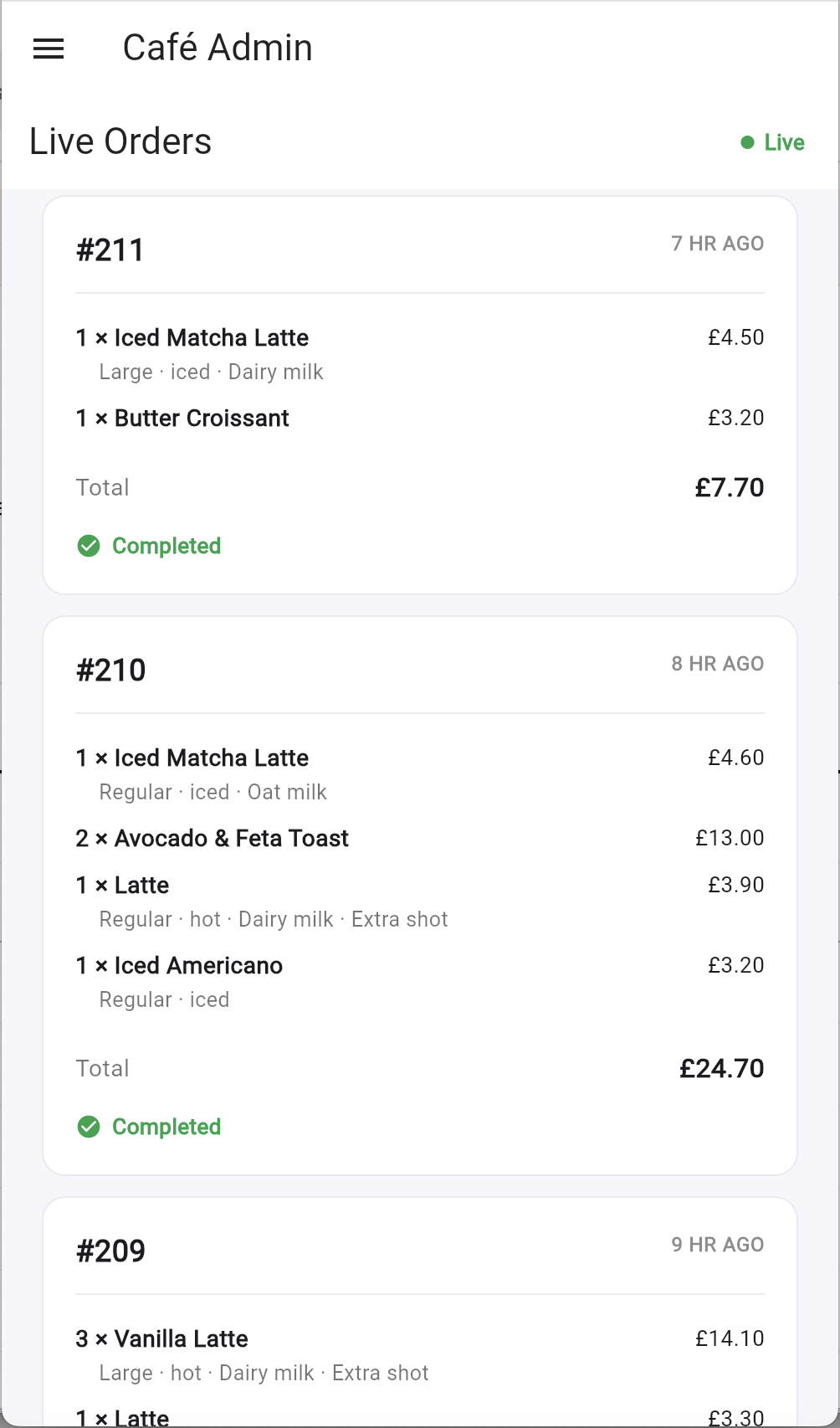
Live Orders
-
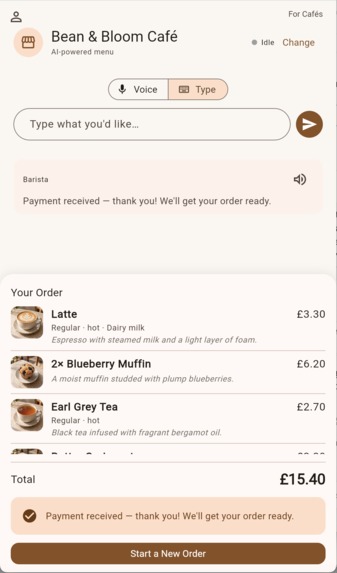
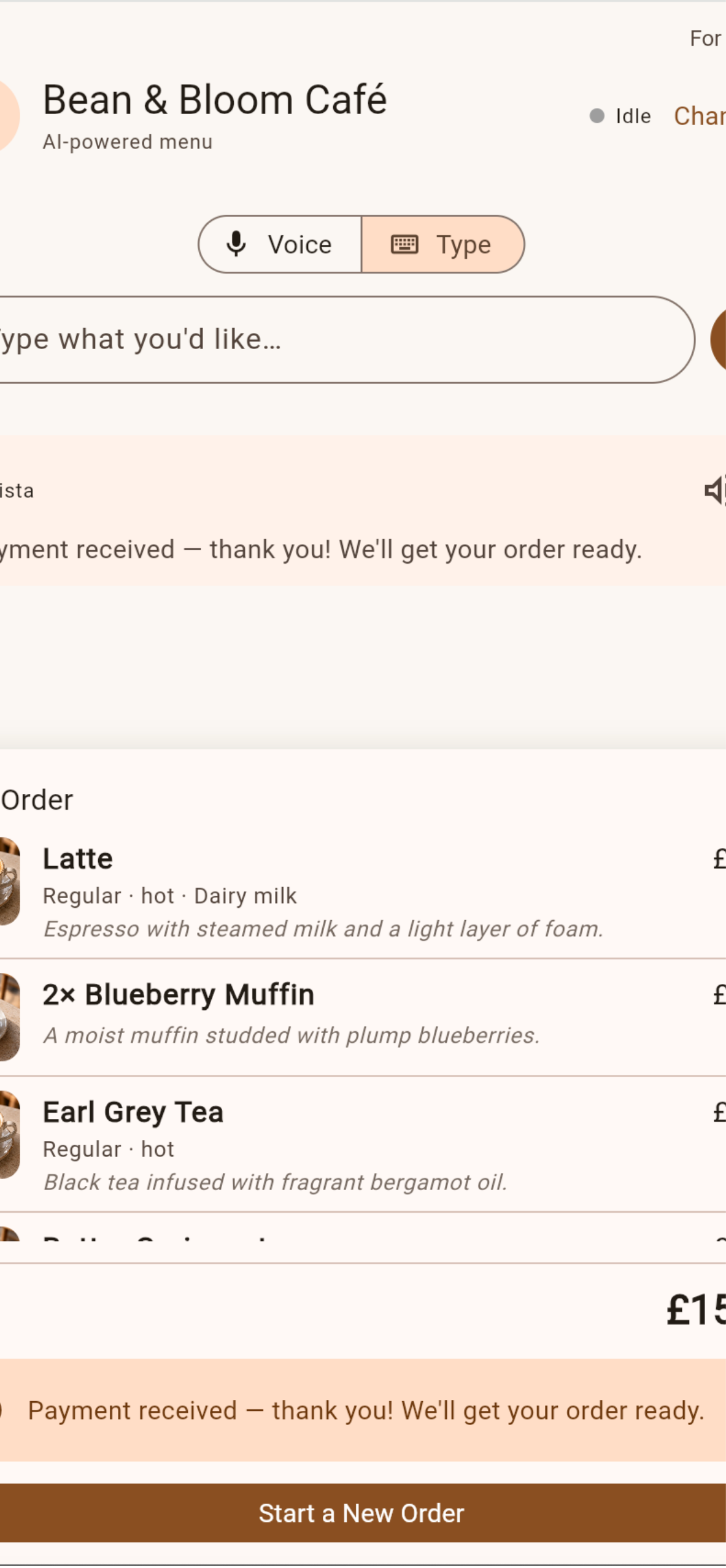
Full App Screenshot, Ordering (Voice and Type)
-
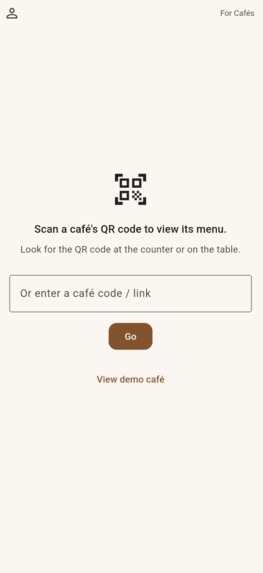
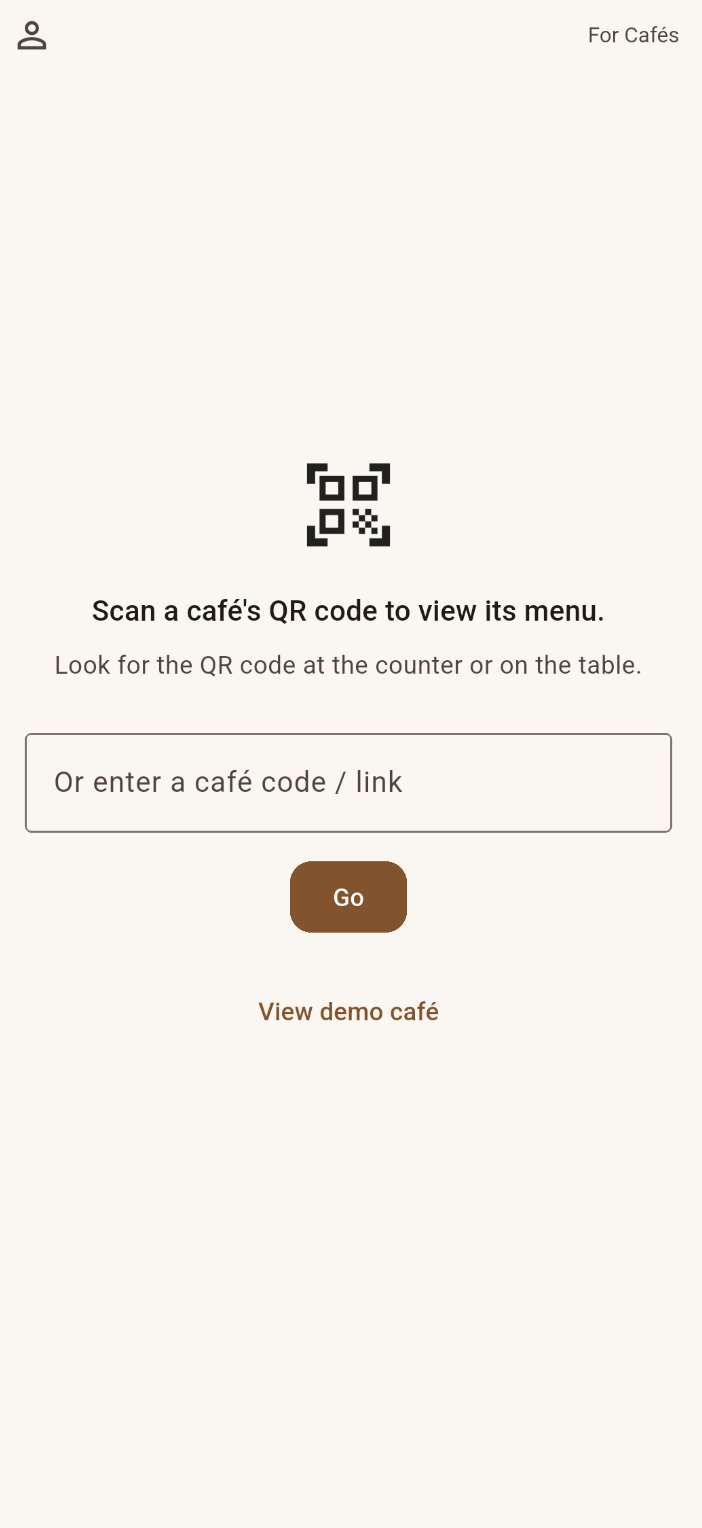
Café Selection
-
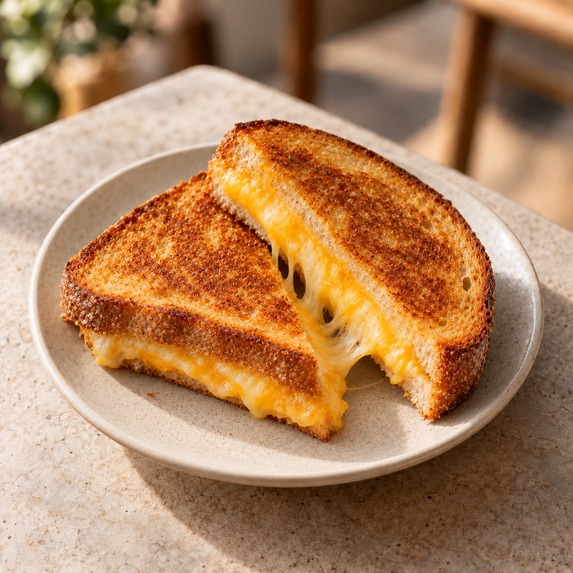
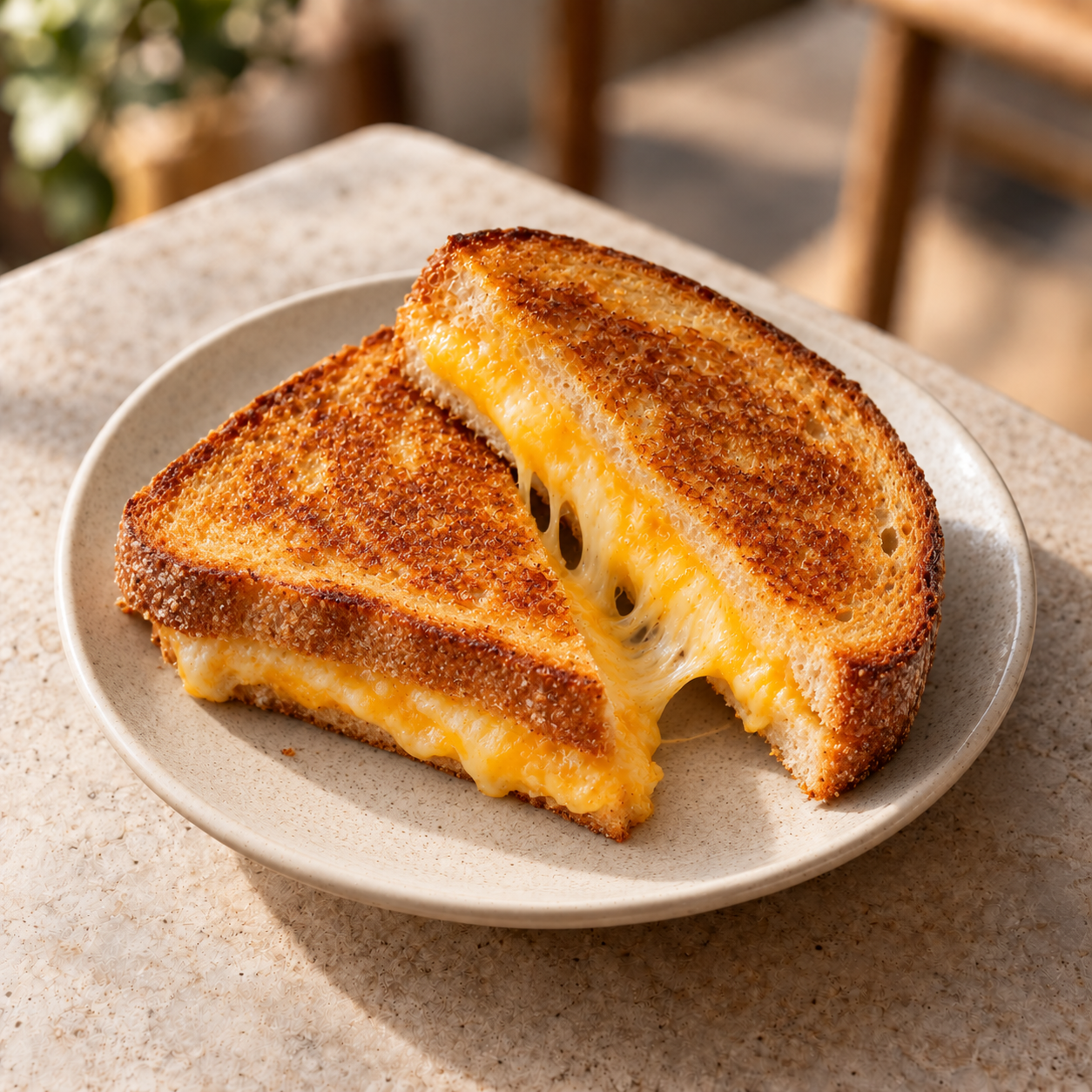
Ex. Menu Photo (Grilled Cheese Sandwich)
-

Ex. Menu Photo (Peach Iced Tea)
-

Ex. Menu Photo (Latte)


Inspiration
Ordering at a café hasn't changed much over the years. To order, you still need to queue, explain your order to a cashier or scroll through menus on a screen.
We wanted to make a new, natural way to order: what if you could just talk to the café?
That's how we were inspired to build BaristaVoice: an AI voice ordering system for cafés. Our aim was to tie together the entire conversation from the customer to the café's ordering workflow. We also wanted to build something that could be used in a real café business rather than just another consumer-facing AI app.
What it does
BaristaVoice lets customers order from a café using natural speech.
A customer can tap the microphone and say something like:
"I'd like a large iced latte and a chocolate croissant." or ask the AI to recommend something.
They can also choose to type if they are uncomfortable speaking or if it's loud.
BaristaVoice will understand and update the order, showing relevant products and images as they are mentioned. A customer can then freely adjust what is being ordered before confirming and paying.
The order is then sent to the café's POS system.
On the café side, businesses can manage their menu, receive and track live orders, view ordering analytics, get tips on how to improve and manage their BaristaVoice subscription via a dedicated dashboard. Individual cafés can also have their own QR code for customers to scan to reach the café's menu. BaristaVoice currently integrates with Square (Sandbox), bringing the voice ordering experience into a real POS workflow.
The business model is B2B: cafés subscribe to BaristaVoice rather than customers paying to use it.
Customers:
- No account needed, making the experience simple and hassle-free
- Customers simply scan the café's QR code or enter their link to start ordering
- Cafés they've ordered from before are stored locally in their profile, in case they visit again
How we built it
BaristaVoice was built using Flutter and Dart, with Supabase as our backend/database infrastructure.
The major technologies we used were:
- Flutter / Dart — customer kiosk and café dashboard
- Supabase — database, authentication, storage and realtime updates
- Groq — natural-language AI and order processing
- ElevenLabs — text-to-speech responses
- Square — POS integration and payment functionality
- RevenueCat — café subscription management (recurring, fixed, monthly/yearly)
- Stripe — café usage-based billing infrastructure (5p/item ordered, charged monthly)
- Claude Code — AI-assisted development
The customer ordering experience is login-free, while café administrators log in to access their dashboard.
Orders are stored using a canonical order model before being submitted to the POS, and this flow is designed so additional POS providers can be added in the future. We also built realtime order updates so that an order can appear in the café's dashboard as soon as it's placed. Staff can have the Live Orders page displayed and mark orders as complete.
Challenges we ran into
One of the main challenges was to make the AI ordering experience feel like a real conversation rather than a chatbot with a microphone attached. The AI needed to understand natural requests, extract the correct products and quantities, handle order changes and make sure the visual order state was correct.
We also needed to ensure that the AI couldn't make up a product or price; orders had to be validated against the café's actual menu before being submitted.
Another important challenge for us was the integration to a real POS system. Getting our internal order system to connect to Square involved managing products, orders and transactions.
We also had to work around constraints of APIs and tools while building and testing the project, including AI request limits, payment sandbox environments and subscription testing.
Finally, we had to make sure we kept the UX smooth: adding too many buttons or menu interactions would undermine the reason for using voice in the first place, so we kept the interaction simple while still giving customers enough visual feedback to know what the AI understood.
Accomplishments that we're proud of
We're especially proud that BaristaVoice goes beyond just a voice demo and ties the entire ordering workflow together. A customer can speak an order, see it interpreted on screen, confirm and pay, and have the resulting order appear in the café's dashboard.
We're also proud of building both sides of the app:
- A customer-facing voice ordering experience
A café management dashboard including:
Live order tracking
Menu management
Analytics
Subscription infrastructure
The project also gave us the opportunity to work with several production-oriented technologies that we haven't previously used together, including Supabase, Square, RevenueCat and ElevenLabs.
Most importantly, we built BaristaVoice around a real business model. The customer experience is free to use, while cafés are the paying customers so that the product is sustainable beyond the initial demo.
Cafés can test BaristaVoice using the free trial without replacing their existing ordering system, allowing them to try it out alongside their current setup.
What we learned
We learned that building an AI product is much more than just connecting an LLM to an interface. The AI itself is only one part of the system: the difficult part is to make the AI interact reliably with databases, pricing rules, payments, POS systems, and a UI that users can trust.
We also learned a lot about design around AI rather than simply adding AI to an existing interface. Voice works best when the rest of the UI supports the conversation rather than competing with it.
On the business side, we learned how important it is to design the monetisation model alongside the product. Thinking about cafés as the customer influenced many of our decisions around the dashboard, POS integrations and analytics.
Finally, building BaristaVoice taught us how much effort is required to turn an idea into a real product. We spent a lot of time fixing bugs, refining features and making the UX smoother.
What's next for BaristaVoice
The current version of BaristaVoice shows the complete customer-to-café ordering workflow, but we have much more to build.
Our future goals include:
- Supporting additional POS systems such as Toast, Lightspeed and Epos Now
- Expanding café analytics and reporting
- Improving automatic menu/product extraction
- Making the conversational ordering experience even more flexible
- Supporting multi-location café businesses
- Refining the pricing model as real usage data becomes available
Our long-term vision is for BaristaVoice to be used in real cafés with real customers, allowing faster, simpler and more efficient ordering without businesses being forced to replace the system they already use.
To use/test the demo café dashboard:
Email: [email protected] Password: !Bean-Bloom-demo123
- If the paywall doesn't appear, you can make a new account (this may happen if multiple judges test the demo café dashboard in a short time period)


Log in or sign up for Devpost to join the conversation.