-
-
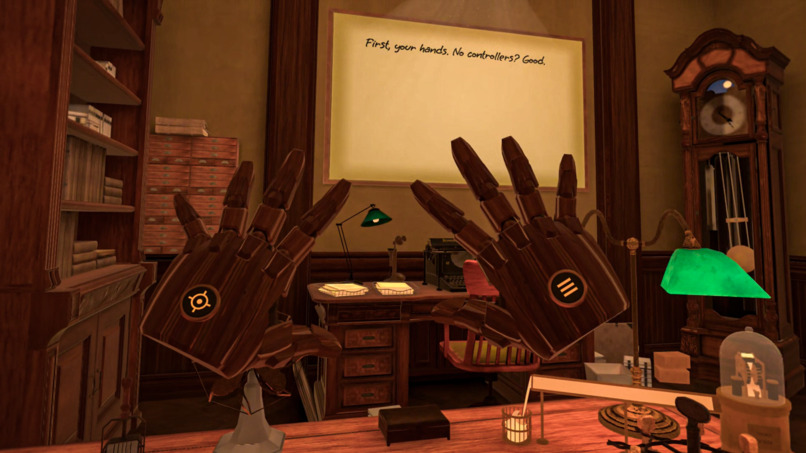
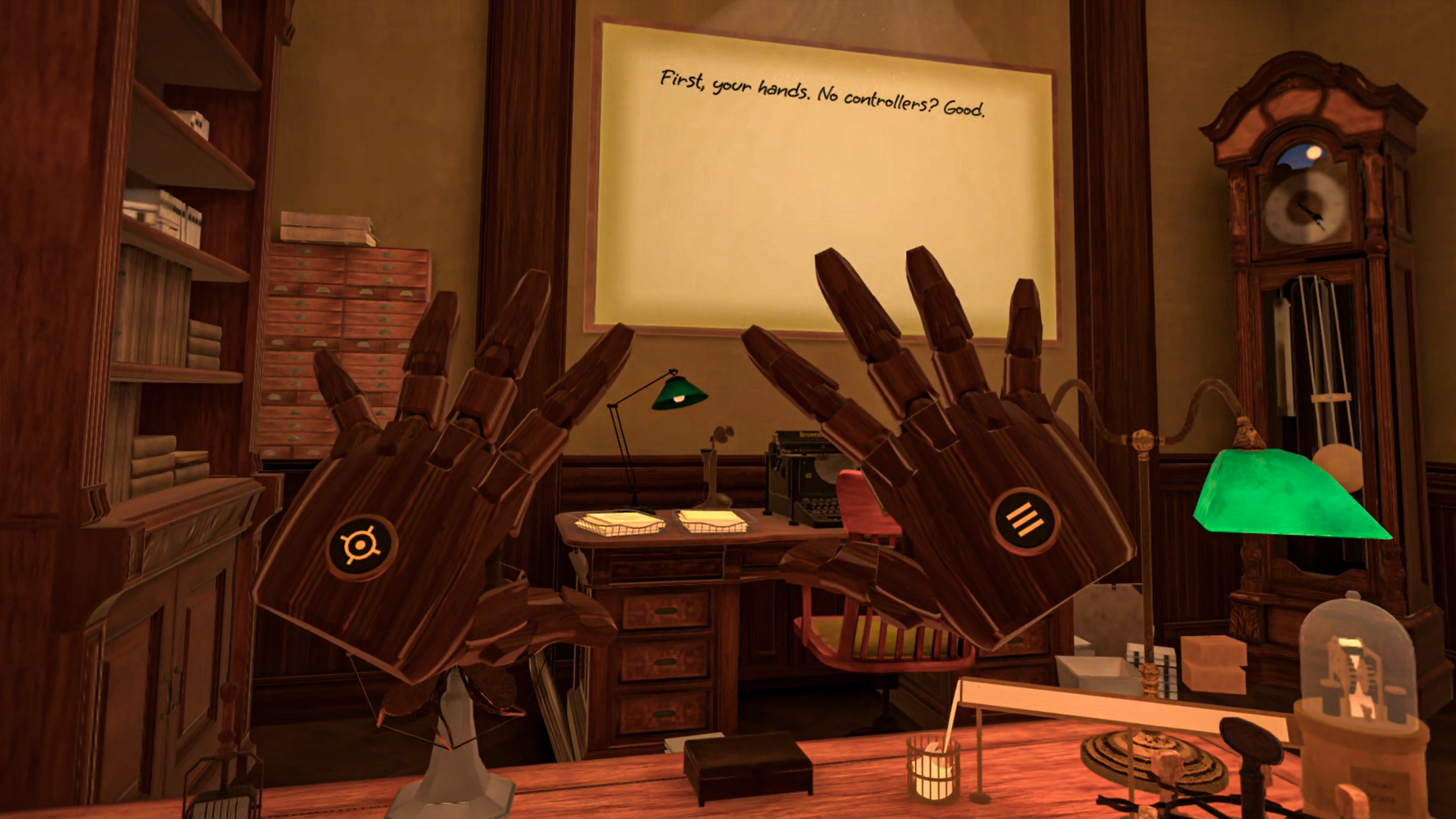
Seated and hands-first: your own two hands at the desk, in front of the narrator’s projector board. Ten fingers. Please keep all of them.
-
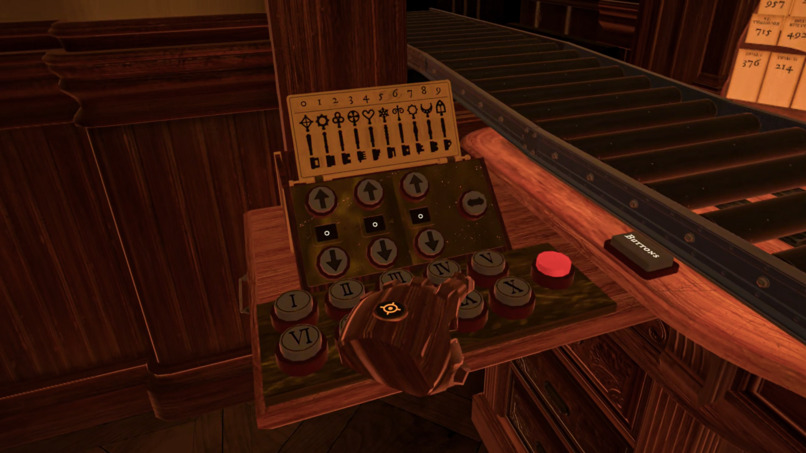
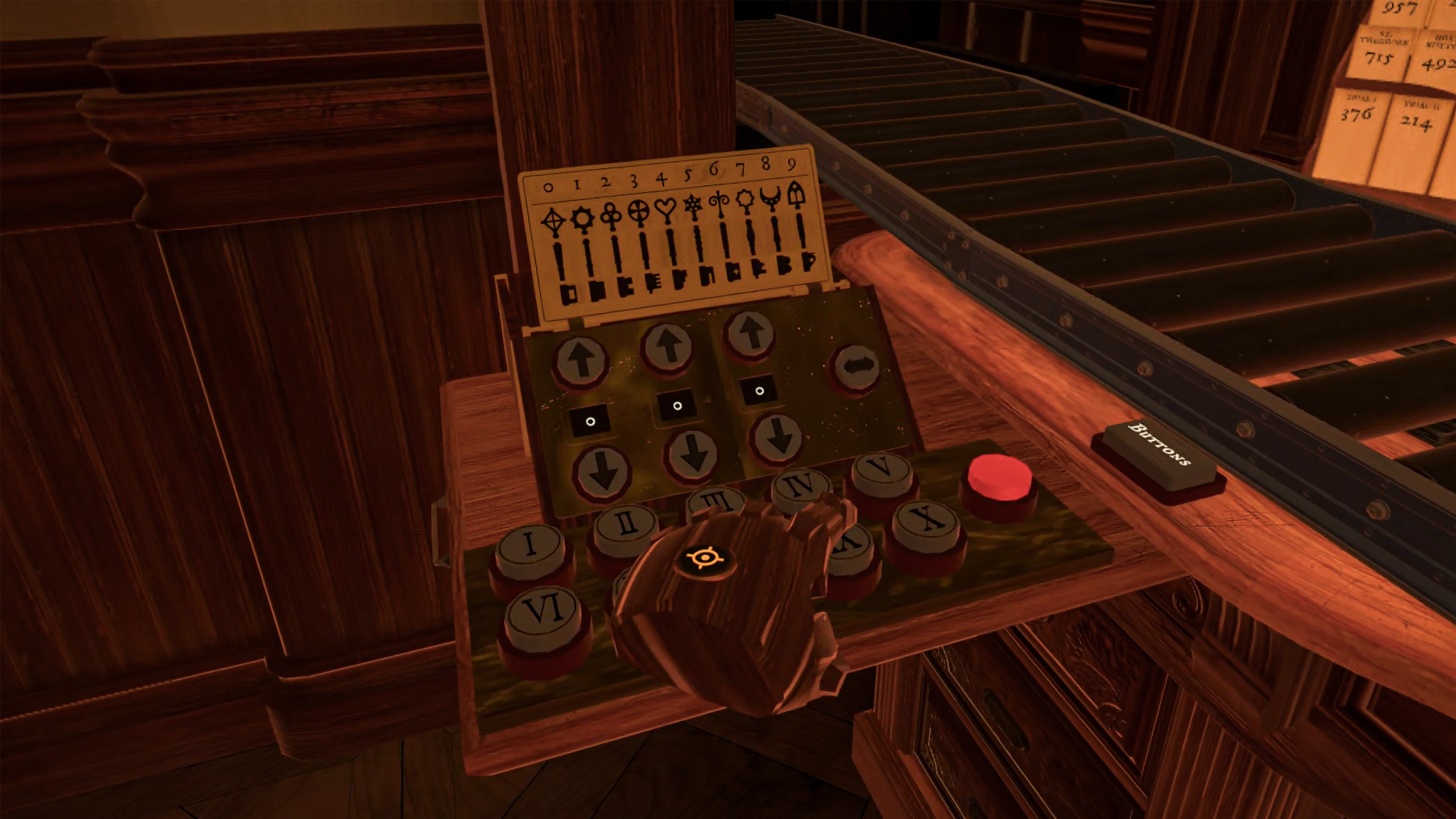
The Lockworks: set a key’s three parts on the dials and it arrives by pipe in a brass capsule. Any key in the building.
-
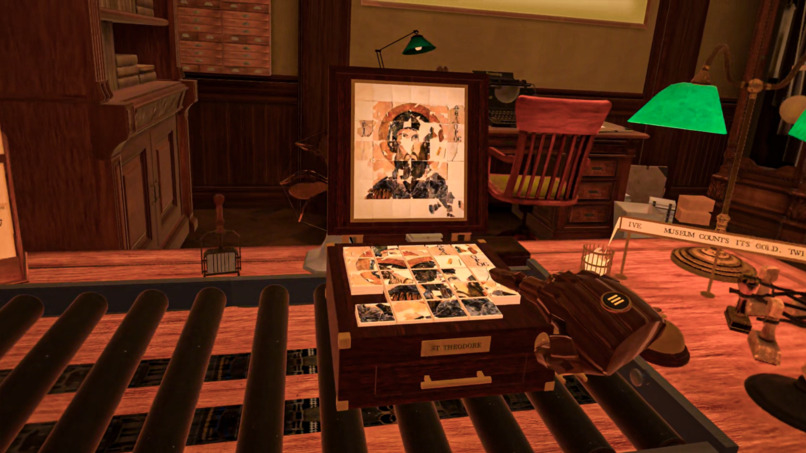
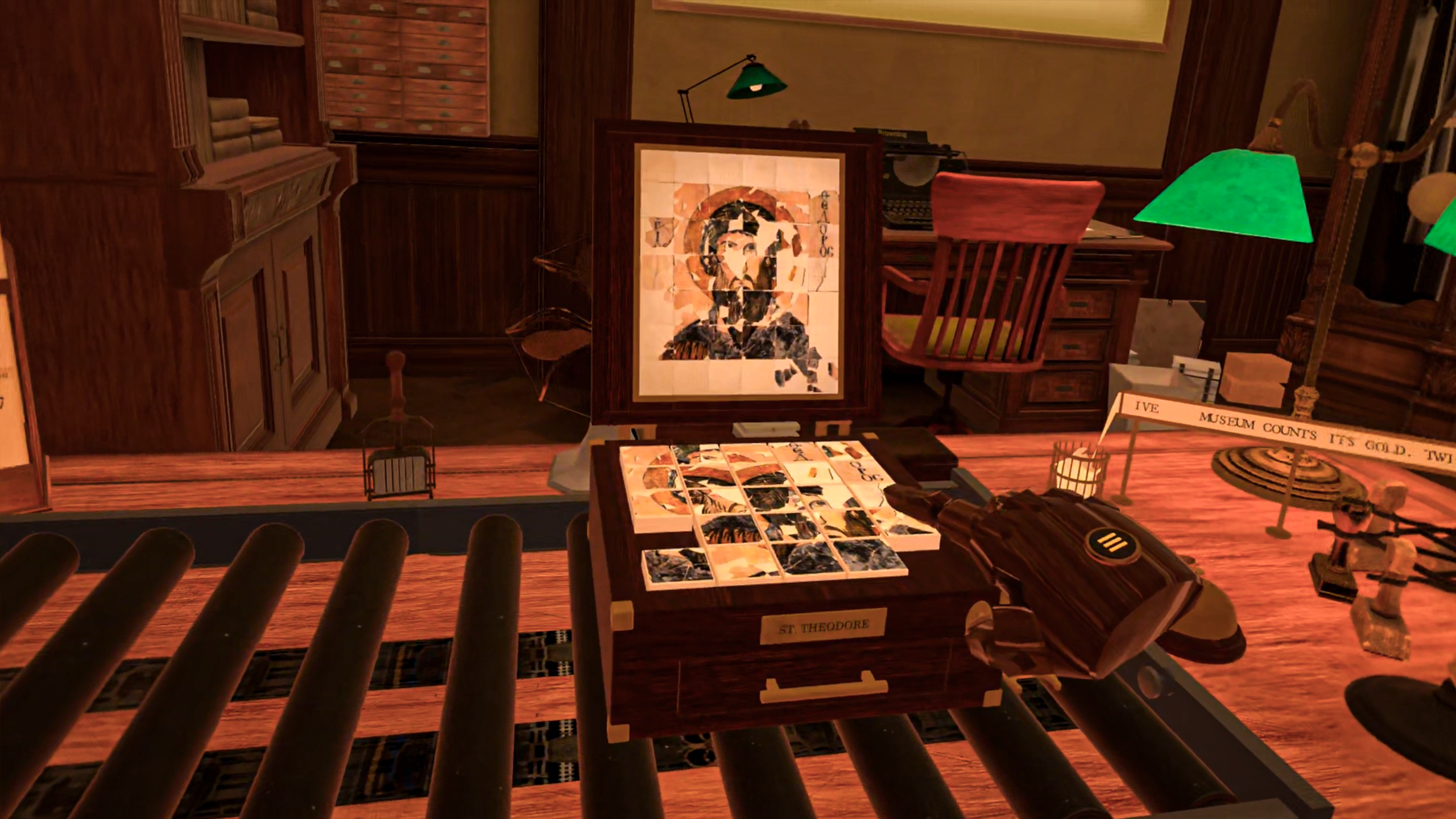
St. Theodore: a 5x5 sliding-tile puzzle of the real 10th-century ceramic icon from Preslav. Some assembly required.
-
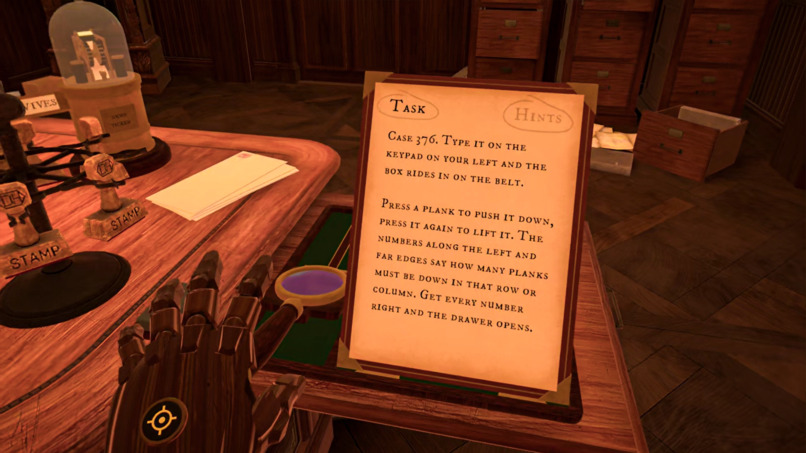
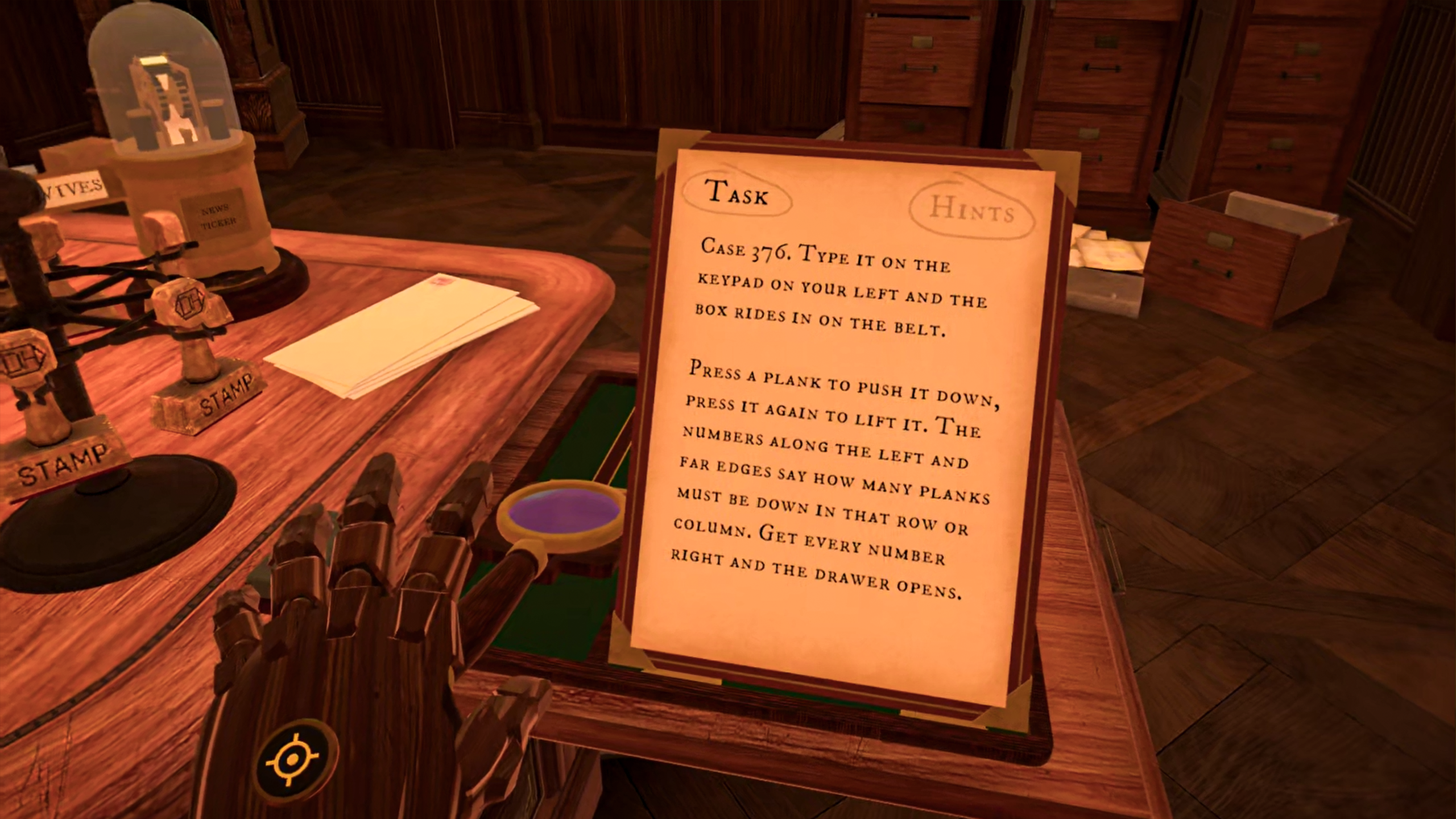
The hint station: a task and tiered hints for every case, and the last hint always gives the solution. It’s not a slot machine.
-
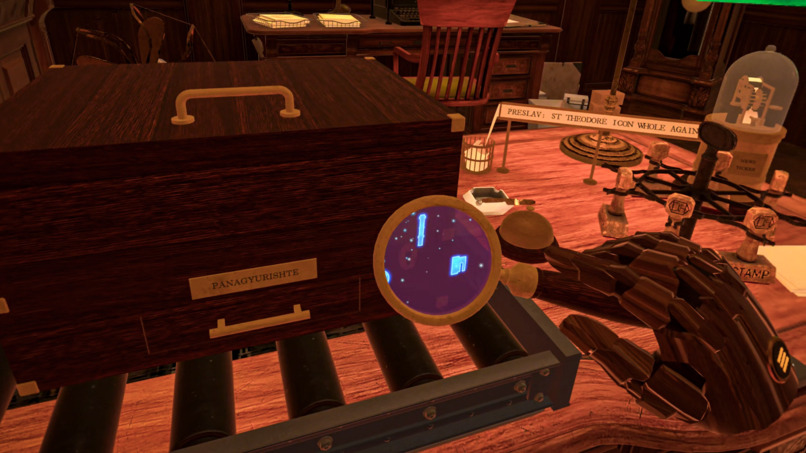
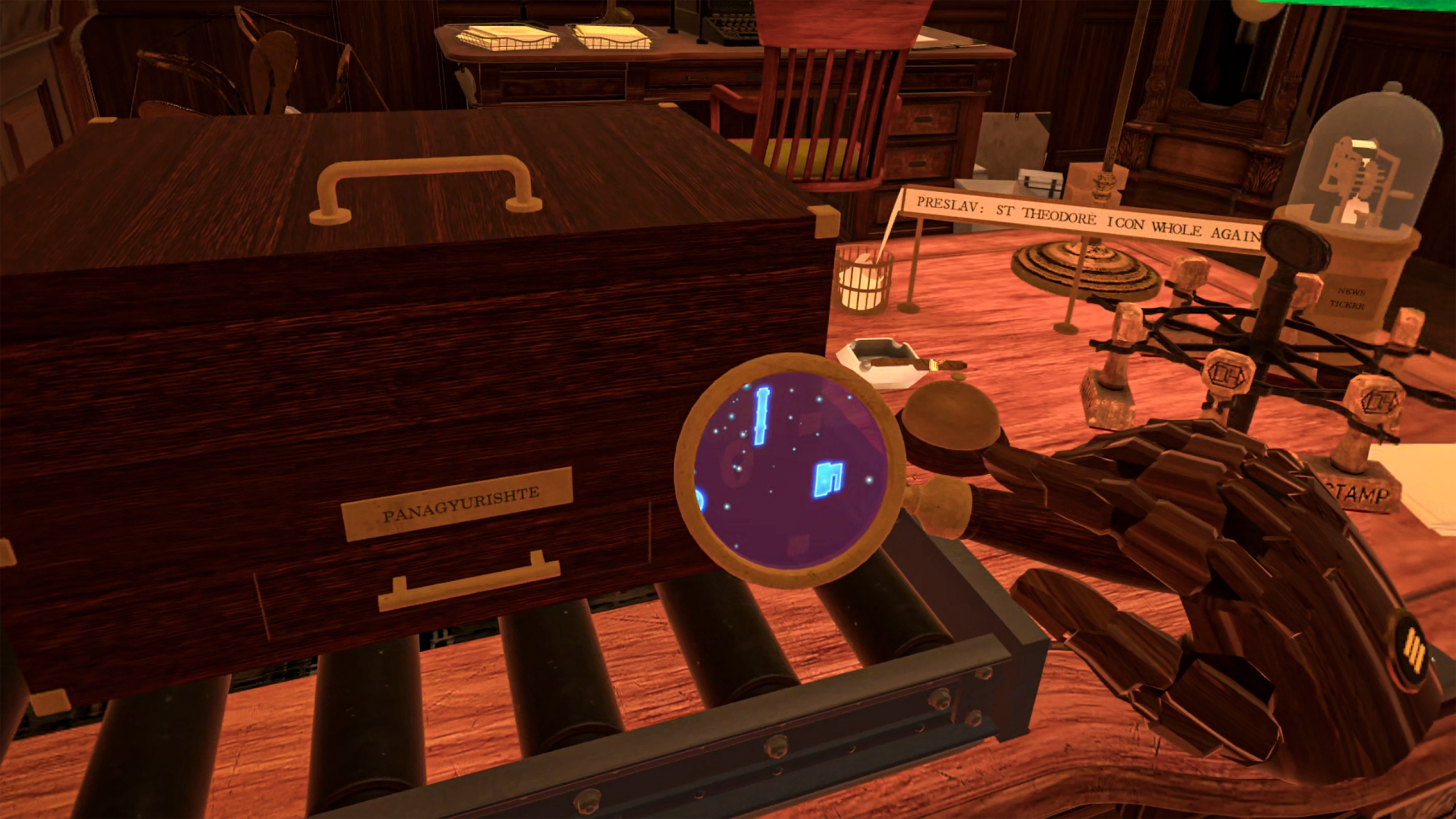
The magnifying glass reveals the hidden marks on a lock, telling you which key to order. Look closer. Then a bit closer.
Inspiration
My previous VR game, Oldest Golden Treasure, is about the Varna Necropolis gold, the oldest worked gold ever found. I wanted to bring real history back, but in a game built for hands (no controllers needed) and in a seated, relaxed setting.
The joke came first: you're the new intern at an agency that handles history's most precious finds, and nobody trusts you with anything older than your coffee. That premise solved two design problems at once. It explains why you start on simple test boxes that teach hand interaction, and it gives a dry narrator a reason to comment on everything you do. It even explains the finale, where you only press keys while a wooden arm handles the gold. Interns don’t touch 6,000-year-old gold.
What it does
You sit at a desk in a rainy wood-and-brass office. Everything happens within arm's reach:
- Call a case. Type a case number on the brass keypad that slides out of your desk. The archive hatch opens and a conveyor belt delivers the box.
- Solve it with presses, taps and grabs. Its drawer opens with a note: the number of the next case.
- Order your keys. Locked artifact boxes need a key. Hold a magnifying glass over the keyhole to reveal hidden marks, look them up on a chart, and order the key from the Lockworks, the agency's mechanical department.
- Ask for help. The hint station gives each case a task and tiered hints, and the narrator has opinions about how many you use.
The cases so far:
- Three Trial Boxes: press-down plank grids with row and column clues, and a sliding-tile marble box.
- The selector box: unlock it and you can order keys.
- St. Theodore: a 5×5 sliding-picture puzzle of the 10th-century ceramic icon from Preslav.
- The goat rhyton: reassemble a gold rhyton from the Thracian Panagyurishte Treasure, piece by piece, from the catalogue card in the lid.
- Three confiscated games a collector had built, which nobody at the agency could beat. Each one is played with a single row of brass keys:
- Thief & Constable: a turn-based chase. Get the thief out through the gate before the constable catches him.
- Tomb Run: program up to 12 moves, press RUN, and watch the archaeologist meet spikes, a collapsing floor and a swinging blade.
- The Sleepwalker: turn the town's turntables in real time to steer a sleepwalker home to bed, past canals and open manholes.
- Grave 295: a grave at the Varna Necropolis that officially doesn't exist. Turn a carousel of sixteen gold pieces and have a wooden arm place the eight real ones on a clay face. The other eight are the collector's copies.
Solve them all and you stamp your own promotion form. You're a detective now. Well... barely.
Overtime. After the second trial, a record sheet slides up behind your case files offering you more puzzles. Every trial and every confiscated game you solve adds three new boards to it that are different variants of the games. Type a number on the keypad to call one. Optional. Unpaid. No hints.
Progress saves after every step in one of three save files, so a short session never costs you a case.
How I built it
I built it solo in Unity 6.3 with URP, OpenXR and the Meta XR Core SDK, and AutoHand for physical hands. Everything is designed for tracked hands. Controllers work, but you never need them. Most of the office environment is a licensed Leartes asset pack, the same one my previous game used. The puzzles, boxes, story, systems and narration were designed and built during the competition window.
- Puzzle boxes: every box is modelled in Blender in walnut, maple, brass and cloth linings, sized to a real desk.
- Puzzle design: I wrote solvers for the mechanical games that search every reachable state. They pick boards with one intended solution and the right number of moves, and they check that guessing doesn't get you through. Each game has three or four finished candidate levels kept for future variants.
- Hands-first rules: only index fingertips press, so a resting palm never triggers anything. Every press needs the finger to lift before it counts again. Tapping replaced dragging wherever precision matters. Lost grabs and stuck keys led to a written rule set for every grabbable object.
- Saving: every step is saved the moment it happens, since Quest can close an app at any time. Every puzzle can rebuild its solved state when a file loads.
- Narration: 87 lines voiced by a real human (my girlfriend), typed out on a projector board, plus funny reactions in the spirit of The Stanley Parable.
- Languages: English, German, Spanish, French, Bulgarian, Polish and Japanese. All texts live in one file that the game loads from my website, so when players report a typo or an awkward translation, I can fix it fast without uploading a new build.
- Atmosphere on mobile hardware: rain runs down the window in a single unlit shader, lightning flashes with the thunder, and someone in a fedora sometimes walks past the frosted corridor glass, drawn by an interior-mapping shader. Lighting is baked, and the game runs at 90 Hz with a 140% render scale.
- Tools: Claude, connected to the Unity editor and Blender, helped with scripting, Play mode testing, modelling scripts and documentation.
Challenges I ran into
- Grabbing built for controllers. The hand system's assisted grab snaps your hand onto nearby objects. That works great with controllers, but with tracked hands it looked bad. I turned it off and adjusted the hand movements so your hand in the game only moves when your real one does.
- Letting go at the right moment. Fingers curl past a handle, so objects fell out of your hand mid-move. Now an object drops only when your thumb, index and middle finger open, not when a fingertip slips off.
- Everything within reach. Distance grabbing with controllers works great and allows players to pick things up from far away. With hands only this is tricky. So the game brings things to you instead: keys rise out of their capsule with the handle toward you, the rhyton pieces lean toward the player, and anything you drop comes back on its own.
- Puzzles you can't brute-force with a few keys. I wanted to design puzzles that cannot be solved fast by random guesses and I am happy that all puzzles so far follow this rule. For example, pressing random keys in "Thief & Constable" wins only about once in 295,000 tries.
- Effects that work on PC but not on Quest. I tried a rain effect and a second camera for the menu to dim the surroundings, but both failed on the headset. I replaced them with my own cheap rain shader and a menu that dims the room with render passes.
- Seven languages on physical props. German runs about 30% longer and Japanese needs full-width letters, so I made a fit check that measures every text in the game.
Accomplishments that I'm proud of
- Ten cases and a full story, from your first day to your promotion, built solo in under eight weeks.
- Every interaction works with bare hands, seated, within arm's reach.
- An office that notices you. The desk ticker prints headlines about your progress, and ring the service bell enough and it prints LOCAL INTERN DISCOVERS BELL. The grandfather clock shows the real time and the moon phase.
- Real history from Bulgaria, from the Thracians to medieval Preslav to the Varna gold, in a game that's mostly jokes.
What I learned
- Design the hands first, then the puzzle. Brass keys that dip and click feel solid with hand tracking; precise drags don't, yet.
- A narrator who reacts makes players feel watched in a good way, and humour is the cheapest way to teach.
- Tools pay off early: the auto solvers for the puzzles and the fit checks saved more time than they took.
What's next for Barely a Detective
- Target launch: Early Access on the Meta Horizon Store in December 2026, before the holidays.
- January 2027: a big content update with new cases.
- February to March 2027: full release.
- More cases, more variants of the existing puzzles, more narrator reactions, a real 3D scan of the goat rhyton, and new sound effects for the mechanical games and other interactions.


