
Inspiration
It started from a simple question: when a flood hits, does anyone know which hospital is about to run short of IV fluids, insulin, or PPE — before it happens?
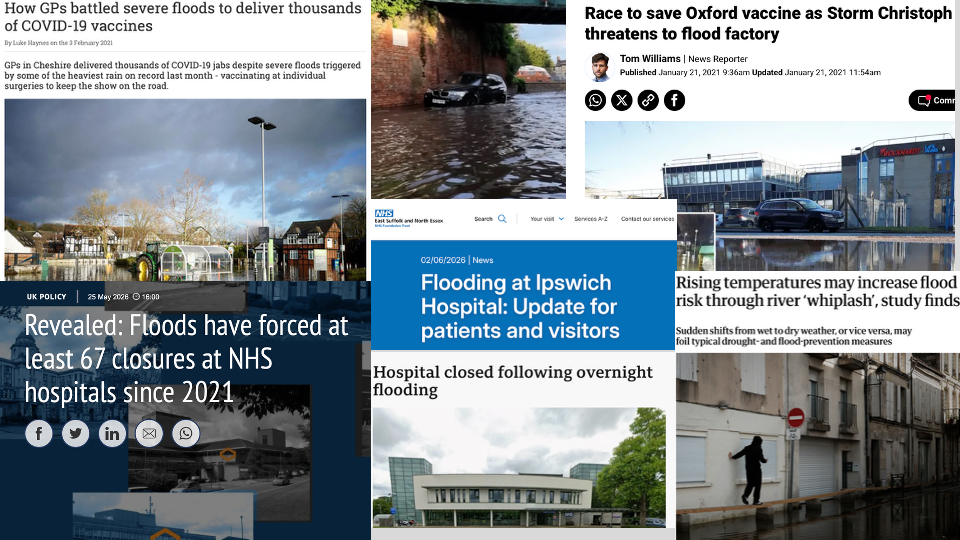
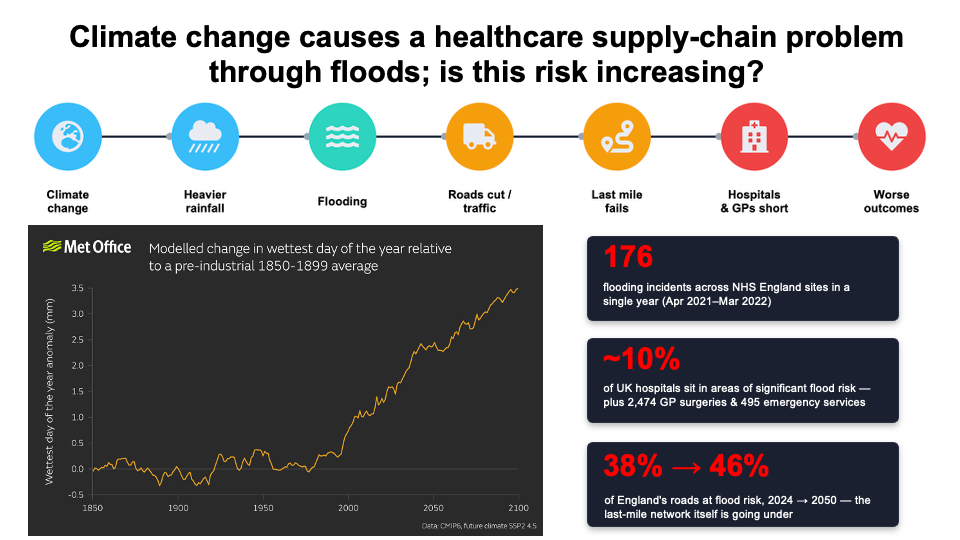
The answer turned out to be no. 176 flooding incidents hit NHS England sites in a single year (Apr 2021–Mar 2022), roughly 10% of UK hospitals sit in areas of significant flood risk, alongside 2,474 GP surgeries and 495 emergency services. And the ground is shifting under all of it: 38% of England's roads are at flood risk today, rising to 46% by 2050 — the last-mile delivery network itself is going underwater, not just the buildings at either end.
What struck us most wasn't the flood risk itself — that's well mapped already. It was the gap sitting right next to it: the UK's actual medicine-shortage response system only activates once a manufacturer self-reports a problem, or a hospital is already short. There's no system that looks at a flood warning and asks "what does this mean for the supply chain, three days from now?" We built BARB to close that specific gap.
What it does
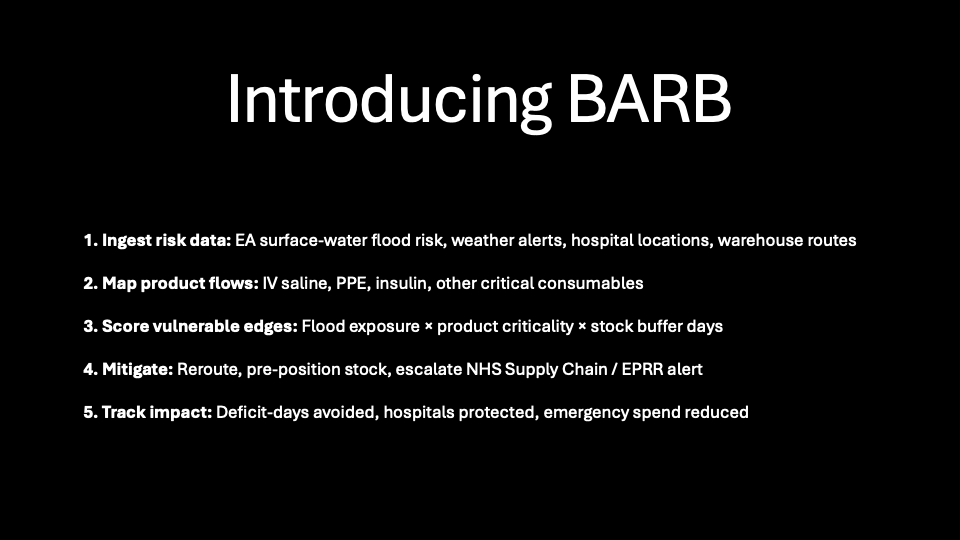
BARB scores supply-chain routes by flood exposure before disruption happens, not after:
- Ingest risk data — Environment Agency surface-water flood risk, live weather alerts, hospital and warehouse locations, delivery routes.
- Map product flows — IV saline, PPE, insulin, and other critical consumables, each following its own real distribution path.
- Score vulnerable edges — a risk score combining flood exposure × product criticality × how many days of stock buffer a site actually has.
- Mitigate — reroute deliveries, recommend pre-positioning stock, or escalate through the NHS Supply Chain / EPRR (Emergency Preparedness, Resilience and Response) alert pathway that already exists.
- Track impact — deficit-days avoided, hospitals protected, emergency spend reduced.
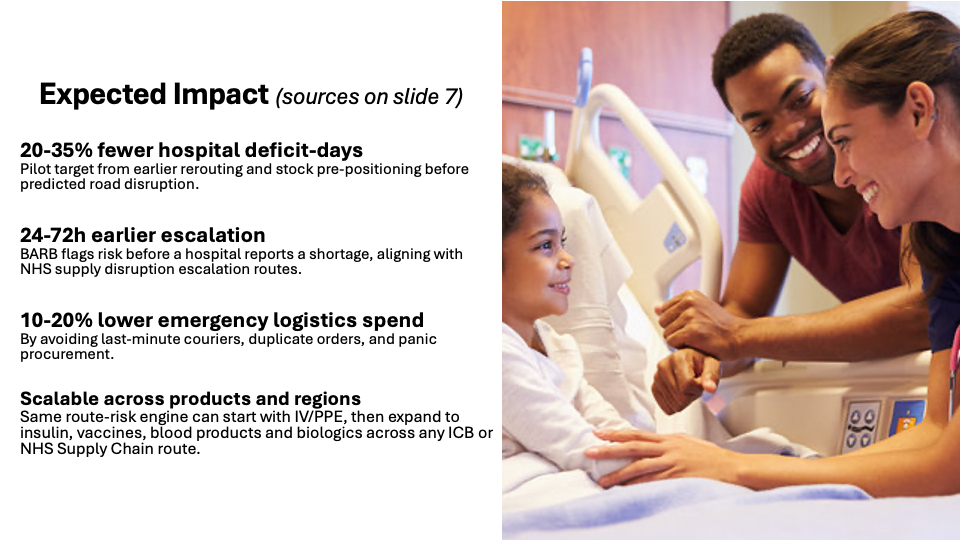
Our pilot-target projections: 20–35% fewer hospital deficit-days, 24–72 hours of earlier escalation versus waiting for a shortage to be reported, and 10–20% lower emergency logistics spend by avoiding the panic-procurement and emergency courier costs that come from reacting too late.
How we built it
Data, the honest version of where it actually came from:
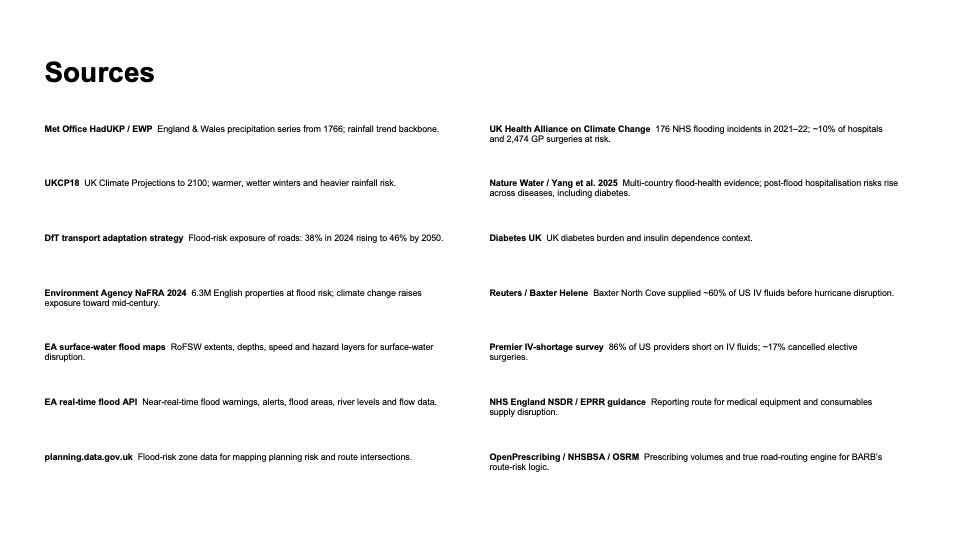
- Environment Agency real-time flood API and surface-water flood maps (RoFSW) for the risk layer.
- Met Office HadUKP/EWP precipitation records and UKCP18 climate projections to ground the "is this risk increasing" question in actual long-run data, not just this year's headlines.
- DfT's transport adaptation strategy for the 38%→46% road exposure figure.
- OpenPrescribing and NHSBSA's Secondary Care Medicines Data for real prescribing and hospital stock-issuance volumes — and OSRM for genuine road-network routing between nodes, rather than a straight-line approximation.
- NHS England's NSDR/EPRR guidance, so our escalation step plugs into a real reporting pathway rather than inventing a new one.
On the engineering side: a Python data and risk-scoring pipeline (flood/weather ingestion, a node-and-edge supply graph, a redirect-recommendation engine) feeding a React/Leaflet frontend, with GitHub for shared version control across the team.
Challenges we ran into
We didn't land on this problem on the first try. We went through several framings before this one — including a much narrower single-product version of the idea — before realising the sharper, more useful version covered multiple critical consumables at once, scored by the same underlying flood-risk mechanism, rather than picking one drug and hoping it generalised.
NHS data structure has real, non-obvious gotchas. We initially assumed Integrated Care Boards (ICBs) were a physical point in the supply chain — they're not; they're a commissioning body, with zero goods passing through them. The real physical chain runs manufacturer → wholesaler → community pharmacy for GP-prescribed medicines, and manufacturer → regional procurement framework → hospital trust pharmacy for inpatient products — two genuinely separate routes we had to model separately, not as one.
Data matching is messier than the dashboards suggest. Roughly 79% of GP practice names in our prescribing export matched cleanly to a real location; the rest were merged, renamed, or ambiguous practices we couldn't confidently geocode in the time we had. We chose to disclose that coverage gap rather than quietly fill it with a guess.
We caught a real bug in our own routing logic during testing — an early version of our redirect engine only checked a node's immediate nearest neighbours for a safe alternative, which meant it sometimes reported "no safe option" when one genuinely existed just slightly further away. Worth catching before a judge did.
Finding documented evidence was harder than expected. We went looking for a clean "a UK flood disrupted insulin/IV fluid delivery" news story to cite, and it doesn't really exist yet as a single citable event — the closest documented analogue is Hurricane Helene knocking out Baxter's North Carolina plant, which supplied roughly 60% of US IV fluids. So instead of overclaiming a UK precedent we couldn't source, we built the case from the pieces that are documented: UK flood frequency data, UK road exposure projections, and — the strongest single piece of evidence we found — peer-reviewed research (Yang et al., Nature Water, 2025) showing post-flood hospitalisation risk rises across multiple conditions, including diabetes.
Accomplishments that we're proud of
We built something that runs on real data, end to end, not a mock-up dressed up as one. Real flood data, real prescribing volumes, real road routing via OSRM, real NHS escalation pathways — and we can point to exactly which parts are real and which are still illustrative, rather than blurring the line.
We found and used the strongest available evidence rather than the easiest. When the obvious headline-style citation didn't exist, we went looking for peer-reviewed research instead and found a genuinely stronger result — post-flood hospitalisation risk rising across multiple conditions including diabetes — than the anecdote we were originally looking for.
We caught our own bug before anyone else did. Testing our redirect logic against real geographic data surfaced a real flaw in the search radius, and we fixed the underlying logic rather than patching around it with better-looking sample data.
We scoped down on purpose. Multiple promising directions could have stretched this into something unfinishable in the time we had. Narrowing to flood risk specifically, across a defined set of critical consumables, with one clear escalation pathway, meant we shipped something complete instead of several things half-built.
What we learned
The NHS supply chain isn't one chain — it's at least two, structured completely differently. Community-prescribed medicines and hospital-administered medicines run through entirely separate procurement and logistics systems, with different data availability for each. Understanding that distinction reshaped how we modelled the problem.
Climate-risk analytics for supply chains already exists as a commercial category — generic platforms sell this to manufacturers across multiple industries, pharma included. The actual gap isn't "nobody analyses climate risk for supply chains," it's that nothing connects that analysis to the NHS's own internal shortage-escalation process in a way that's clinically and operationally specific to healthcare. That distinction sharpened our pitch considerably.
Disclosing a limitation is more persuasive than hiding one. Every time we stated plainly what was real data versus an assumption — practice-matching coverage, illustrative wholesaler relationships, the lack of a clean UK precedent — the project got stronger, not weaker, because it meant every claim we did make could be trusted.
What's next for BARB
- Pilot with one NHS Trust or ICB, validating our risk-scoring retrospectively against real past DHSC Medicine Supply Notifications to see whether BARB would have flagged a genuine disruption earlier than it was actually caught.
- Expand product coverage beyond IV saline, PPE, and insulin to vaccines, blood products, and biologics, using the same underlying route-risk engine.
- Extend beyond flood risk to heat and storm exposure, since cold-chain products like insulin face a compounding risk heatwaves create — increased patient demand at the exact moment refrigeration infrastructure is most stressed.
- Replace our remaining hand-curated assumptions with real data through partnership access — particularly wholesaler-to-pharmacy relationships, which aren't public today but could be modelled accurately with the right data-sharing agreement.
- Scale the routing layer nationally across every NHS Supply Chain route and ICB, not just the flood-documented regions we used to prove the concept.

Log in or sign up for Devpost to join the conversation.