-
-
Introduction to Bar Bot Team
-
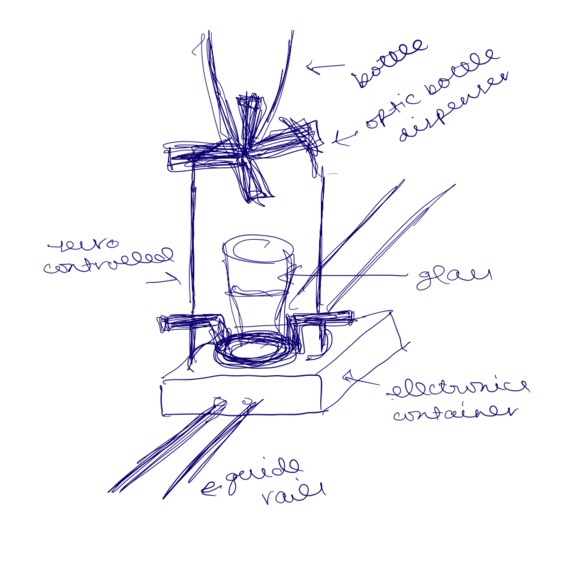
diagram of assembly
-
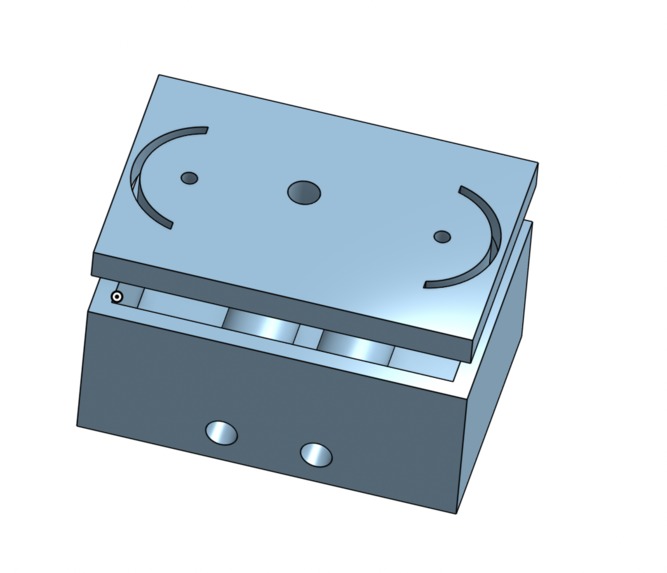
CAD model of box containing electronics, guide rail attachment
-
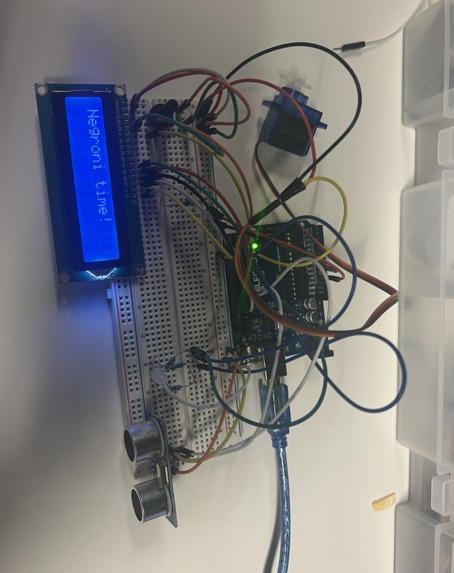
current integrated circuit elements (LCD screen, RGB LED, ultrasonic sensor, Servo motor)
-
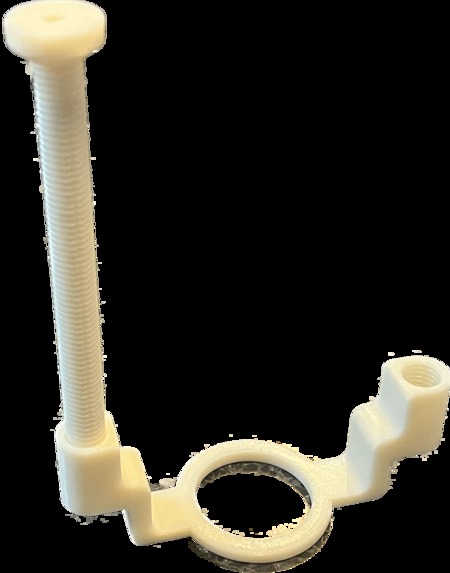
3D printed glass holder with 1/2 screws


BAR BOT OVERVIEW
In this project, a drink can be ordered using a mobile LightBlue application, and the liquid from 6 possible bottles is automatically dispensed. Instructions will be provided to the user on where to move the structure on which the glass rests to, and displayed on an LCD screen.
FINAL VIDEO
BAR BOT FINAL DELIVERABLES
Final Video link Final product In our final deliverable, two Servos and an LED are controlled by the LightBlue application on an iPhone. These two Servos move at a slow, controlled pace, but more importantly move in tandem. The LED indicates to the user that the Servos are moving (ie. the bottle cap is being opened and the liquid is being dispensed), so the user knows not to touch the device.
Limitations We faced significant challenges in the making of this project, despite the relatively simple scope of it. Firstly, we had an ambitious vision for the final product, which involved the ordering of many parts and significant amounts of 3D printing. Two of the three ordered parts did not arrive before our Demo Day (they still haven't arrived), so we found ourselves needing to shift away from the weight sensor and unable to test our Servos with the desired optic drink dispensers. In lieu of the weight sensor, we planned to use RFID to "check" if the user is of-age. This control would allow the Arduino to know when to begin the dispensing sequence (when to turn the Servos). We had finished this code, and have it displayed in this DevPost. When we went to demo our project, uploading the code to the MKR1010 board caused the computer to lose access to the port. This occurred on 2 MacBook laptops, as well as 2 Dell computers in Detkin Lab. 4 TAs assisted us, and none of us could solve the problem. For this reason, time constraints, and a need to complete senior year, we simplified our circuit to achieve the deliverable. Although it might not look like much, we have spent extensive time on this final project!!
Future directions In the future, we would love to create an assemblage like that shown in the diagram, using wood to create a base on which the bottles would rest, guide rails to move the Arduino along the base, and 3D printing to create a casing for the electronics, and extensions from the Servo to push the optic drink dispensers open and closed.
BAR BOT MVP DELIVERABLES
Servo rotational control (1) For MVP, we’ve demonstrated control over the speed and positions that will correlate to “open” and “closed” when integrated with the optic drink dispensers. In this preliminary version, a time delay is used to control “how much” drink is dispensed.
Video demo link
Servo rotational control (2) In this more advanced Servo script, an ultrasonic sensor takes the place of the weight sensor that will be used in the final product. When a distance of less than 10 cm from the sensor is achieved, the Servo closes in response. For the final product, the Servo will close the tap in response to a certain weight being achieved. This weight will be calculated using the known density of the selected liquids and the desired volume.
Video demo link
LED-Servo integration Finally, an RGB LED is integrated in the same way it will be in the final project. When the module on which the glass rests is free to move (in this case when the Servo is not moving) the LED will be green. As the dispenser is being opened or closed, the LED will be yellow, demonstrating that it is in transition. And finally, when the dispensing mechanism is open, the LED will be red, showing that liquid is being dispensed. For MVP, the ultrasonic sensor is still used in place of the weight sensor, controlling the Servo’s “opening” and “closing” of the tap.
Video demo link
LCD screen The LCD screen is used to communicate instructions about use to the user. In this example, the user has selected to make a Negroni. Their choice is displayed, and then they are instructed to move the glass to bottle 1, then bottle 3, and finally bottle 5, before being informed that their drink is finished. When integrated, the move instructions will correlate to the LED coloring- move instructions will only be displayed when the LED is green.
Video demo link
Structural elements The platform on which the glass will rest has been printed, and an image is linked. Below this circle that indicates where the glass should be positioned will be the weight sensor, calibrated to the weight of the cup. The long screws will attach it to a box structure containing circuitry elements (Arduino, battery, protoboard, etc.) with holes so that it can freely move along the guide rails. This structure will contain a space through which the RGB LED can be displayed, providing information to the user about operation status. These screws contain a path through the center, through which the vars attached to the Servo motor will be able to open and close the optic drink dispenser. This mechanism is demonstrated in diagram form, but we are still waiting for our 3D prints to be complete and our ordered structural elements to arrive.

Log in or sign up for Devpost to join the conversation.