Inspiration
In rural communities, critical physical and economic assets sit idle. A diesel pump set might run for just two weeks during the planting window before sitting in a shed for the remainder of the year; leftover drip irrigation line gathers dust; an experienced mechanic's afternoon goes unused. Meanwhile, someone two towns over needs those exact tools or skills to save their harvest or repair an engine, but has no simple, local way to find them.
Existing marketplace and classified platforms assume persistent 5G connectivity, unlimited data buckets, and high-end hardware. For rural users operating on strict prepaid mobile data plans—often around 1 GB for an entire month—loading a modern, JavaScript-heavy web application can consume an entire day's bandwidth allowance in a few clicks. We built Banyan to fix this broken distribution problem with software that treats every byte and milliwatt as a scarce resource.
What it does
Banyan is an ultra-lightweight community exchange platform that allows neighbouring villages and towns to share surplus materials, lend equipment, and trade practical skills.
Core capabilities include:
- The Four Pillars: Direct listings categorised into Materials (pipe, timber, seed, bricks), Equipment & Tools (pump sets, tillers, sprayers), Skills & Jobs (engine repair, tailoring, harvesting, tutoring), and Help Wanted community requests.
- Smart Intent Search: Users can search colloquially (e.g., "things to clear a fallen trunk"). An integrated language model translates practical intent into concrete item queries (axe, saw, rope) while ensuring every returned result maps strictly to verified listings in the local database.
- Strict Low-Data Architecture: The entire initial load sits under 48 KB. Images never download automatically—they display their exact file payload size (e.g., "38 KB") and load strictly on tap, accompanied by an interactive data budget meter that tracks monthly consumption.
- Offline-First Resilience: Listings remain accessible even when walking through zero-signal fields. Users can draft new posts offline, which are stored locally and synced automatically once signal is restored.
- Multilingual Out of the Box: Accessible onboarding with immediate language selection (English, Spanish, Hindi) and a native data-saver toggle that cuts animations and non-essential CSS transitions.
How we built it
We split responsibilities across a two-person team, focusing on lean performance and low-overhead infrastructure:
- Frontend & UX (Alek): Built with Preact and TypeScript to achieve native React developer ergonomics with a microscopic bundle footprint. Designed a custom, code-drawn SVG icon system and layout with zero external web fonts. Implemented a robust Service Worker strategy via Cache API and IndexedDB to deliver complete offline browsing and background write synchronization.
- Backend & API (Jahan): Developed using FastAPI in Python paired with an optimized SQLite database schema for fast read-heavy operations, town-to-town geographic sorting, and lightweight payload serialization.
- Smart Search Pipeline: Deployed Qwen3-4B through an OpenAI-compatible endpoint. The model functions purely as an intent-parsing semantic router: it outputs clean keyword refinement chips (e.g., "within 10 km", "free") and queries the database via structured SQL parameters, preventing any generative hallucinations or fabricated inventory.
- Security & Privacy: Enforced strict client/server rate-limiting, stripped EXIF metadata from user uploads, excluded private contact information from LLM context windows, and kept phone numbers/emails shielded behind direct confirmation states.
Challenges we ran into
- Bundle Budgeting Under 50 KB: Modern frontend packages frequently blow past small payloads through unseen sub-dependencies. Replacing large utility libraries with vanilla browser APIs and switching from standard React to Preact required rewriting standard routing and state hooks to keep the entire initial payload under 48 KB.
- Offline Data Synchronization Conflicts: Managing multi-state writes—such as a user editing or posting an item while offline without generating duplicated database IDs or stale data states upon reconnecting—required building a clean, idempotent queue in IndexedDB.
- Constraining LLM Hallucinations: Large language models naturally want to generate helpful prose rather than rigid search filters. Prompt engineering and structuring Qwen3's outputs to return solely valid query tokens and radius parameters without inventing phantom equipment took extensive iteration and strict JSON schema enforcement.
Accomplishments that we're proud of
- Lighthouse Performance Benchmarks: Reaching 97–99 Performance and a flat 100 Accessibility score across every primary route, including full screen-reader compliance, strict keyboard navigation, and reduced-motion support.
- Sub-Byte Search Refinement: Structuring the query architecture so that tapping a filter chip or tightening distance costs as little as ~350 bytes over the wire.
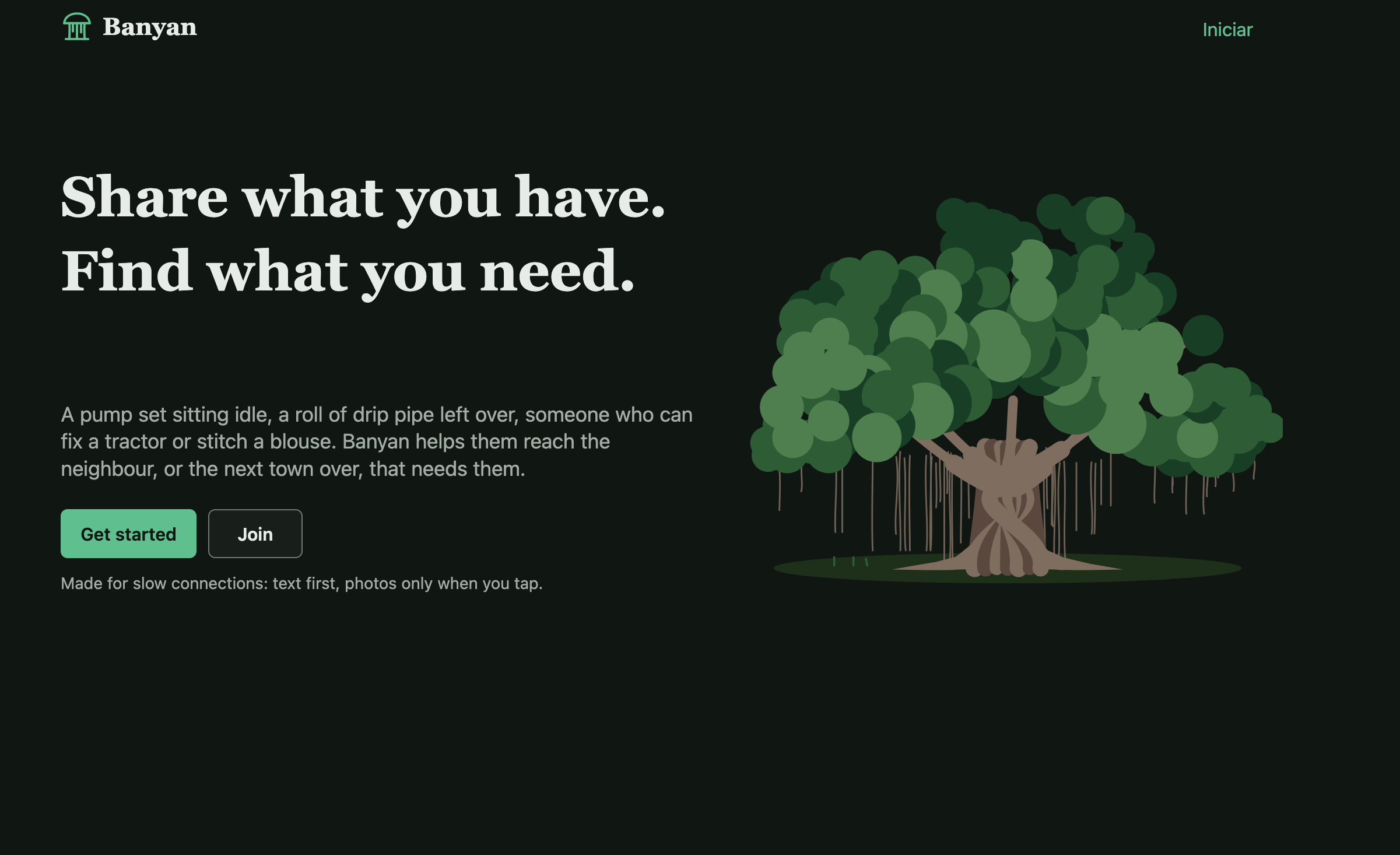
- True Zero-Bandwidth Visuals: Eliminating font files and third-party styling CDNs entirely, drawing illustrations such as the growing Banyan tree landing visual directly in lightweight vector code.
What we learned
- Building for resource-constrained environments is not simply about minifying code—it requires a complete shift in product empathy. Showing a user the byte count of an image before they choose to open it creates immediate transparency and digital trust.
- Small, open-weights language models (like Qwen3-4B) are fast and cost-effective when applied as specialized intent parsers rather than full conversational agents, keeping backend operating costs and response latency low.
What's next for Banyan
- SMS & USSD Fallback Integration: Extending listing creation and discovery to basic feature phones via two-way SMS and USSD menus for regions where mobile data is completely unavailable.
- Decentralized Local Mesh Sync: Enabling peer-to-peer data syncing over local Wi-Fi hotspots or Bluetooth Low Energy (BLE) at weekly village markets, allowing communities to trade updates without hitting cellular towers.
- Micro-Rental Escrows: Exploring lightweight, low-fee community credit protocols to handle tool deposits and multi-day equipment borrowing guarantees safely.

Log in or sign up for Devpost to join the conversation.