Inspiration
Traditional banking applications force every customer to navigate the same menus, dashboards, and predefined workflows, even though every financial question is different.
We asked ourselves:
What if the banking interface adapted to the customer's current need instead of forcing the customer to adapt to the interface?
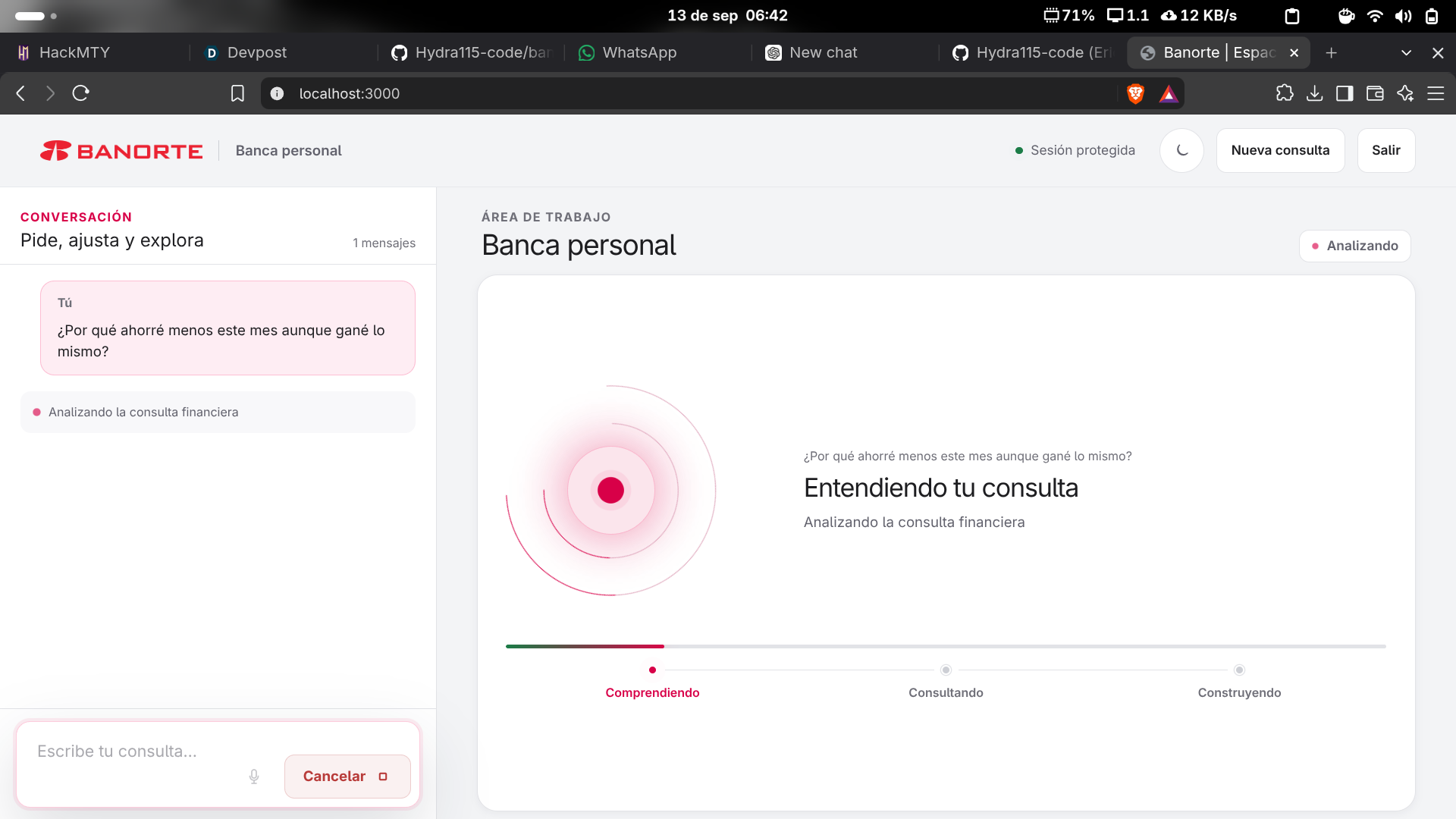
That idea inspired Banorte Gen UI: an experience where AI does more than answer financial questions. It understands the user's intent, securely retrieves the necessary financial data, and generates the most useful interface for that specific situation in real time.
Instead of navigating through multiple screens to find an answer, users simply describe what they want to understand.
What it does
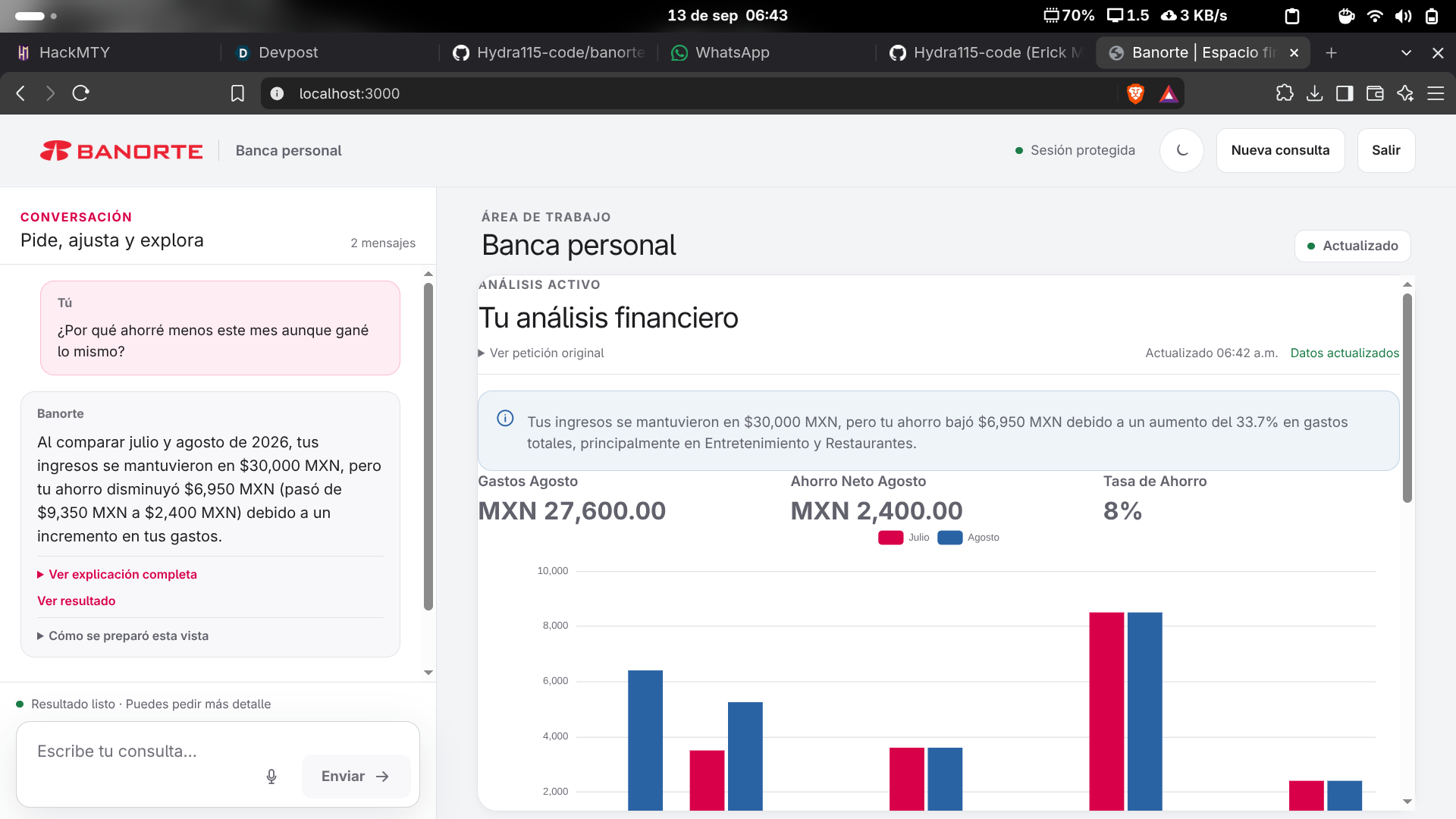
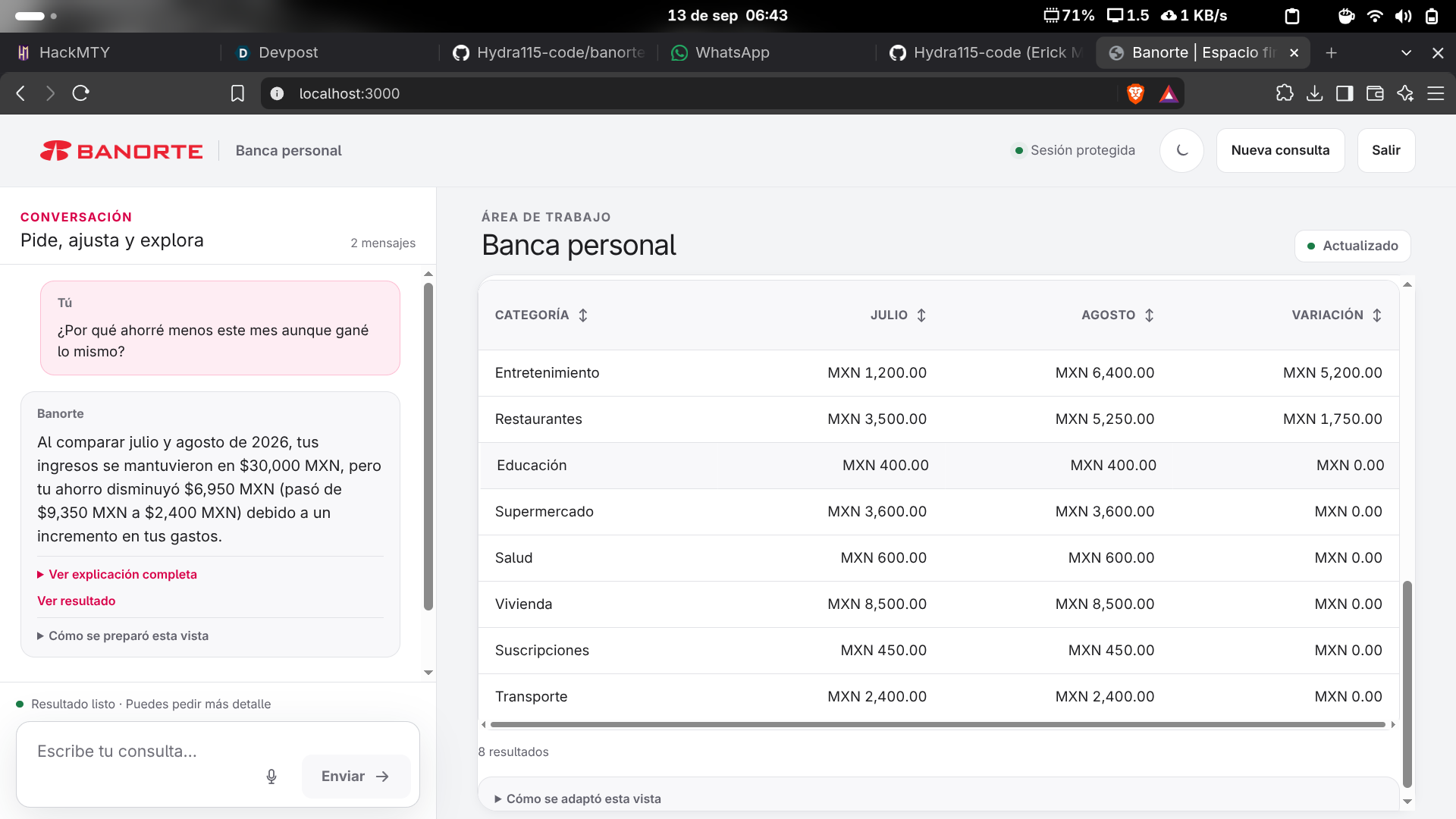
Banorte Gen UI transforms natural-language financial questions into personalized, interactive interfaces.
For example, a user can ask:
“Why did I spend more this month?”
The system analyzes the relevant financial data and dynamically generates the most appropriate combination of:
- Metrics
- Tables
- Charts
- Filters
- Category comparisons
- Supporting transactions
- Financial insights
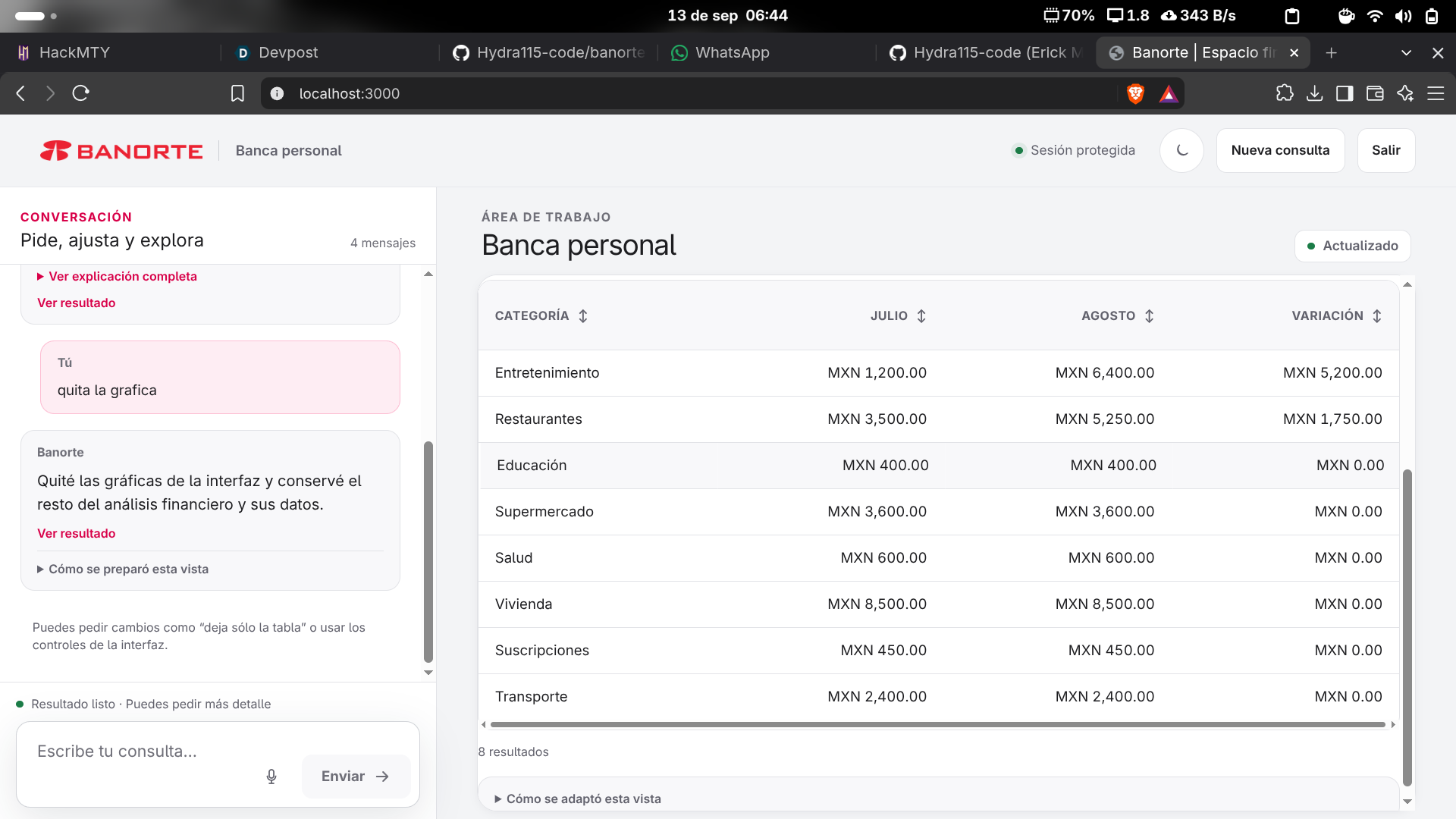
The user can then modify the generated interface conversationally:
“Now show only Entertainment and Restaurants, including the individual transactions behind the change.”
Instead of rebuilding the experience from scratch, the interface updates while preserving its financial data, session state, conversational context, and previous UI revisions.
Users can also interact through voice using ElevenLabs real-time transcription, making financial exploration more natural and accessible.
How we built it
The frontend is built with:
- Next.js
- React
- TypeScript
- Zustand
- Apache ECharts
- Motion
- Vercel AI SDK
We created a custom renderer capable of transforming validated UI specifications into components from our financial design system.
The backend uses:
- Node.js
- TypeScript
- Google Gemini
- Model Context Protocol (MCP)
- Zod
- Supabase
Gemini interprets each request, determines which financial information is required, selects the appropriate MCP tools, evaluates their results, and composes a declarative interface.
Our MCP server exposes financial tools and resources for:
- Accounts
- Balances
- Transactions
- Category spending
- Cash flow
- Period comparisons
- Unusual transaction analysis
- Other financial operations
In total, the system integrates 13 MCP financial tools and resources.
Supabase provides authentication, PostgreSQL storage, RPC functions, and row-level security. Every financial request is associated with an authenticated user, and all data used in the demonstration is completely synthetic.
Safe Generative UI
Instead of allowing the model to execute generated HTML or JavaScript, we designed a typed and validated A2UI-equivalent protocol.
The protocol defines approved:
- Layouts
- Components
- Data bindings
- Interactions
- Semantic events
- Incremental UI patches
This gives Gemini flexibility over what interface should be created without giving it unrestricted control over application code.
The complete generation cycle is:
Intent → MCP tools → Financial data → Generated UI → User interaction → Updated UI
Challenges we ran into
Making the interface genuinely generative
Our first challenge was avoiding the creation of a chatbot attached to a traditional dashboard.
Early versions generated nearly identical dashboards for different questions.
To solve this, we separated financial intent from visual composition. Gemini determines what information matters and how it should be presented using our component system instead of selecting from predefined screens.
Conversational UI editing
Another challenge was maintaining context across interface changes.
For example:
“Remove the chart.”
The system needs to understand which chart the user means and modify the existing interface rather than creating an unrelated new response.
We implemented:
- Persistent sessions
- UI revisions
- Data revisions
- Interface snapshots
- Semantic events
- Incremental patches
This allows the interface to evolve continuously throughout the conversation.
Financial accuracy
A generated interface may look correct while presenting an unsupported financial conclusion.
Because this is a financial application, we introduced deterministic safeguards for cases such as:
- Unsupported conclusions
- Insufficient anomaly samples
- Unequal comparison periods
- Hidden category substitutions
- Forecasts without disclosed assumptions
- Interfaces contradicting explicit user instructions
Gemini handles interpretation and presentation, while deterministic validation ensures that the financial evidence supports the generated result.
Avoiding overly restrictive validation
Some early safeguards were too strict.
For example, when a user requested transactions from Entertainment and Restaurants, two separate tables containing one category each could incorrectly fail validation because each table individually did not contain both categories.
We changed the validator to reason about the complete interface composition rather than isolated components.
This allowed flexible layouts while still rejecting interfaces containing missing, unsupported, or additional categories.
Reducing generation latency
Originally, users had to wait for the entire reasoning and UI generation process before seeing anything useful.
We redesigned the rendering pipeline to progressively stream a data-bound interface while Gemini continues refining the final result.
This reduced the median time to first useful interface from:
$$ 12.76\text{ seconds} \rightarrow 3.75\text{ seconds} $$
representing a:
$$ \frac{12.76 - 3.75}{12.76}\times100 \approx \mathbf{70.6\%} $$
improvement.
Accomplishments that we're proud of
- Built a closed-loop generative UI system, rather than a chatbot beside a fixed dashboard.
- Integrated Gemini with 13 MCP financial tools and resources.
- Created a safe, typed A2UI-equivalent protocol.
- Enabled conversational modification of generated interfaces.
- Implemented incremental UI and data patches.
- Preserved sessions and previous interface revisions.
- Protected user data using Supabase Auth and Row Level Security.
- Integrated real-time voice transcription with ElevenLabs.
- Added recovery mechanisms for invalid UI, interrupted streams, partial data, and revision conflicts.
- Reduced median time to first useful UI from 12.76 seconds to 3.75 seconds.
- Achieved a 70.6% performance improvement.
- Completed 15 out of 15 optimized performance runs without UI or data-patch errors.
- Used exclusively synthetic financial data throughout the project.
What we learned
We learned that generative UI requires much more than asking an LLM to return JSON.
A reliable generative interface requires:
- Typed contracts
- Secure data-access tools
- Controlled UI components
- Semantic validation
- Session management
- State synchronization
- Progressive streaming
- Domain-specific safeguards
We also learned that generative systems and deterministic systems work best together.
Gemini determines how to interpret a financial request and how the answer should be presented.
Deterministic validators ensure that the generated interface remains consistent with the available financial evidence.
One of our most important lessons was that failure should also be intent-aware.
When a proposed interface is invalid but the underlying financial data is correct, the system should not return a generic error.
Instead, it should preserve the evidence and render a smaller, safer interface that still helps the customer make progress.
What's next for Banorte Gen UI
Our next steps include:
- Expanding the personal banking component catalog.
- Supporting personalized budgets and savings goals.
- Adding recurring-spending detection and configurable alerts.
- Improving forecasting with clearly disclosed assumptions.
- Learning user presentation preferences without sacrificing safety.
- Conducting accessibility and usability testing with real participants.
- Building a larger evaluation dataset for financial accuracy.
- Adding distributed session storage and production observability.
- Extending the architecture to additional banking experiences.
Our long-term vision is to build a banking platform where the interface is no longer a static collection of screens.
Instead, every interface is dynamically constructed around the financial decision the customer is trying to make.
Built With
- next.js
- react


Log in or sign up for Devpost to join the conversation.