-
-
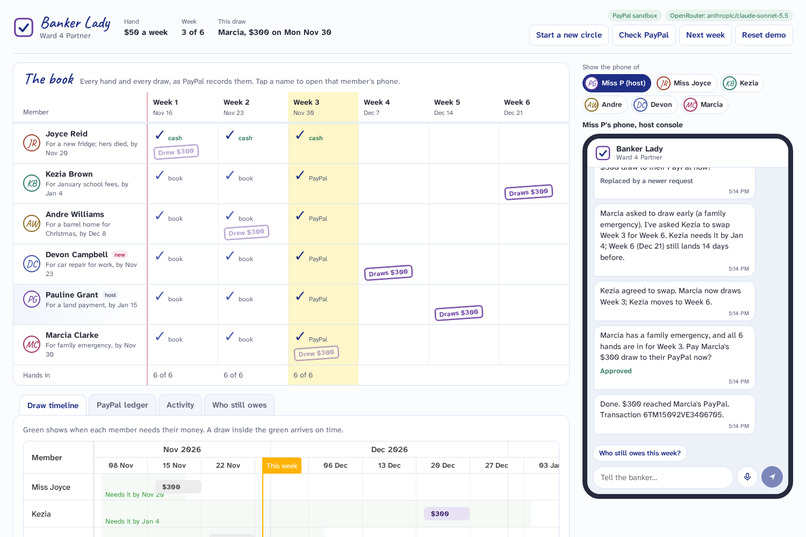
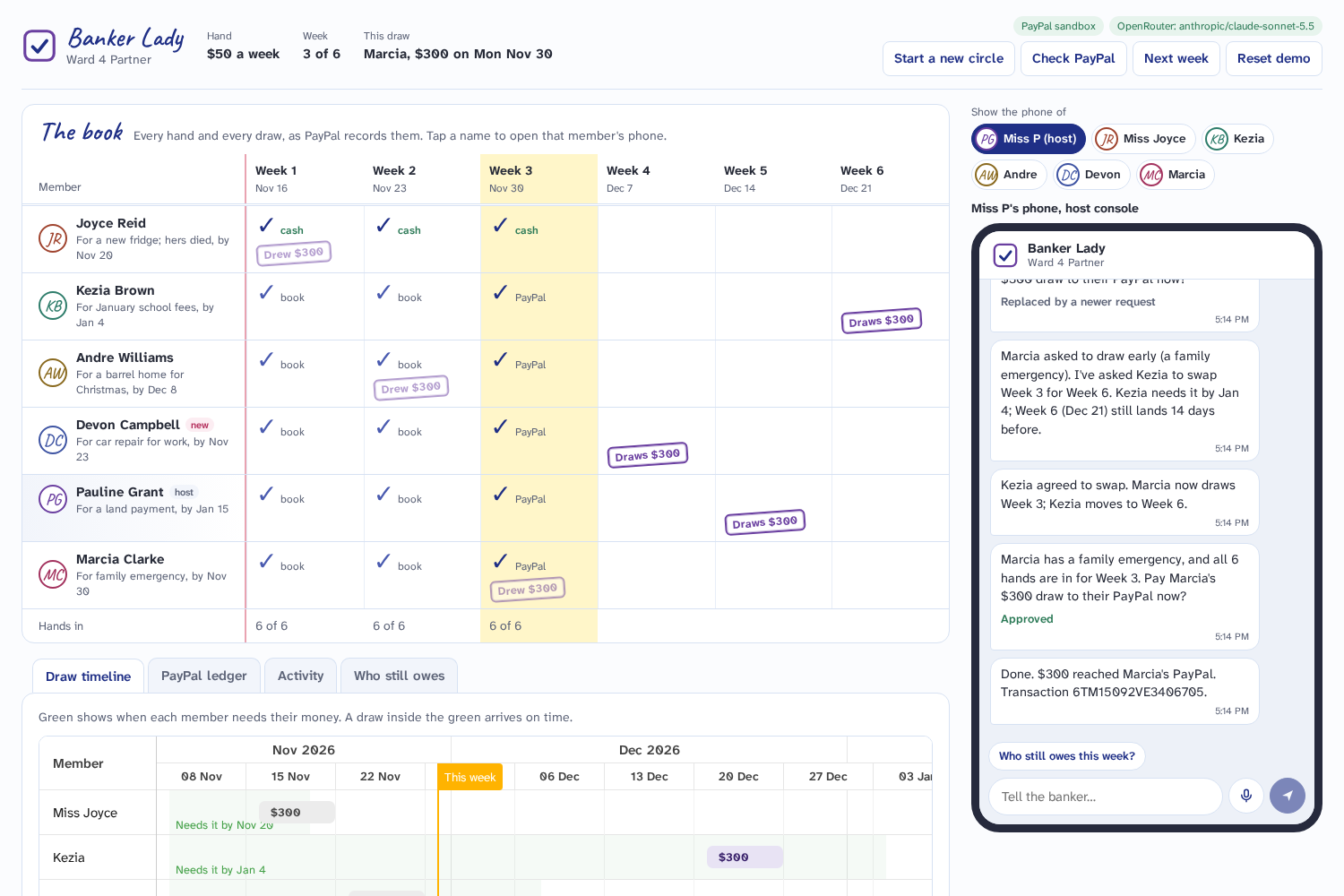
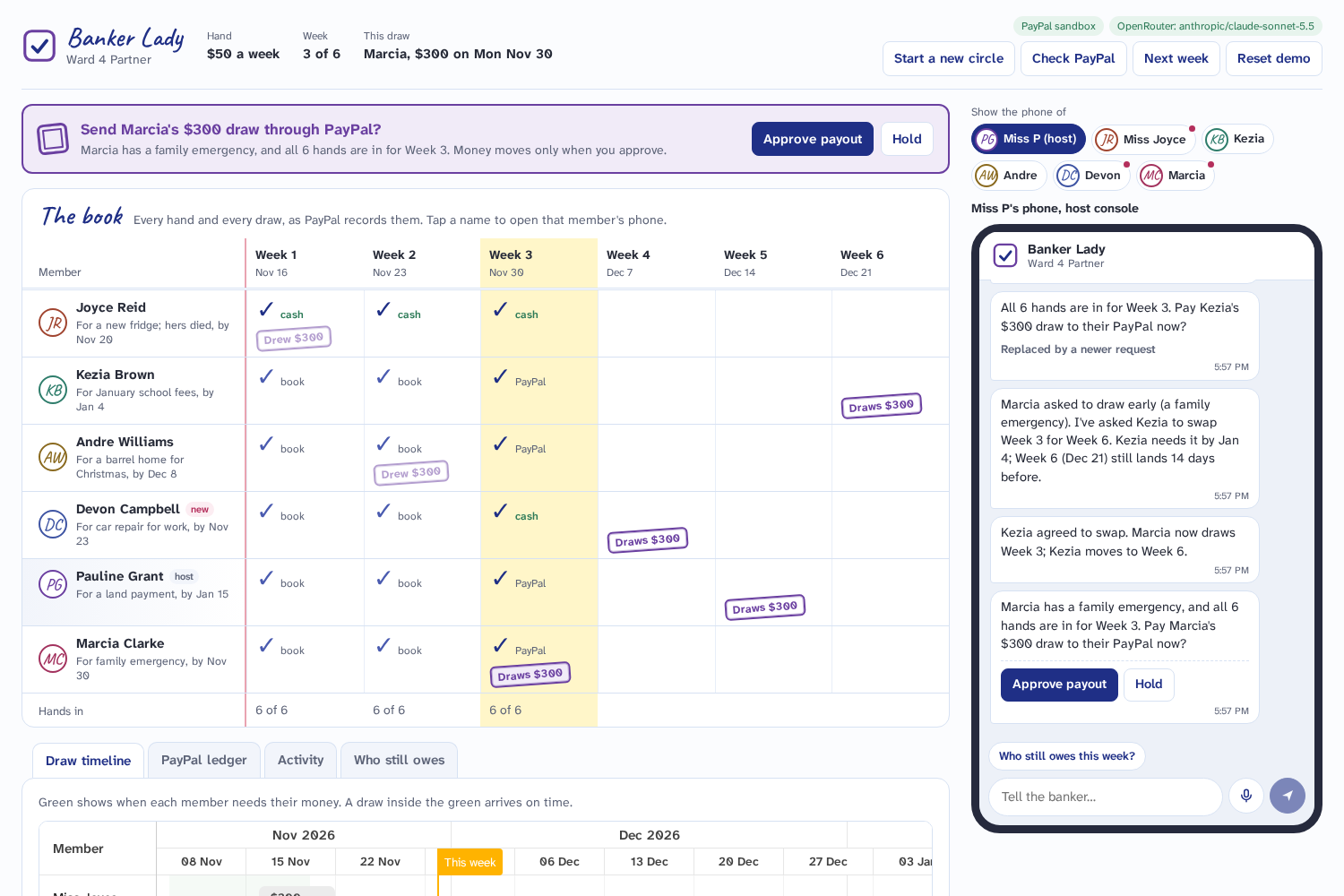
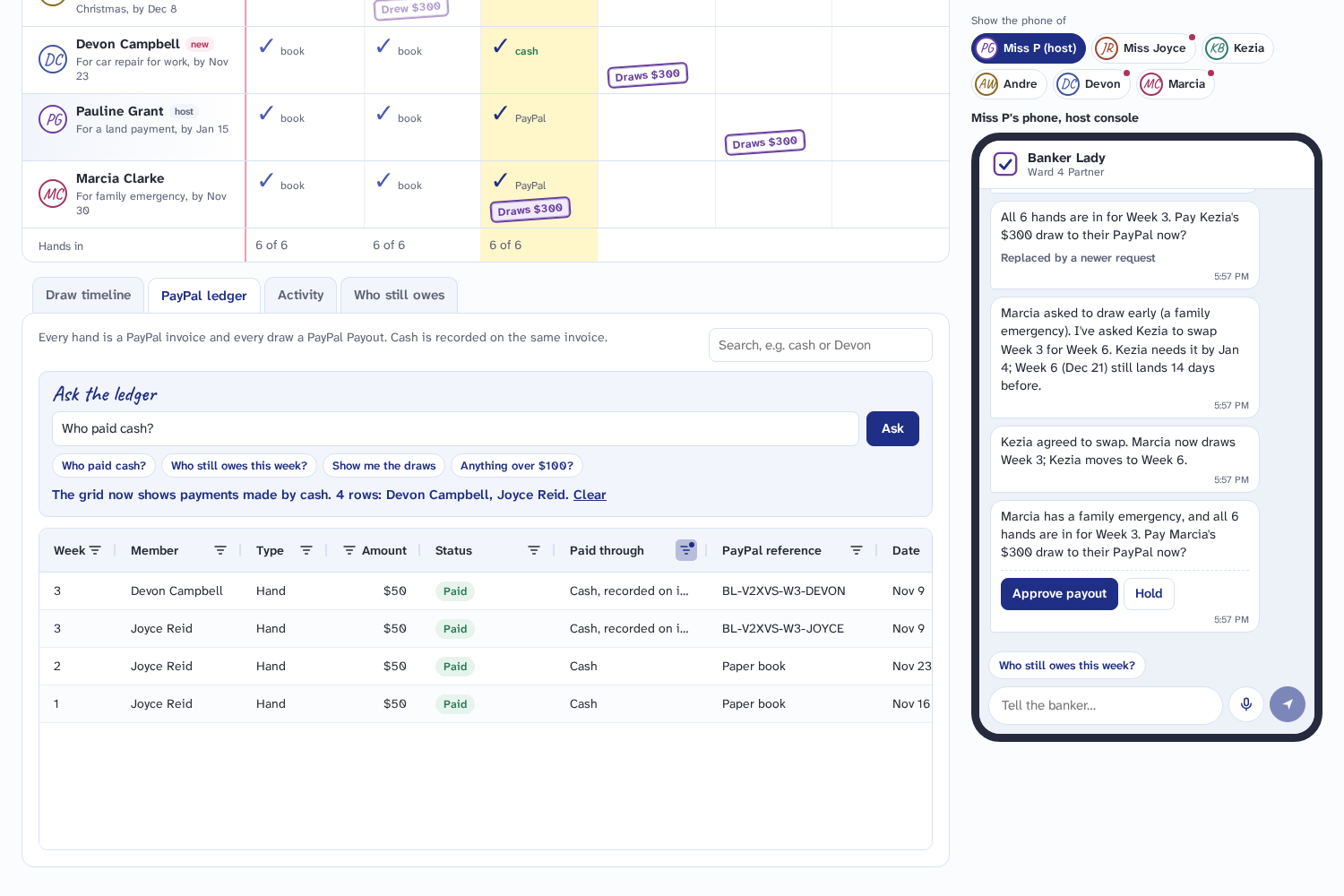
All six hands are in and Marcia's $300 draw has landed through PayPal Payouts.
-
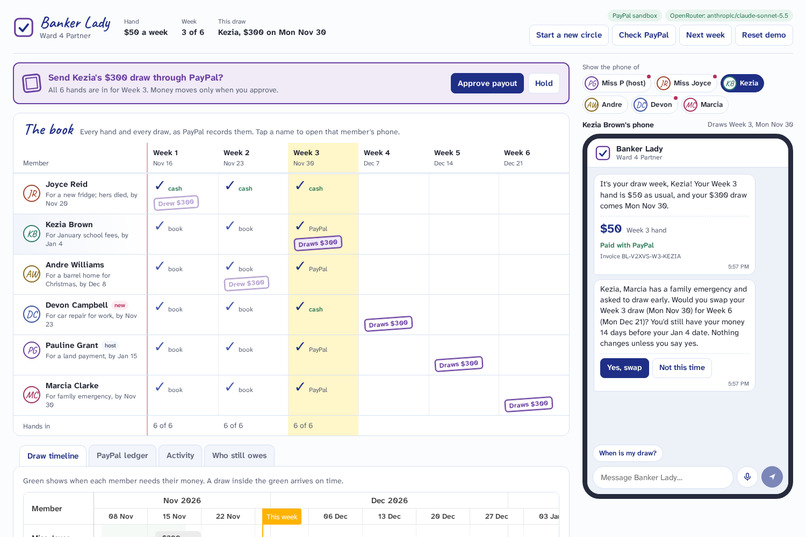
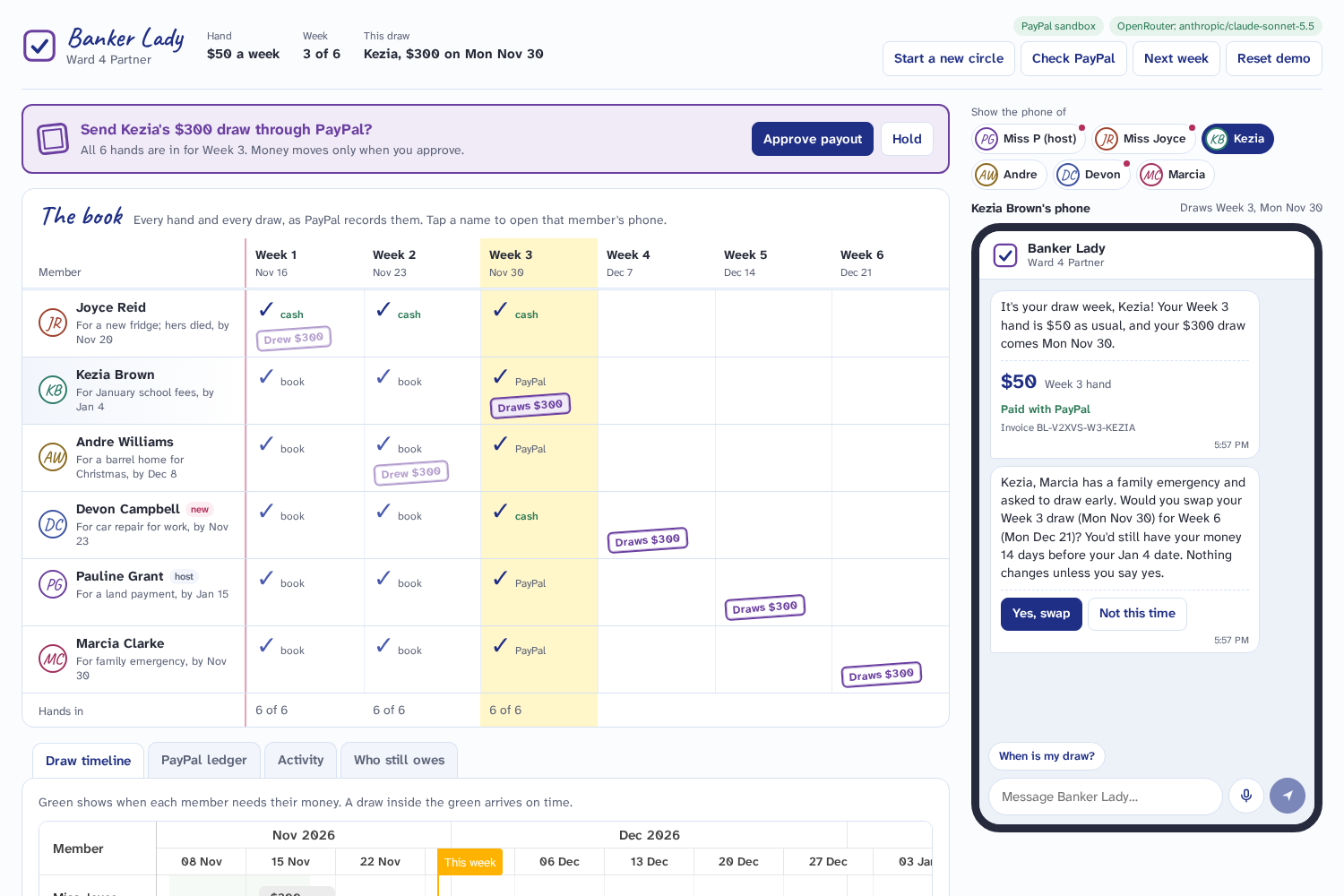
Kezia is asked to swap in plain words. She only hears "family emergency", and nothing changes unless she says yes.
-
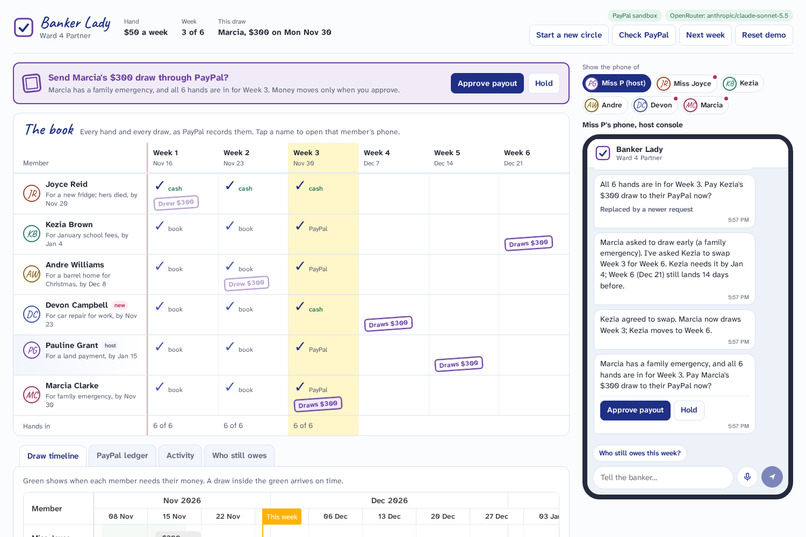
The AI can't move money. Every payout waits for the host to tap Approve.
-
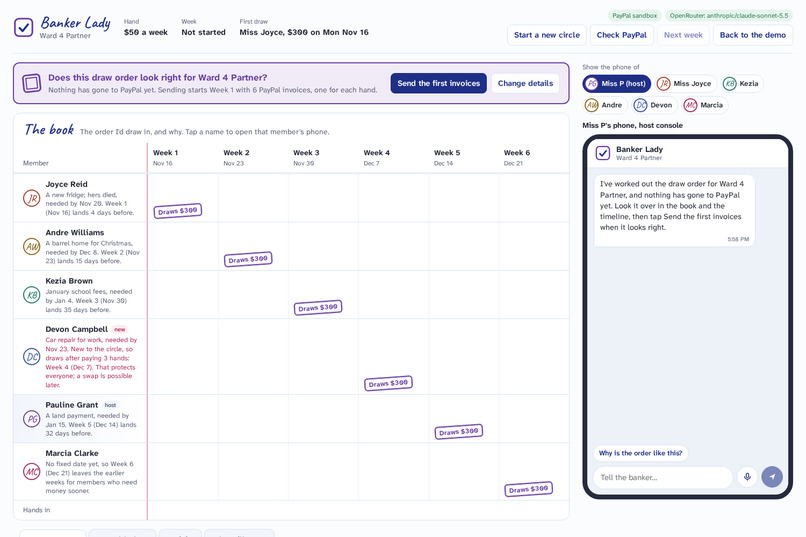
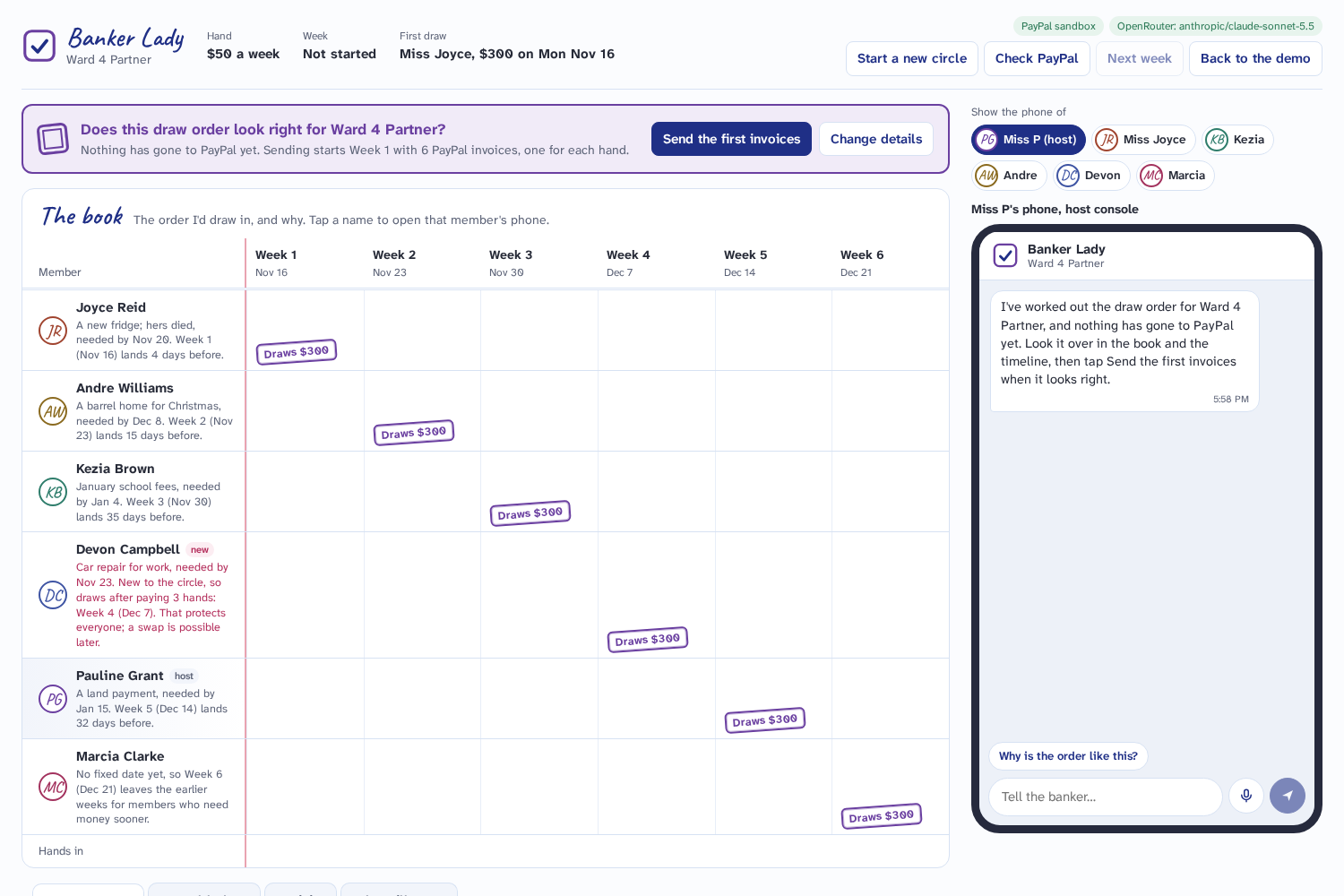
A new circle gets a fair draw order with a reason for each member, before any PayPal invoice goes out.
-
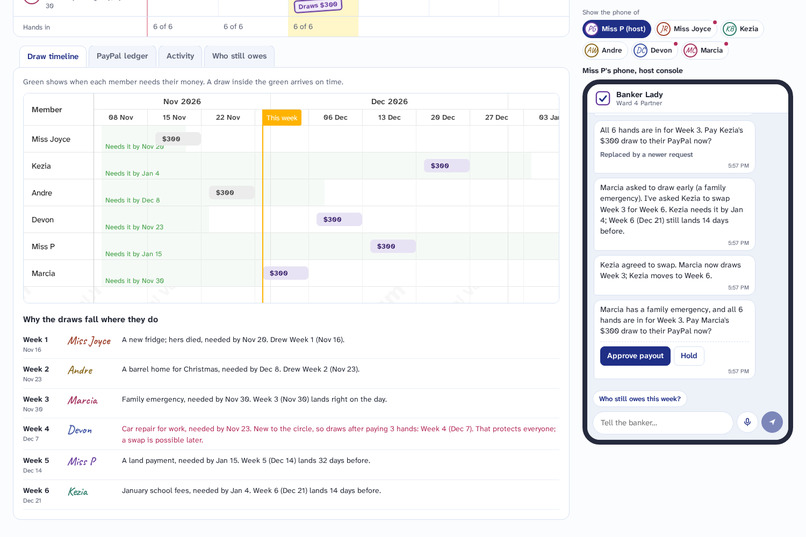
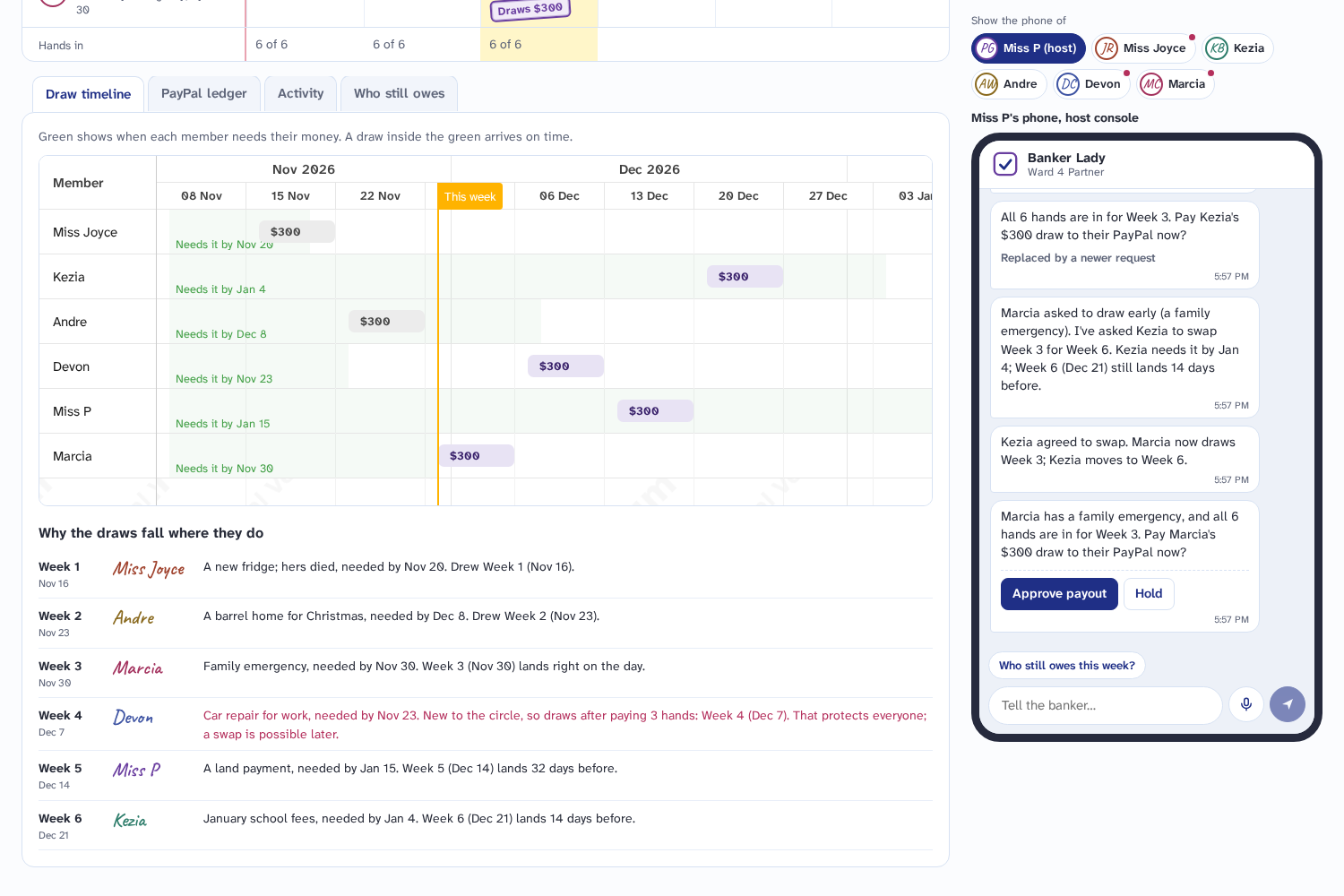
The Bryntum timeline shows each draw against the date that member needs their money.
-
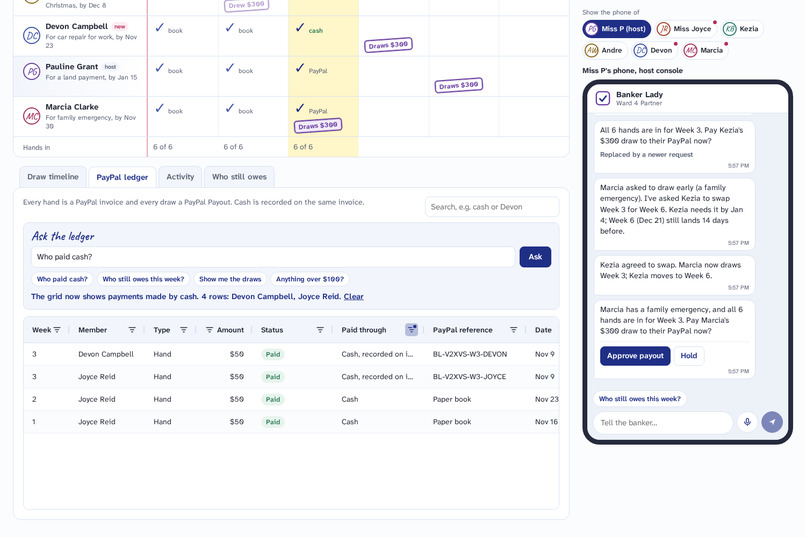
Ask the ledger turns "who paid cash?" into a real AG Grid filter over PayPal records.
-
-


Inspiration
Long before banking apps, families saved together. It's called partner in Jamaica, susu in West Africa and the Caribbean, tanda in Mexico and committee in South Asia. Each week, every member "throws a hand" (a fixed amount) into the pot, and one member takes the whole "draw". Circles like these have paid for homes, school fees, nurse training and flights home for funerals.
They also rest on one person, the banker, who keeps the book, chases late hands, juggles emergencies and holds the money. When that trust breaks, families can lose everything. In March 2001, hundreds of angry members of a "partner" scheme in Montego Bay, Jamaica, crowded its offices demanding their money back. I wanted to keep the warmth of a good banker and remove the single point of failure.
What it does
Banker Lady runs a savings circle on PayPal, with Claude doing the banker's judgment work.
Banker Lady is agentic commerce with a human in the loop: the agent sends reminders, records cash payments and prepares payouts through PayPal, but only the host can release money.
- Every hand is a PayPal invoice. Members pay in PayPal, and cash handed to the host is recorded on the same invoice, so the book and PayPal never disagree.
- Every draw is a PayPal Payout, sent only after the host taps Approve. The AI can't move money.
- The draw order is fair by design. The host enters each member's goal and date. Banker Lady places each draw so the money arrives before it's needed, and new members draw only after paying in for a few weeks. The host sees the order and the reason for each draw before any invoice goes out.
- Emergencies are handled kindly. In the demo, Marcia needs her draw early. Banker Lady finds that Kezia can swap and still have her money 14 days before her school fees are due. Kezia is asked in her own language, and nothing changes unless she says yes.
- Private things stay private. The circle only sees "family emergency". The details stay between Marcia and the banker.
- Reminders come without shame, in each member's language, including Jamaican Patois.
- Ask the ledger turns a question like "who paid cash?" into a real grid filter.
How I built it
Banker Lady is TypeScript throughout: a Node and Express server, a React web app and live updates over server-sent events. I built it with Claude Code.
- PayPal: Invoicing v2 creates and sends invoices, sends reminders and records cash payments. Payouts v1 sends the draws.
- One path to money: buttons, Claude's tools and the offline fallback all call the same actions, so the AI has no way around the host's approval.
- Claude: Sonnet 5.5 runs through OpenRouter with tool calling. JSON schema responses turn a plain question into a ledger filter.
- Draw order: the Hungarian algorithm assigns the weeks, so the order comes from code that can explain itself.
- Sponsor tools: a Bryntum Scheduler timeline shows each member's need-by window against their draw, an AG Grid ledger lists every PayPal record, and Render hosts the app from one
render.yaml. - No keys needed: simulated PayPal and an offline banker let anyone run the whole demo.
Challenges I ran into
Keeping a secret from a helpful model. Testing with the real model showed that one tool could write an emergency's private details into the goal text the whole circle sees. I removed that path, then went further, because no filter can reliably catch a paraphrase. Private details now stay on the server, each browser receives only its own phone's chat, the model sees a detail only when talking to that member, and swap requests use fixed wording with no model text in them.
Dates. Given "Mon Nov 30", the model guessed the year and stored a date in 2020. It now gets full dates, and the tool rejects anything before the circle starts.
Money has more states than paid and unpaid. Running the full flow on the PayPal sandbox exposed gaps in my handling of payouts that are held or fail, and of the status poll overlapping with a cash payment. Each of those now has its own handling.
A public demo with no sign-in. Limits per visitor and a daily cap on AI calls keep strangers from running up the bill.
What I learned
Prompts are for tone and judgment. Rules about money and privacy belong in code, where the model can't talk its way past them. A member can only act for themselves because the tool layer enforces it, and a payout can only create a request for the host.
I also learned to test the tests. I removed each of seven privacy protections in turn to confirm that npm test failed each time.
What's next
Member sign-in comes first: the demo lets anyone open any phone to show the story, so privacy currently holds per phone rather than per person. After that, a database in place of in-memory state and PayPal webhooks in place of polling.
Try it
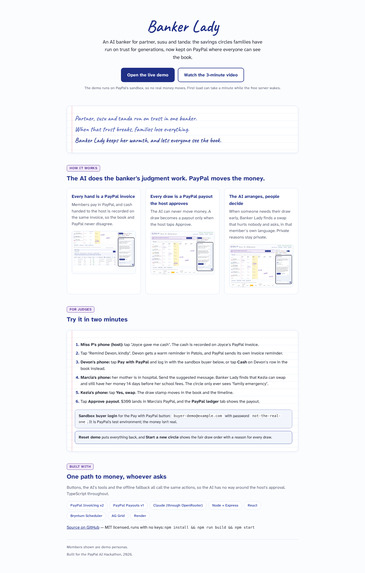
Open the live demo and allow up to a minute for it to wake. It uses the PayPal sandbox, so no real money moves. The story starts in Week 3 of a six-person circle:
- On Miss P's phone, tap "Joyce gave me cash", then "Remind Devon, kindly".
- In the book, tap Cash on Devon's row. Paying with the Pay with PayPal button needs a sandbox buyer login.
- Open Marcia's phone and send the suggested message.
- Open Kezia's phone and tap Yes, swap.
- Tap Approve payout, then see the payout in the PayPal ledger tab.
Reset demo starts it again. Everyone shares one circle, so you may see another visitor's changes. To run it yourself with no keys: npm install && npm run build && npm start.
Built With
- ag-grid
- bryntum-scheduler
- claude
- express.js
- hungarian-algorithm
- node.js
- openrouter
- paypal
- paypal-invoicing-api
- paypal-payouts-api
- react
- render
- server-sent-events
- typescript
- vite
