-
-
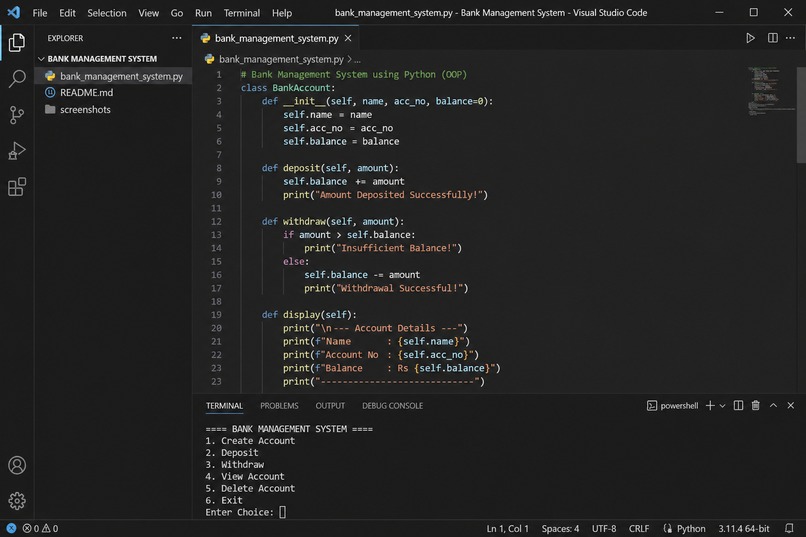
This is my project Bank management image .
-
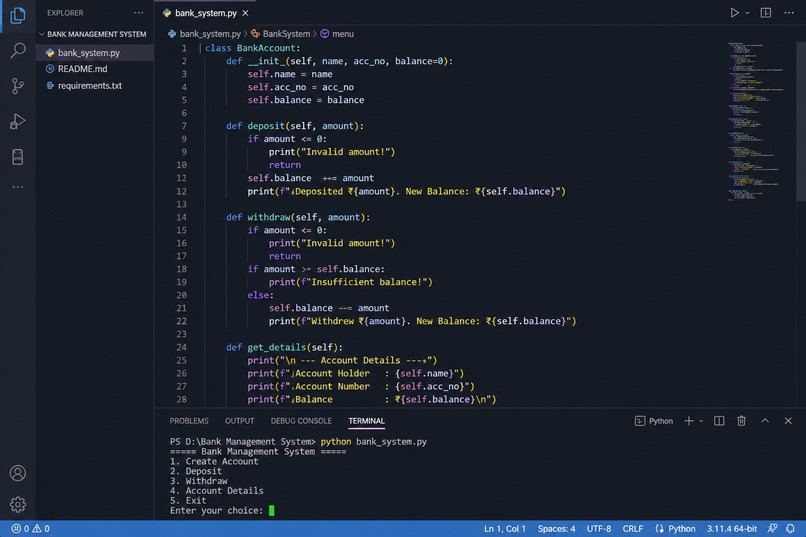
Python coding of bank management system.
Inspiration
The idea of this project came from the need to simplify banking operations. Many small systems still rely on manual processes which are slow and error-prone. The inspiration behind this project came from observing how traditional banking processes can often be slow, complex, and difficult to manage, especially for beginners or small-scale users. In many cases, people still rely on manual systems that are prone to errors and inefficiencies.
As a student learning programming, I wanted to create a solution that not only simplifies these operations but also reflects how technology can improve everyday financial management. This project represents my effort to bridge the gap between theoretical knowledge and real-world application.
I was highly motivated to build something practical that demonstrates the power of Python and Object-Oriented Programming. Through this project, I aimed to design a system that is simple, user-friendly, and capable of handling essential banking tasks such as account creation, transactions, and data management.
This project is not just about coding — it is about understanding real-life problems, thinking logically, and building solutions that can make processes faster, more reliable, and more efficient. It reflects my passion for learning, problem-solving, and continuously improving my technical skills.
What it does
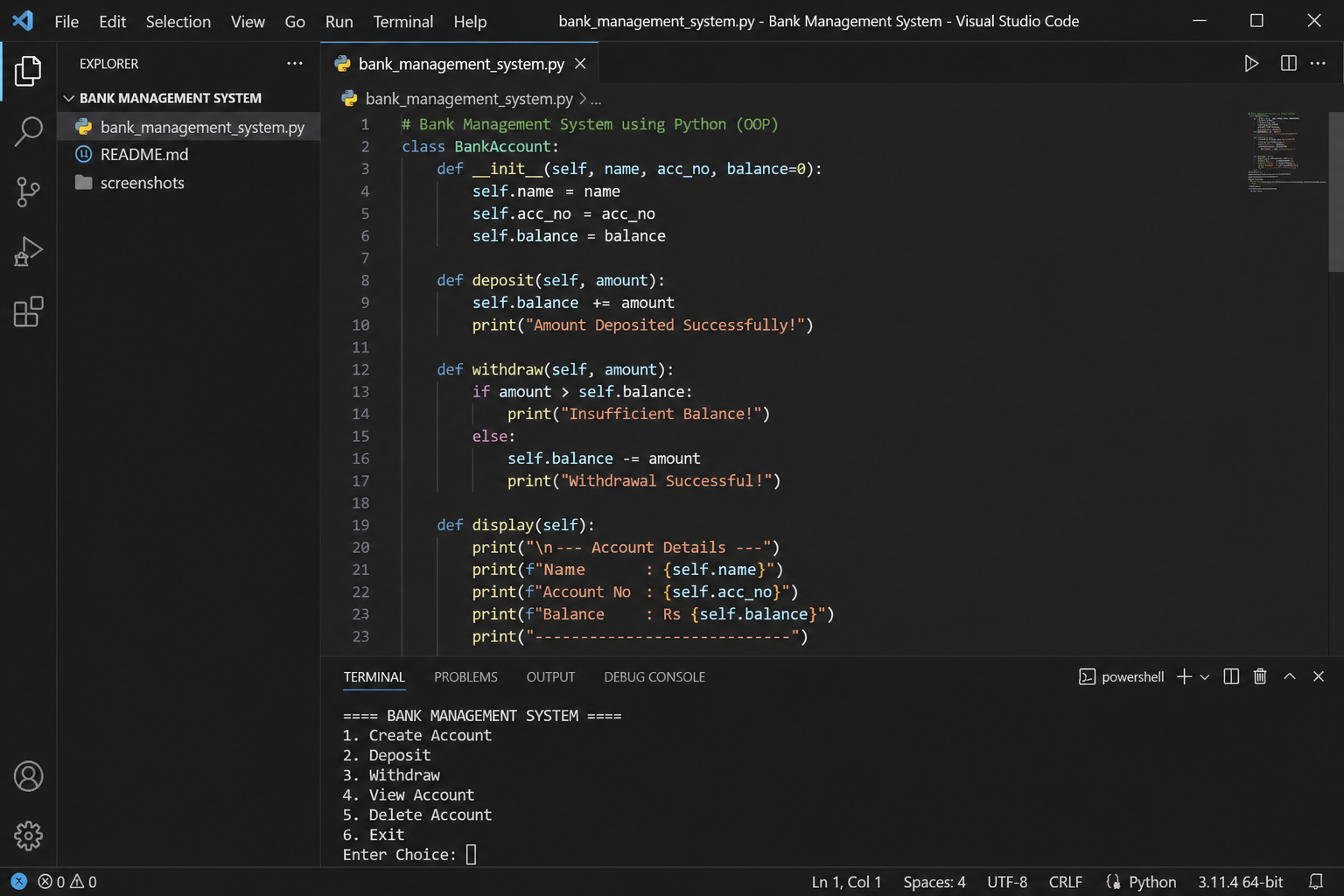
This project is a Bank Management System developed in Python using Object-Oriented Programming. It allows users to create accounts, deposit and withdraw money, view account details, and delete accounts. This project is a fully functional Bank Management System developed using Python and Object-Oriented Programming principles. It is designed to simulate real-world banking operations in a simple, efficient, and user-friendly way.
The system allows users to create and manage bank accounts, perform secure transactions such as deposits and withdrawals, and view complete account details whenever needed. It provides a structured and organized approach to handling financial data, ensuring accuracy and ease of use.
Beyond basic functionality, this project demonstrates how programming can be used to solve real-life problems by transforming manual and time-consuming banking processes into a fast and reliable digital system. It highlights the importance of logical thinking, structured design, and efficient data handling.
The system is built with scalability in mind, meaning it can be further enhanced with advanced features such as graphical user interfaces, database integration, and security systems. This reflects not only the current capabilities of the project but also its potential for future growth.
Overall, this project showcases how a simple idea can be turned into a meaningful solution that improves efficiency, reduces errors, and provides a better user experience through the power of technology.
How we built it
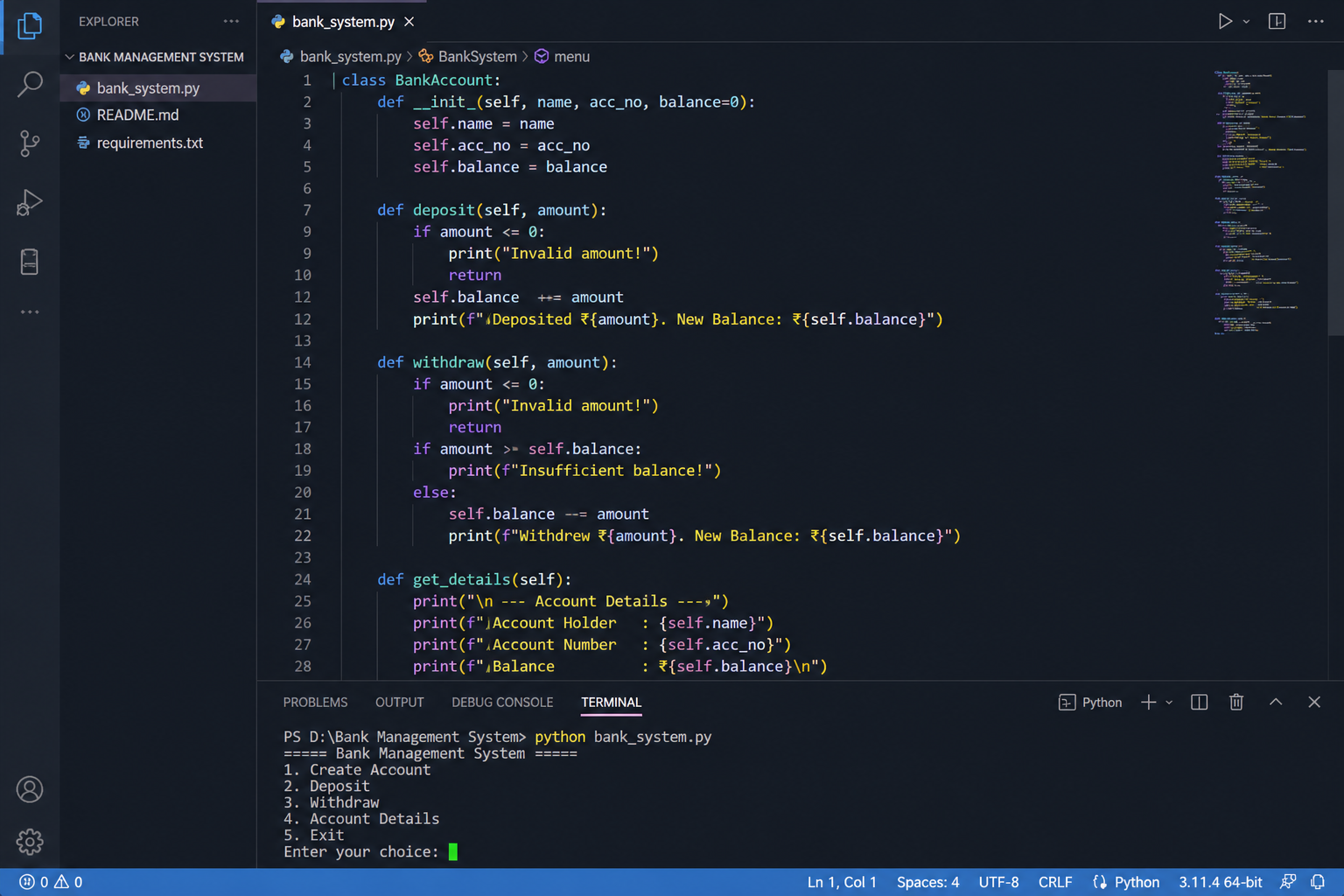
The system is built using Python classes and functions. Each bank account is represented as an object, and a main system manages multiple accounts using a menu-driven interface. The development of this project followed a structured and step-by-step approach, focusing on applying core programming concepts in a practical and meaningful way. We started by understanding the requirements of a basic banking system and identifying the key functionalities such as account creation, transaction handling, and data management.
The project was built using Python, with a strong emphasis on Object-Oriented Programming principles. We designed classes to represent real-world entities like bank accounts and used methods to perform operations such as deposit, withdrawal, and account display. This approach helped us organize the code efficiently and make it more scalable and maintainable.
We implemented a menu-driven interface to ensure smooth user interaction. This allows users to easily navigate through different options and perform actions without confusion. Each feature was carefully tested to ensure accuracy, reliability, and proper handling of edge cases such as insufficient balance or invalid account access.
Throughout the development process, we focused on writing clean, readable, and well-structured code. We continuously improved the system by testing different scenarios and refining the logic to make it more robust and user-friendly.
This project is a reflection of our learning journey, where we transformed theoretical knowledge into a working application. It highlights our ability to think logically, solve problems effectively, and build systems that simulate real-world operations. It also demonstrates our commitment to learning and improving our technical skills through hands-on experience.
Challenges we ran into
One of the main challenges was managing multiple accounts and ensuring correct transaction handling. We also worked on making the system simple and user-friendly. During the development of this project, we faced several challenges that helped us grow as problem solvers and developers. One of the main difficulties was managing multiple bank accounts efficiently while ensuring that each account’s data remained accurate and secure. Handling user input correctly and avoiding logical errors required careful planning and testing.
Another challenge was implementing transaction operations such as deposits and withdrawals in a way that reflects real-world scenarios. For example, ensuring that users cannot withdraw more than their available balance and handling such cases gracefully required proper validation and control flow.
We also encountered challenges in designing a clear and user-friendly interface. Since the system is menu-driven, it was important to make sure that users could easily understand and navigate through different options without confusion. This required refining the structure and improving the flow of the program.
Debugging and testing were also significant parts of the development process. Identifying errors, fixing bugs, and ensuring the system runs smoothly under different conditions required patience and attention to detail.
Despite these challenges, each obstacle became an opportunity to learn and improve. These experiences strengthened our understanding of programming concepts, enhanced our logical thinking, and gave us confidence in building real-world applications. Overcoming these difficulties made the final system more reliable, efficient, and meaningful.
What we learned
We learned how to apply OOP concepts such as classes, objects, and methods in a real-world project. We also improved our problem-solving and coding skills. Through the development of this project, we gained valuable knowledge and hands-on experience in applying programming concepts to real-world problems. One of the most important lessons was understanding how Object-Oriented Programming (OOP) can be used to design structured, scalable, and maintainable systems. We learned how to create classes, define methods, and manage data effectively using objects.
This project also helped us improve our logical thinking and problem-solving skills. We learned how to break down a complex system into smaller, manageable parts and implement each feature step by step. Writing clean and organized code became a key focus, which enhanced both readability and efficiency.
We also developed a deeper understanding of user interaction and input handling. Ensuring that the system responds correctly to different user actions required careful planning and testing. This taught us the importance of validation, error handling, and building user-friendly interfaces.
Another important learning outcome was the value of persistence and continuous improvement. During development, we faced multiple challenges, but by debugging and refining our code, we were able to overcome them. This strengthened our confidence and encouraged us to keep learning and experimenting.
Overall, this project not only improved our technical skills in Python but also taught us how to think like a developer, approach problems creatively, and build practical solutions that can be applied in real-life scenarios.
Future improvements
In the future, this system can be improved by adding a graphical user interface (GUI), database integration, and security features like login authentication. While this project successfully demonstrates the core functionality of a Bank Management System, there are many opportunities to further enhance and expand its capabilities. This project serves as a strong foundation that can be developed into a more advanced and fully-featured application.
One of the major future improvements would be the integration of a graphical user interface (GUI). This would make the system more interactive and visually appealing, allowing users to perform operations through buttons and forms instead of a text-based menu.
Another important enhancement would be the use of a database system such as MySQL or SQLite to store account data permanently. Currently, the data is stored temporarily during program execution, but with database integration, the system would be able to securely store and retrieve user data even after the program is closed.
Security can also be significantly improved by adding authentication features such as login systems, password protection, and data encryption. This would make the system more realistic and aligned with real-world banking standards.
Additionally, the project can be extended by adding advanced features such as transaction history tracking, account statements, interest calculation, and even mobile or web-based access. These improvements would transform the system into a complete digital banking solution.
In the future, this project has the potential to evolve into a professional-level application. It reflects a continuous learning mindset and a commitment to improving both technical skills and practical knowledge. With further development, it can become a powerful system capable of handling real-world banking operations efficiently.
Built With
- classes
- cli
- data-structures
- functions
- loops
- object-oriented-programming
- object-oriented-programming-(oop)
- oop
- problem
- python
- software-development

Log in or sign up for Devpost to join the conversation.