-
-
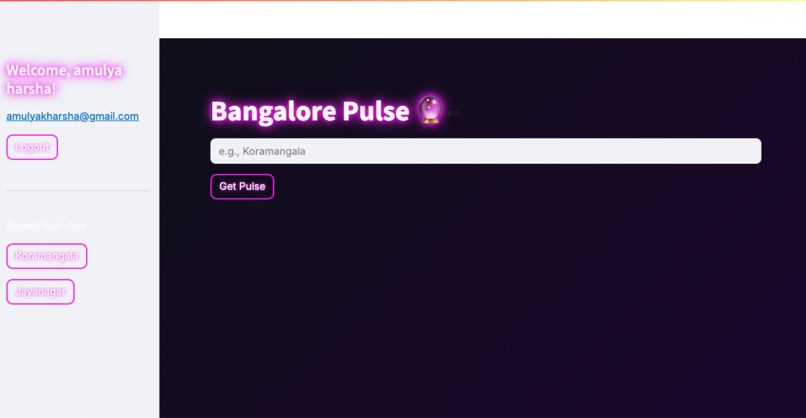
Page after login
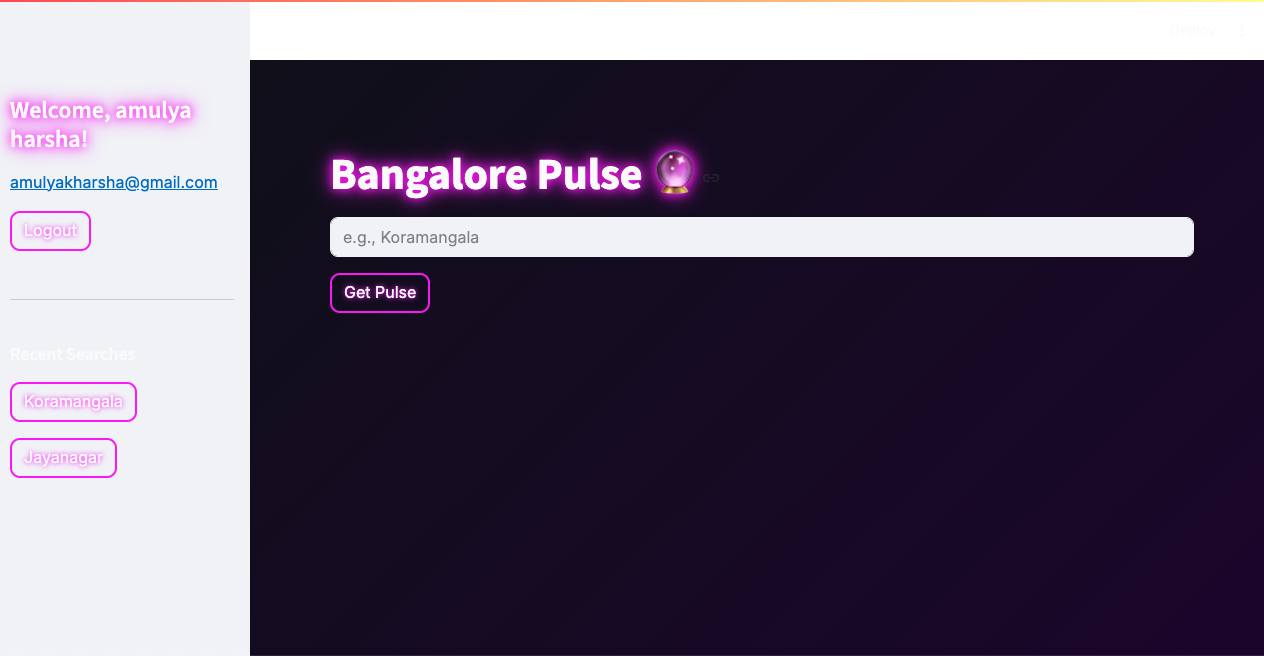
Inspiration
Anyone who lives in Bangalore knows the feeling: you want to go out, but you have a dozen questions. What's the traffic in Koramangala like? Is it raining in Indiranagar? Will I even find parking? We were tired of juggling five different apps just to get a simple answer.
We wanted an app that just tells you. A real-time "vibe check" for any neighborhood, powered by AI, that gives you a clear, human-like summary of what's happening right now. That's how "Bangalore Pulse" was born.
What it does
"Bangalore Pulse" is an AI-powered web app that gives you a live "vibe check" for any neighborhood in Bangalore.
It answers the question, "What's it like in Koramangala right now?". It pulls real-time data from multiple sources—news, web search, local business listings, and weather—and uses the Google Gemini API to analyze everything and produce a simple, human-readable summary.
Key Features
AI-Powered Vibe Check: A concise, markdown-formatted summary of the area's current atmosphere, traffic, and events.
Real-Time Data: Uses NewsAPI, SerpApi, and WeatherAPI for the most up-to-date information.
Local Recommendations: Suggests top-rated cafes and restaurants in the searched area.
Personalized Experience: Uses Auth0 for secure logins and MongoDB Atlas to save each user's search history.
Dynamic UI: Features a custom "Neon Pulse" theme with an animated background and a live map.
How we built it
This was a 48-hour sprint, so I chose my tools for speed and power. I spun up a Streamlit frontend because it's fast and looks great.
The real magic was feeding the brain—the Google Gemini API—a ton of live data. I pulled from NewsAPI and SerpApi simultaneously (using Python's threading so it wouldn't be painfully slow) to get a real-time snapshot of news, social posts, local places, and even the weather. To make it feel like a real product, I added secure logins with AuthО and saved everyone's search history to MongoDB Atlas.
Challenges we ran into
Honestly, a huge chunk of my time was just fighting with APIs. I hit every classic hackathon roadblock: mysterious authentication failures with MongoDB, duplicate key errors in Streamlit, and realizing my perfectly written code was useless because a secrets file wasn't loading correctly. It was a marathon of debugging and learning on the fly.
Accomplishments that we're proud of
Building a Full-Stack App in 48 Hours: I'm proud of creating a complete, end-to-end application from scratch in a single weekend. It includes a secure frontend, a multi-API backend with concurrent data fetching, and a cloud database.
Sophisticated AI Synthesis: I used the Google Gemini API for a complex task beyond simple text generation. The app uses Gemini as a real-time reasoning engine to synthesize messy data from multiple live sources into a single, clear, and valuable insight.
Integrating Six Different Services: I successfully integrated six different cloud services and APIs (Gemini, Auth0, MongoDB, NewsAPI, SerpApi, and WeatherAPI) into one seamless user experience.
A Polished, Memorable UI: I designed and implemented a custom "Neon Pulse" UI with CSS animations and a dynamic background. The goal was to create an engaging product that leaves a lasting impression, not just a functional tech demo.
What we learned
This project was a masterclass in turning a simple idea into a full-stack reality. I learned that an app's magic isn't just in the AI, but in the gritty details of making everything work together—wrangling five different APIs, debugging obscure network timeouts, and managing concurrent data fetching to create a smooth user experience.
The biggest lesson was in value creation. The app's purpose isn't to show news or a map; its value is in the synthesis. I learned how to use Gemini as a tool to transform a flood of overwhelming data into a single, clear, and actionable insight—the "Vibe Check."
Finally, this hackathon taught me about resilience. Hitting roadblock after roadblock is frustrating, but systematically debugging and pushing through is what turns an idea into a working product. I didn't just build an app; I built a complete, end-to-end system from scratch.
What's next for Bangalore Pulse
Hyper-Personalization & Proactive Alerts: The next step is to train the AI on user preferences (e.g., "I'm a foodie," "I prefer quiet places") to provide tailored recommendations. I plan to implement proactive notifications, such as "Heavy traffic detected on your usual route home, consider leaving now."
Deeper Local Integration: I aim to incorporate more Bangalore-specific data sources, including real-time BMTC transit schedules and, crucially, local Kannada-language news and social media to capture a more authentic city pulse.
Community-Powered Insights: The future version will allow users to validate the AI's vibe checks and submit their own real-time reports (e.g., "Road blocked here," "Unexpected crowd"). This creates a powerful, crowdsourced layer of intelligence that keeps the app more accurate than any single data source.

Log in or sign up for Devpost to join the conversation.