Inspiration
In today's internet landscape, It's surprising to spend more that three minutes scrolling instagram reels without seeing an anthropormorphized dogs doing kickflips on skateboards, "fruit with a face eating fruit not with a face," and the countless ai comments promoting the same crypto scheme. While some of these forms of generative content bring harmless fun and practical use cases, people today have also begun to use these accessible tools to promote hate and disinformation online. With our generation having grown up on the internet, a place we grew up supposing would always be a window to the outer world, has today become a known "Slop Fest." In an effort to take a leap ahead of the rapid AI race, and experiment with newly published detection methods, we've developed Baloney.
What it does
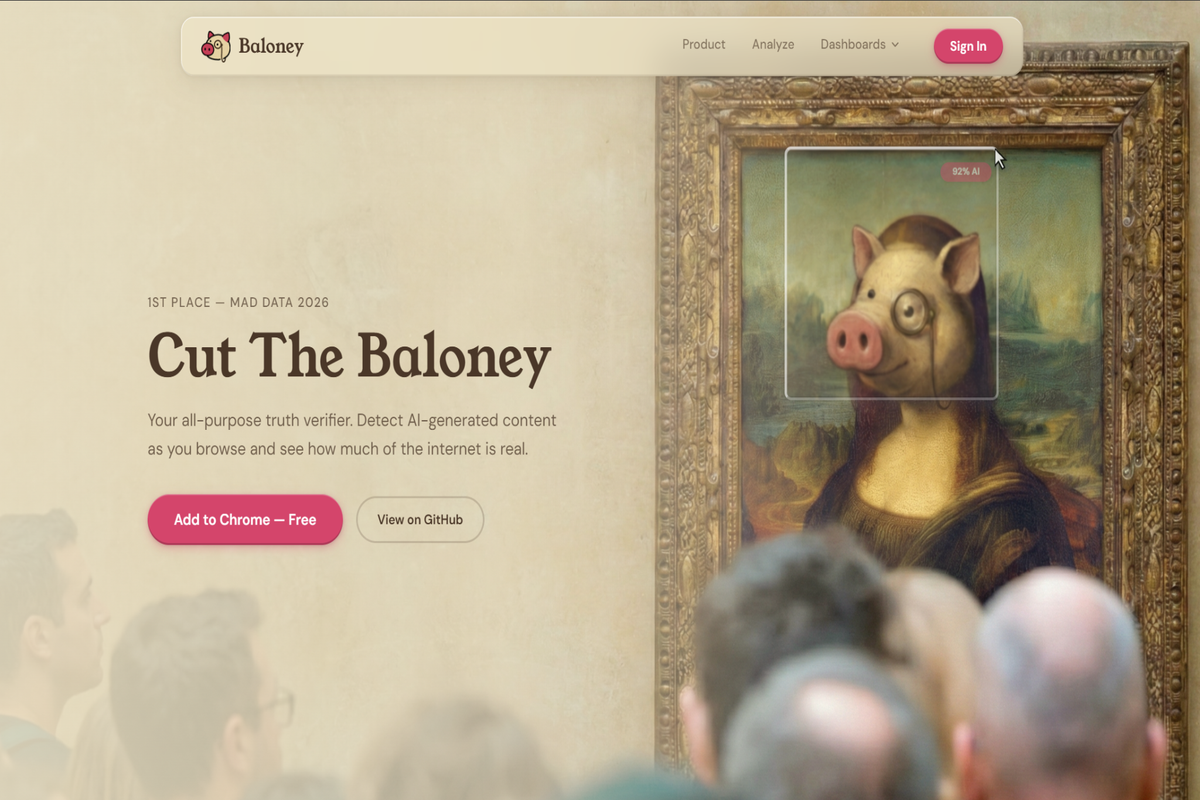
Baloney is a Chrome extension paired with a web analytics dashboard that detects AI-generated content in real time. As you browse any website, the extension silently scans images and lets you highlight text for analysis using a 6+ signal ML ensemble.
How we built it
When developing Baloney, we began by purely brainstorming from the problem perspective exactly how we'd want to fix the problem. We wanted to introduce a non invasive way to detect ai generated content whenever a user prefers such a catered searching experience. Utlizing the Google Chrome Extension SDK, we discovered a way to gather interesting and revealing data about the immense use of generative content online without invading social media sites scraping restrictions by having users opt in. Our extension sends api calls from the collected media content and uses several research backed generative detection models. The analysis returned is stored in a protected supabase database, where when users return to the baloney.app dashboard, they recieve analyzed metric reports on the authenticity of their content.
The detection pipeline combines commercial APIs (Pangram 99.85% text accuracy, SightEngine 98.3% image accuracy), Google SynthID watermark detection (Gemini text + Imagen images), and statistical/frequency/metadata analysis. Frontend: Next.js 16 on Vercel with 17 API routes. Database: Supabase Postgres (7 tables, 11 views, 4 RPCs). Extension: Chrome MV3 with Grammarly-inspired UX.
Data Methods
- 6+ independent detection signals per modality with dynamic weight allocation
- Google SynthID watermark detection — Bayesian detection of invisible Gemini/Imagen watermarks
- 207-sample evaluation benchmark across 15+ content categories
- ROC curves (AUC 0.982), confusion matrix, ablation study proving ensemble > individual methods
- Bootstrap confidence intervals, per-domain accuracy analysis
- SHA-256 content hashing for crowd-sourced provenance tracking across platforms
- Real-world dataset: every scan generates a data point (platform, content type, verdict, confidence, timestamp)
Challenges we ran into
We ran into several challenges when using our models trained on determining generative content when faced with real world data sets. Unlike an image downloaded from Gemini's website with an embedded SynthID metatag that automatically flags it, a screenshot or other altered file could yield false results at this stage in detection technology.
Accomplishments that we're proud of
We're really proud of our ability to learn and build something that addresses a real problem in this new, unknown, and unpredictble field. On top of the chrome extensions usefulness in detecting AI, it also comes equipped with features to completely blur and block out elements on a users page. In combining all of these frameworks, we were able to really consider and make choices on the user experience, app design, display and analysis of data.
What we learned
What's next for Baloney
With how proud of the initial concept we are, we hope to fully finish a production grade version of Baloney, and launched on the chrome web store. In collecting this information, we also note the value this data and our analysis have for social media companies, news outlets, educational institutions, and other entities that would want an accurate determination of AI.
Research opportunities: Misinformation velocity measurement, cross-platform content migration tracking, detection arms race benchmarking, information diet behavioral studies, and data protection insights for web safety standards.
AI Tools Used
Claude Code (Opus 4.6 + Sonnet 4.6) for validation, testing, and error elimination. Every architectural and product decision made by humans. Full disclosure: docs/AI_CITATION.md
Links
- Live Demo: baloney.app
- GitHub: https://github.com/nategarelik/baloney
- AI Citation: https://github.com/nategarelik/baloney/blob/master/docs/AI_CITATION.md


Log in or sign up for Devpost to join the conversation.