-
-
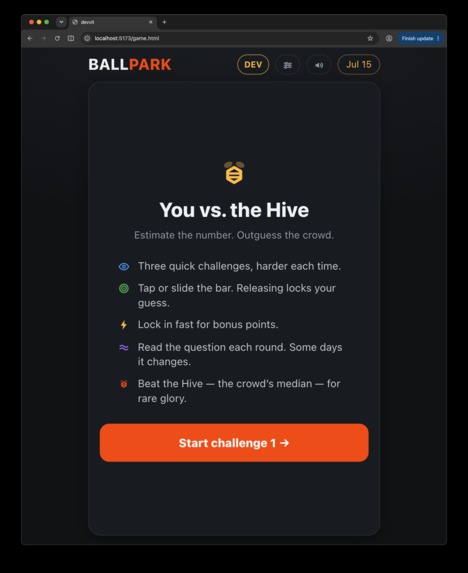
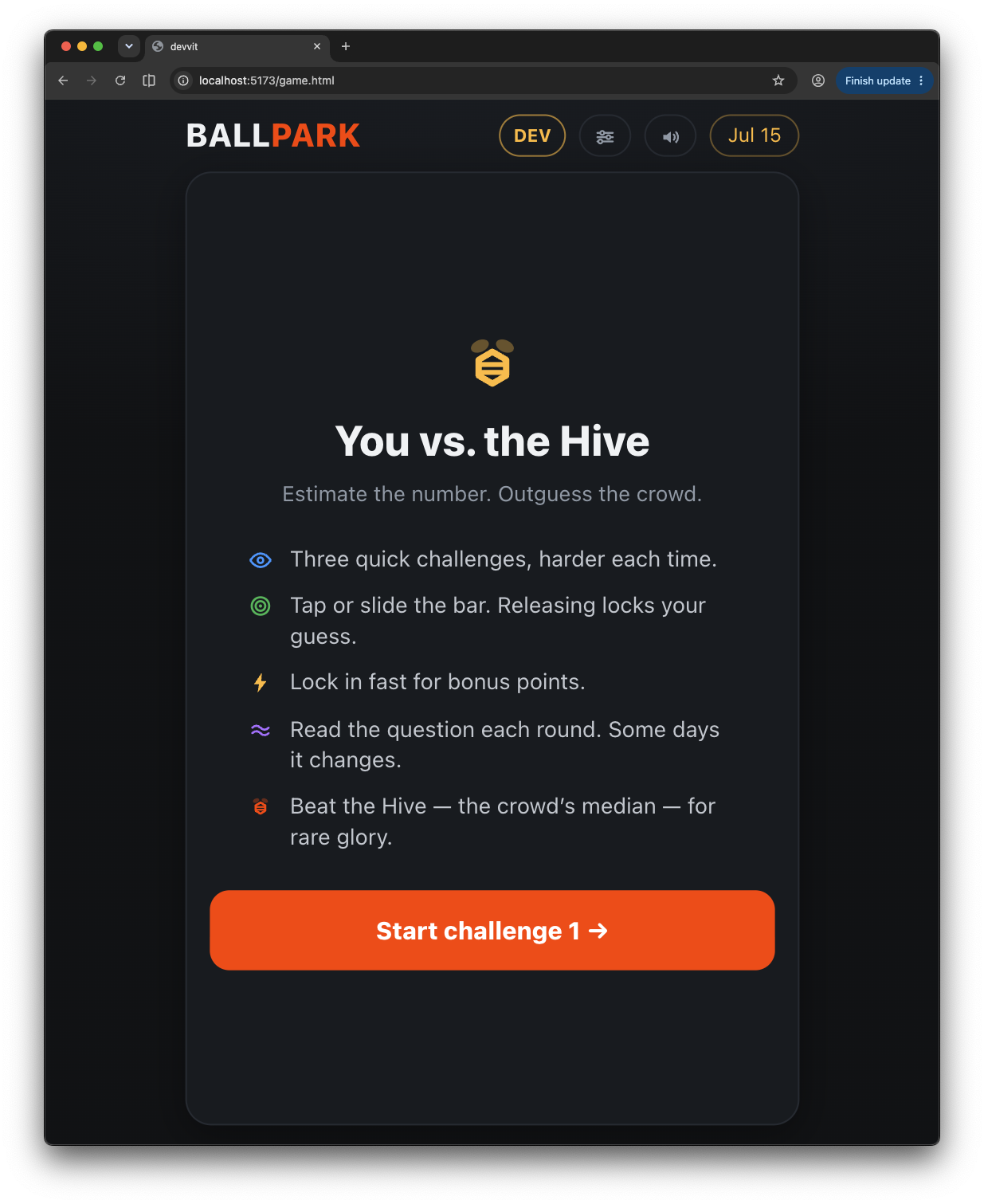
Tutorial and loading screen.
-
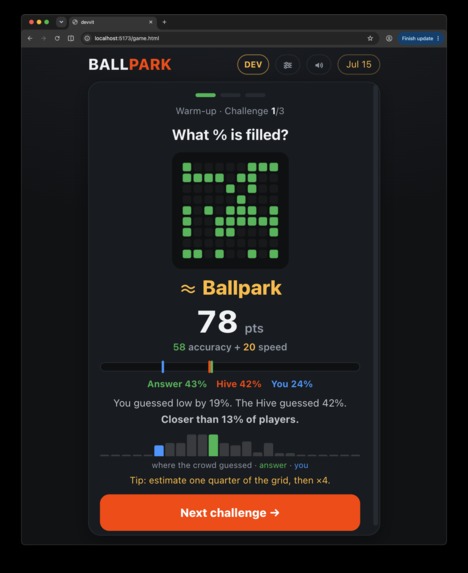
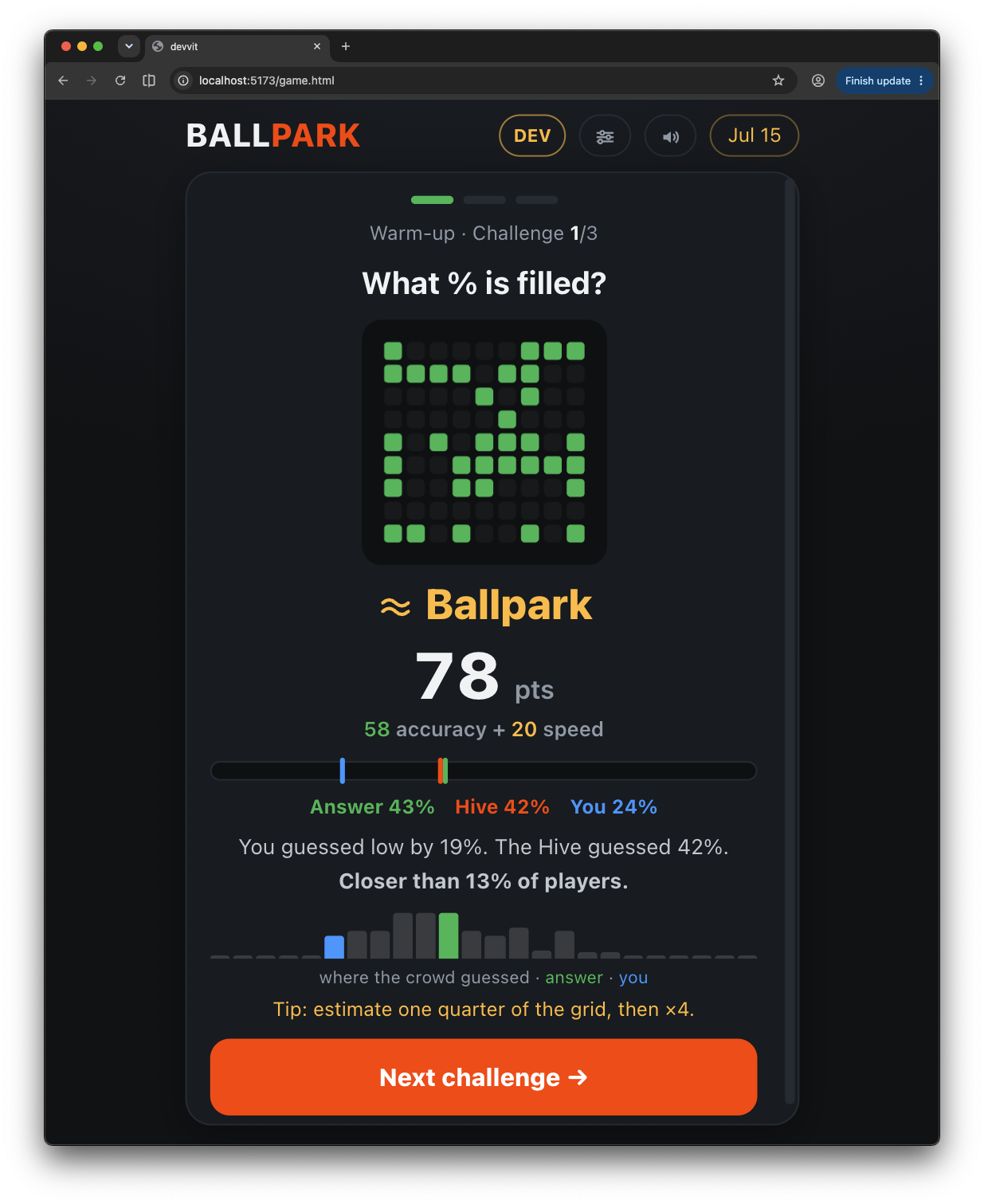
Example easy challenge.
-
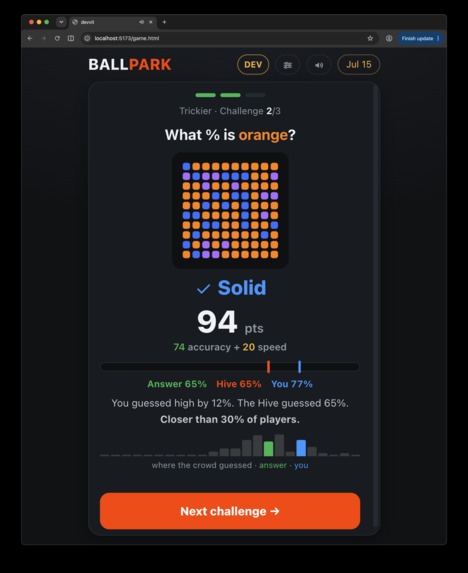
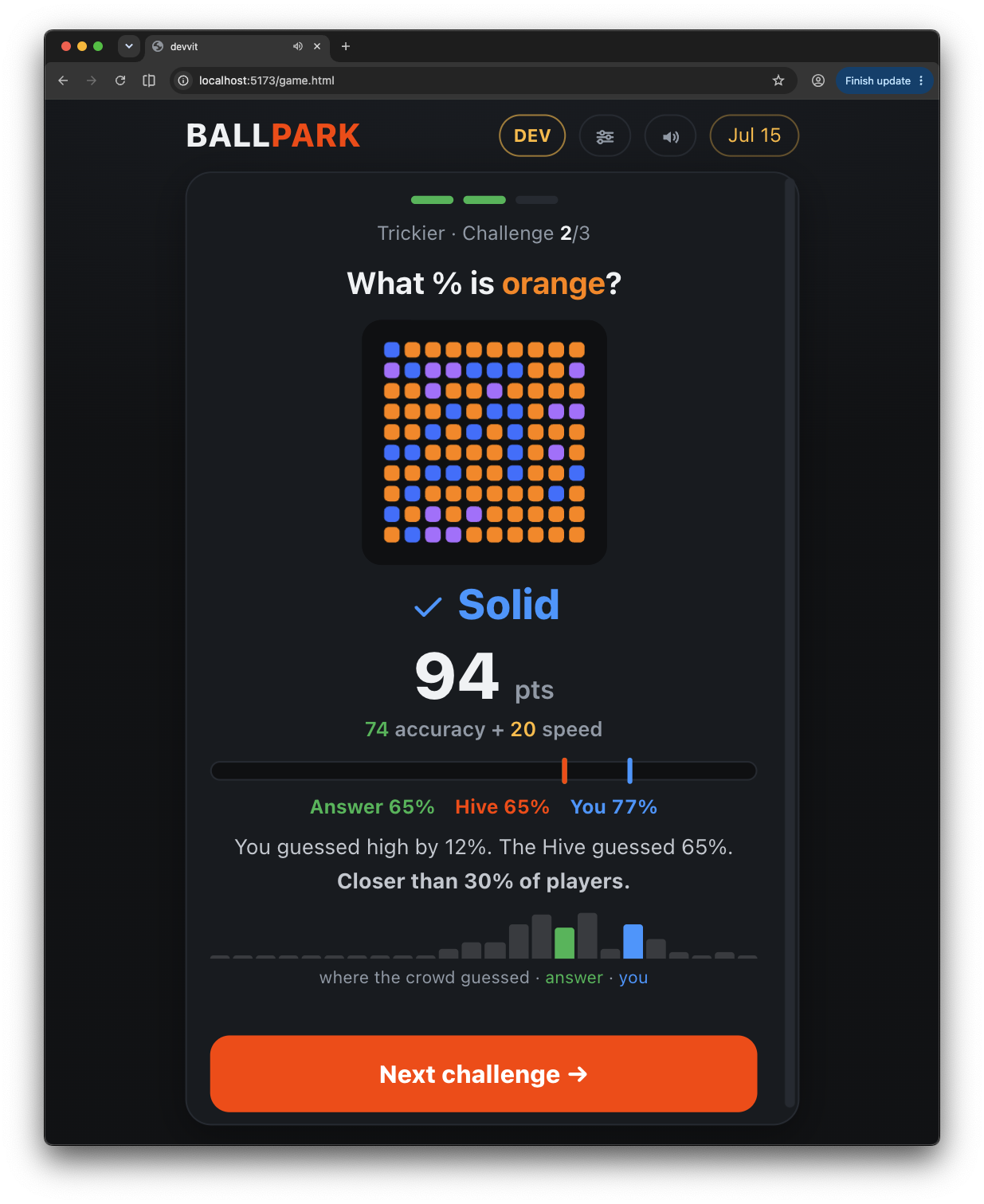
Example medium challenge (mosaic)
-
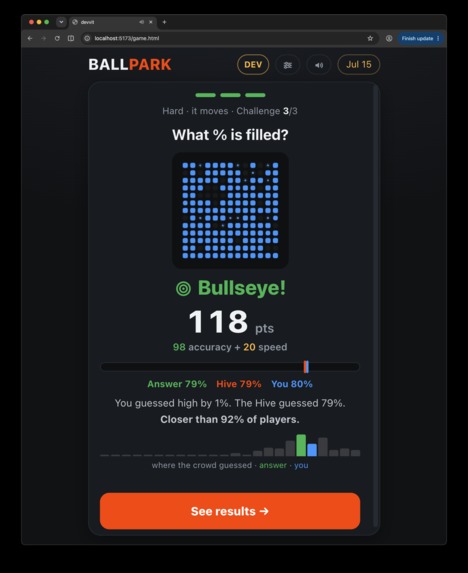
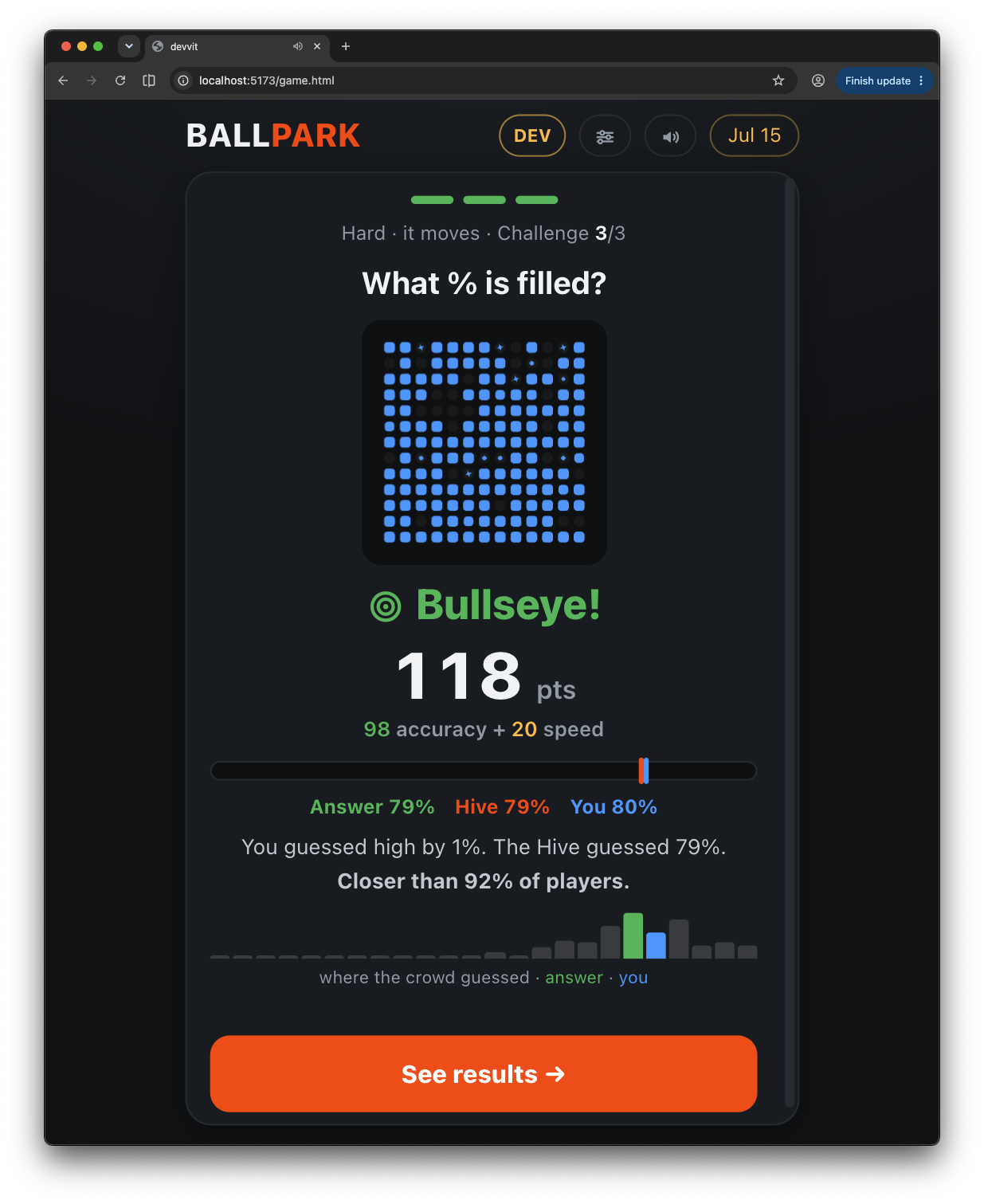
Example hard challenge (movement)
-
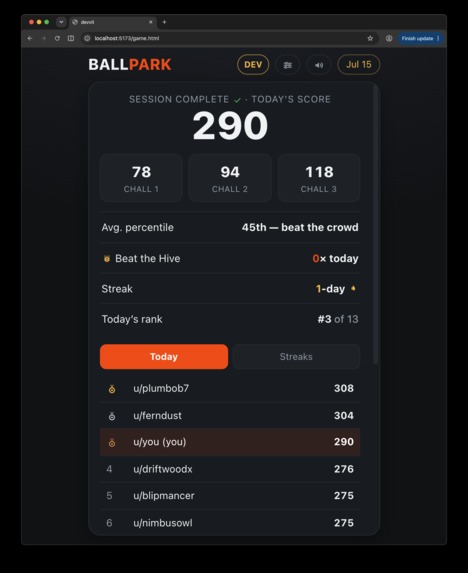
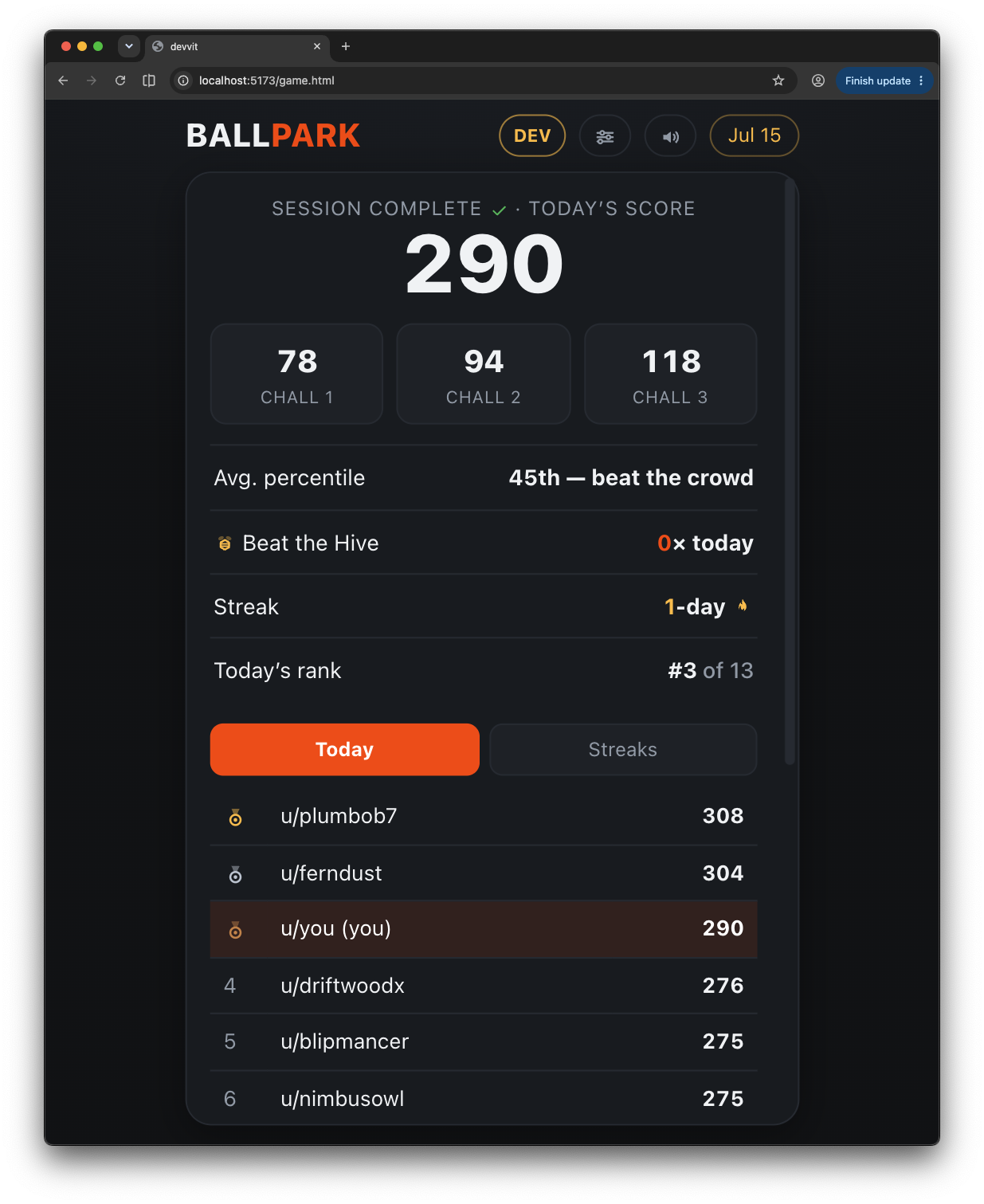
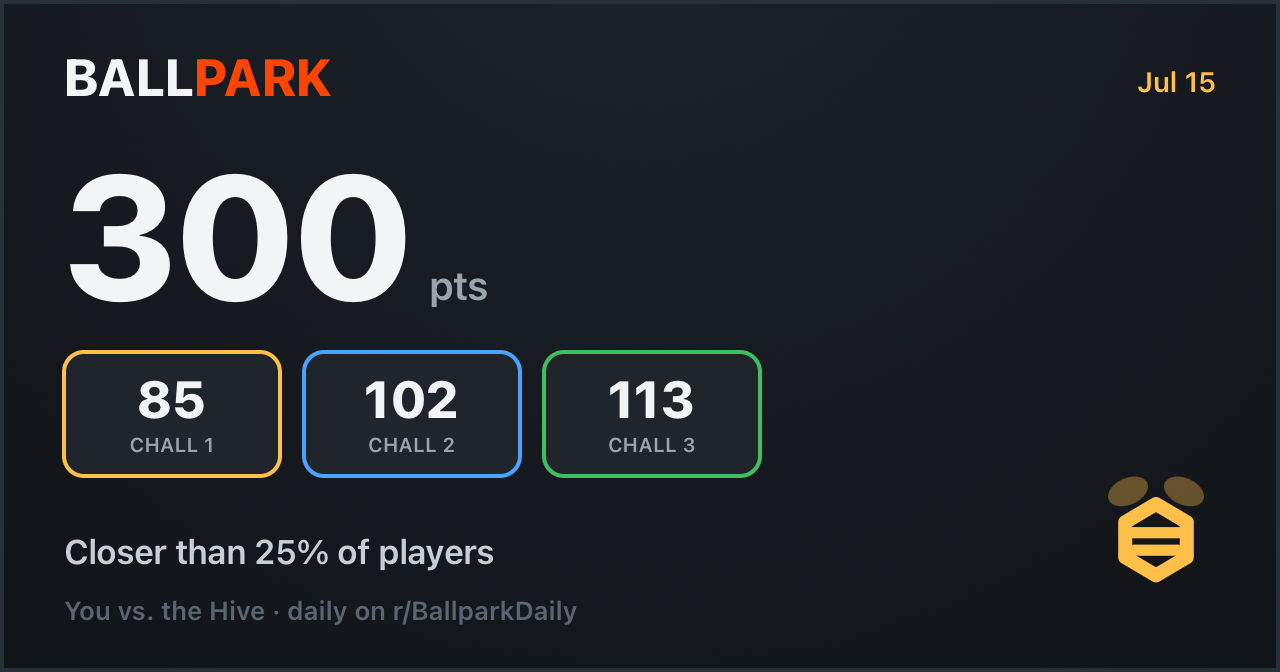
Final score and leaderboard for the day (7/15)
-
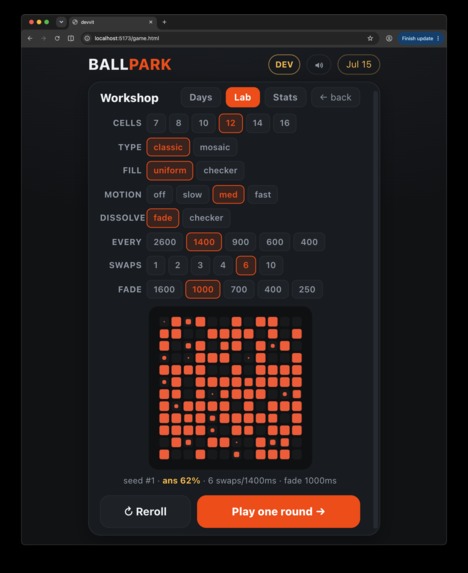
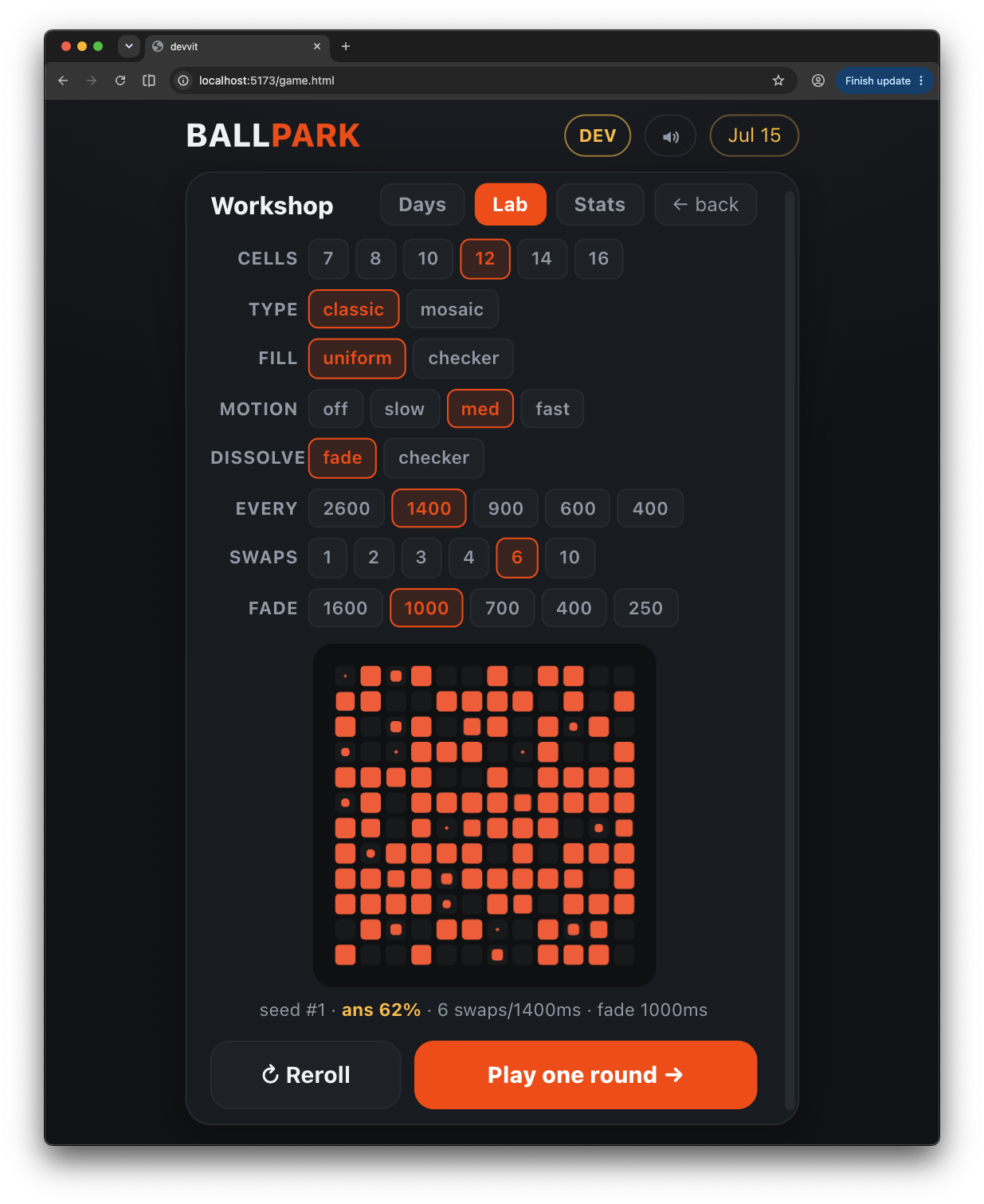
Lab / Level Designer - Refining Level Settings
-
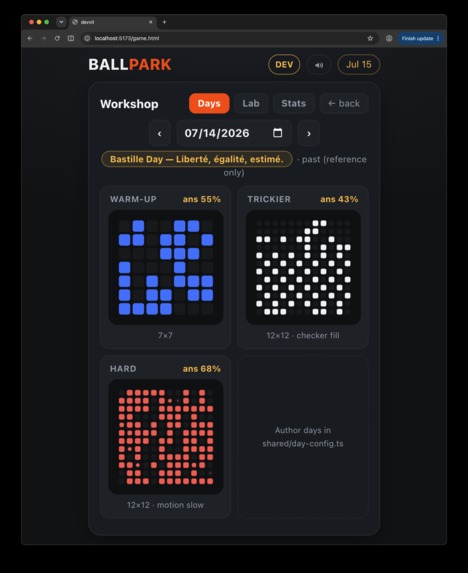
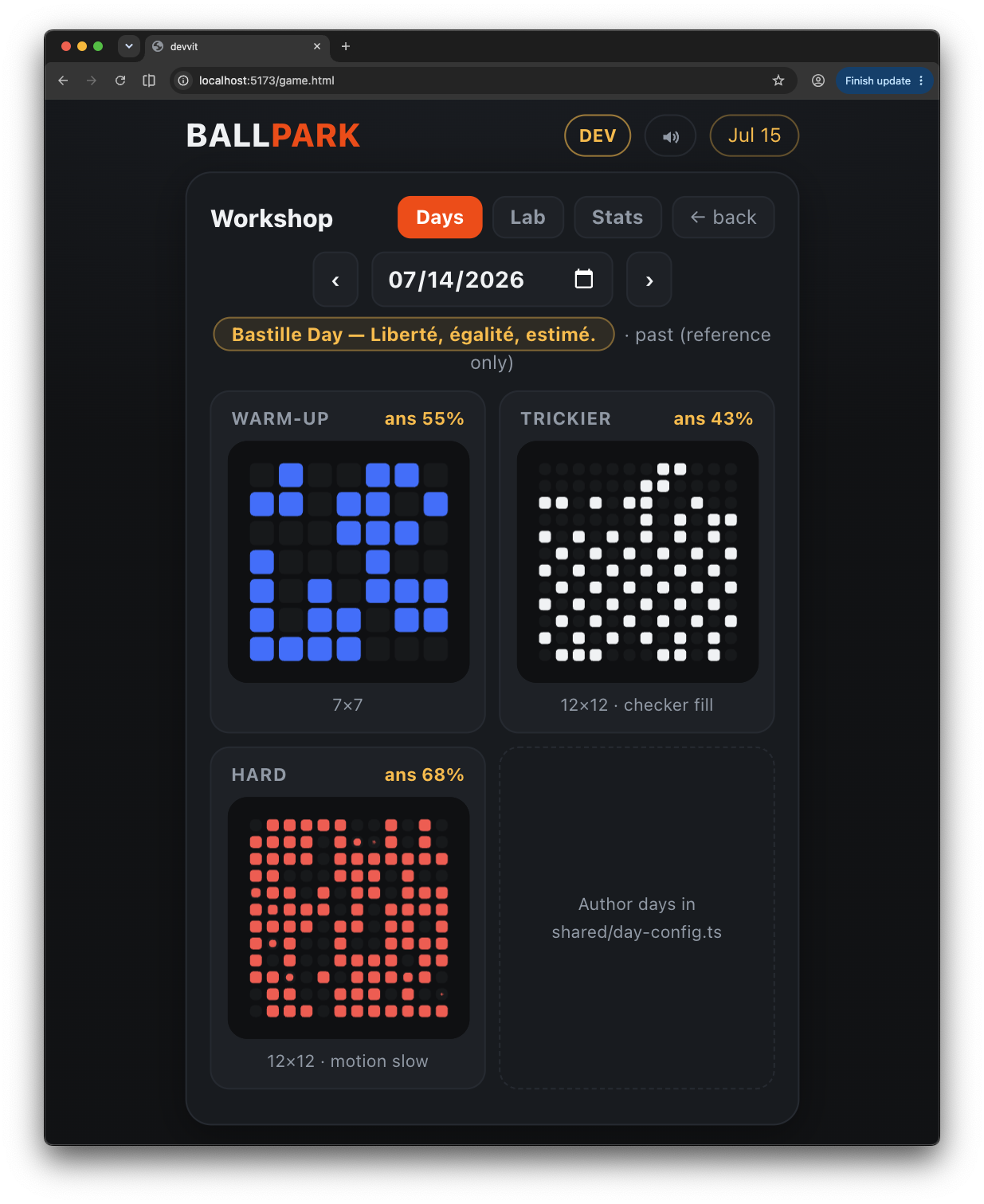
Lab / Level Designer - Day Preview
-
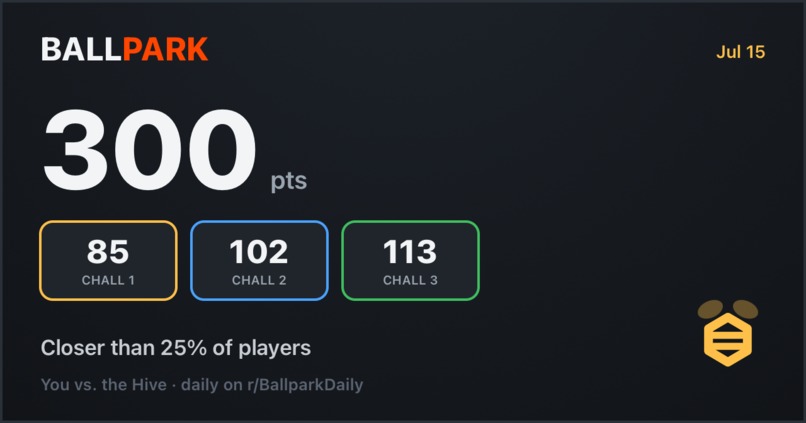
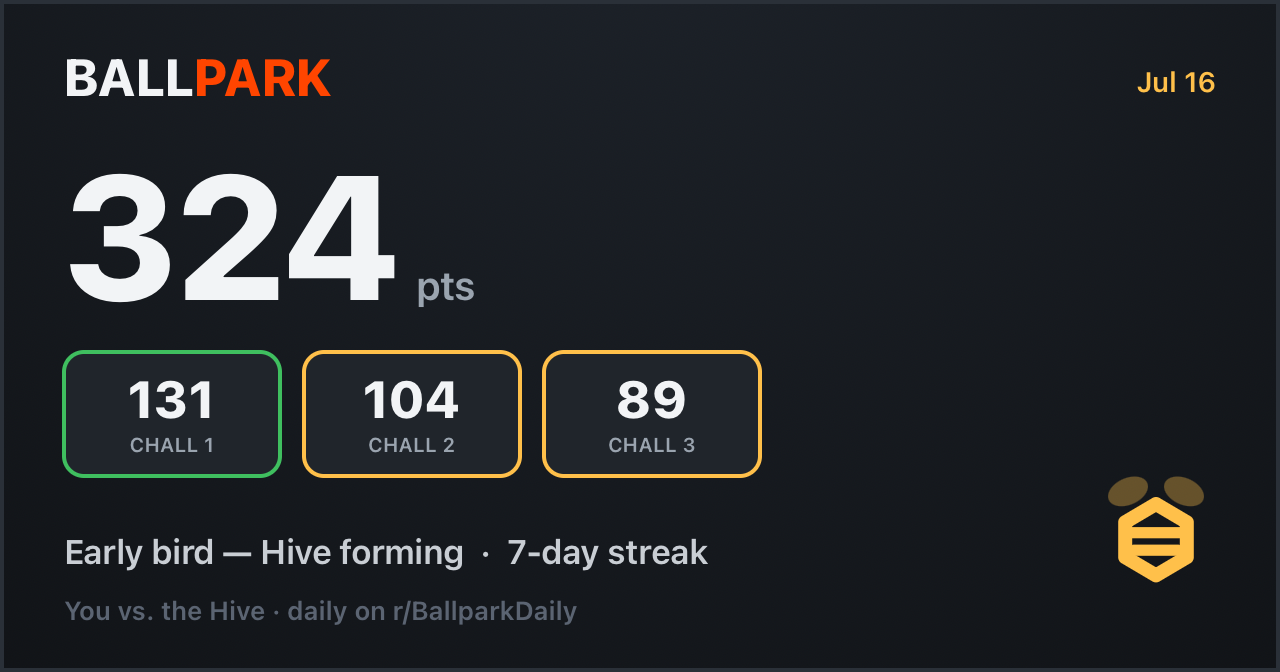
Final scorecard with hive formed
-
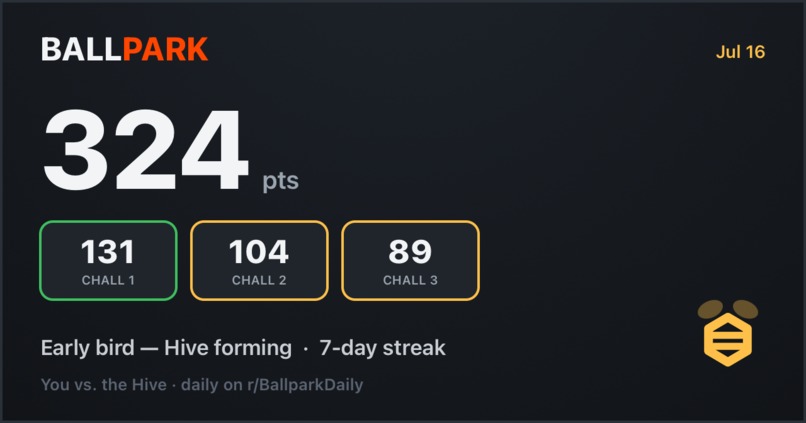
Final scorecard as earlybird
Inspiration
There is an old experiment where a crowd guesses the number of jellybeans in a jar, and the median of the guesses lands closer to the truth than almost any individual. I have always found that slightly eerie, and I wanted to build something where you could feel it happen to you, live, every day. Reddit seemed like the right place to try, because the crowd is already there and a daily post is a natural rhythm for it.
What it does
Each day at midnight UTC, the app creates a post with a session of three visual estimation challenges. A grid appears, some portion of it filled, and you answer "what % is filled?" on a number line that starts blank. I kept it blank on purpose: if the input showed a default value, that number would anchor everyone's guesses and quietly poison the crowd data.
After you lock a guess, you see the answer, how far off you were, and the Hive: the median of everyone who played that challenge today. You also see the percentile of players you were closer than, which turned out to matter more than I expected, because beating the Hive itself is genuinely uncommon. The median is usually within a few points of the truth. So the game tracks beating it as a lifetime count instead of a daily expectation, and the day-to-day feedback comes from your percentile.
The boards are generated procedurally from the date, so there is no content pipeline and no art. Some days the grid moves while you estimate. Some days it is a three-color mosaic and the question becomes "what % is orange?" Some days a region of the board is a perfect checkerboard, which reads as exactly 50% and tells you nothing, so the real information is in the rest. Holidays get themed palettes. There are streaks, a daily leaderboard, achievement flair, and a share button that posts your result card into the post's comments.
How I built it
React, TypeScript, and a single HTML5 canvas for the boards, on Reddit's Devvit Web platform, with a small Hono server and Redis for state. The design decision everything else hangs on: the client and server import the same pure generation module, so the client can render any day's board deterministically from a seed, while the answer itself never leaves the server until your guess is locked. Leaderboards are Redis sorted sets, the daily post is a scheduler cron, and the share-to-comments uses Devvit's user-actions API so the comment comes from the player, not the app.
I also built myself a moderator-only workshop inside the app: a preview of any future day's boards, a small lab for playtesting level parameters with live knobs, and a stats view that reads the completion funnel out of the keys the game already writes. Special days are authored in a version-controlled config file; everything else stays procedural.
Challenges I ran into
The scoring curve took two tries. I started with relative error, which felt fine until I widened the answer range and realized it was brutal on small answers and generous on large ones: missing 5% by three points scored worse than missing 90% by ten. It is now a symmetric curve based on percentage points missed.
Cold start was a design problem more than a technical one. The Hive does not exist until people have played, and I decided early that the game would never fabricate guesses. Below five players it honestly says the Hive is still forming, and an early-bird bonus compensates the first players for the missing comparison.
One I did not see coming: every daily post served "today's" game, so opening yesterday's post silently played today's session. A playtester found it confusing within a day of the public sub going live. Posts now remember their date and route you to the current session.
Accomplishments that I'm proud of
A real crowd formed during playtest week: around a dozen players a day, enough that every challenge revealed a live median and percentiles. I shipped over twenty versions in nine days, almost all of them in response to specific playtester feedback, and posted release notes publicly on the dev subreddit as I went. And the entire game ships without a single image asset; every board, icon, and share card is drawn in code.
What I learned
Playtesters rewrote the game's language. I had written "scrub the bar" everywhere, and it turned out players did not know the word and were answering by tapping anyway, which the input had always supported. The copy now says tap.
Motion tuning surprised me. Two cells crossfading every 1.4 seconds is nearly invisible while you are busy estimating; six cells moving together at the same rhythm is unmissable. Motion reads as events, not as frequency. I found the setting I now ship by playing with knobs in the lab and level design tools built as part of the MVP.
And the original hunch held up: the crowd really is hard to beat. Watching the Hive land within two or three points of the answer, day after day, with a dozen casual players, is the thing that makes people come back.
What's next
A five-challenge session is already running on the dev subreddit as an A/B against the three-challenge main game; if the completion funnel holds up, it ships together with per-player challenge-order shuffling, which makes shared answers much less useful. After that: player-created challenge posts (parametric, so they carry no moderation burden), a configurable daily reset hour per subreddit so regional communities can have their day roll over at a sensible local time, and the count-style scene variants (dots, beans) that were prototyped before the jam.
Built With
- devvit
- hono
- html5
- react
- redis
- tailwind
- typescript
- vite
