Inspiration
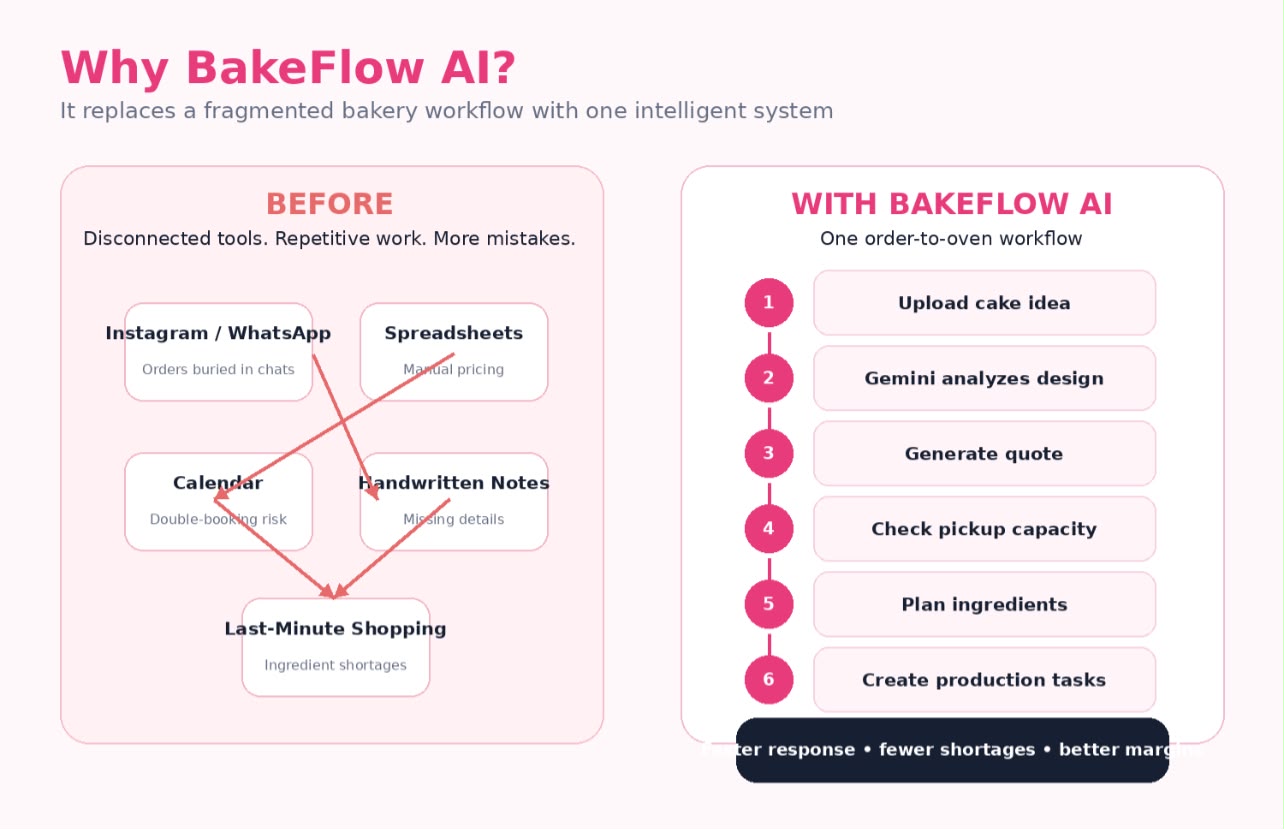
BakeFlow AI was inspired by the everyday challenges faced by home bakers and small custom-cake businesses. Many still manage orders through Instagram, WhatsApp, spreadsheets, calendars, and handwritten notes. This creates slow responses, inconsistent pricing, double bookings, ingredient shortages, and unnecessary administrative work.
At the same time, customers often struggle to explain exactly what they want, while bakers have to manually translate a photo or message into servings, ingredients, labor, pricing, and production time.
We wanted to connect these two sides through one intelligent platform — taking a customer's cake idea all the way from inspiration to production.
What it does
BakeFlow AI is an AI-powered operating system for small bakeries that transforms a cake photo or written description into a production-ready order.
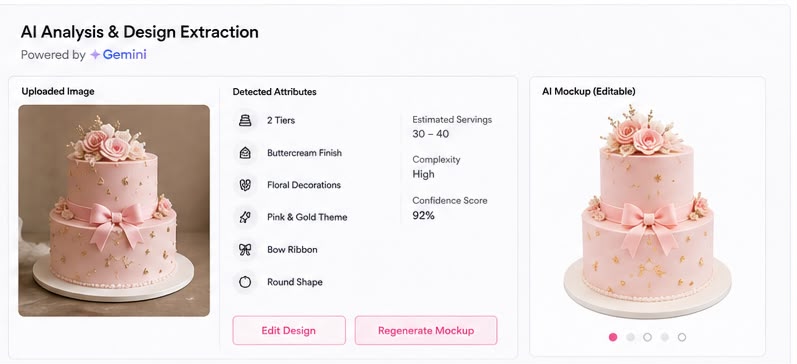
A customer uploads a reference image or describes their ideal cake. The system analyzes the request and extracts details such as tiers, colors, style, decorations, servings, and complexity.
BakeFlow AI then helps:
- Generate an editable cake design specification
- Create a visual design mockup
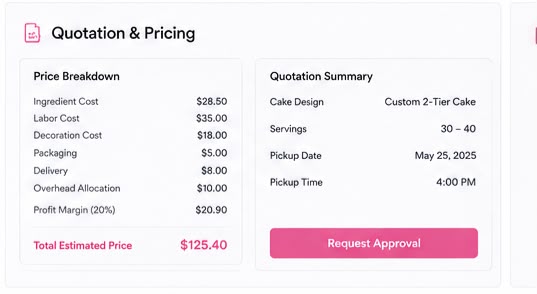
- Calculate a transparent price estimate
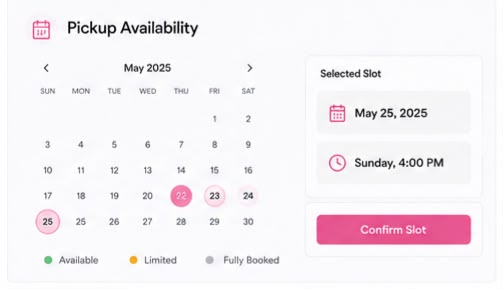
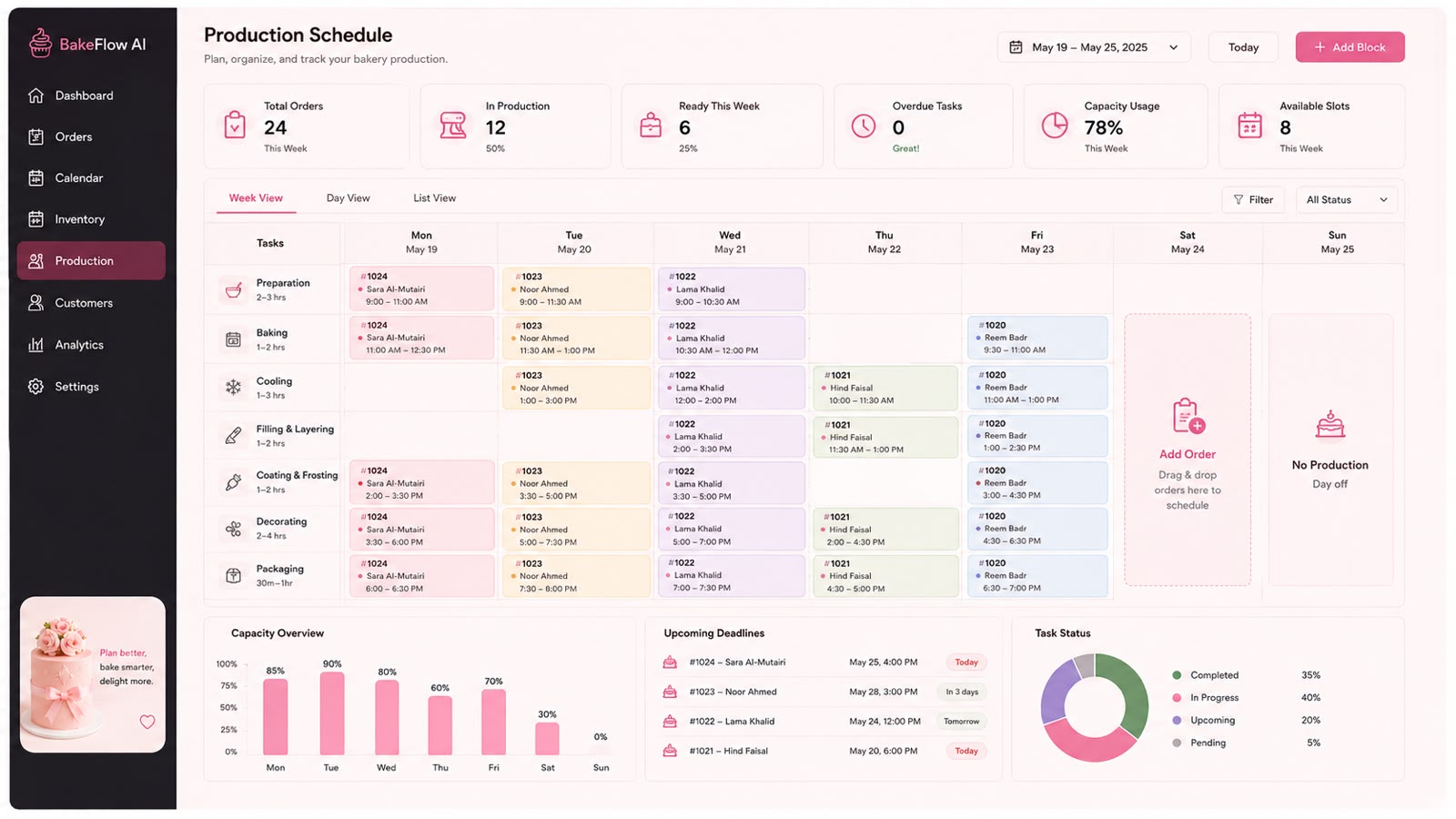
- Check bakery capacity and available pickup slots
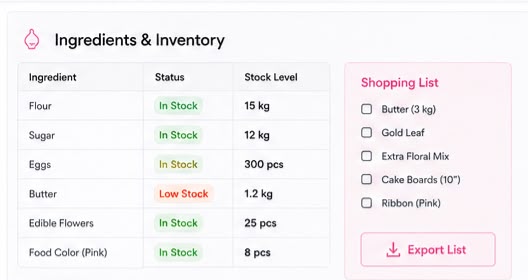
- Calculate ingredient requirements
- Detect inventory shortages
- Generate a shopping checklist
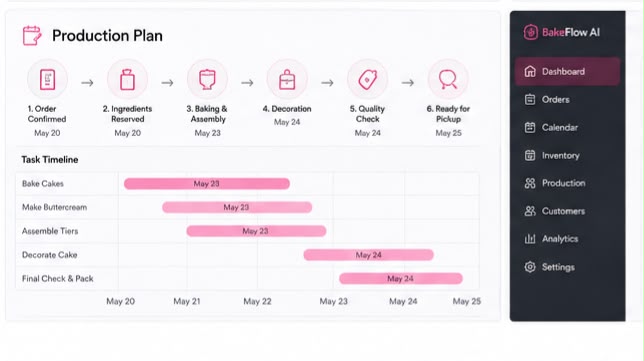
- Build a production schedule
- Reserve ingredients after confirmation
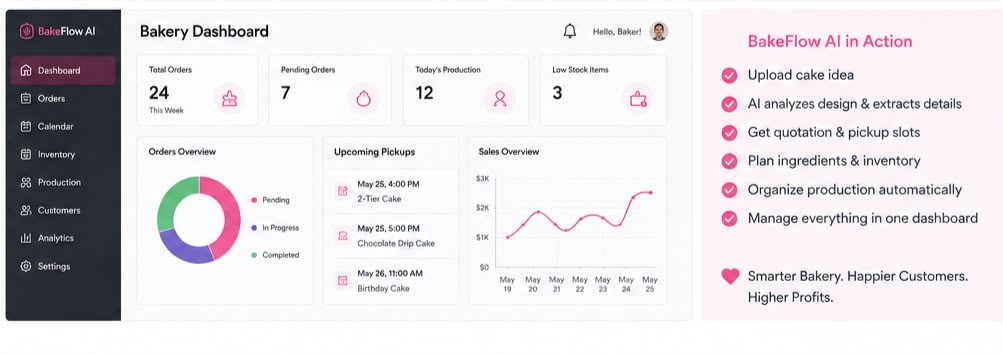
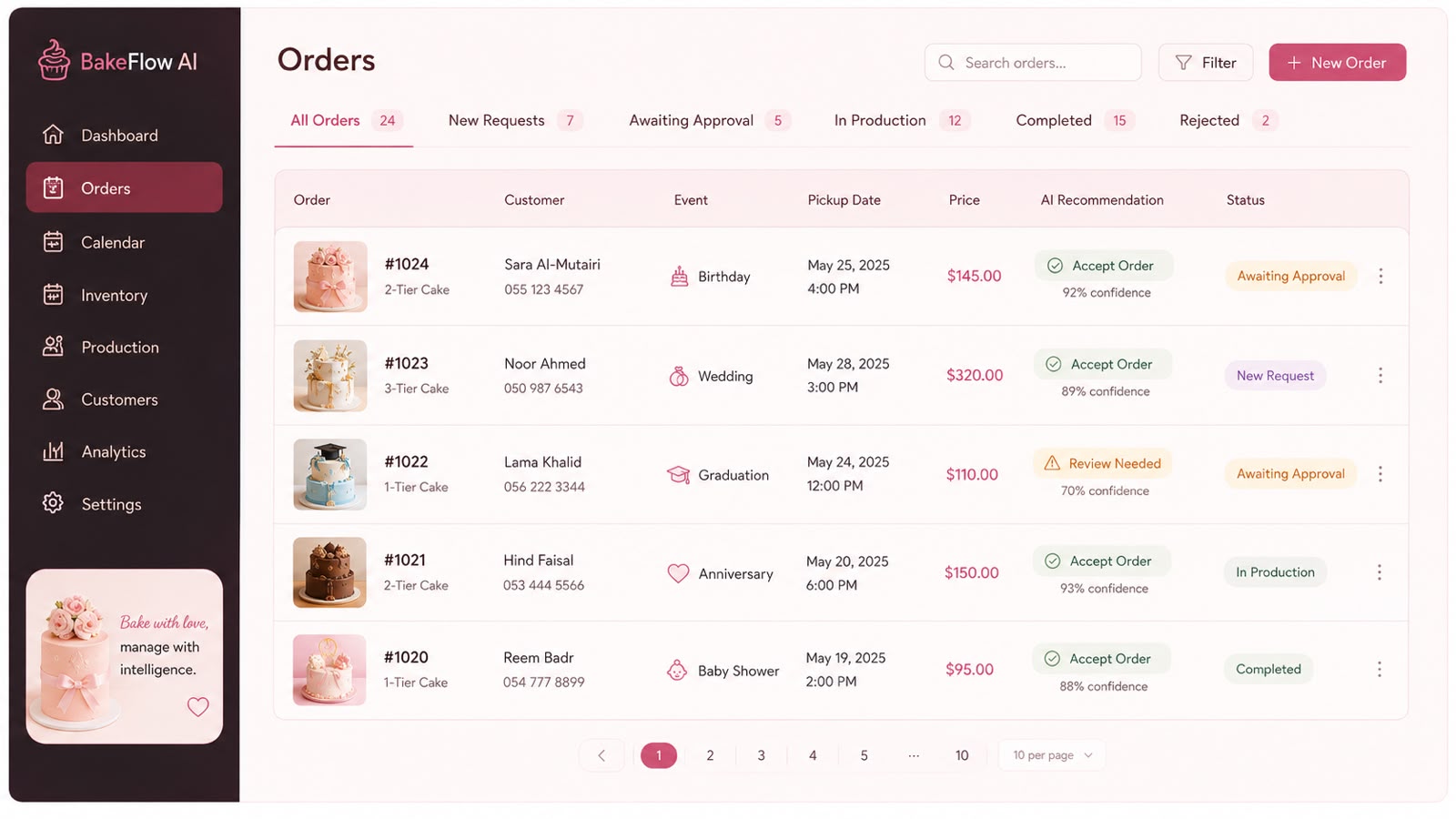
- Centralize orders, inventory, approvals, and tasks in a baker dashboard
The result is one connected order-to-oven workflow instead of several disconnected tools.
How we built it
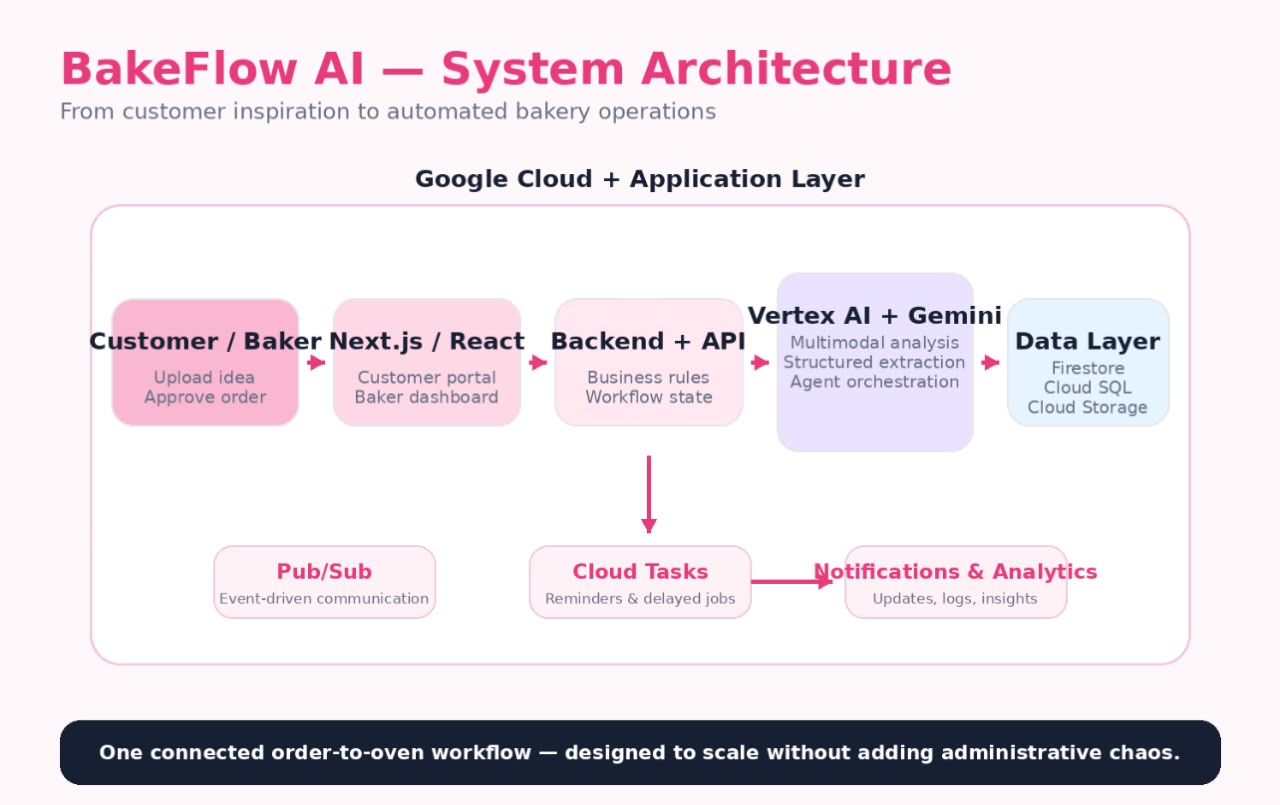
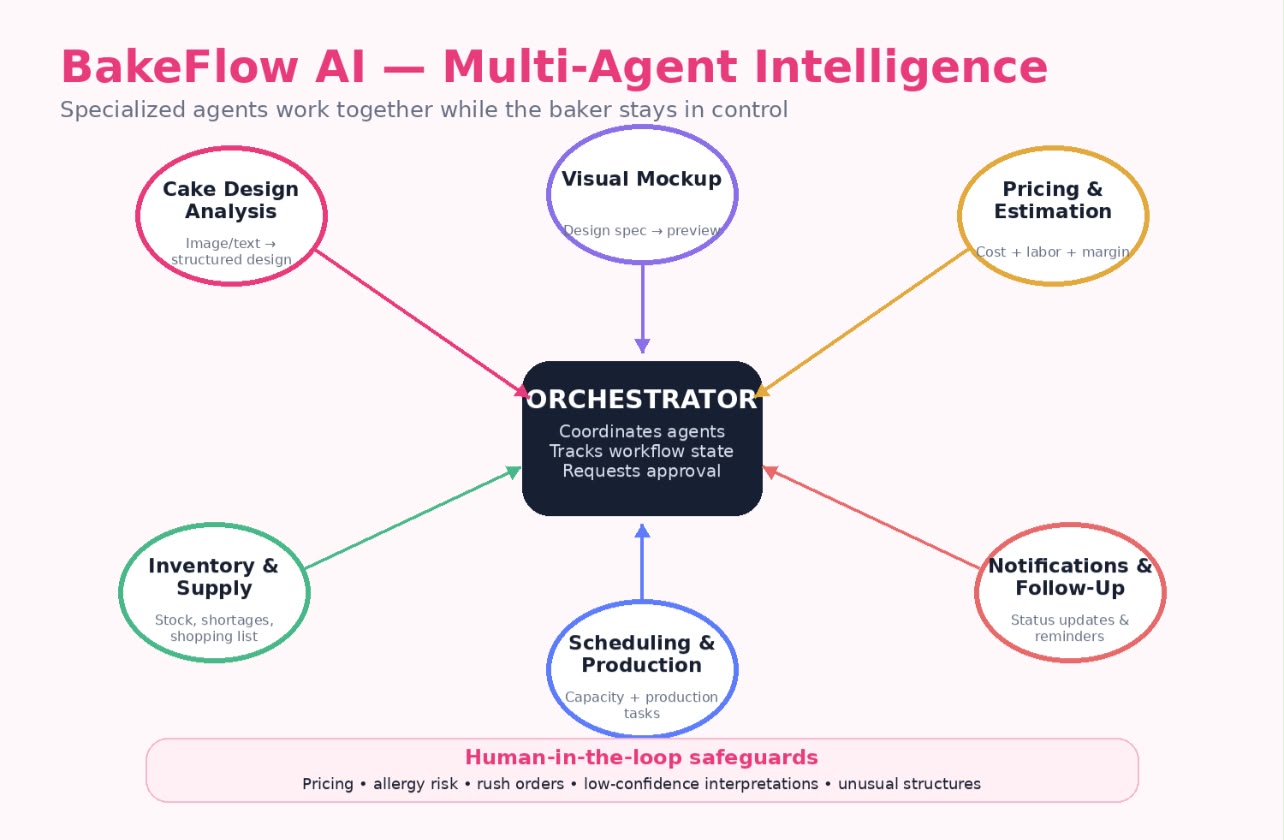
BakeFlow AI was designed using a modular, multi-agent architecture.
Gemini and Google Cloud Vertex AI handle multimodal understanding, allowing the system to interpret both cake images and natural-language descriptions and convert them into structured information.
Specialized agents support different parts of the workflow, including design analysis, pricing, inventory, scheduling, customer communication, notifications, and workflow orchestration.
For important operational decisions, we combine generative AI with deterministic business rules. AI helps understand the customer's intent, while rule-based logic handles calculations such as pricing, ingredient quantities, capacity, and scheduling.
Our technology stack includes Next.js, React, Tailwind CSS, Google Cloud Run, Firebase, Firestore, Cloud SQL, Cloud Storage, Pub/Sub, Cloud Tasks, Gemini, Vertex AI, and Vertex AI Agent Builder.
For the hackathon MVP, we focused on demonstrating one complete journey: cake request → AI analysis → quotation → capacity and inventory check → baker approval → production-ready order.
Challenges we ran into
One of our main challenges was deciding where AI should automate decisions and where human approval was still necessary.
Creative requests can be interpreted by generative AI, but information involving allergies, pricing, ingredient substitutions, complex designs, and production capacity cannot simply be guessed.
To address this, we designed BakeFlow AI with human-in-the-loop controls. AI outputs remain editable, uncertain interpretations can trigger clarification, and important decisions can require baker approval.
Another challenge was scope. The complete vision includes social media integrations, payments, supplier ordering, forecasting, and multi-branch support. Instead of building many incomplete features, we focused on making one complete end-to-end workflow clear and demonstrable.
Accomplishments that we're proud of
We're proud that BakeFlow AI goes beyond being another AI image generator or simple bakery ordering system.
It connects multimodal and generative AI with real operational decisions. A single cake request can move through design interpretation, pricing, capacity checking, ingredient planning, approval, inventory reservation, and production scheduling within one system.
We're also proud of building responsible AI principles into the concept from the beginning, including confidence indicators, editable outputs, auditability, and human approval for high-risk decisions.
Most importantly, BakeFlow AI addresses a real problem experienced by small businesses while providing a foundation that could scale far beyond the hackathon.
What we learned
Building BakeFlow AI taught us that AI becomes much more powerful when it is connected to real workflows rather than used only to generate content.
We learned how multimodal AI can turn unstructured images and descriptions into structured operational information.
We also learned that generative AI and deterministic systems work best together: AI can understand customer intent and creativity, while traditional logic provides reliability for calculations, inventory, scheduling, and business rules.
The project also reinforced the importance of explainability, confidence scores, editable outputs, and human oversight when designing practical AI systems.
What's next for BakeFlow AI
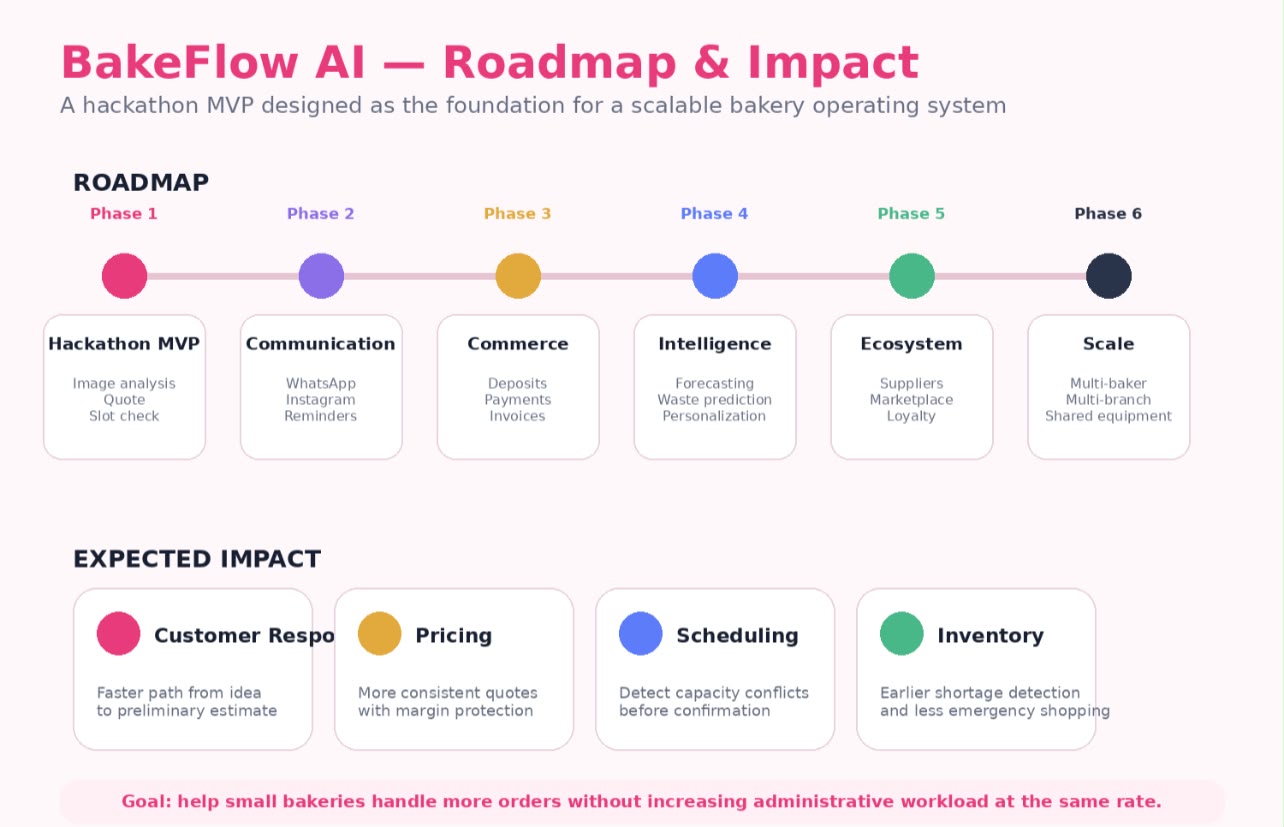
The next step is to evolve BakeFlow AI from a hackathon MVP into a complete intelligent operating platform for small bakeries.
Future features include:
- WhatsApp and Instagram integrations
- Online deposits and payments
- Automated invoices
- Delivery tracking
- Demand forecasting
- Dynamic labor estimation
- Waste prediction
- Personalized customer recommendations
- Automated supplier ordering
- Loyalty programs
- Multilingual support
- Multi-baker and multi-branch management
Our long-term vision is simple: help small bakeries manage more orders, reduce waste and administrative work, protect their profitability, and spend more time creating.
Built With
- ai
- cloudrun
- cloudsql
- cloudtask
- firebase
- firestore
- gemini
- google-cloud
- javascript
- machine-learning
- nextjs
- react
- typesscript
- vertexai

Log in or sign up for Devpost to join the conversation.