DEMO VIDEO: https://youtu.be/j_5ge1McwV4 PRESENTATION VIDEO (my zoom would not share my screen, I am so sorry! The presentation is in my zip file): https://youtu.be/scrcgi6Fw4Y
Inspiration
BakedBoston was inspired by a simple mismatch: local bakeries often have edible surplus food, while nearby pantries serve communities facing food insecurity. Coordinating a pickup is harder than it sounds: food must be collected before it expires, pantries need capacity to receive and distribute it, and volunteer drivers need routes they are realistically willing to accept.
We built BakedBoston to make local food rescue more transparent, efficient, and climate-aware.
What it does
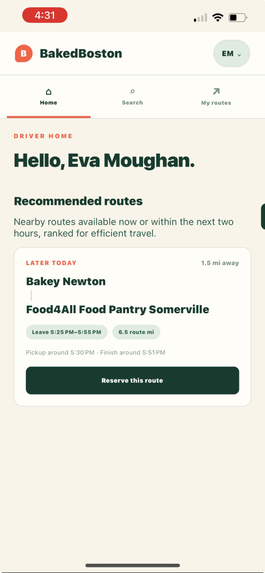
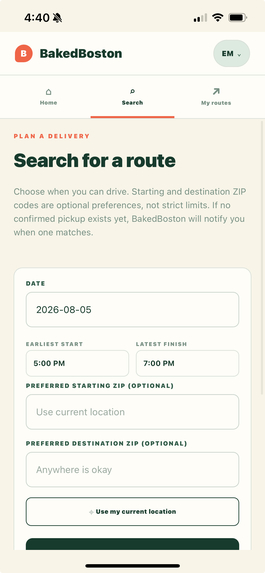
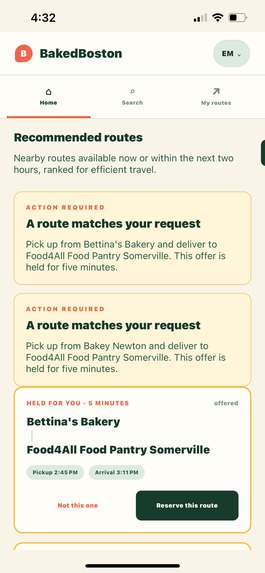
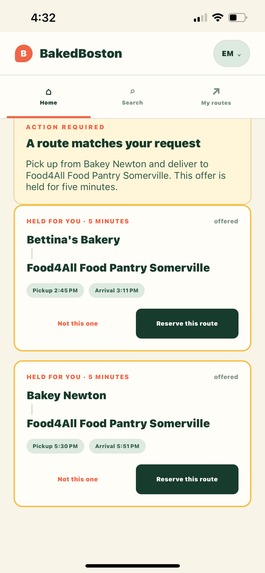
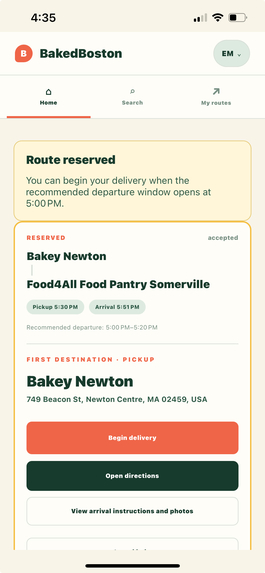
BakedBoston is a food-rescue coordination platform that connects bakeries with surplus food, food pantries, and volunteer drivers.
The platform:
- Records surplus-food pickup opportunities from bakeries.
- Matches donations to compatible pantry receiving capacity.
- Generates feasible volunteer pickup-and-delivery routes.
- Estimates volunteer acceptance using travel time, schedule compatibility, and location deviation.
- Evaluates food recovery, pantry coverage, equitable distribution, transportation emissions, and food-waste emissions.
- Provides mobile workflows for drivers, bakeries, and pantries, plus a web-based live simulator and analytics dashboard.
BakedBoston is aligned with Track 3: Supply Chain Transparency and Circular Economy because it creates a more measurable, accountable, and circular pathway for food that would otherwise become waste.
How we built it
BakedBoston consists of a web platform, mobile application, operational database, and Python optimization engine.
- Web platform: Next.js, React, TypeScript, Tailwind CSS, Leaflet, and Vercel.
- Mobile application: React Native, Expo, TypeScript, Expo Location, Notifications, and SecureStore.
- Database: Neon PostgreSQL with Drizzle ORM.
- Optimization engine: Python, Gurobi, mixed-integer optimization, rolling-horizon re-optimization, and seeded simulation.
- Maps and routing: Google Routes and Google Places.
- Supporting services: Vercel Blob, Resend email, Svix webhook verification, and Stripe Identity integration.
The optimizer evaluates feasible driver–bakery–pantry routes and ranks them using an acceptance-adjusted expected-impact score. It balances food distributed, pantry coverage, equitable allocation, environmental benefit, and driver convenience rather than optimizing only one metric.
Architecture Diagram and Technical Specification
Bakeries / Pantries / Volunteer Drivers
                 |
                 v
     React Native Mobile Application
                 |
                 v
       Next.js Web Platform + API
                 |
      ---------------------------
      |            |            |
      v            v            v
 Neon PostgreSQL  Google Maps  Vercel Blob
 Operational data  Routing      Documents/images
      |
      v
 Python Optimization and Simulation Engine
      |
      v
 Route recommendations, impact estimates,
 operational records, and analytics dashboard
The system uses role-based access controls, authenticated API requests, validated input fields, auditable delivery states, and protected storage for sensitive user data. The route optimizer can process multiple driver requests in rolling decision periods and re-optimize after rejected assignments.
Climate Impact Assessment and Carbon Reduction Projections
BakedBoston evaluates environmental impact by comparing the emissions avoided when bakery surplus is rescued with emissions created through transportation and food that remains undistributed at a pantry.
The model accounts for:
- Food sent to landfill, pig-feed pathways, or compost when not collected.
- Pantry residual food that cannot ultimately be distributed.
- Transportation emissions associated with each selected route.
- Net CO$_2$e benefit relative to leaving bakery surplus uncollected.
In a seeded 500-run simulation across standard, scarce-driver, and high-surplus conditions, BakedBoston produced the following average results:
| Condition | Food distributed | Net CO$_2$e benefit | Expected acceptance | Pantry coverage |
|---|---|---|---|---|
| Standard | 234.85 kg | 43.36 kg CO$_2$e | 75.2% | 90.8% |
| Scarce drivers | 149.46 kg | 31.43 kg CO$_2$e | 77.7% | 83.8% |
| High surplus | 248.76 kg | 47.44 kg CO$_2$e | 76.3% | 92.5% |
If the standard simulated conditions continued for a full year, the model projects approximately 85.7 metric tonnes of food distributed and 15.8 metric tonnes of net CO$_2$e benefit. These are scenario-based estimates, not verified carbon credits.
Challenges we ran into
The largest challenge was ensuring that the model did not treat every collected donation as equally valuable. A donation may be picked up but still not be fully distributed because of food usability, pantry capacity, storage, volunteer availability, or expiration.
We also had to balance competing goals. The shortest route is not always the most climate-beneficial route, the route with the most food is not always the fairest, and the highest-impact route is not useful if a volunteer is unlikely to accept it.
Finally, comparing multiple academic routing approaches fairly required the same seeded surplus, pantry, driver, and acceptance conditions across every model.
Accomplishments that we're proud of
- Built a working prototype spanning mobile, web, database, and optimization systems.
- Created an optimizer that considers food recovery, fairness, coverage, emissions, and volunteer practicality together.
- Built a live simulator that makes routing decisions explainable.
- Modeled the full donation pathway, including uncollected food, pantry residual food, transportation, and disposal emissions.
- Created reproducible simulations using fixed random seeds.
- Designed the platform so real organizations can eventually replace simulated assumptions with their own operational data.
What we learned
We learned that food rescue is not simply a transportation problem. It is a coordination problem involving timing, trust, driver participation, pantry capacity, food quality, and environmental tradeoffs.
We also learned that transparent assumptions matter. Instead of hiding tradeoffs behind a single recommendation, BakedBoston explains why a route was selected and measures what happens to food throughout the rescue process.
Implementation and Adoption Strategy
BakedBoston can be adopted in stages.
- Pilot with a small local network: onboard several bakeries, pantries, and volunteer drivers in one neighborhood or city.
- Collect real operational data: replace simulated food-surplus, capacity, acceptance, and disposal assumptions with observed data.
- Integrate daily operations: allow bakeries to post surplus, pantries to confirm receiving capacity, and drivers to claim or receive recommendations.
- Measure outcomes: provide organizations with food-recovery, emissions, delivery, and coverage reports.
- Scale through partnerships: work with food banks, municipal food-access programs, universities, and local business associations.
The platform is designed to support practical deployment before expanding to more advanced verification and reporting features.
Scalability and Sustainability Roadmap
Near term
- Pilot with local bakeries and pantries.
- Calibrate the model using real pickup, acceptance, and distribution data.
- Improve notifications, route claiming, and institution onboarding.
- Publish transparent impact dashboards.
Medium term
- Support larger multi-neighborhood and multi-city networks.
- Add organization-specific capacity, refrigeration, and volunteer scheduling constraints.
- Develop reporting for nonprofit partners, municipalities, and funders.
- Add multilingual and accessibility improvements.
Long term
- Create a privacy-conscious, tamper-evident impact trail by anchoring cryptographic hashes of verified rescue records to a blockchain testnet.
- Enable transparent sustainability reporting without placing personal or sensitive operational data on-chain.
- Explore interoperable digital records for donation provenance, recovery metrics, and environmental reporting.
What's next for BakedBoston
Next, we will validate BakedBoston with real partner organizations and replace prototype assumptions with real donation, pantry-capacity, and volunteer-participation data.
Our goal is to turn BakedBoston into scalable local food-rescue infrastructure: one that helps communities recover more food, reduce avoidable emissions, improve transparency, and make volunteering easier.
Built With
- 3.11+
- blob
- css
- drizzle
- gurobi
- html
- javascript
- kit
- native
- next.js
- node.js
- orm
- postgresql
- python
- react
- serverless
- sql
- storage
- tailwind
- typescript

Log in or sign up for Devpost to join the conversation.