-
-
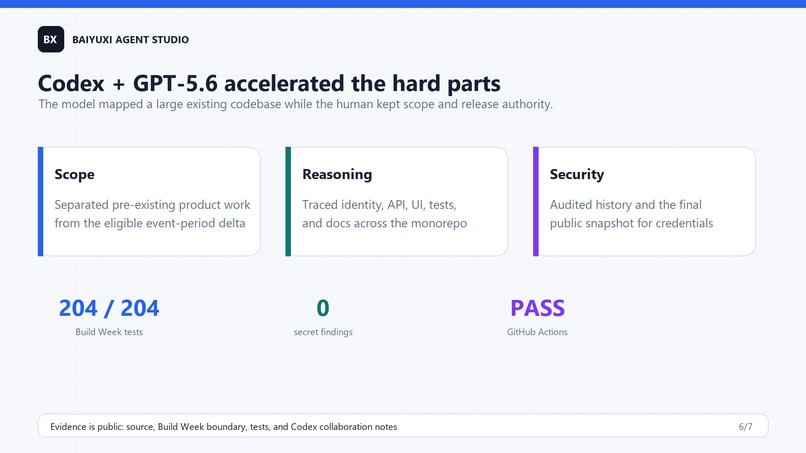
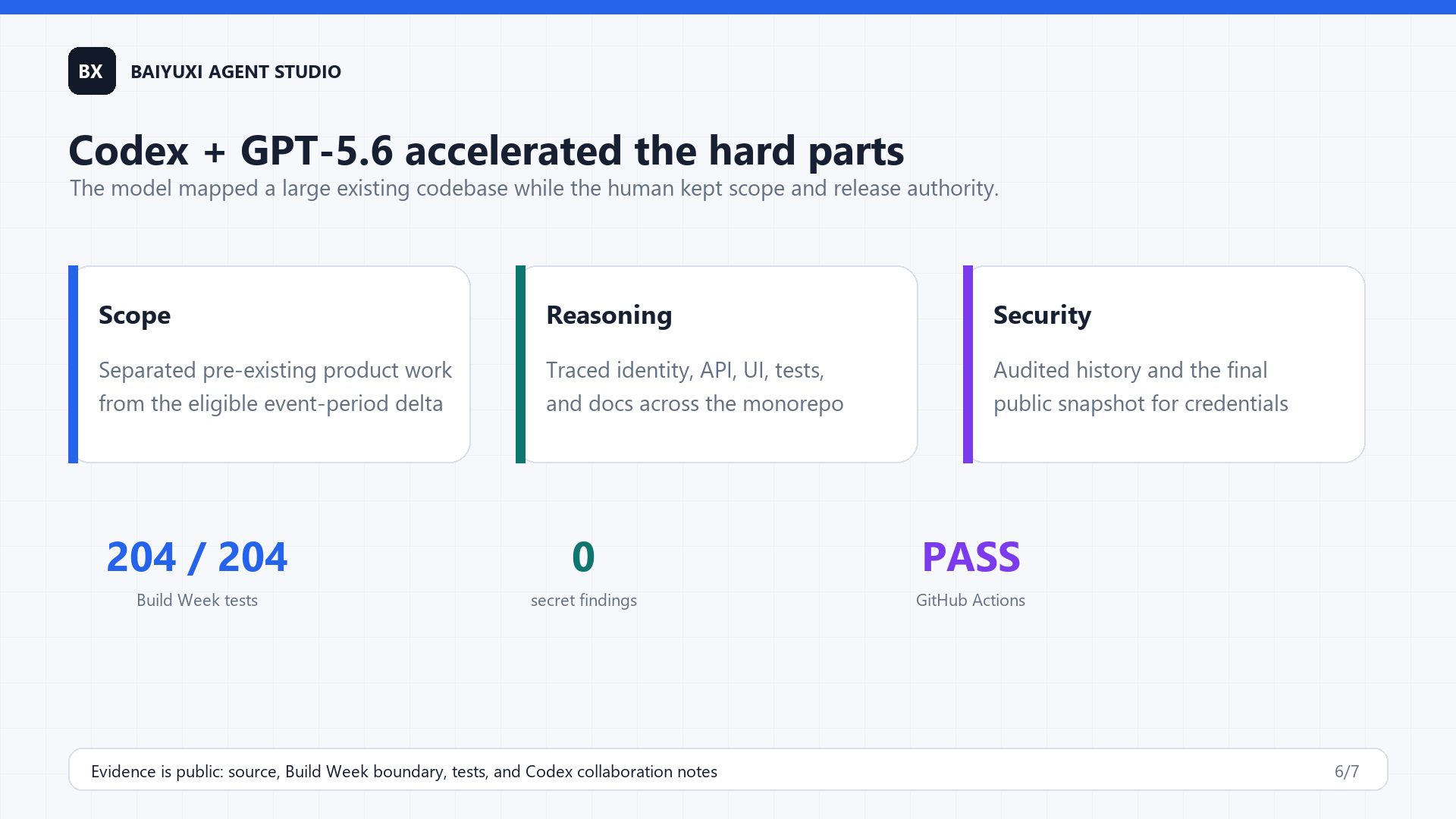
Codex + GPT-5.6 accelerated cross-repo reasoning and verification.
-
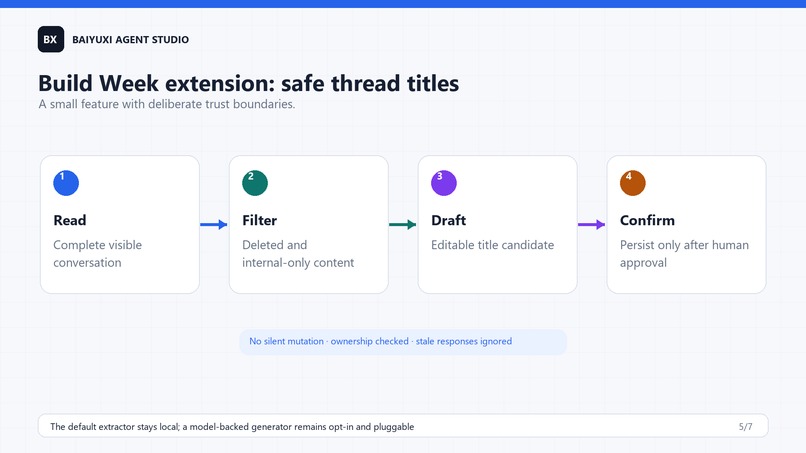
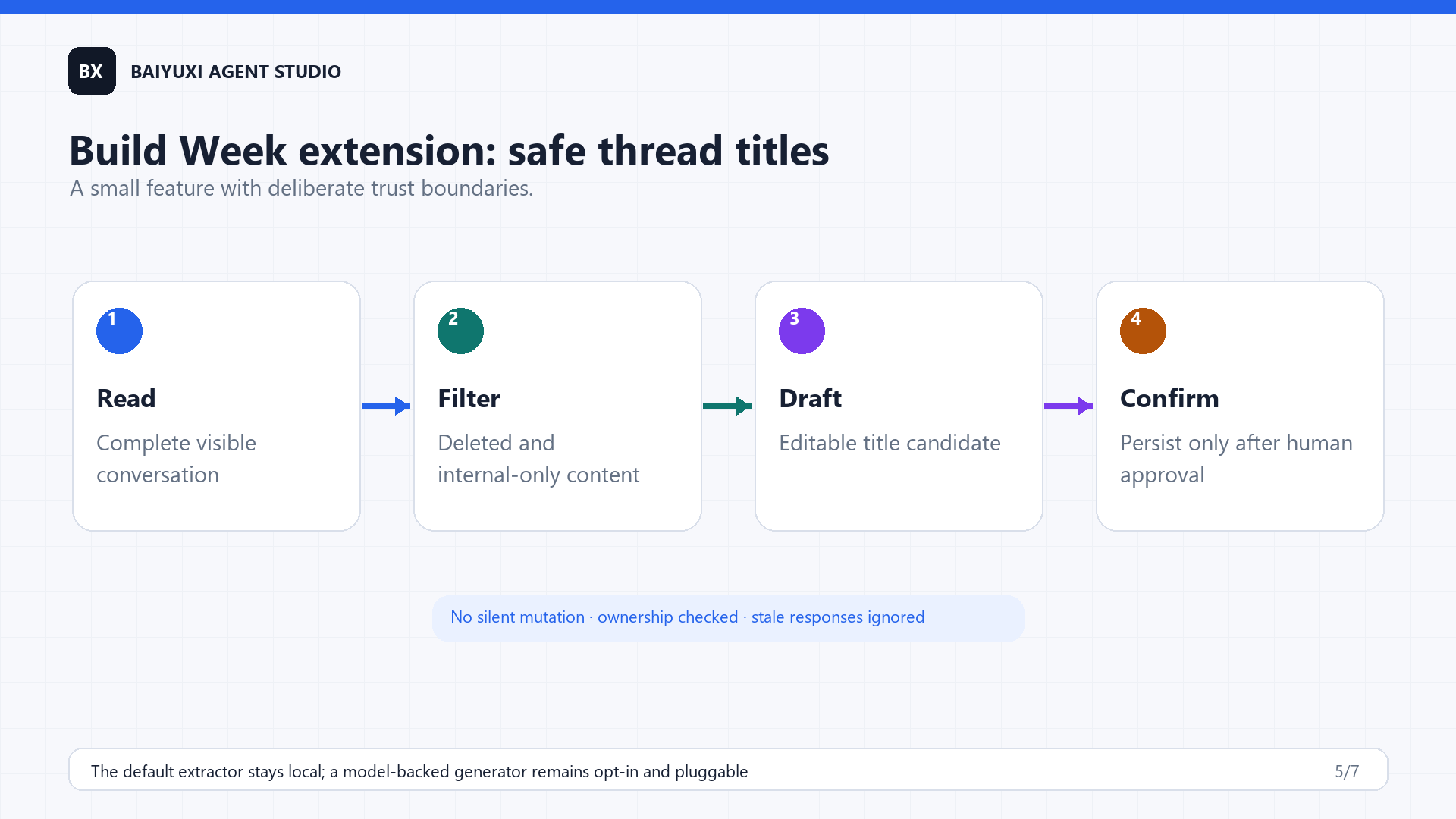
Build Week extension: safe, editable thread-title candidates.
-
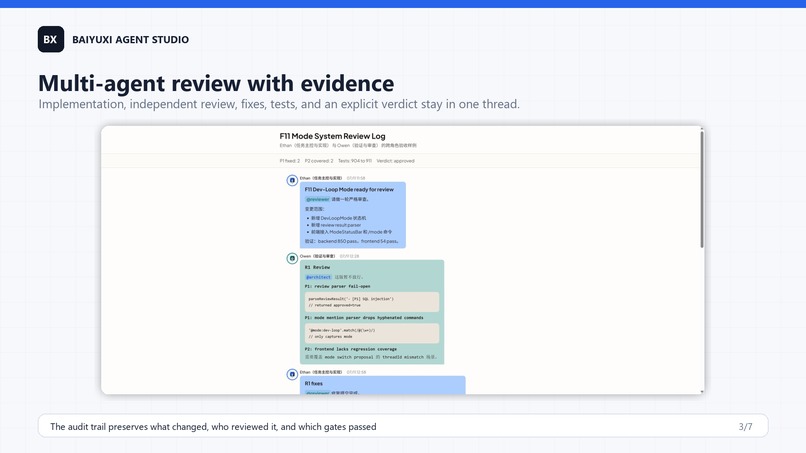
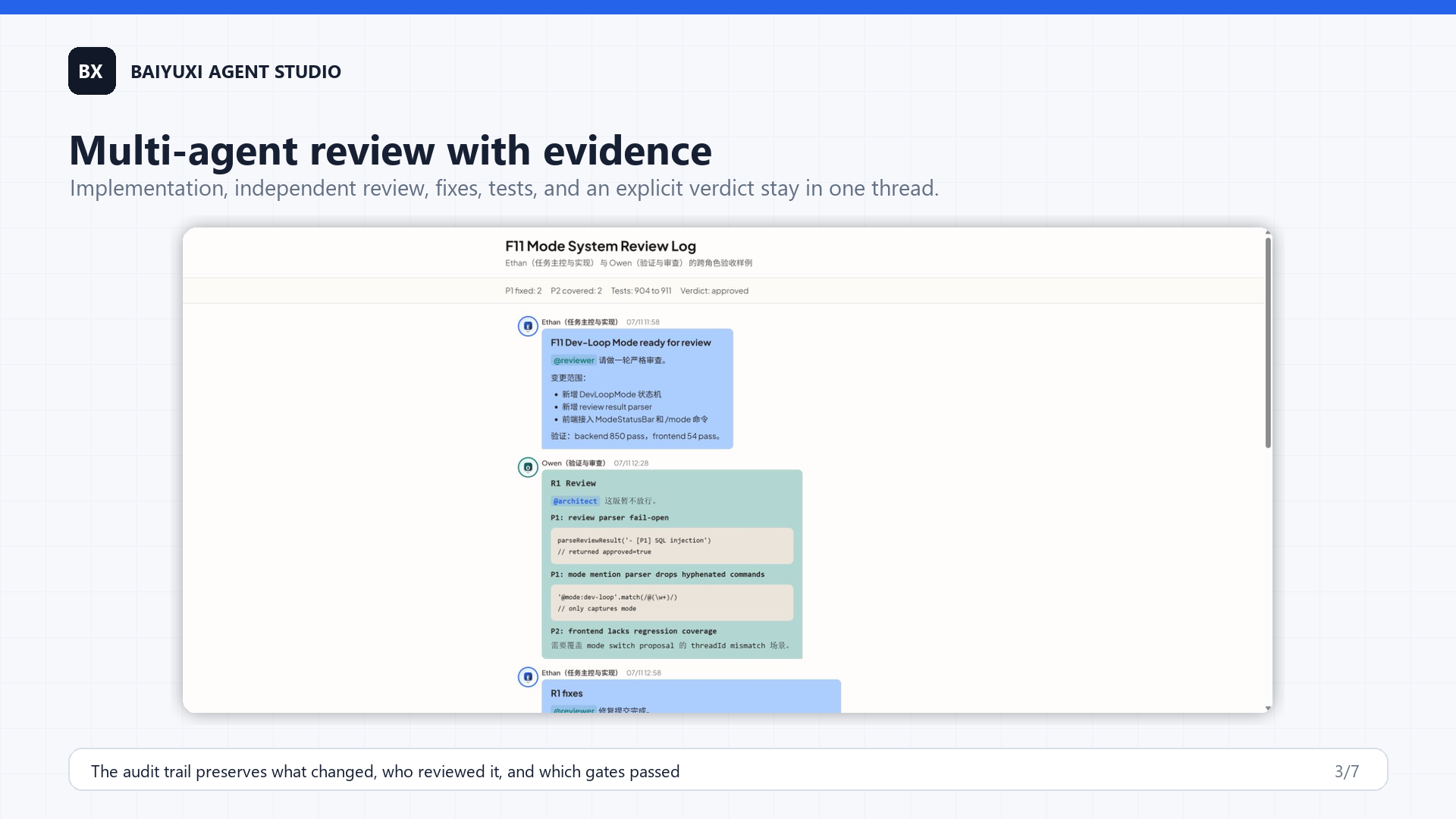
Multi-agent review with inspectable evidence and human approval.
-
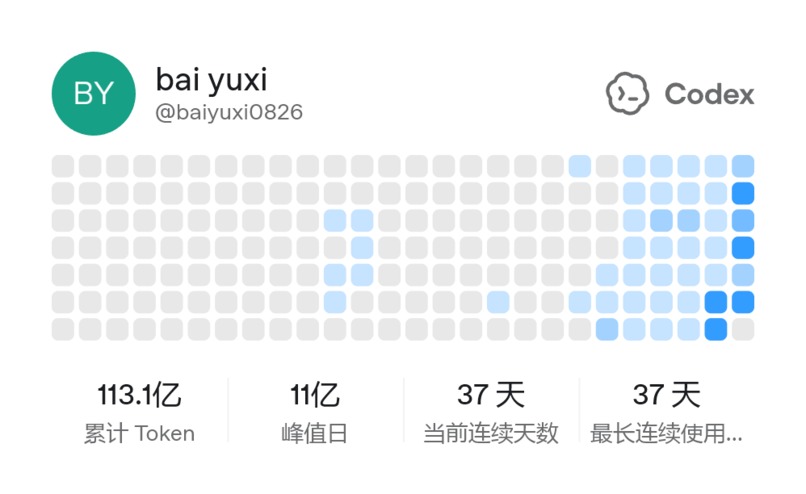
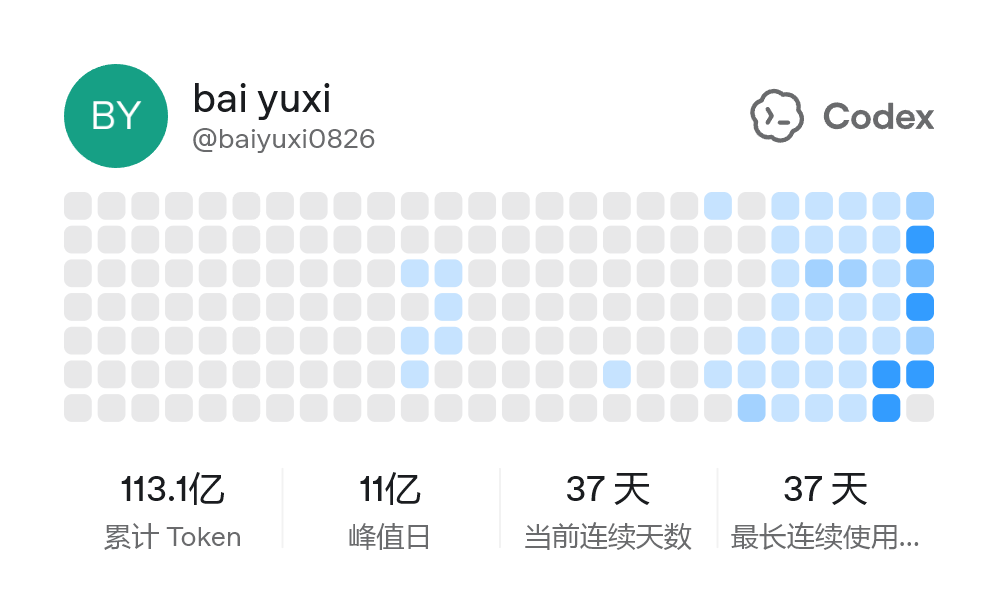
Supplemental Codex usage context: cumulative activity and a 37-day streak; project attribution remains anchored to the /feedback session ID.
Inspiration
Using multiple AI coding tools often turns the human into a router. Context is copied between windows, decisions are repeated, and the evidence behind a change disappears when a session ends.
I wanted a different relationship with AI: the human should provide intent, judgment, and final approval, while agents coordinate as a development team. That idea became Baiyuxi Agent Studio — a workspace built around one principle: models set the ceiling, but the platform sets the quality and safety floor.
What it does
Baiyuxi Agent Studio is a coordination layer above agent CLIs such as Codex. It brings multi-agent conversations, persistent agent identities, thread isolation, shared memory, skills, MCP tools, invocation records, cross-model review, and delivery gates into one workspace.
Users can route work with agent mentions, preserve decisions across long-running tasks, inspect which provider and tools handled an invocation, and move work through specification, implementation, review, testing, and release.
Build Week scope: Agent Studio existed before the event. This submission focuses only on the meaningful extension completed during the Build Week eligibility window:
- Completed the migration of runtime code and test fixtures to the public agent identity model.
- Restored the repository-wide runtime and quality gate after that migration, including configuration-registry and routing consistency fixes.
- Added an explicit conversation-title candidate flow for long collaboration threads.
The title flow is intentionally human-controlled. It reads the complete visible conversation, filters deleted and internal-only messages, generates an editable candidate, and changes the stored title only after confirmation. It also enforces authentication and thread ownership, ignores stale responses, and protects IME input during confirmation.
The current default title strategy is a deterministic local extractor with a pluggable generator interface. It does not silently send conversation content to a model.
How we built it
Agent Studio is a TypeScript monorepo with a Next.js and React frontend, a Fastify API, shared runtime types, and an MCP server. Redis provides persistent runtime state when enabled, SQLite stores local evidence, and Socket.IO supports live collaboration updates.
Codex is integrated as a first-class agent adapter. The platform can launch the Codex CLI, apply project instructions and MCP configuration, accept runtime model and reasoning settings, and preserve structured invocation events for the workspace.
For the Build Week release, I used Codex with GPT-5.6 to reason across the existing monorepo, map the eligible event-period delta, audit the repository before public release, identify privacy and credential risks, and assemble reproducible submission evidence. GPT-5.6 was especially useful for tracing changes across runtime, API, UI, tests, and documentation without losing the distinction between existing functionality and new Build Week work.
The new title workflow was verified with focused API and frontend tests, TypeScript checks, repository formatting and quality checks, and diff validation.
Challenges we ran into
The first challenge was provenance. Agent Studio is an established project, so I needed to make the Build Week boundary explicit and avoid presenting the entire platform as newly built.
The second challenge was that conversation naming looks like a small UI feature but crosses several trust boundaries. Reading a thread requires identity and ownership checks. Internal routing messages must remain hidden. A generated title must never overwrite a user-visible value without confirmation. Delayed responses, long paginated threads, mixed-language spacing, and IME composition all needed separate handling.
The third challenge was restoring a reliable root quality gate after a broad public-runtime migration. Runtime identities, configuration variables, routing behavior, fixtures, and tests all had to agree before the public release could be treated as complete.
Accomplishments that we're proud of
- Shipped a complete, editable, two-step thread-title candidate workflow.
- Preserved strict authentication, ownership, and message-visibility boundaries.
- Prevented hidden automatic mutations by separating candidate generation from title persistence.
- Added regression coverage for stale requests, long threads, internal messages, mixed-language titles, and IME input.
- Restored the repository-wide quality gate after the public runtime migration.
- Kept the project model-agnostic while making Codex a first-class, configurable team member.
- Maintained an installable product instead of building only a presentation prototype.
What we learned
Reliable agent collaboration is less about one large prompt and more about identity, memory, routing, evidence, and explicit decision points.
I also learned that human control must be designed into the data flow. “Generate a title” and “apply a title” are different actions. Keeping them separate made the feature safer, easier to review, and easier to extend.
Finally, Build Week reinforced the value of verifiable AI collaboration. A useful submission should show not only what an AI helped create, but also which work was new, how it was tested, and where the human remained responsible for the final decision.
What's next for Baiyuxi Agent Studio
Next, I plan to add an opt-in model-backed title generator through the existing generator interface while retaining the deterministic local fallback and explicit confirmation step.
I also want to improve guided onboarding, expand external agent onboarding through the A2A contract, strengthen self-evaluation and feedback loops, and create a dedicated public demo profile that can show Codex and GPT-5.6 collaboration without exposing private provider configuration.
The long-term goal is to make verified multi-agent delivery accessible to individuals who have ideas but do not have a traditional software team.
Built With
- gpt-5.6
- openai-codex

Log in or sign up for Devpost to join the conversation.