-

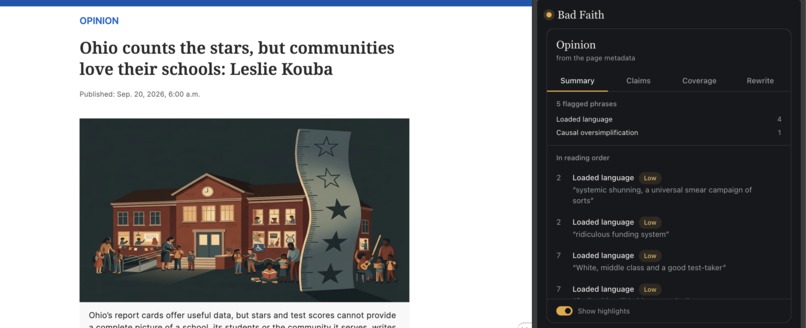
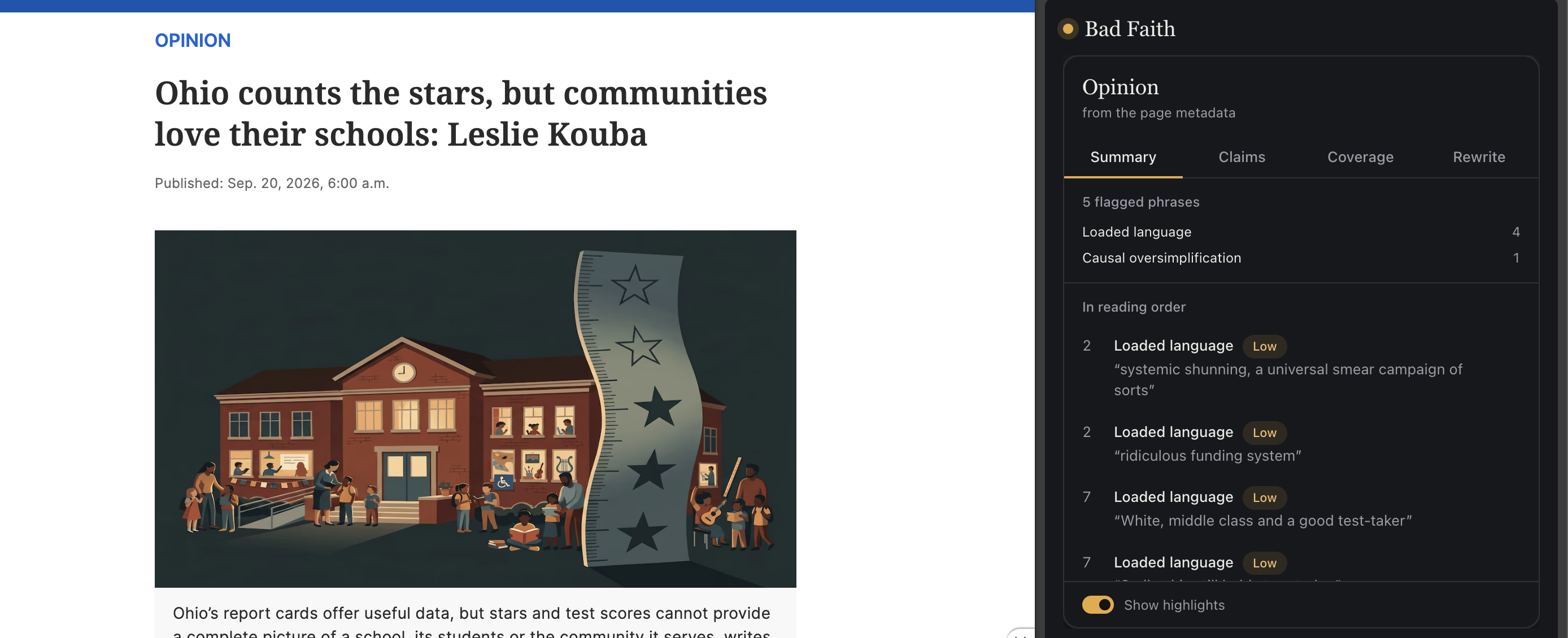
Flags manipulative and provocative wording
-

Get real-time insight into what other outlets are saying on the same topic
-
Automatically informs you if the article you are reading is "News" or "Opinionated"
-
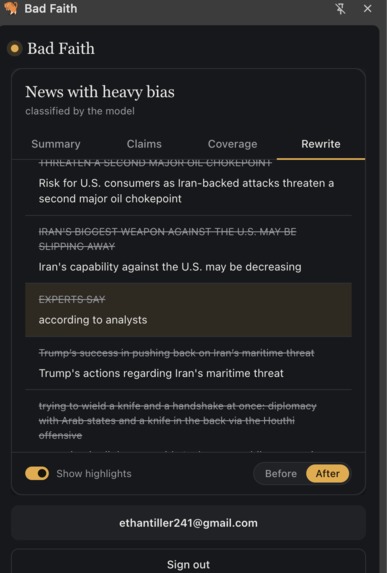
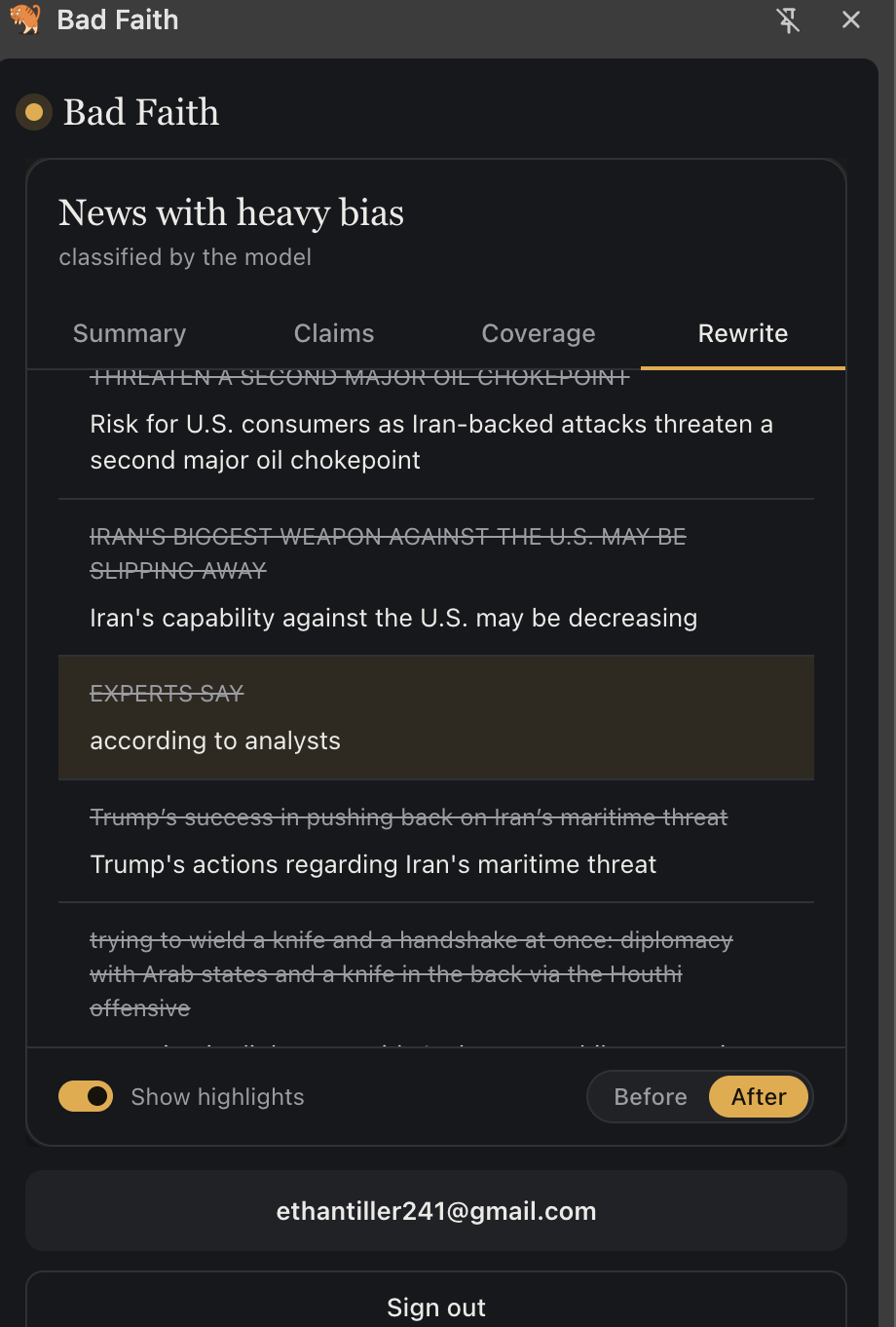
Re-write your article neutrally to provide transparency
-

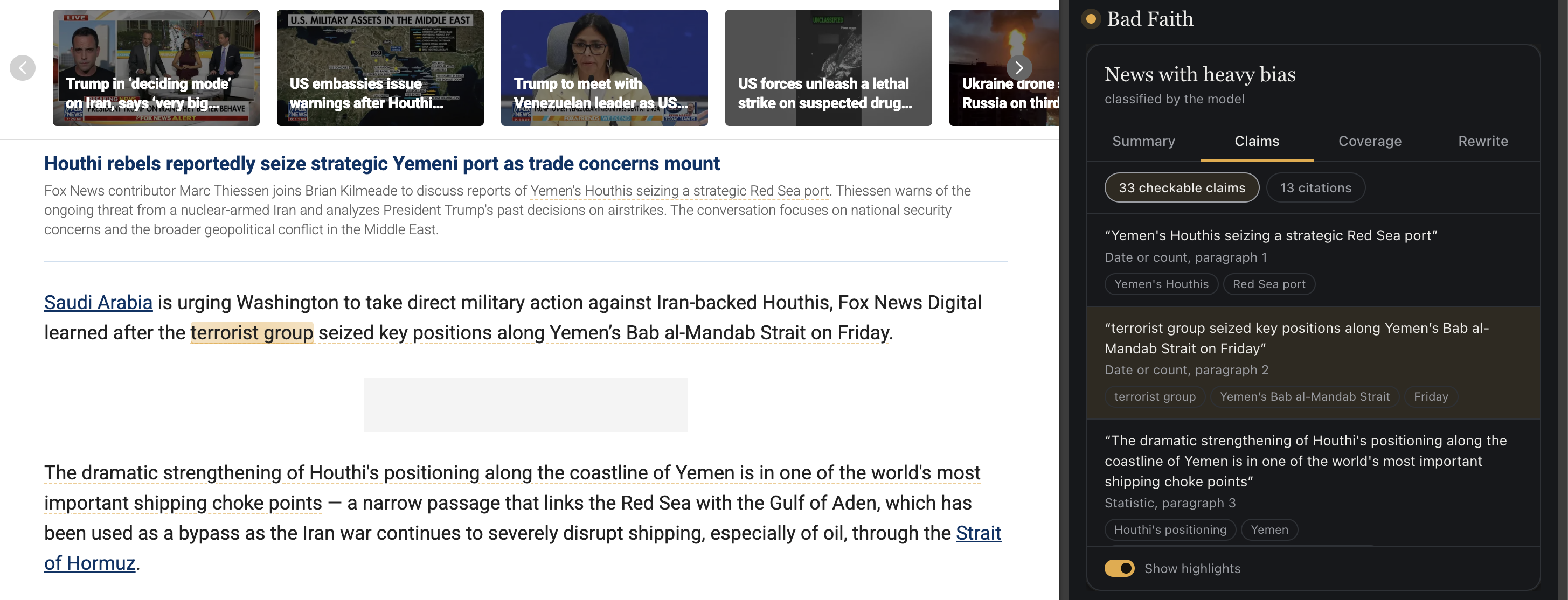
Highlights claims the article is making


Inspiration
In today’s attention economy, the news industry is increasingly driven by clicks rather than context. Across the board, organizations are financially incentivized to use provocative, sensationalized language to capture eyeballs instead of focusing on objective, level-headed reporting. We built Bad Faith to help readers cut through the noise, recognize manipulative rhetoric, and instantly verify claims so they can navigate the modern web with confidence.
What it does
Bad Faith is an automated news auditor wrapped in a Chrome extension. When you read an article, the extension scans the text to highlight manipulative techniques like loaded language, false dilemmas, or misleading statistics right on the page. Readers can then choose to have those biased sections rewritten into neutral language for a more objective perspective. It also extracts testable claims from the text, allowing users to instantly verify them against a live consensus of other news outlets to see if a claim is supported, contradicted, or missing crucial context. Finally, the tool verifies the quotes used in the article and provides immediate background information on the speakers and organizations, giving readers full context on exactly who is shaping the narrative.
How we built it
We structured Bad Faith as a monorepo containing a TypeScript Chrome extension, a Python 3.12 FastAPI backend, and a standalone CLI evaluation harness. We utilized the Nemotron LLM to classify rhetoric and extract entities. To power our real-time coverage verification, we built a highly concurrent async pipeline using DuckDuckGo's news index, pulling live reporting snippets to feed the LLM as evidence. We tied it all together with Supabase for authentication and intelligent caching.
Challenges we ran into
Building a fast, reliable coverage pipeline was our biggest hurdle. We initially tried using the public GDELT API but were immediately bottlenecked by 429 rate limits. We also realized that attempting to scrape full HTML from external news sites introduced massive latency and bot-blocking issues. We successfully pivoted to a streamlined async search pipeline that relies entirely on search engine snippets, cutting our verification latency down to our strict ~3-second target.
Accomplishments that we're proud of
We are proud of our robust evaluation and anti-hallucination safeguards. We rigorously benchmarked the Nemotron model’s performance using the SemEval dataset to ensure high-quality, standardized rhetorical classification. To prevent the model from inventing evidence, we built a strict grounding gate that verifies every single quote it references exists verbatim in the original article. We also pushed beyond our initial scope by engineering an entity-context feature that automatically surfaces background information on the people and organizations quoted, giving readers immediate insight into exactly who is speaking.
What we learned
We learned that when building complex LLM tools, standardizing the data contract is everything. We also learned the hard way that fetching live news data requires building highly defensive, fail-open search clients. You don't always need to scrape the whole web to fact-check; sometimes a clean, targeted search engine snippet provides the exact context the model needs to make an accurate judgment.
What's next for Bad Faith
We plan to expand our pipeline to support multi-language auditing, allowing users to cross-reference claims against international reporting. Ultimately, we want to build a public macro-dashboard that aggregates our data to track the long-term credibility and rhetorical habits of major news outlets, holding the industry accountable at scale.
Built With
- chrome
- fastapi
- javascript
- llm
- nemotron
- python
- react
- semeval
- supabase
- typescri
- typescript


Log in or sign up for Devpost to join the conversation.