-
-
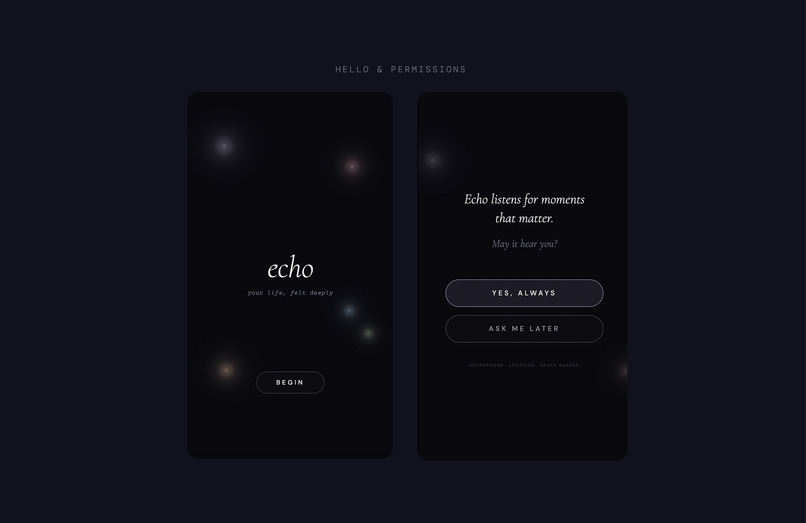
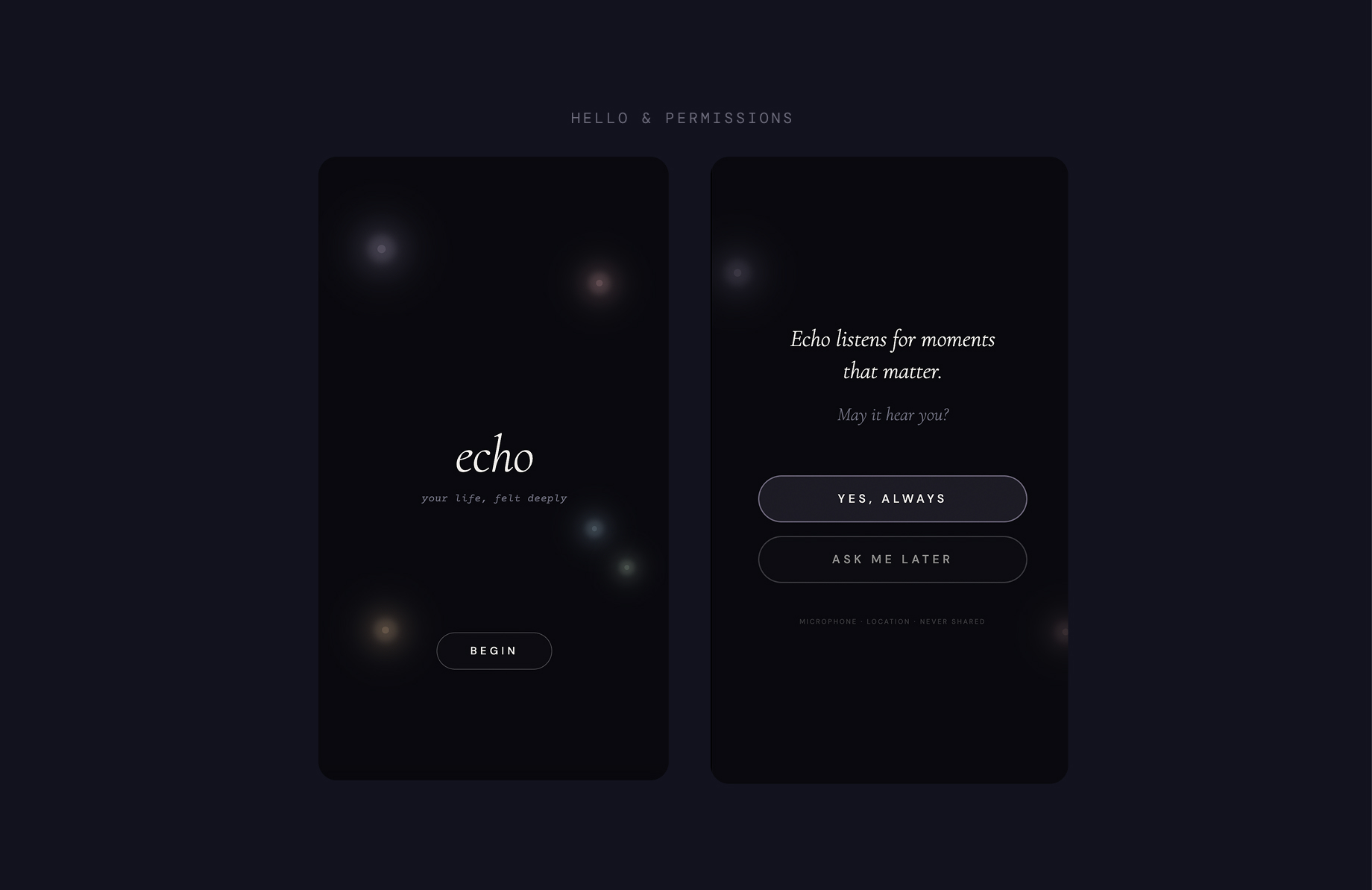
hello & permissions
-
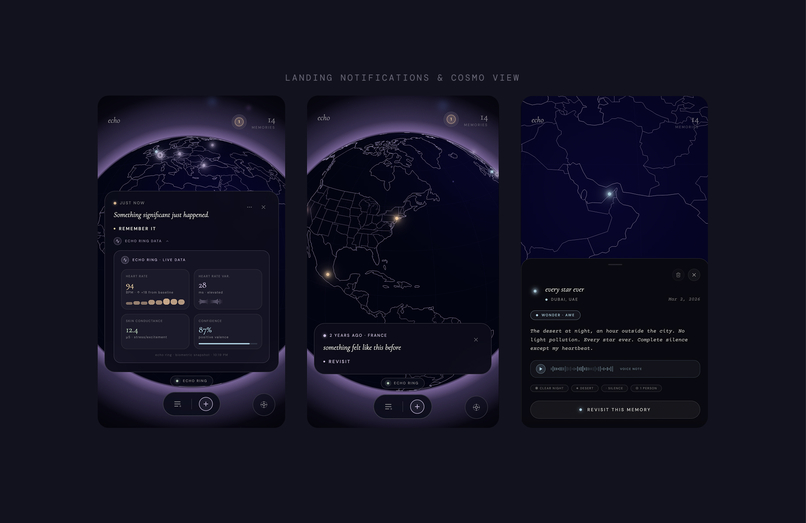
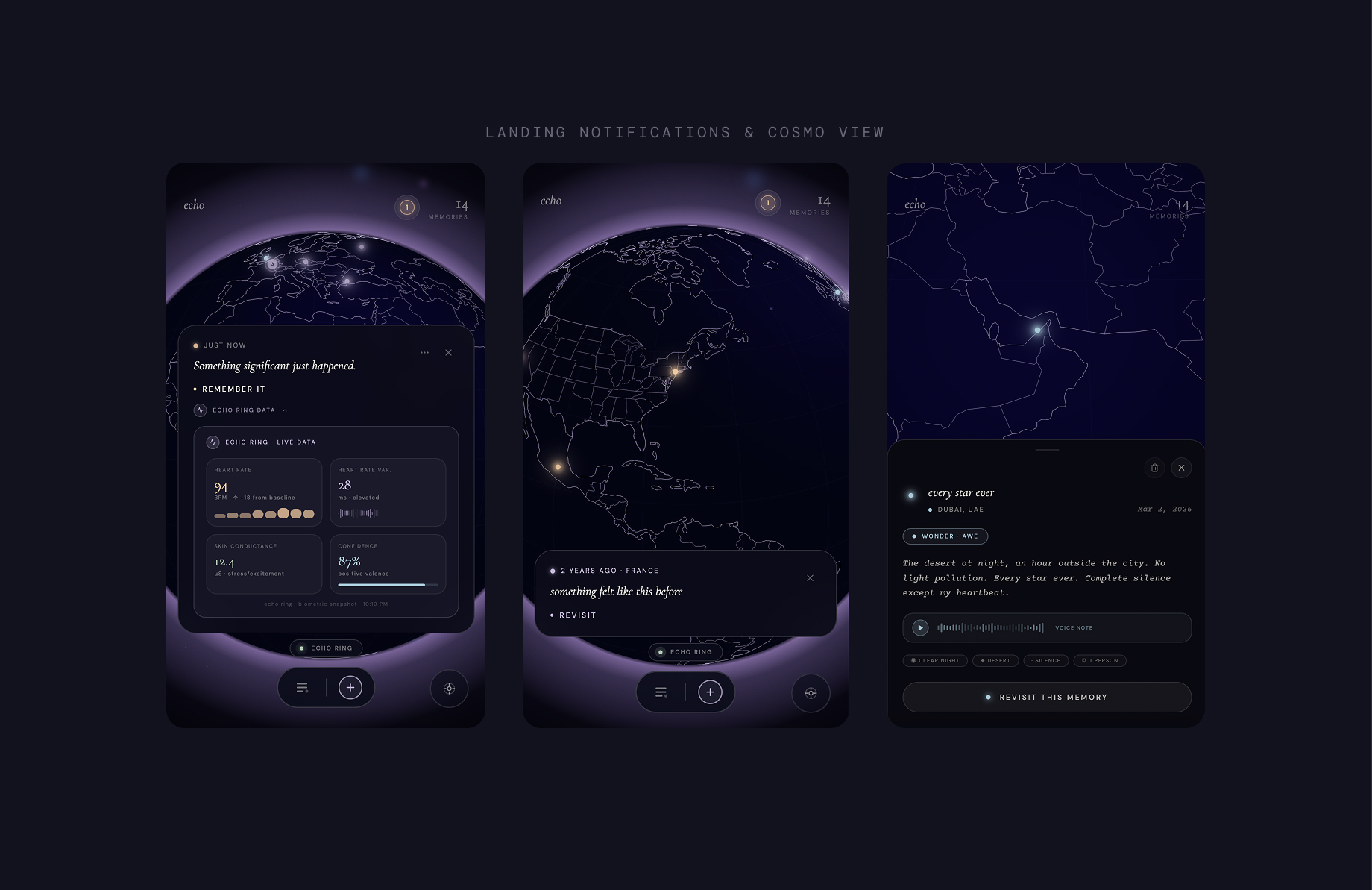
landing notifications & cosmo view
-
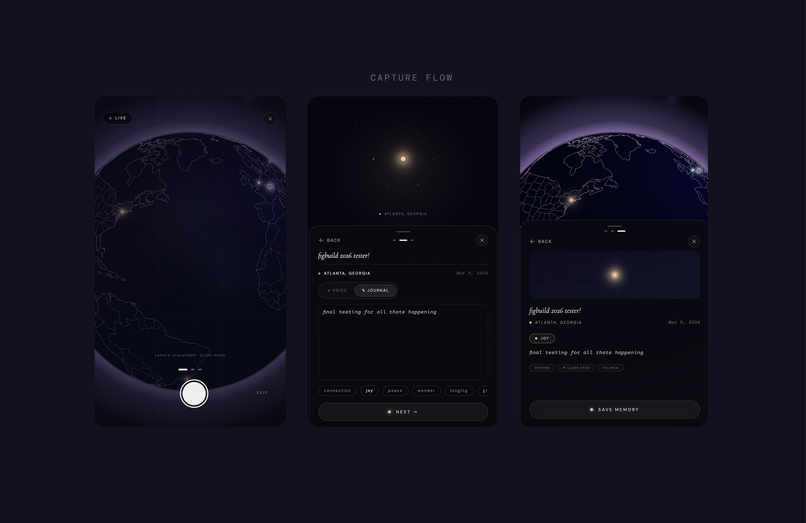
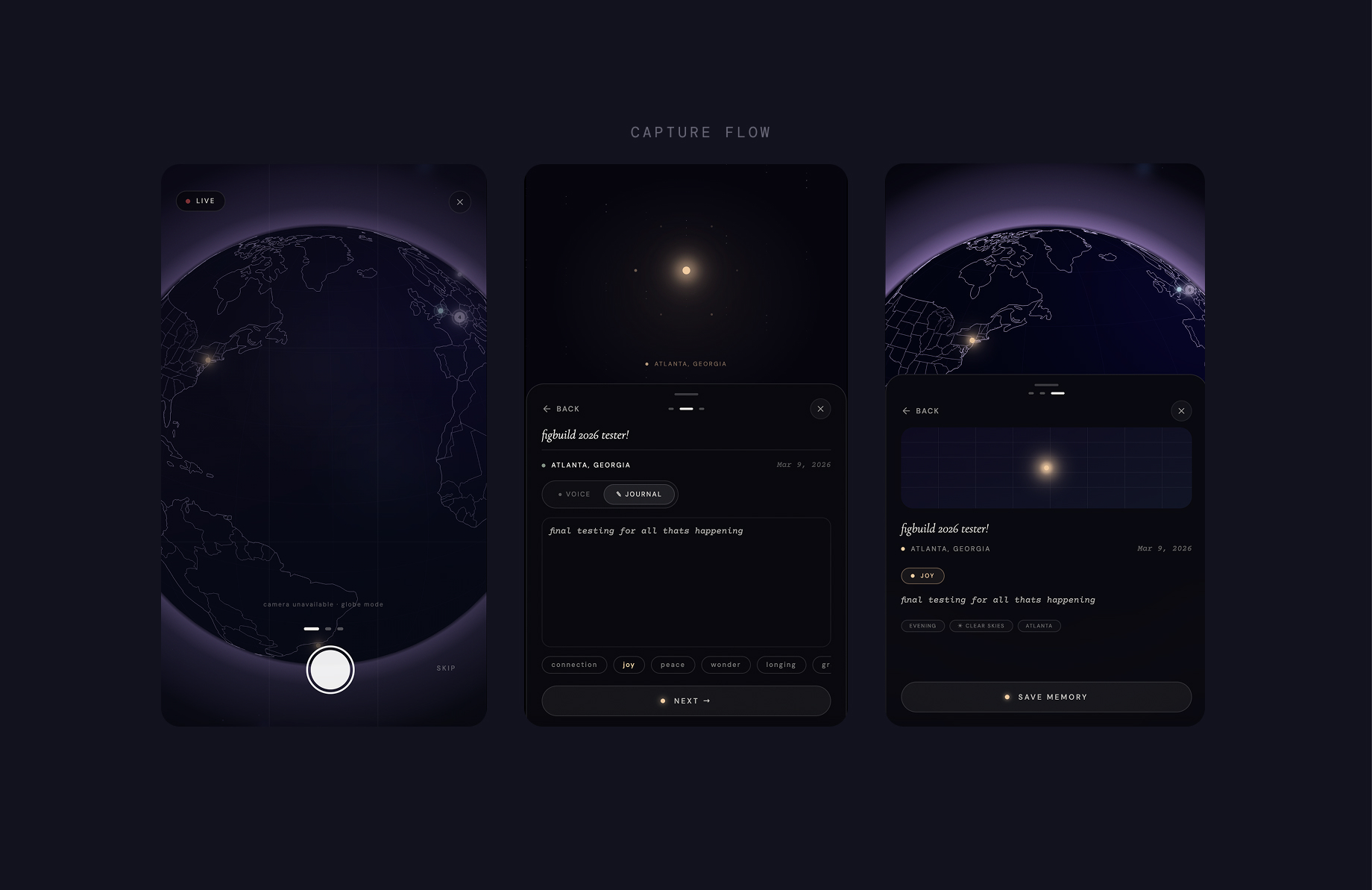
capture flow
-
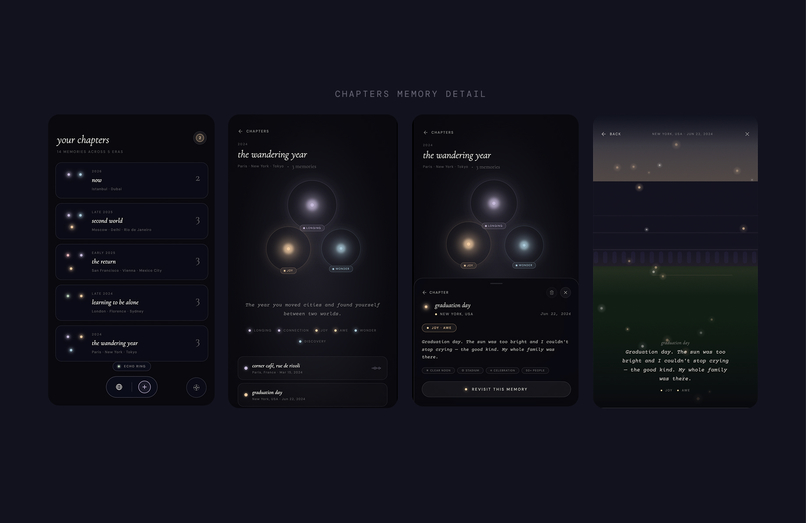
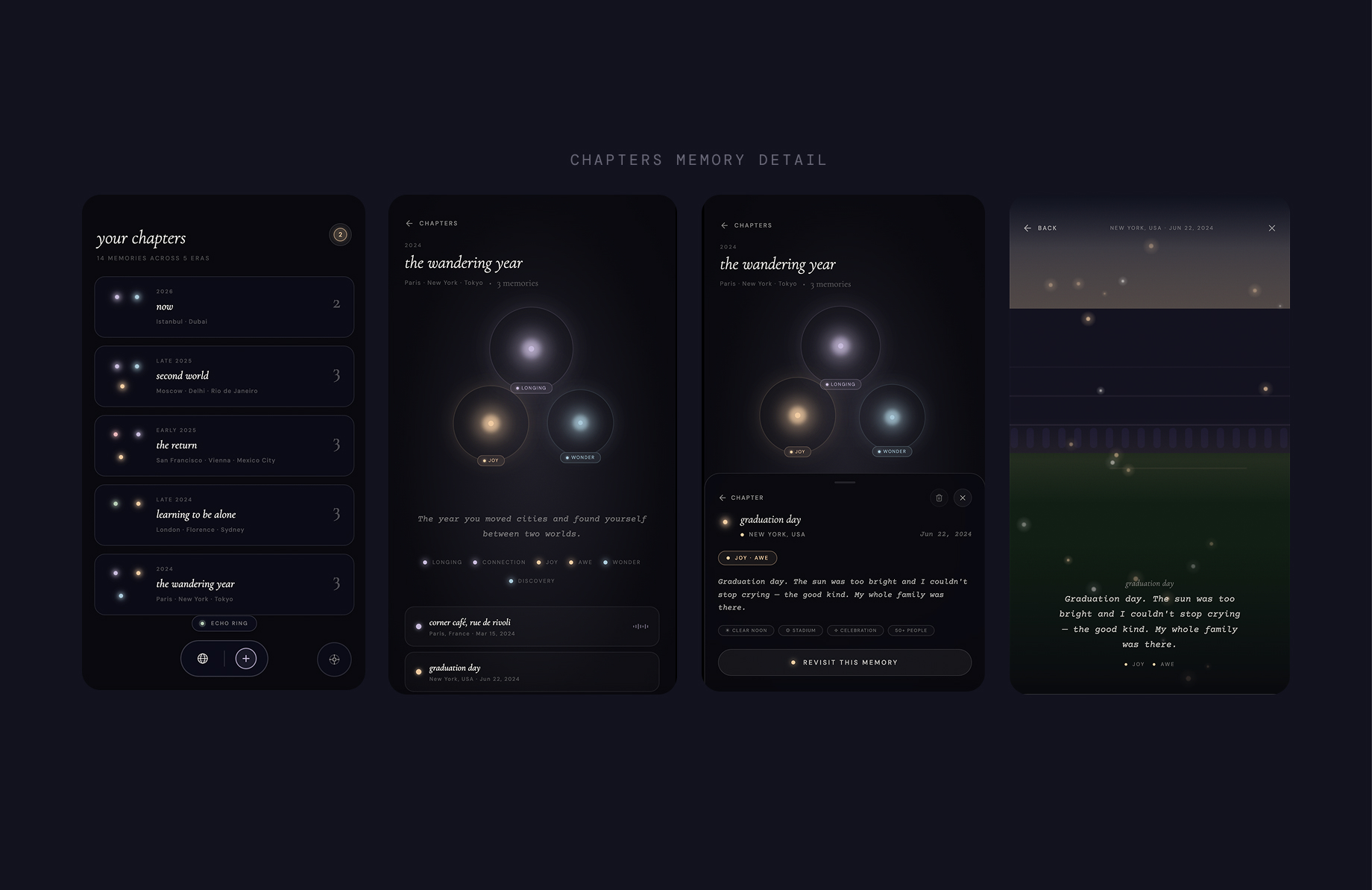
chapters & memory detail
Inspiration
It started with nostalgia. That specific ache of looking back at a moment, a conversation, a place, a feeling, and wishing you had paid more attention while you were there. Not that you weren't present, you just didn't know yet that it would matter later on. That gap between living a moment and recognizing its significance is what echo is built around. The question that drove our project is simple: what if something could notice for you, before you knew to look?
What it does
echo is a dual-surface wellness tool: a biosensor ring paired with a mobile app. It is designed to detect emotionally significant moments in real time and help you hold onto them, or revisit memories you may be thinking of subconsciously but can't quite put your finger on.
The ring reads three physiological signals: heart rate variability, skin conductance, and heart rate. When a meaningful threshold is crossed, it delivers a haptic pulse to the ring, and a notification to the app. You then choose whether to capture the moment as a photo, voice note, or simple line, or let it pass.
Every memory lives on a spinning globe at the exact coordinates where it was experienced. Over time, memories cluster into chapters, organized by place and era.
How we built it
The prototype was built entirely in Figma Design and brought to life on Figma Make.
Challenges we ran into
The hardest part was holding the vision together while learning the tools. Figma Make required a kind of prompting and interaction we hadn't expected. Prompting it to produce interactions that felt right meant describing not just what should happen, but the tiny specific details that make what should happen. The gap between imagination and execution in an AI-assisted prototyping environment is its own design problem that we ran into.
Conceptually, the challenge was precision. echo had to feel personal without being niche, and scientifically grounded without being too "out there" as it is based on a imaginative device. Finding the right frame for a new sense, and not just a memory app, was the turning point that made everything else come together.
Accomplishments that we're proud of
We're proud that echo feels like something that could genuinely exist. The globe works. the cosmos glow, the capture flow is three steps and works (for the most part), and the nostalgia ping demo lands the way we imagined it. For a concept this abstract, a wearable that detects emotional significance in real time, making it feel intuitive rather than speculative was the real accomplishment. (We hope you find it intuitive too!)
We're also proud of the design language. Every decision, from the typefaces to the dreamy look, was made in service of the same idea: that the tool should be like a place to store pleasant memories like a dream journal.
What we learned
Emotionally significant moments leave a measurable physiological trace before conscious recognition catches up! The neuroscience of memory consolidation became echo's scientific backbone: we tend to undervalue our lives as we're living them, and the memories we fail to hold onto are precisely the ones that build resilience and meaning over time.
We also learned that iterative prototyping is inseparable from the design itself. You cannot know what something feels like until you're walking through it yourself, which is, fittingly, exactly the problem echo was built to solve (in a different sense of course).
What's next for echo
The immediate next step is the ring. Moving from form concept to functional prototype, with actual HRV and skin conductance sensing, validated to report emotional significance. The core research question is whether the physiological threshold echo uses can be personalized over time: your emotional baseline is not the same as anyone else's, and maybe echo could learn yours.
Beyond hardware, we want to explore the nostalgia ping more deeply; the biological signal, where Echo detects the physiological signature of reminiscence and surfaces a past memory that matched it. That feature, more than anything else, is where Echo stops being a capture tool and becomes something closer to something more personal to your inner mind.
Built With
- claude
- figma
- figmamake


Log in or sign up for Devpost to join the conversation.