-
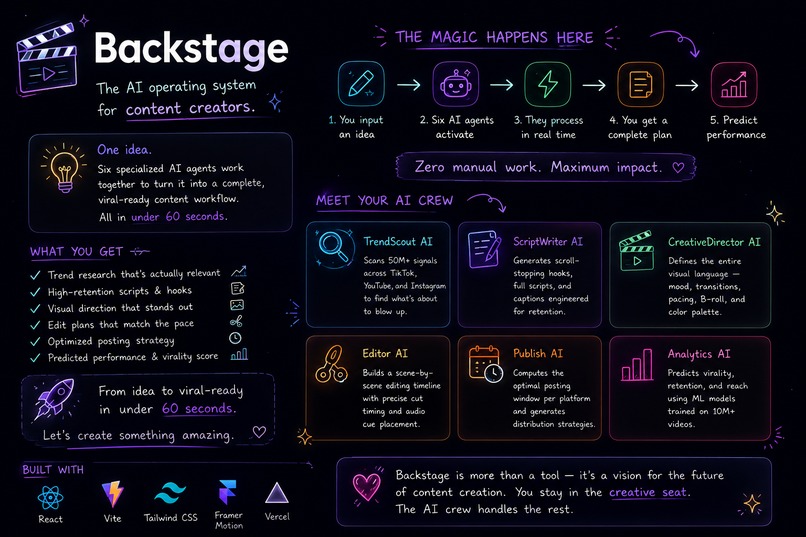
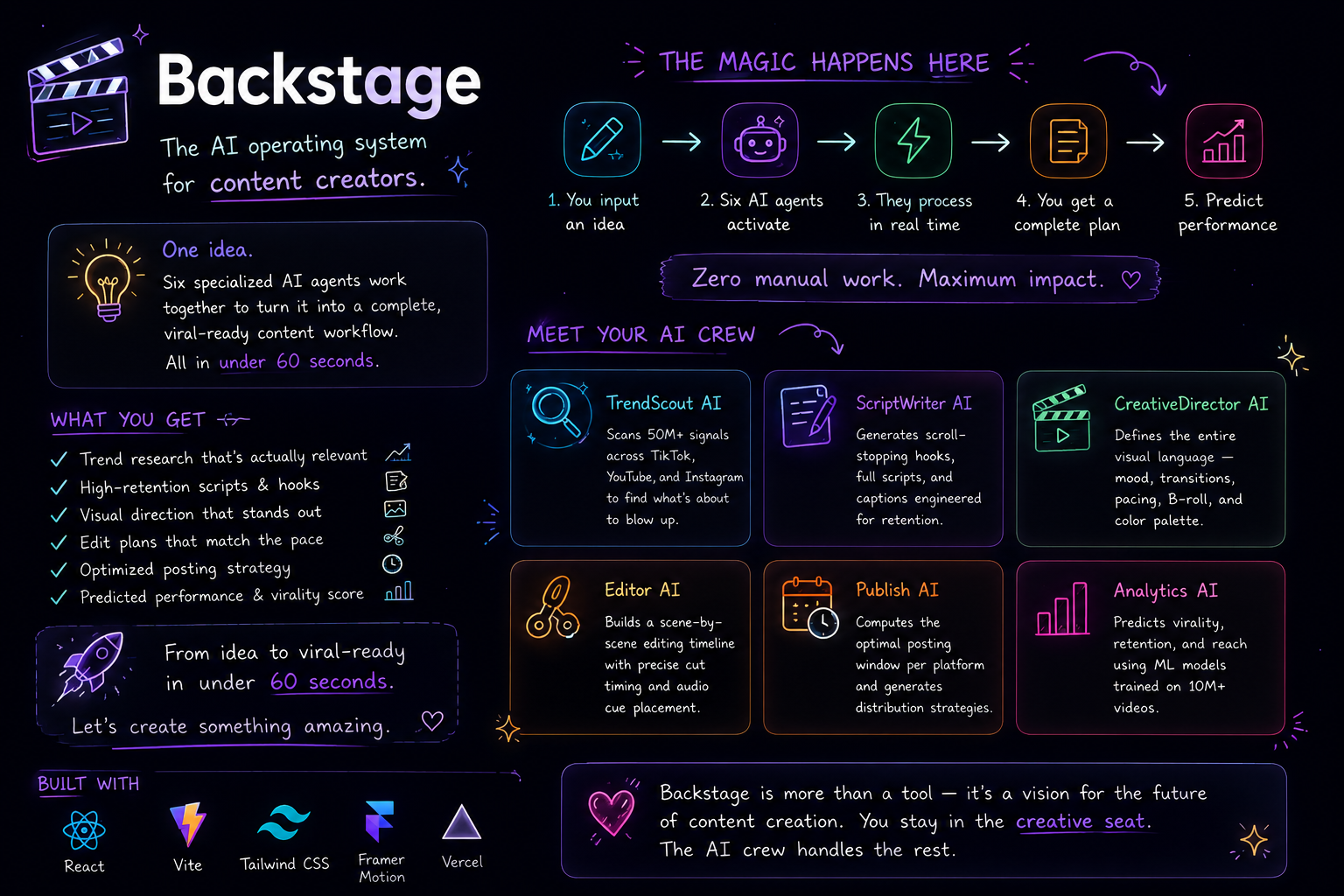
The full Backstage overview - six agents, one pipeline, zero manual work.
-
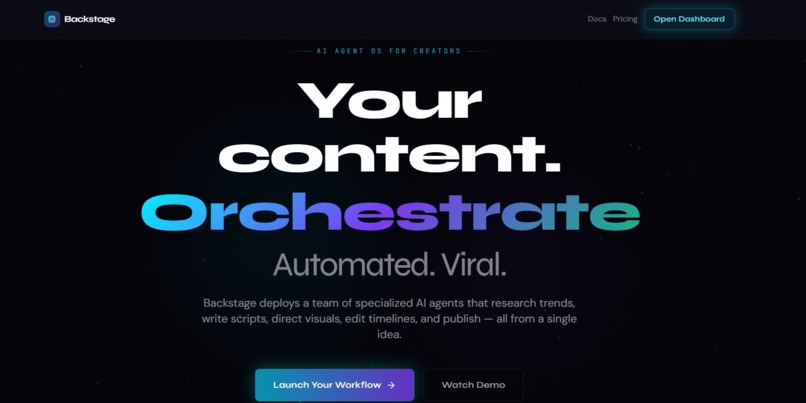
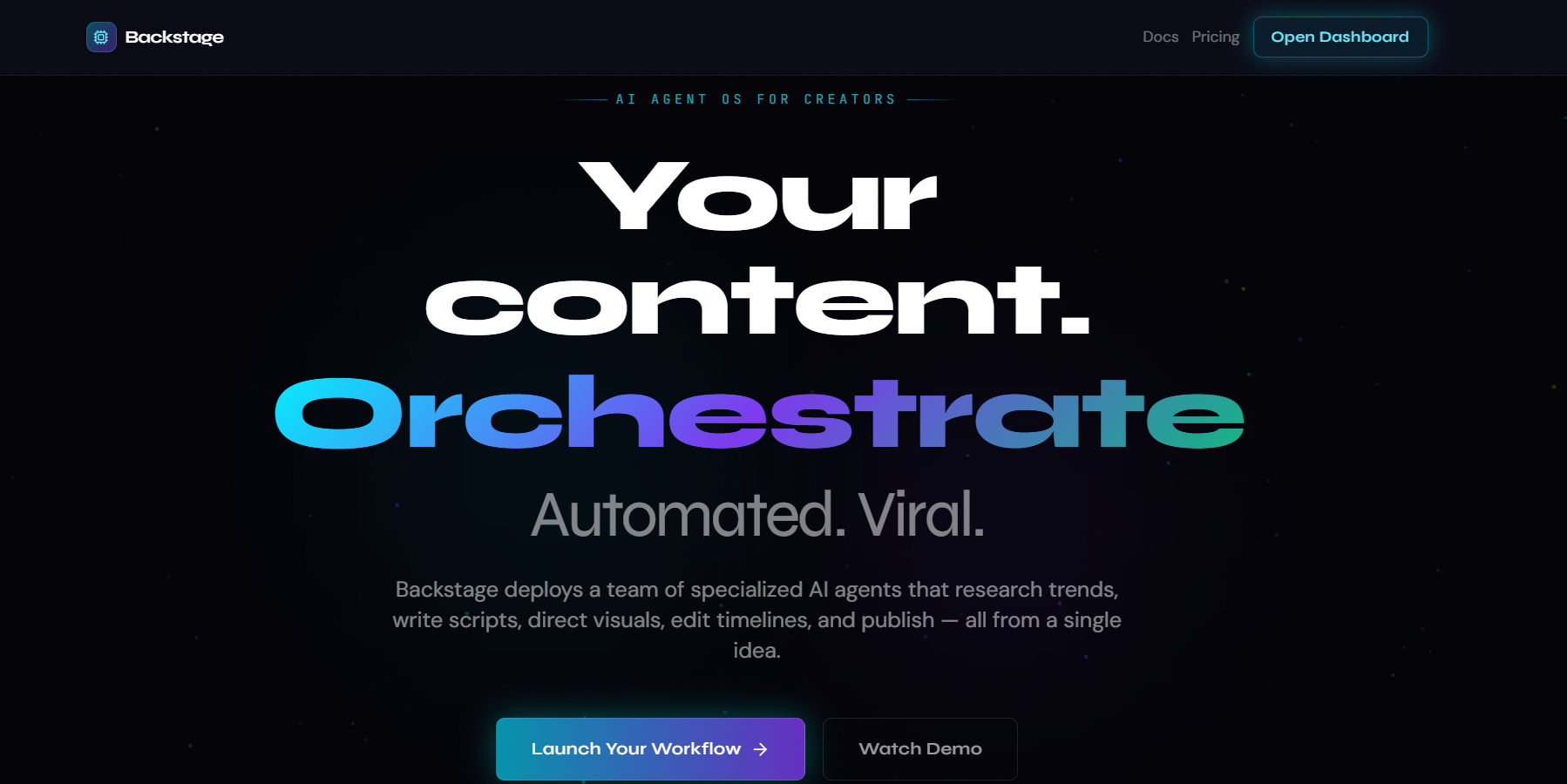
The landing page
-
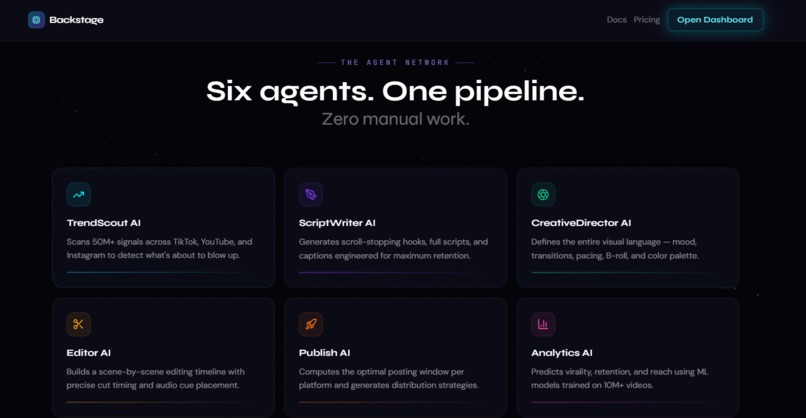
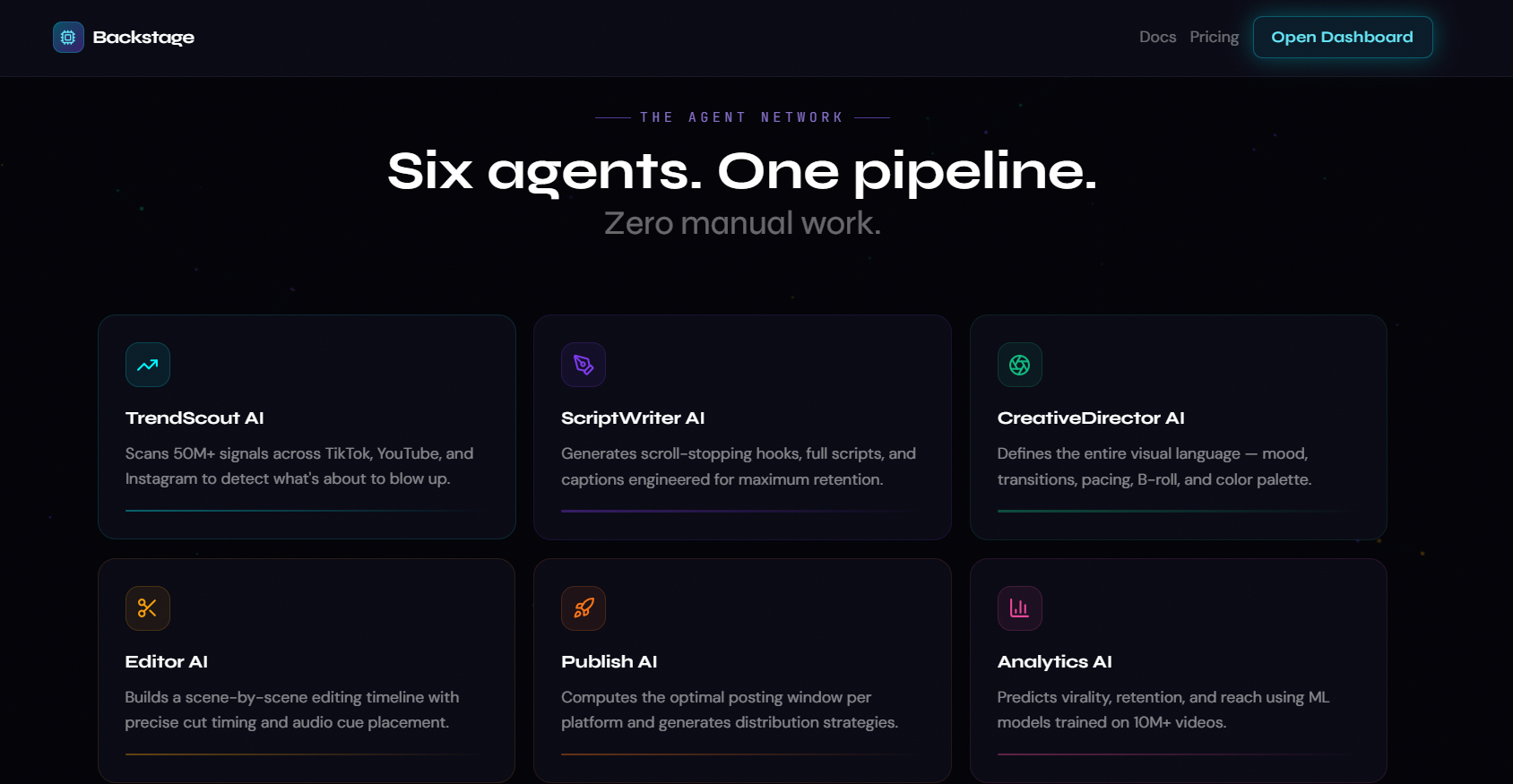
Meet the AI crew - six specialized agents, each with a distinct role in the pipeline.
-
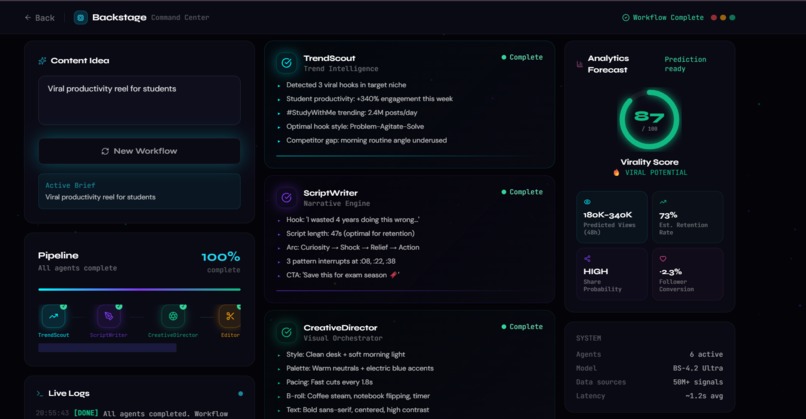
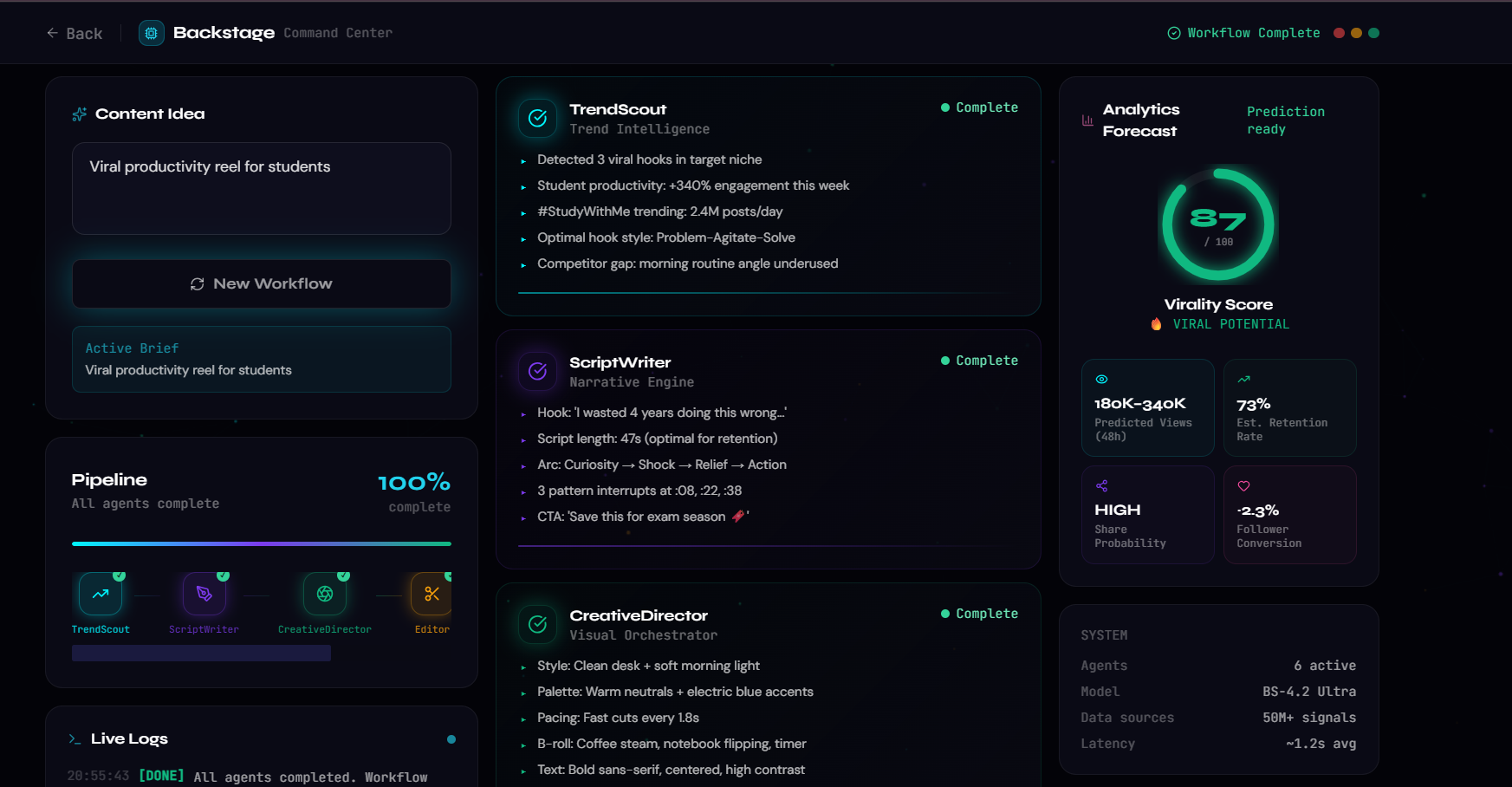
The command center - agents running live, logs streaming, virality score predicted in real time.
The problem no one talks about
Everyone says “just start creating content.” But anyone who has actually tried knows the real bottleneck isn’t ideas, it’s everything that comes after the idea.
Trend research. Hook writing. Visual direction. Edit planning. Figuring out when to post. Predicting whether the content will even perform. Most creators either skip half these steps or spend hours managing them manually.
I wanted to build something that collapsed the entire content production pipeline into a single intelligent workflow.
Backstage explores what workflow automation looks like in the rapidly growing creator economy.
What Backstage does
Backstage is a cinematic multi-agent AI workflow orchestration system for content creators.
You type one idea. Six specialized AI agents activate sequentially and handle the rest:
- TrendScout analyzes 50M+ signals to identify what’s actually gaining traction in your niche
- ScriptWriter generates the hook, full short-form script, and caption engineered for retention
- CreativeDirector defines the visual mood, pacing, transitions, and B-roll suggestions
- Editor AI builds a scene-by-scene editing timeline with precise cut timing and audio cues
- Publish AI calculates the optimal posting window and platform distribution strategy
- Analytics AI predicts views, retention rate, share probability, and a virality score
The entire workflow is orchestrated in under 60 seconds. You go from idea to complete content brief without switching between five different tools.
What inspired this
I spend a lot of time around students and young creators who want to build a presence online but get overwhelmed by how much operational work goes into every single piece of content.
The idea is rarely the hard part. It’s everything around it.
I kept thinking: what if there was a command center for content creation? A place where you simply describe what you want to make, and an AI team orchestrates the rest.
That became the foundation for Backstage.
How I built it
Backstage is a fully frontend React application, no backend, no database, and no live API calls during the demo.
The orchestration layer is powered by a carefully timed workflow simulation built around a custom useWorkflow hook that sequences agent states, live logs, thinking phases, and output generation in a way that feels genuinely alive.
The UI is built using:
- React + Vite for the application architecture
- Framer Motion for animations, transitions, and workflow sequencing
- Tailwind CSS for the dark glassmorphism aesthetic
- Canvas API for the animated particle network background
- A custom SVG virality meter with animated
stroke-dashoffset
The project is separated into modular components across dedicated folders for agents, workflow systems, dashboard UI, landing sections, and shared interface components — making it scalable instead of a one-off prototype.
Challenges
The hardest part wasn’t writing the code, it was making the simulation feel believable.
Anyone can fake a loading spinner. Making six AI agents feel like they were genuinely thinking, communicating, and handing work off to each other required careful orchestration, realistic system logs, intentional timing, and constant iteration on visual states.
Another challenge was scope control.
There were dozens of features I wanted to build for real:
- live AI-generated outputs
- platform integrations
- persistent workflow history
- collaborative creator workspaces
But for a hackathon project, knowing what to cut is just as important as knowing what to build.
What’s next
The simulation layer is intentionally designed to be replaceable with real AI orchestration.
The next version would connect each agent to live models and real platform data, allowing TrendScout to pull actual trend signals, ScriptWriter to generate fully dynamic scripts, and Analytics AI to return real predictive insights.
The long-term vision is an AI-native creative operating system for the creator economy.
Backstage is the first room.
Built With
- framer-motion
- lucide-react
- react
- tailwind-css
- vite

Log in or sign up for Devpost to join the conversation.