💡 Inspiration
A recognizable guest is not automatically the right guest for a podcast. Producers need to understand who fits their show, what makes the conversation worthwhile and whether an appearance could help them reach audiences they currently miss.
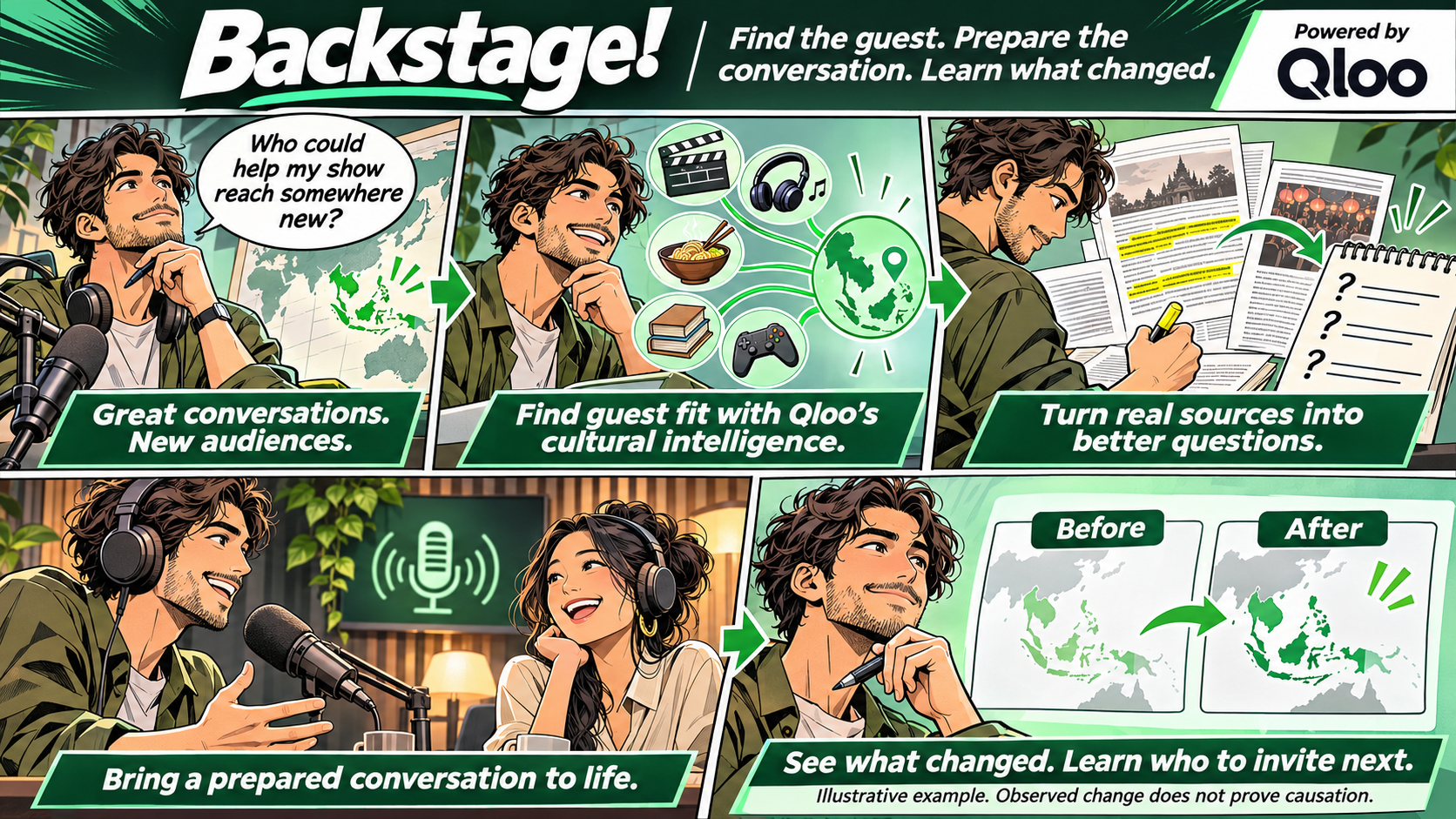
Backstage began with a simple example: imagine a guest has strong cultural affinity in Virginia, while your podcast has a relatively small audience there. Could you investigate that opportunity, invite the guest, then examine whether your Virginia audience changed afterward?
That question became a broader workflow: choose a guest with evidence, prepare a thoughtful interview and preserve enough context to learn from the result.
🎙️ What it does
Backstage is a research and planning workspace for podcast hosts and producers. It connects Qloo-powered guest discovery, source-grounded interview preparation and regional audience analysis.
🔎 Discover guests who fit your show
Hosts describe their show through editorial goals and cultural references, such as artists, films, books and brands. Backstage uses Qloo to help discover and compare relevant guests. Producers explicitly confirm identities, inspect evidence, pin a shortlist, exclude previous guests and record their reasons for choosing someone.
🗺️ Investigate regional opportunities
Geographic evidence helps producers explore where a guest’s cultural affinity may align with an audience they want to reach. Maps sit alongside readable location information and coverage details. Missing evidence stays visible, and small geographic samples are not presented as statewide popularity or listener counts.
Before publication, hosts can save a regional hypothesis containing the guest, target region, supporting evidence and what they hope to observe.
📚 Prepare source-grounded questions
Backstage keeps source notes, links, factual premises and interview questions together. Producers can develop guest-specific questions, record their purpose and prepare follow-ups.
The implemented Anthropic workflow is designed to inspect selected evidence and propose an editorial case and cited question drafts. Human review remains essential: generated questions do not approve themselves. When supporting sources change, affected review states can reopen.
📝 Export a host-ready brief
Research becomes a practical interview brief and timed run sheet. The workspace brings together the guest rationale, sources, questions, review status and interview structure. Producers can save their decisions, return to their work and export a brief for preparation or recording.
📈 Review what happened afterward
After recording an episode’s publication details, hosts can import regional channel analytics through the scoped CSV workflow and compare equivalent before-and-after periods.
The original hypothesis stays connected to the observed result: did regional views or watch time change, was data missing, and did the whole channel grow during the same period?
Backstage does not claim that a guest caused audience growth. The current regional demo uses clearly labeled synthetic analytics; no real creator-growth result is claimed.
🛠️ How we built it
Backstage uses Python and vanilla JavaScript, HTML and CSS. Qloo supplies cultural and geographic evidence, while the Anthropic integration implements a bounded evidence-inspection and interview-drafting workflow.
We used Refero research to guide the interface, emphasizing readable evidence, clear decisions, desktop/mobile layouts and purposeful motion. Saved drafts, exclusions, question revisions and review states are part of the product workflow.
The public application runs through a Cloudflare Worker gateway and a Render Free Python service. Provider credentials stay server-side, and bounded requests help protect limited API access.
🧩 Challenges we ran into
The hardest problem was preserving the meaning of the evidence from discovery through the final interview brief.
Names can refer to different people or works. Geographic coverage can be uneven. Rankings depend on the inputs and comparison set. Editing a source can invalidate a previously approved question. Imported analytics can contain missing or suppressed values.
We built around these constraints while addressing saved-work recovery, export consistency and deployment configuration. Keeping recorded evidence, synthetic examples and live provider responses distinguishable was especially important.
🏆 Accomplishments that we're proud of
Backstage connects three decisions that are often handled separately: selecting a guest, preparing the conversation and reviewing regional results.
The hosted workflow has been checked for saved guest evidence, geography, shortlist actions, reload persistence, source-note examples and Markdown export. Genuine Qloo responses were validated during development, while the public example retains recorded evidence rather than presenting every interaction as a fresh API call.
We are particularly proud of the connection between source revisions and editorial review. A question should not retain the appearance of approval after its supporting evidence changes.
The Anthropic workflow is implemented; hosted live-model verification remains pending in this version.
📖 What we learned
A recommendation becomes more useful when someone can inspect its evidence, change the inputs, reject an assumption and still keep their work intact.
We also learned that identifying a regional opportunity and proving an audience-growth effect are different tasks. Making that distinction visible creates a more credible product and more useful records of editorial decisions.
The value of AI is not simply generating more questions. It is helping a producer reach a better-prepared conversation with less disconnected research and clearer reasons behind each choice.
🚀 What's next for Backstage
Our next steps are to complete hosted AI verification, validate imports with real podcast-owner analytics and test the workflow with producers. We want to measure whether Backstage reduces preparation effort and improves the usefulness of interview briefs.
Longer term, Backstage can help a show learn from its editorial decisions and observed results while keeping the producer in control.
The goal is simple: help hosts answer three connected questions. Who should we invite? What should we ask? What can we learn after the episode goes live?
Built With
- anthropic-claude
- cloudflare
- css3
- docker
- github
- html5
- javascript
- python
- qloo
- render

Log in or sign up for Devpost to join the conversation.