Inspiration
A screenplay contains creative intent, but producing it requires a connected set of decisions: which scenes need specialist crew, how locations affect the schedule, what those choices cost, and how to explain the project to potential collaborators.
Those decisions often live in separate documents. Backlot brings them into one inspectable workspace, helping independent filmmakers move from a screenplay to a production plan whose assumptions they can question.
What it does
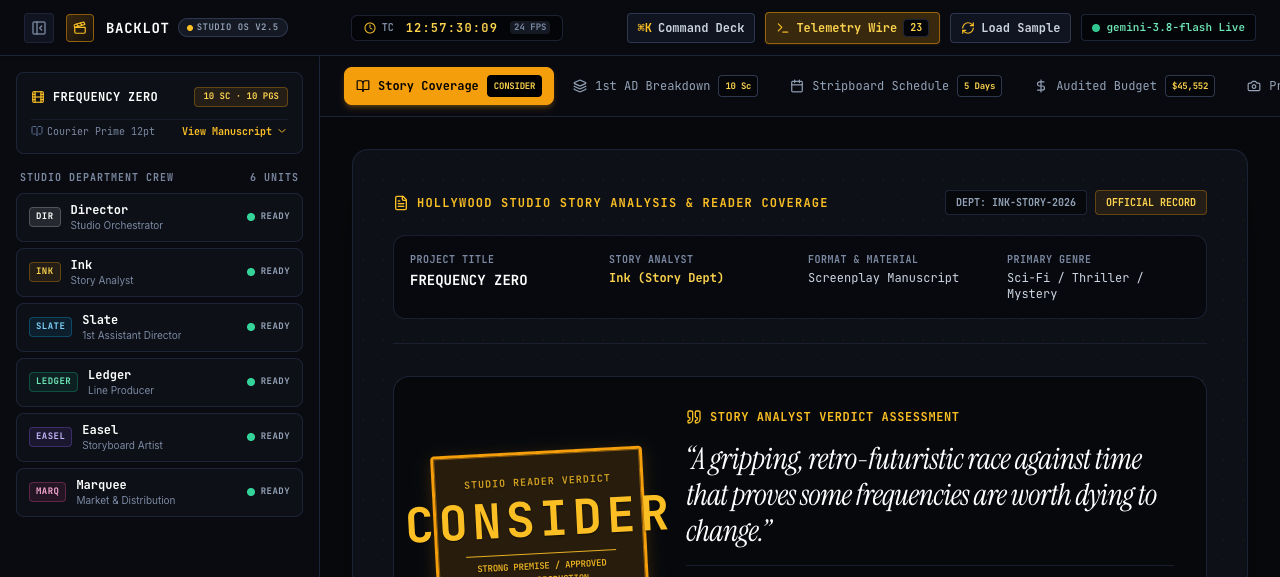
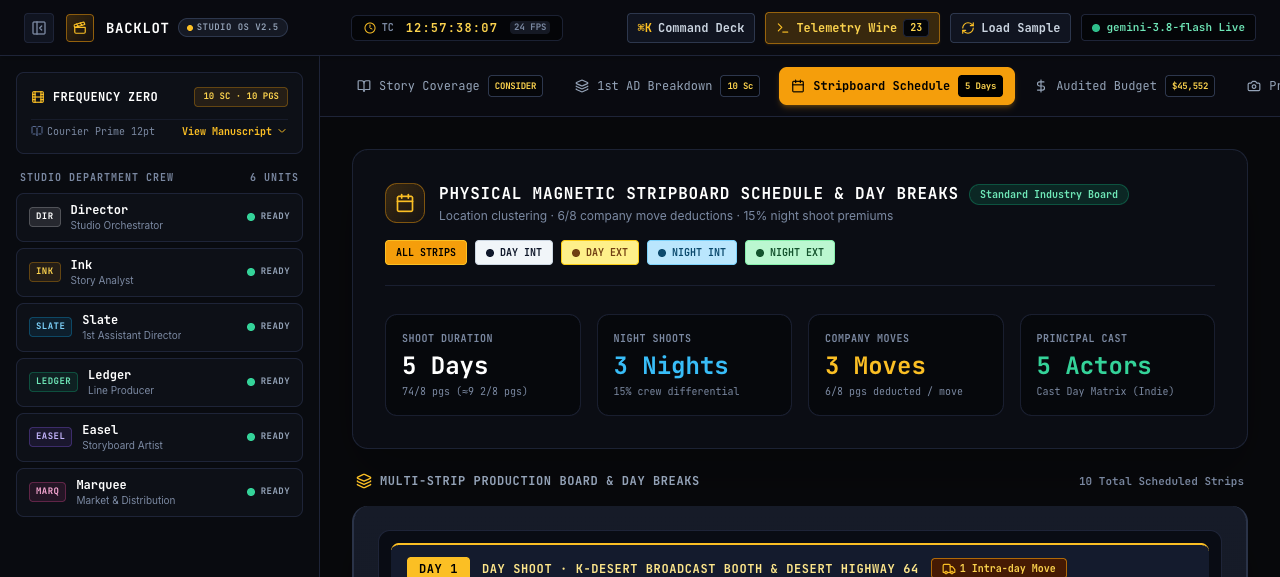
Backlot turns screenplay text into scene extraction, story coverage, a physical production breakdown, a shooting schedule, an itemized budget, and a pitch kit. Optional storyboard planning provides shot descriptions and previz cards.
The interface follows a studio crew: Director coordinates the workflow; Ink analyzes the story; Slate identifies production requirements; Ledger calculates schedules and costs; Easel plans shots; and Marquee researches the market and packages the pitch.
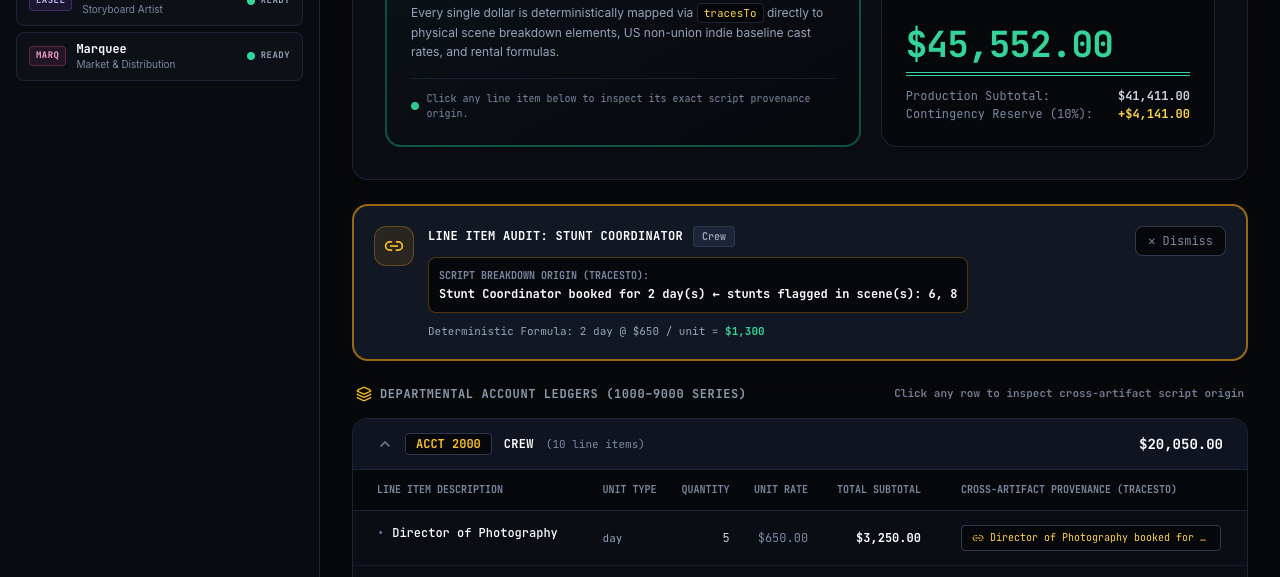
The connection between those outputs is the central feature. In the recorded FREQUENCY ZERO example, driving stunts identified in scenes 6 and 8 lead to a Stunt Coordinator line item: two days at $650 per day, totaling $1,300. The budget drawer shows the calculation and its breakdown reference. The resulting example includes a five-day schedule and a $45,552 estimated budget, including contingency.
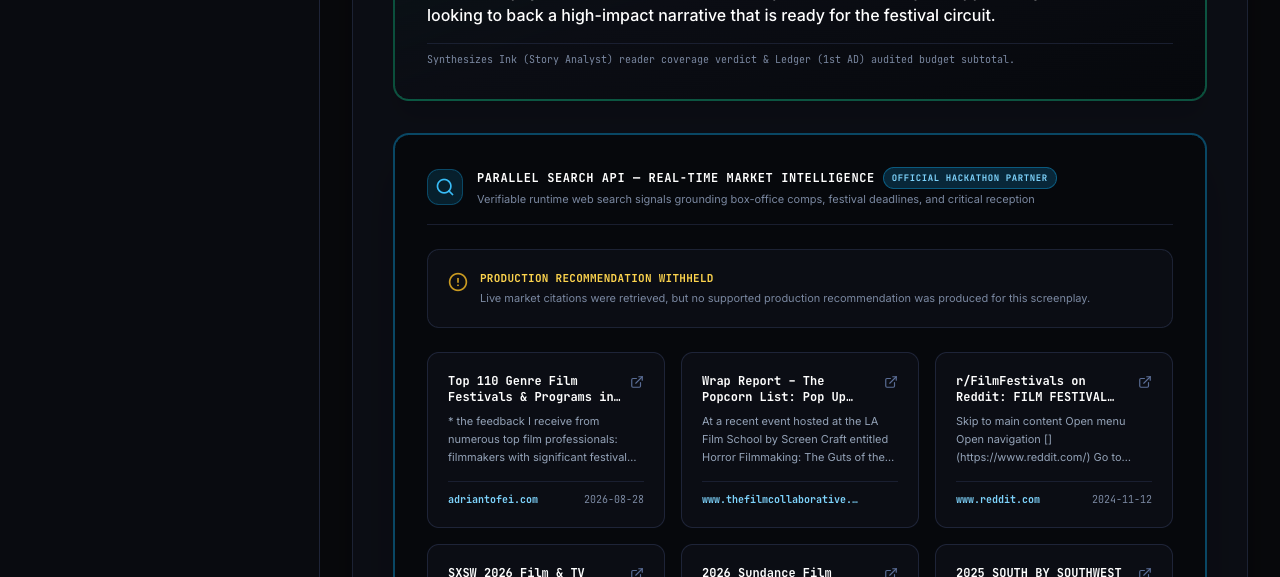
Marquee calls Parallel Search during the run and presents retrieved market and festival information with source links and excerpts. Backlot checks proposed production recommendations against the available evidence and existing production plan. In the demonstration, it retrieves sources but withholds a production recommendation because sufficient supporting evidence was not established.
How we built it
The web application uses Next.js, React, TypeScript, and Tailwind CSS on Google Cloud Run. Server-Sent Events stream execution progress into the crew interface. Zod validates structured inputs and outputs.
Gemini is accessed through Google's official Gen AI SDK with Vertex AI. Backlot integrates Google's managed agent platform through a deployed Vertex AI ReasoningEngine: Director sends an authenticated request from Cloud Run to Marquee running in Google Agent Runtime / Vertex AI Agent Engine as a custom container. Marquee invokes the Parallel Search API through a direct authenticated REST client, then uses Gemini to assemble the pitch kit.
The response must match the originating run and preserve the computed production budget. Managed-agent failures are surfaced explicitly. Ledger's scheduling and budget arithmetic run in deterministic TypeScript, with costs traceable to breakdown requirements or documented production assumptions.
Cloud Build builds the containers, Artifact Registry stores the images, Secret Manager supplies the Parallel credential, and IAM service accounts control service access. The public MIT-licensed repository includes the deployed implementation, container configuration, tests, and setup instructions.
Challenges we ran into
Keeping creative interpretation and financial calculations consistent required a clear division of responsibility. Gemini extracts and synthesizes information; deterministic code calculates rates, quantities, subtotals, and contingency. A correct calculation still depends on the quality of the extracted requirements and configured assumptions, so those remain visible for review.
Search grounding presented another challenge: a relevant URL is not automatically evidence for a proposed budget or production change. Backlot preserves source attribution and can withhold a recommendation when support is insufficient.
Moving Marquee to a managed runtime also required authenticated invocation, schema validation, timeout handling, and checks that remote output belonged to the same run and had not changed the budget.
Accomplishments that we're proud of
- A deployed workflow connecting screenplay analysis, production planning, and live market research in one interface.
- An inspectable link from a scene requirement to a calculated budget line item.
- Actual managed ReasoningEngine execution and runtime Parallel Search integration.
- Clear handling of unsupported recommendations instead of inventing a confident answer.
- Automated tests covering ledger calculations, agent contracts, citation handling, and release checks.
What we learned
Useful AI production tools need visible assumptions and clear boundaries. Specialist roles make outputs easier to inspect, deterministic calculations make costs reproducible, and source excerpts help users judge whether research supports a recommendation.
Backlot produces a planning draft for filmmaker review. Its budgets are estimates based on configured rates and assumptions; retrieved web reporting is attributed rather than independently certified. The sample mode supports quick exploration, while a fresh run exercises Gemini and Parallel.
What's next for Backlot
The next step is testing the workflow with independent filmmakers on their own scripts, measuring corrections and time spent reviewing each artifact. Planned improvements include editable rate assumptions, clearer comparisons between screenplay revisions, and call-sheet and production-software exports.
Built With
- cloud-run
- docker
- gemini
- github
- google-cloud
- google-gen-ai-sdk
- javascript
- next.js
- node.js
- parallel-search-api
- react
- tailwind-css
- typescript
- vertex-ai
- vertex-ai-agent-engine
- vitest
- zod

Log in or sign up for Devpost to join the conversation.