Inspiration
Film and television producers often need small, specific tools such as continuity trackers, clearance logs, cast availability boards, and production records. Generic spreadsheets lose the context of the production, while building custom software for every need takes too long.
Backlot was created to turn a producer's plain-English request into a practical, reviewable tool while keeping the real script or production PDF at the center of the workflow.
What it does
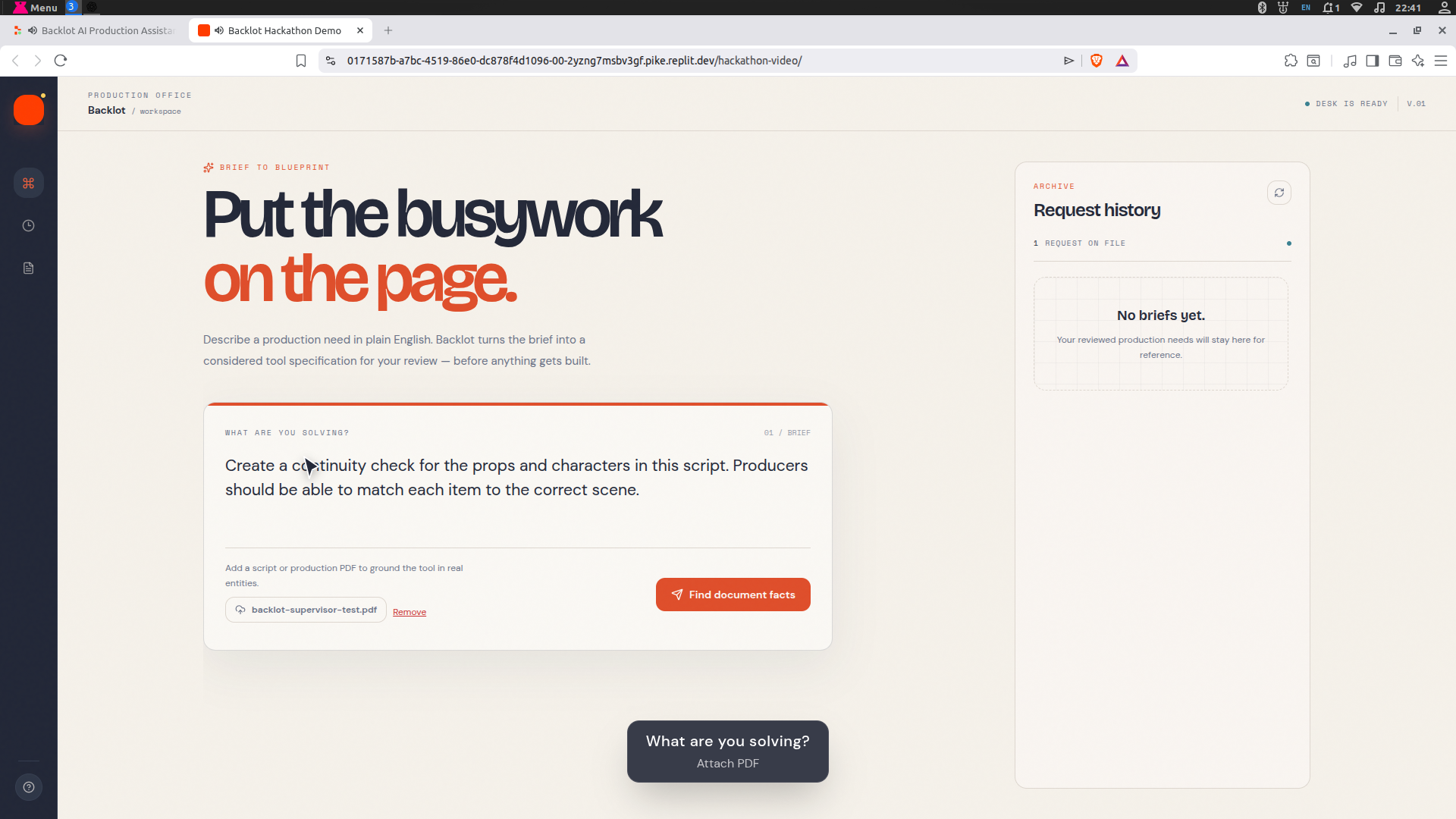
Backlot accepts a production brief and can ground it in a real script or production PDF. It extracts production entities such as characters, scenes, props, locations, and rights mentions.
The producer reviews the grounded facts, chooses between a Production tool or a limited Interactive experience, and reviews the generated plan before anything is built. Backlot then validates the result and can publish a usable tool under a standalone path.
The verified demo creates a Continuity Check interactive experience using real grounded entities:
- RED HERO UMBRELLA → SCENE 12
- MAYA CHEN → SCENE 12
- vintage SUNBURST COLA sign → SCENE 13
The experience reaches the real “Continuity Verified!” success state and can be reset with “Play Again.”
How we built it
Backlot uses a React and Vite frontend with a shared Express API server. PostgreSQL and Drizzle persist requests, grounded facts, plans, generated code, validation results, and published tools.
Google Cloud Vertex AI is the AI provider. Native PDF grounding extracts facts from production documents before generation. Generated tools are validated before publishing and served dynamically from persisted project data.
The interface is designed for producers rather than developers, with guided navigation, review screens, quality checks, request history, and producer-friendly error messages.
Challenges we ran into
The hardest parts were grounding generated experiences in real production entities, handling native PDF extraction reliably, validating generated JSX before it could be shown, and keeping interactive experiences constrained enough to be dependable.
We also had to make sure generated games had reachable win states, clean reset behavior, and no developer-facing language in the producer or player experience.
Accomplishments that we're proud of
We built a complete brief-to-tool workflow rather than a static AI demo. A producer can describe a need, attach a real production PDF, review extracted facts, inspect a generated plan, validate the result, and open the saved tool.
The Continuity Check example was tested end to end with real characters, props, and scenes from the demo document. The game reaches its success state, resets correctly, and remains available from request history.
What we learned
Production context matters as much as generation. An AI-generated tool is more useful when the producer can verify the source facts, understand the plan, and see a quality check before using the result.
We also learned that constrained interactive formats, such as match and branch experiences, are easier to validate and more trustworthy than open-ended generated games.
What's next for Backlot
Backlot could next support clearance tracking, cast availability, location continuity, wardrobe and prop tracking, and rights review.
We also want to improve collaborative review, add richer publishing analytics, and make it easier for production teams to reuse grounded facts across multiple tools.
Built With
- drizzle-orm
- express.js
- ffmpeg
- framer-motion
- github
- google-cloud-vertex-ai
- postgresql
- react
- replit
- tailwind-css
- typescript
- vite

Log in or sign up for Devpost to join the conversation.