Inspiration
A productive meeting can leave a team with clear ideas and an empty backlog. Turning conversations into useful user stories takes time, and important context often disappears: why a feature matters, what “done” means, and which decisions need clarification.
We built Backlogger to bridge that gap, turning meeting recordings into actionable backlog drafts with evidence that helps people review and trust them.
What it does
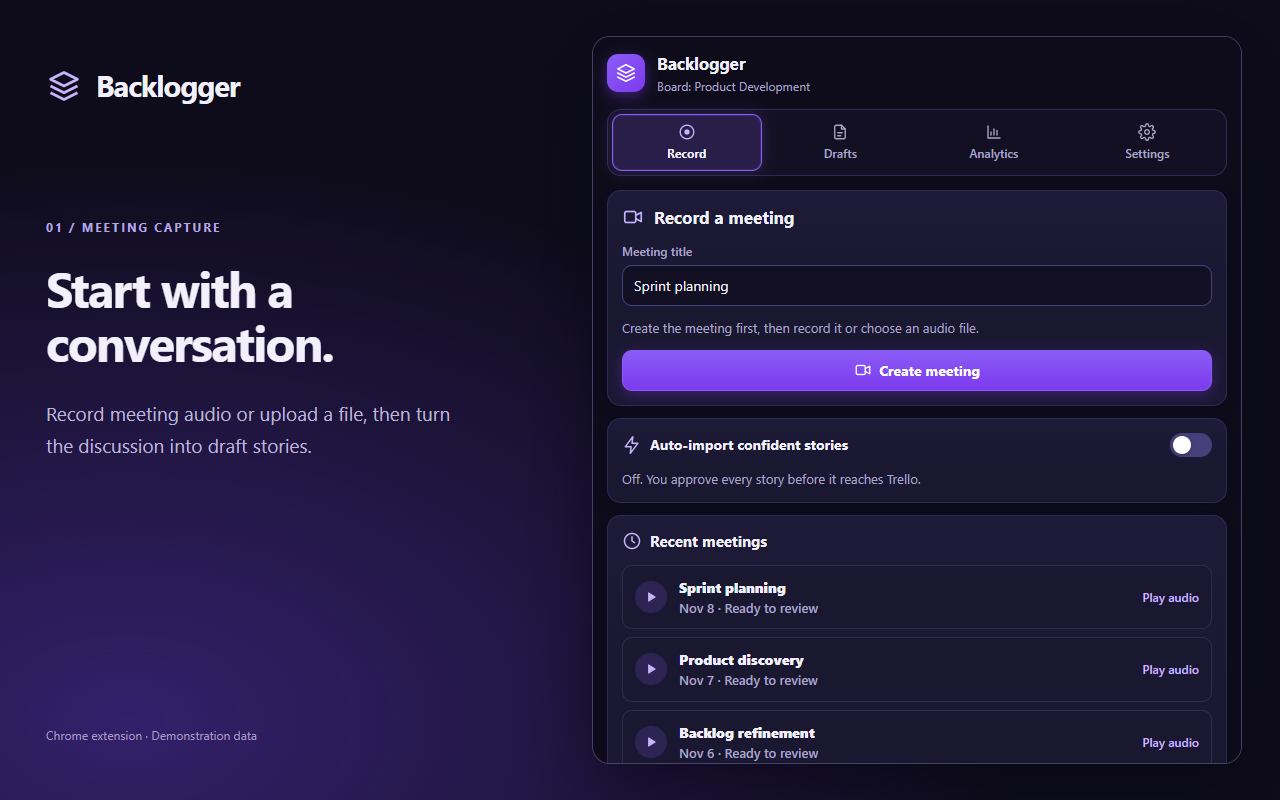
Backlogger is a Chrome extension that turns meeting recordings into user stories for Trello and Jira.
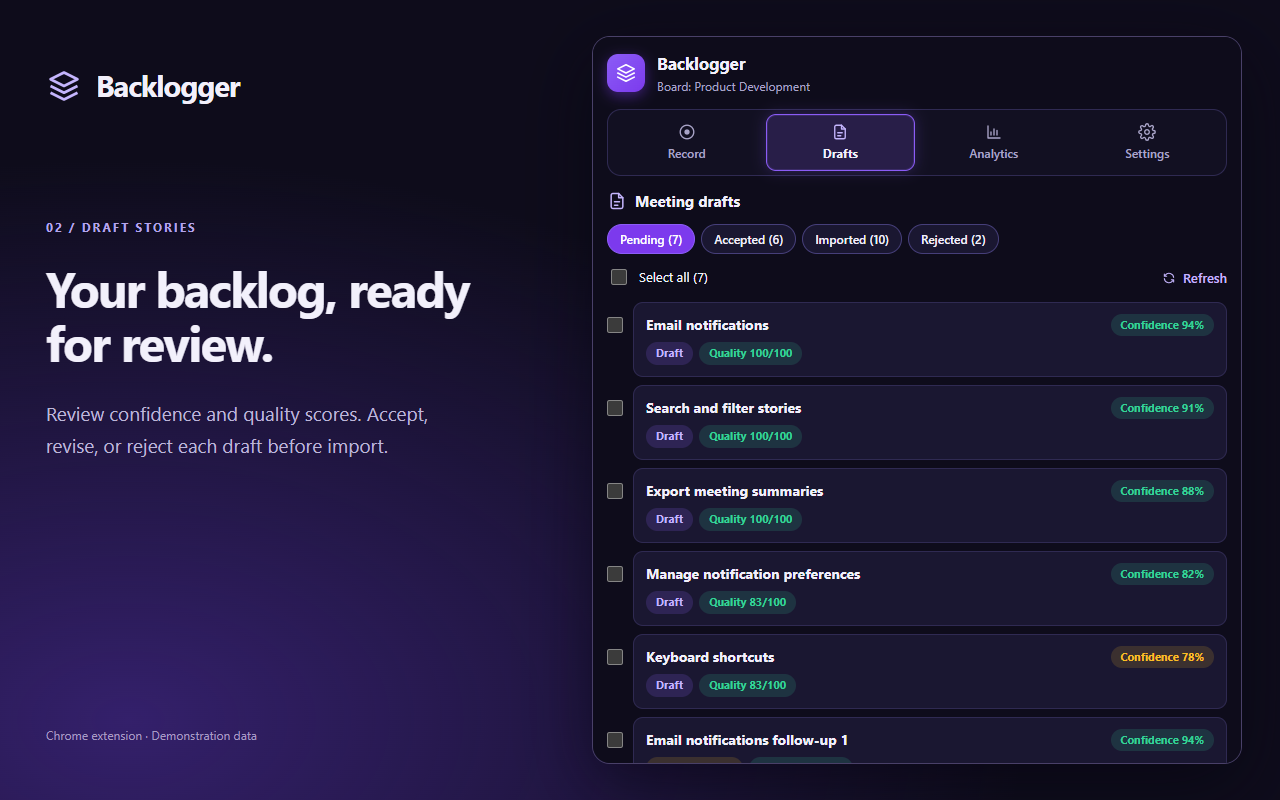
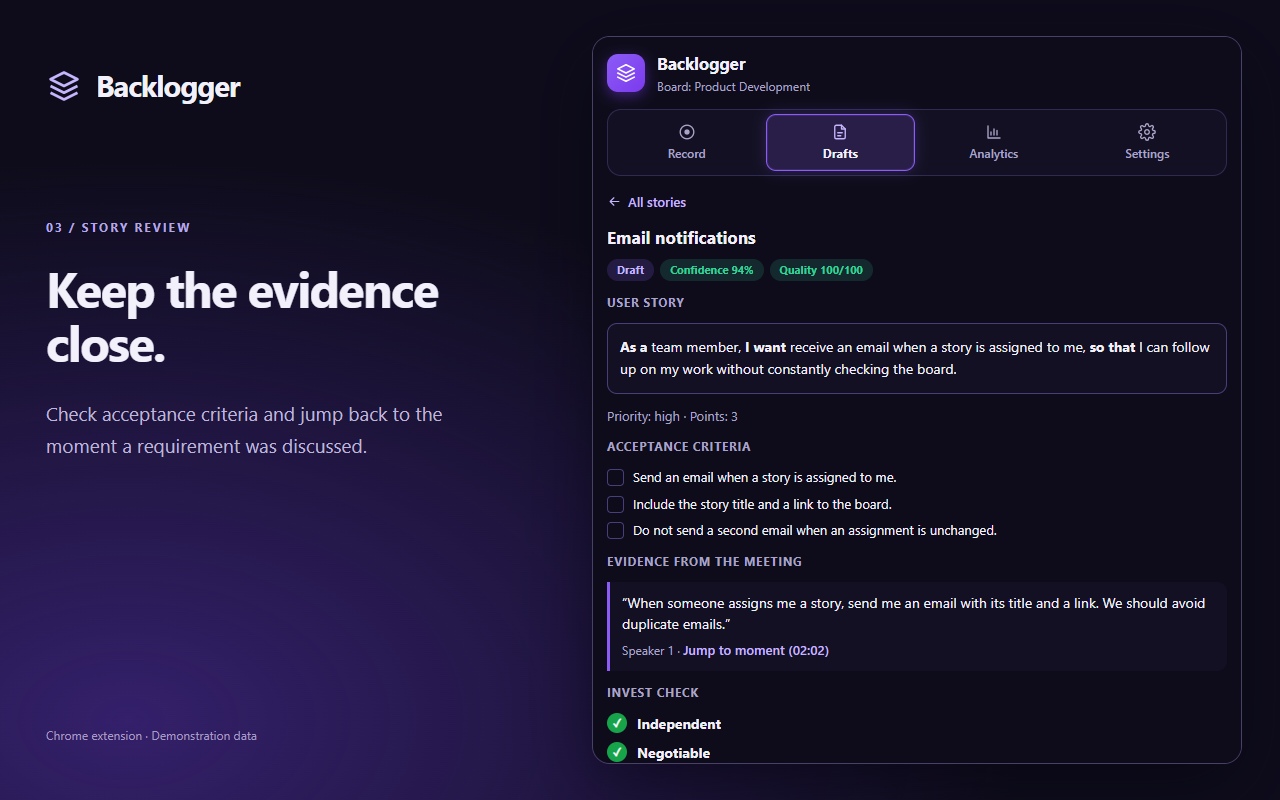
Each draft includes acceptance criteria, proposed implementation tasks, and timestamped meeting evidence. Reviewers can play the relevant audio inside the extension, edit stories, accept or reject them, and export approved work.
Stories are evaluated against INVEST: Independent, Negotiable, Valuable, Estimable, Small, and Testable. Existing board context helps identify overlapping requirements and opportunities to refine scope.
Selectable creativity levels support both conservative extraction and broader exploration. Labels distinguish discussed, inferred, and proposed stories so reviewers can see where suggestions go beyond explicit meeting decisions.
How we built it
The Google Gemini API powers Backlogger’s core workflow: transcribing recordings, extracting requirements, drafting structured user stories, and critiquing their quality.
We also use Gemini embeddings to retrieve relevant existing stories and compare scope across new and existing backlog items. This gives the model context to identify potential duplication and dependencies.
Our pipeline combines timestamped evidence, explicit assumptions, and human review to make generated requirements easier to verify. Intermediate results are preserved so a later processing failure does not discard earlier work.
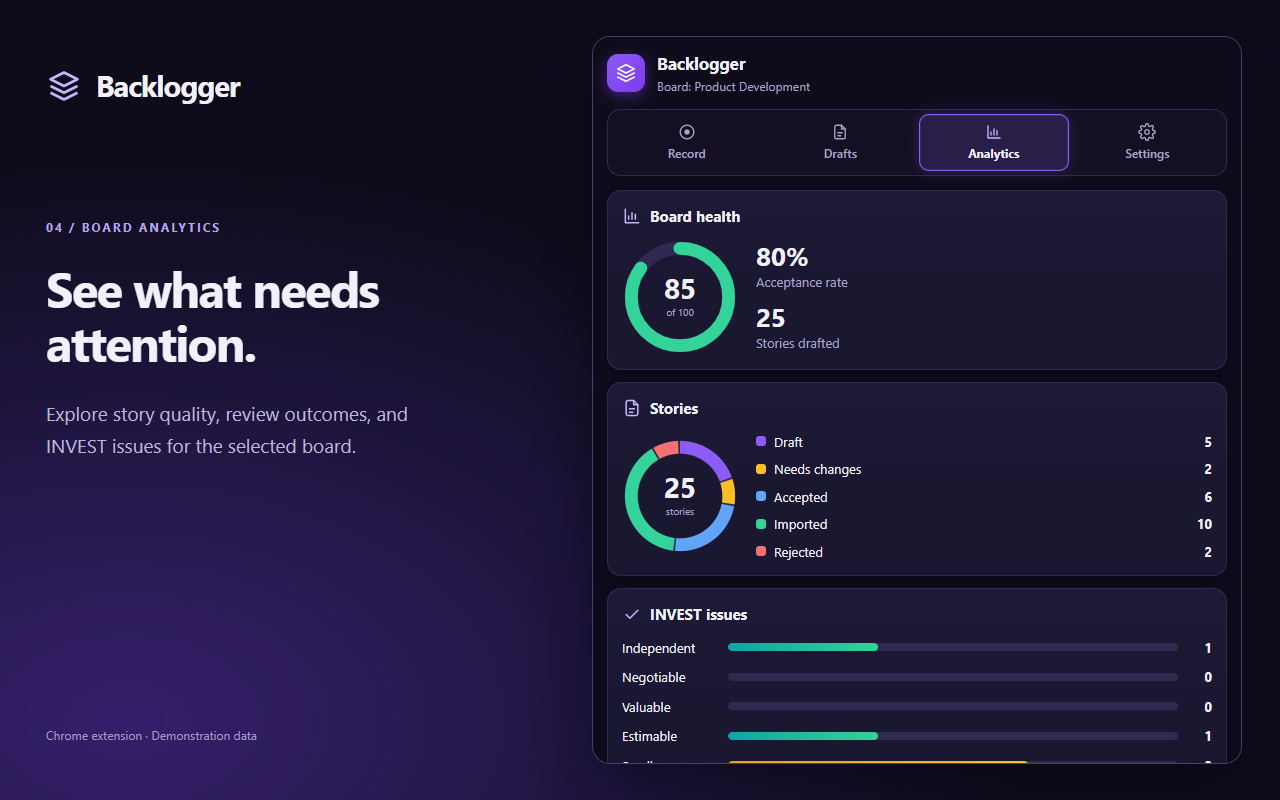
Tiger Data, built on PostgreSQL and TimescaleDB, provides the database foundation for Backlogger. We store meeting records, stories, revisions, and review events together. A TimescaleDB hypertable captures analytics events, while time-bucketed queries support daily backlog quality trends. Board analytics also expose acceptance metrics, draft outcomes, and recurring INVEST issues.
This connects individual review decisions to a broader question: how is the team’s backlog quality changing over time?
Backlogger is released under the MIT License and built with open-source tools including React, TypeScript, WXT, FastAPI, SQLModel, and PostgreSQL. Our repository includes database migrations, setup instructions, tests, and board adapters, giving other developers a foundation to inspect, adapt, and extend the project.
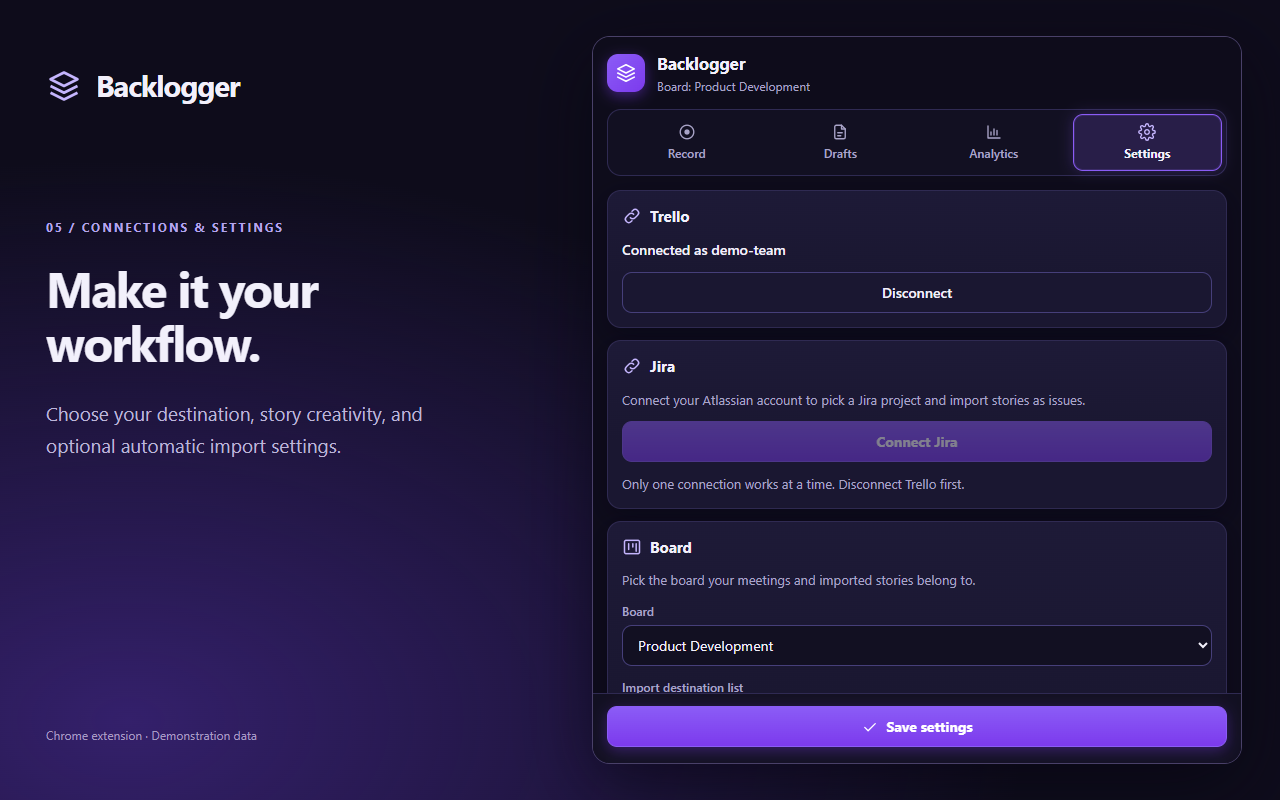
We use private Supabase Storage for recordings and Trello and Jira integrations to move approved stories into existing team workflows.
Claude Code and OpenAI Codex assisted development, with their contributions documented in our AI usage disclosure.
Challenges we ran into
Audio handling was an unexpected obstacle. Audio-only WebM recordings could be identified as video, causing processing failures. Explicit media-type handling helped the browser, backend, and Gemini process recordings consistently.
Defining a useful story was another challenge. A polished draft can still contain unsupported assumptions, overlap existing work, or cover too much scope. We added evidence requirements, semantic comparisons, and assumption labels to make these problems visible during review.
Integrations also required careful handling of authorization callbacks, project-specific Jira fields, and export retries. Duplicate protection helps prevent repeated requests from creating repeated backlog items.
Accomplishments we're proud of
We connected recording upload, AI processing, evidence playback, human review, and backlog export in one workflow.
We are especially proud of keeping source evidence close to every draft. Reviewers can hear the conversation behind a requirement before deciding whether it belongs in their backlog.
What we learned
We learned that useful AI products require more than convincing text. Traceability, clear uncertainty, recoverable failures, and human judgment are essential.
We also learned to separate confidence from quality. A story can accurately reflect a meeting while still being too large or difficult to test. Reviewers need visibility into both.
What's next for Backlogger
We plan to build a companion web app where teams can explore detailed analytics, review meeting history, and track how their backlog quality changes over time.
We also want to support more project management platforms beyond Trello and Jira, bringing Backlogger into more teams’ existing workflows.
Built With
- claude-code
- fastapi
- google-gemini-api
- jira-api
- openai-codex
- python
- react
- sqlmodel
- supabase
- tigerdata
- trello-api
- typescript
- wxt


