-
-
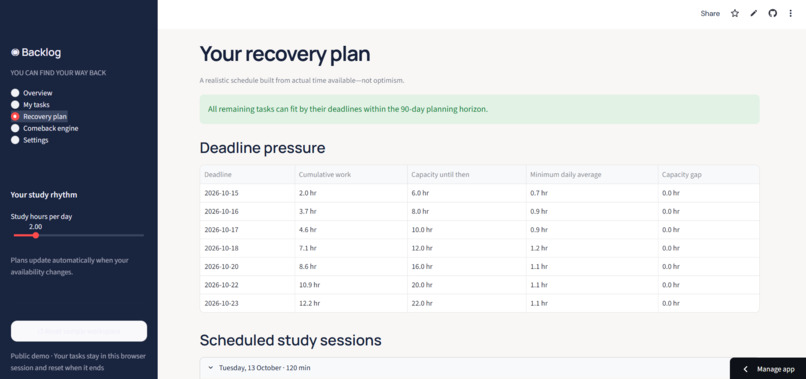
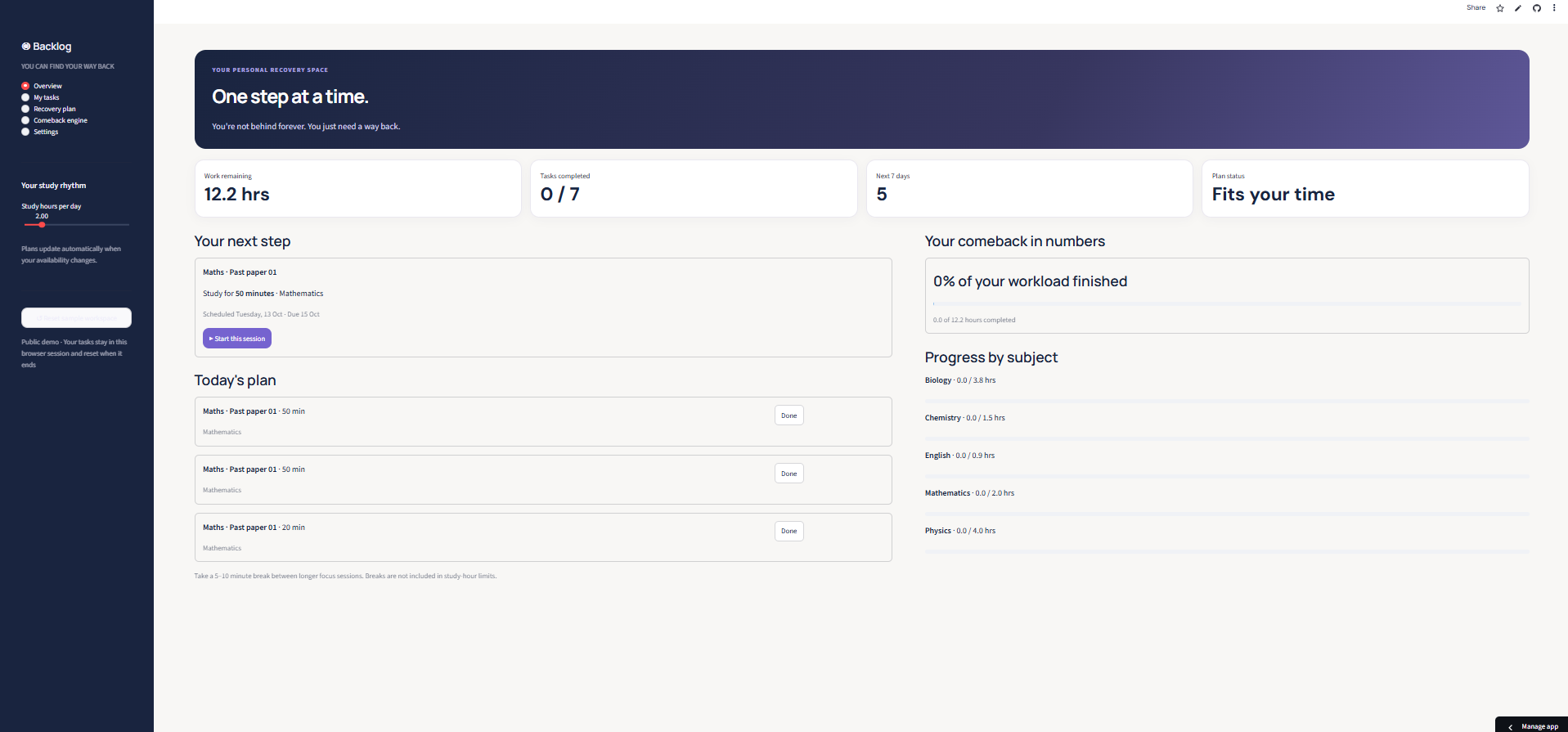
Backlog dashboard showing unfinished workload, study progress, and personalized next steps.
-
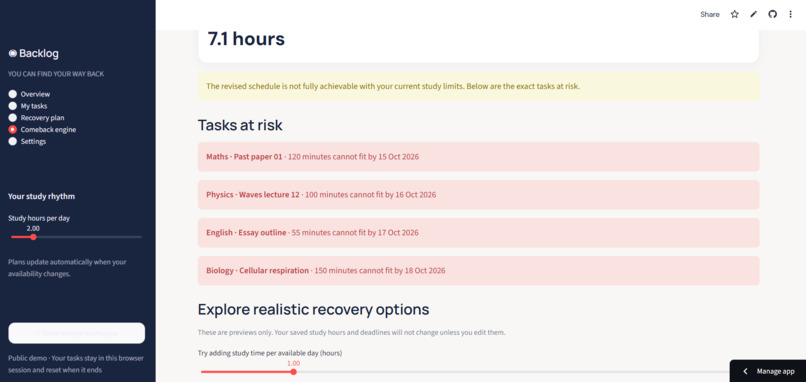
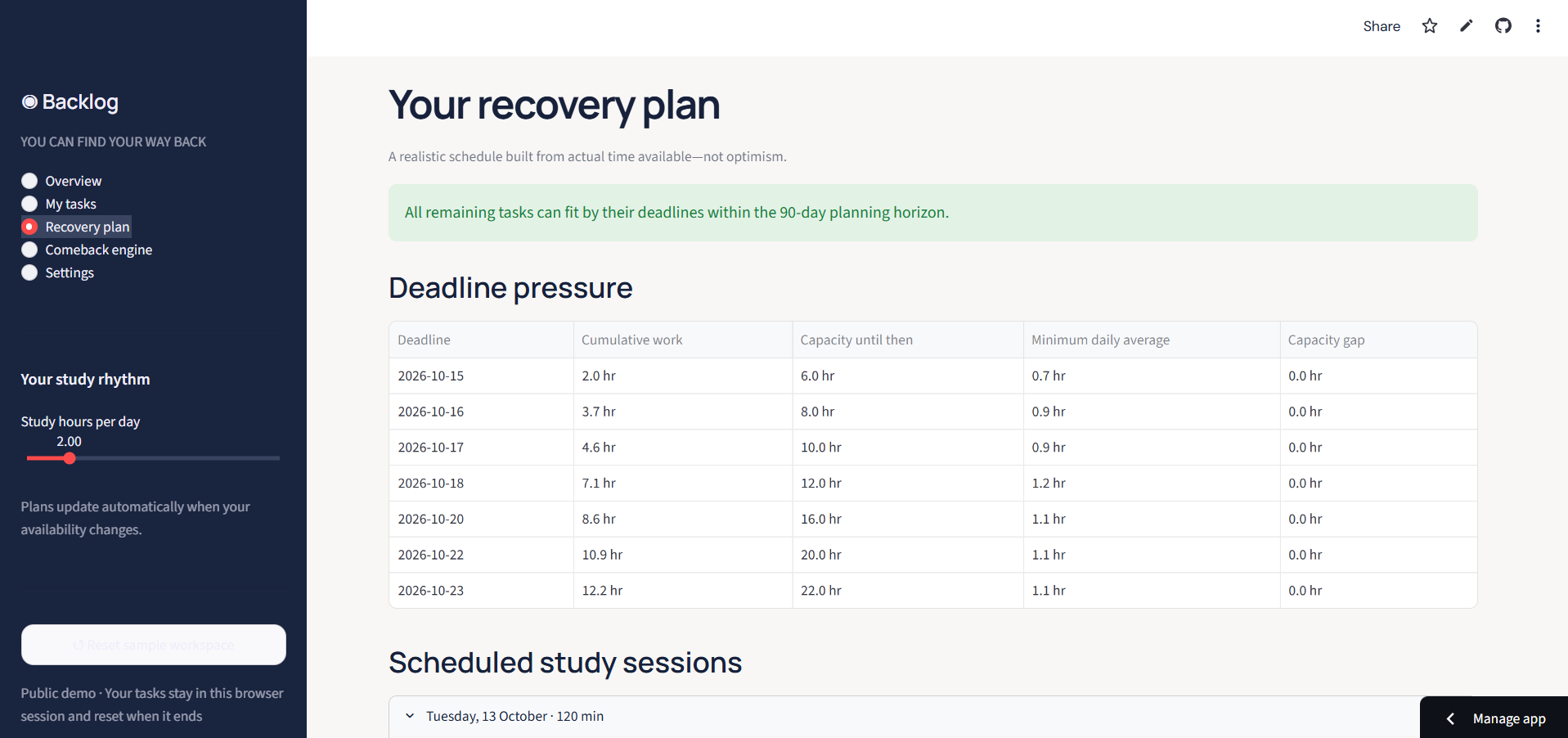
Smart Recovery Planner creating realistic study sessions based on deadlines and availability.
-
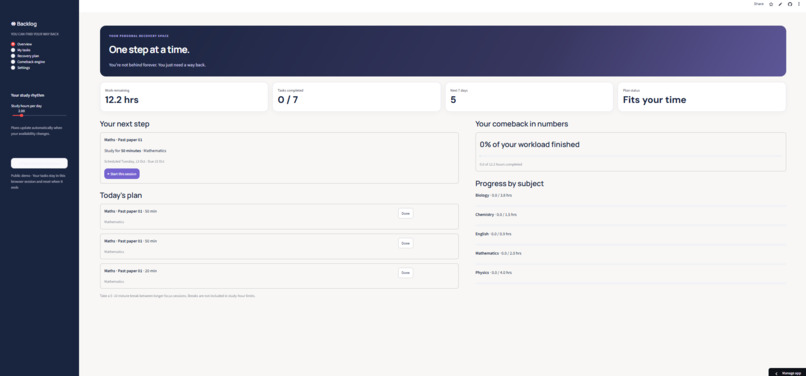
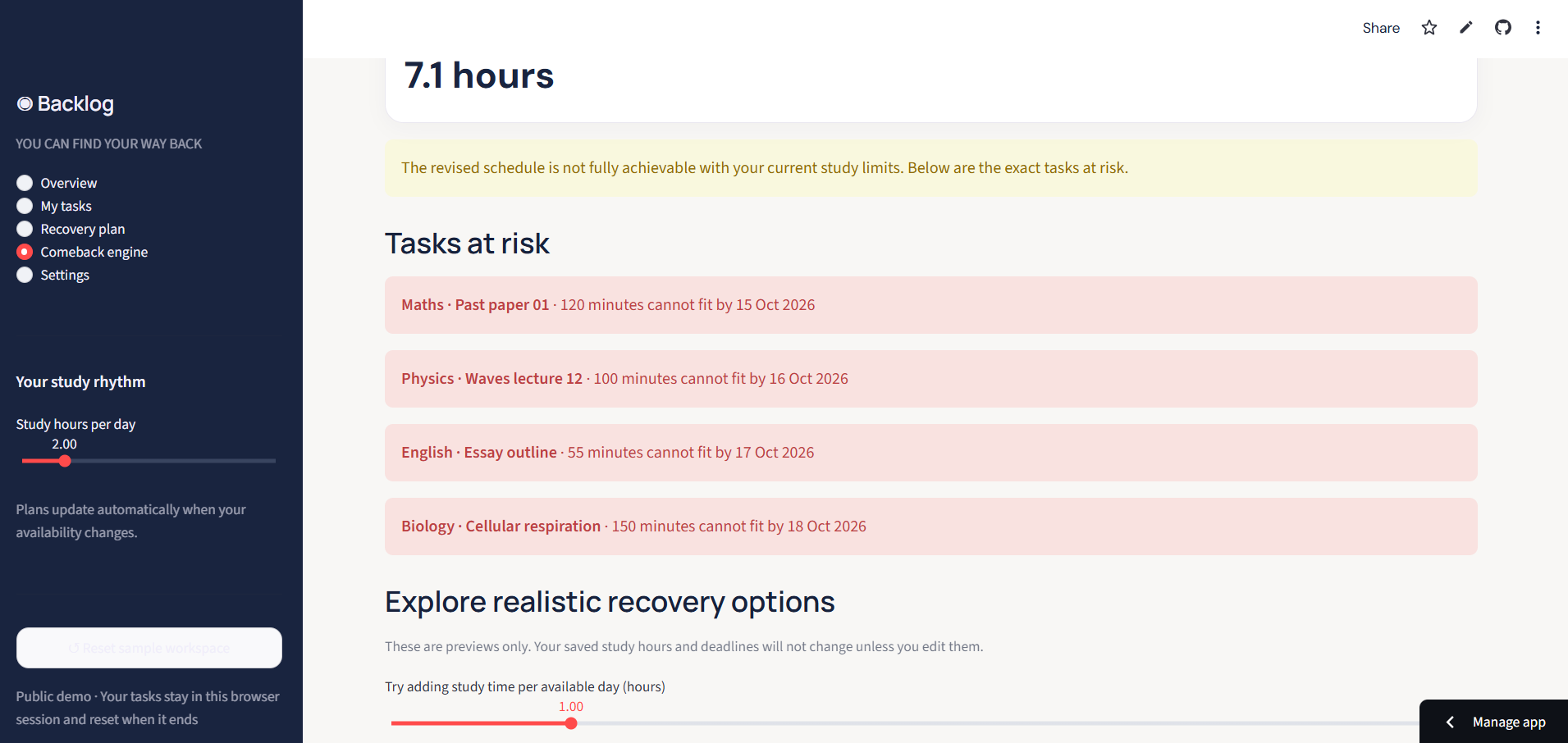
Comeback Engine identifying tasks at risk and helping students recover after missed study days.
Inspiration
Every student knows how overwhelming it can feel to fall behind. Recorded lectures accumulate, assignments remain unfinished, and deadlines approach faster than expected.
Most productivity applications focus on helping users organize their work. But students who are already behind often face a different problem: they don't know where to begin, whether catching up is realistic, or how to recover after missing another study day.
That inspired Backlog, an intelligent academic recovery planner built around one message:
"You're not behind forever. You just need a way back."
Our goal is to make academic recovery feel achievable, structured, and free from unnecessary guilt.
What It Does
Backlog transforms unfinished academic work into practical, personalized recovery plans.
Students can add lectures, assignments, and revision tasks, specifying their subjects, durations, deadlines, and priorities.
The application then provides:
- Workload Dashboard: Displays remaining study hours, completed tasks, upcoming deadlines, and progress by subject.
- Smart Recovery Planner: Generates daily study sessions using deadlines, priorities, and available study time.
- One Next Step: Recommends one specific, manageable action to help overwhelmed students get started.
- Comeback Engine: Recalculates study schedules when students miss days or their availability changes.
- Realistic Deadline Warnings: Identifies tasks that cannot be completed before their deadlines rather than generating impossible schedules.
- Recovery Options: Allows students to explore how additional study hours could affect their plans.
Unlike a traditional to-do list, Backlog focuses on helping students recover when their original schedules no longer work.
How We Built It
Backlog was developed using:
- Python for application logic and workload calculations.
- Streamlit for the interactive web interface.
- SQLite for persistent storage in the local prototype.
- GitHub for source-code hosting and version management.
- Streamlit Community Cloud for public deployment.
The scheduling engine uses deterministic, rule-based calculations rather than depending on AI-generated guesses.
It considers task deadlines, remaining duration, priority, study-hour limits, and unavailable days when generating recovery sessions.
Longer tasks are divided into manageable sessions, while completed work is excluded from future planning.
The public hackathon demonstration uses temporary session-based workspaces, allowing visitors to explore Backlog without registering or entering personal information.
AI-assisted development tools were used during implementation, testing, and presentation preparation.
Challenges We Faced
One of our biggest challenges was ensuring that Backlog produced realistic schedules rather than simply attractive ones.
A planner that promises students they can finish twenty hours of work in ten available hours would undermine trust.
We addressed this by implementing scheduling logic that calculates available capacity and explicitly reports work that cannot fit before deadlines.
Another challenge involved database connection handling during Streamlit execution. We identified and corrected a SQLite threading error during real-world testing.
We also tested rescheduling after missed study days, changing available hours, tracking completed tasks, and handling workloads that exceeded available capacity.
Finally, we deployed Backlog online and tested its main recovery features through the public website.
Accomplishments We're Proud Of
Our biggest accomplishment is building a functional academic recovery application rather than presenting only a concept or design mockup.
Backlog can calculate unfinished workloads, generate realistic study schedules, recommend manageable next steps, and revise plans after missed days.
We are especially proud of the Comeback Engine, which identifies tasks at risk and offers realistic recovery options without shaming students for falling behind.
The application is publicly accessible and demonstrates a practical solution to a common student problem.
What We Learned
Building Backlog highlighted the importance of designing technology around real human behavior.
Students don't always follow perfect routines, and productivity software should adapt to that reality.
We also learned how to structure a Python application, implement deterministic scheduling, test core calculations, manage application data, and deploy a working web product.
Most importantly, we learned that useful innovation isn't always about adding more artificial intelligence. Sometimes, transparent calculations and thoughtful user experience can solve a problem more reliably.
Business Model and Future Potential
Backlog initially targets high-school students, university students, and online learners struggling with accumulated academic work.
We propose a freemium business model.
The free version would offer essential task management, workload tracking, and recovery planning.
Potential premium features could include advanced progress analytics, calendar synchronization, multiple personalized schedules, and deeper study insights.
Before introducing paid subscriptions, we would validate demand through student interviews, repeat usage, retention, and willingness-to-pay experiments.
Future growth opportunities include partnerships with universities, educational organizations, and online learning platforms.
What's Next
Our next priorities are:
- Conducting user testing with real students.
- Improving planning flexibility and mobile usability.
- Introducing secure student accounts and persistent cloud storage.
- Exploring calendar and learning-platform integrations.
- Validating sustainable monetization through real student feedback.
Our long-term vision is to make Backlog a trusted academic recovery companion for students around the world.
Because falling behind doesn't mean failing. Every student deserves a realistic way forward.

Log in or sign up for Devpost to join the conversation.