-
-
Question Page
-
Nepal Closet
InspirationInspiration
Most of us overpack for trips, or buy new clothes "for the trip", while the wardrobe at home is already full. Then we still end up with photos where the shirt matches the wall, or we're cold in a dress chosen for "summer". Packing apps give generic lists, and style apps push you to shop. I wanted the opposite: an app that starts from what you already own and tells you which of those clothes will work at that place, in that weather.
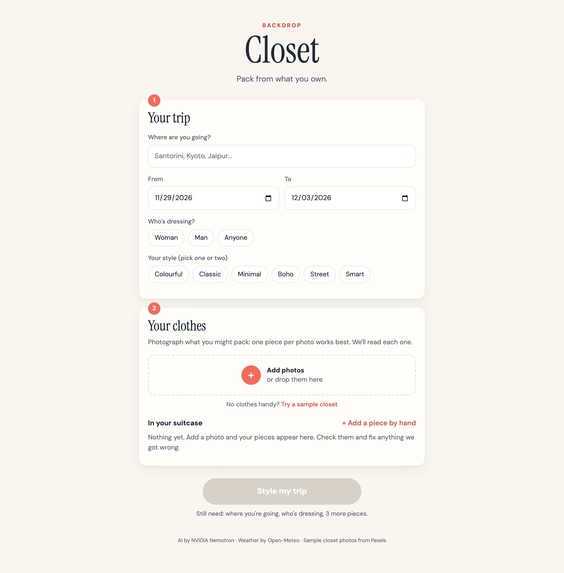
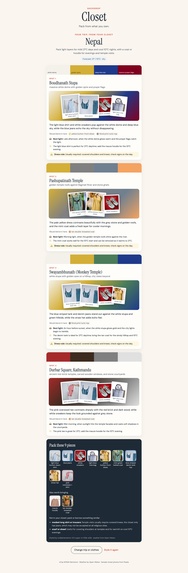
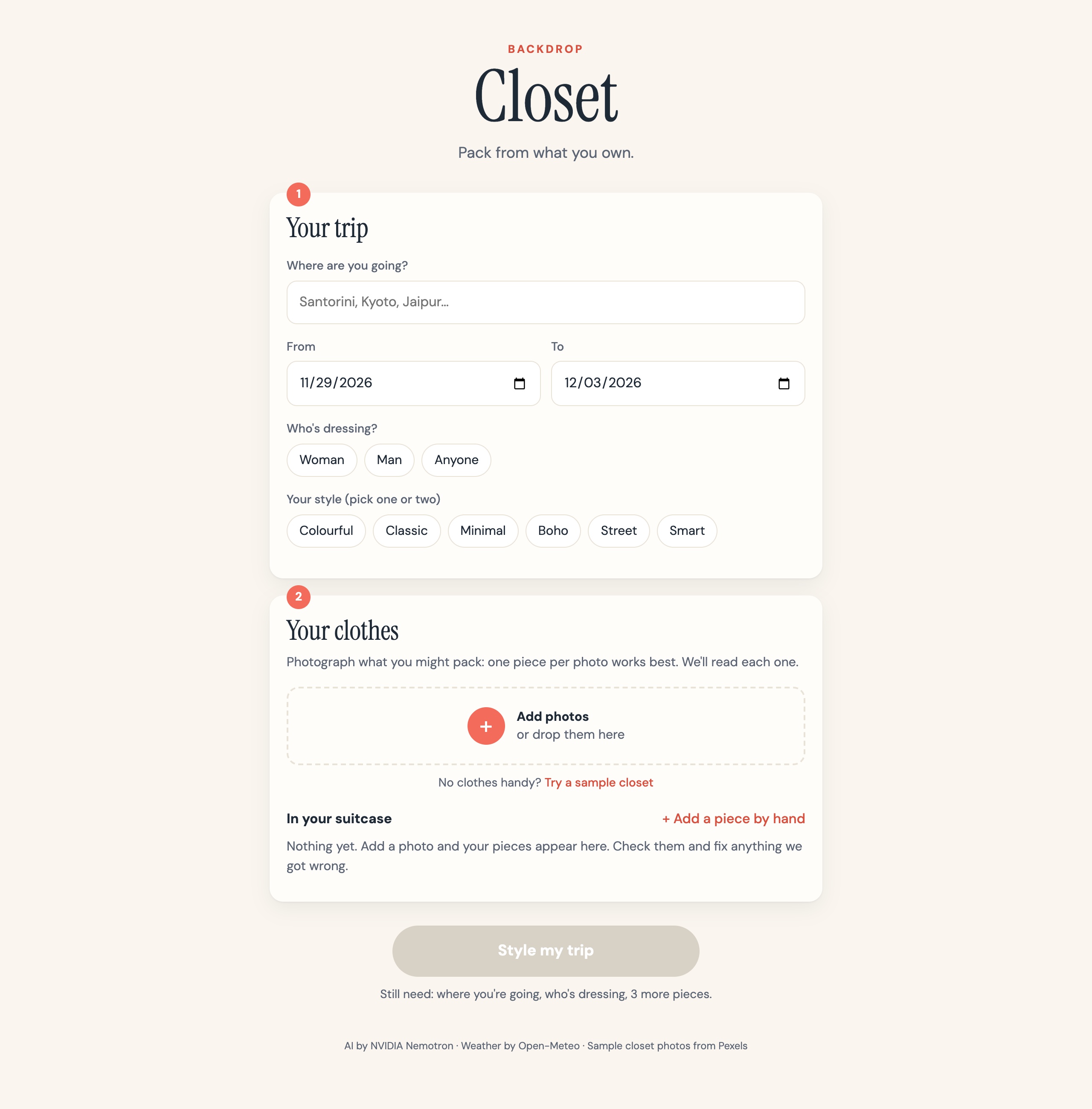
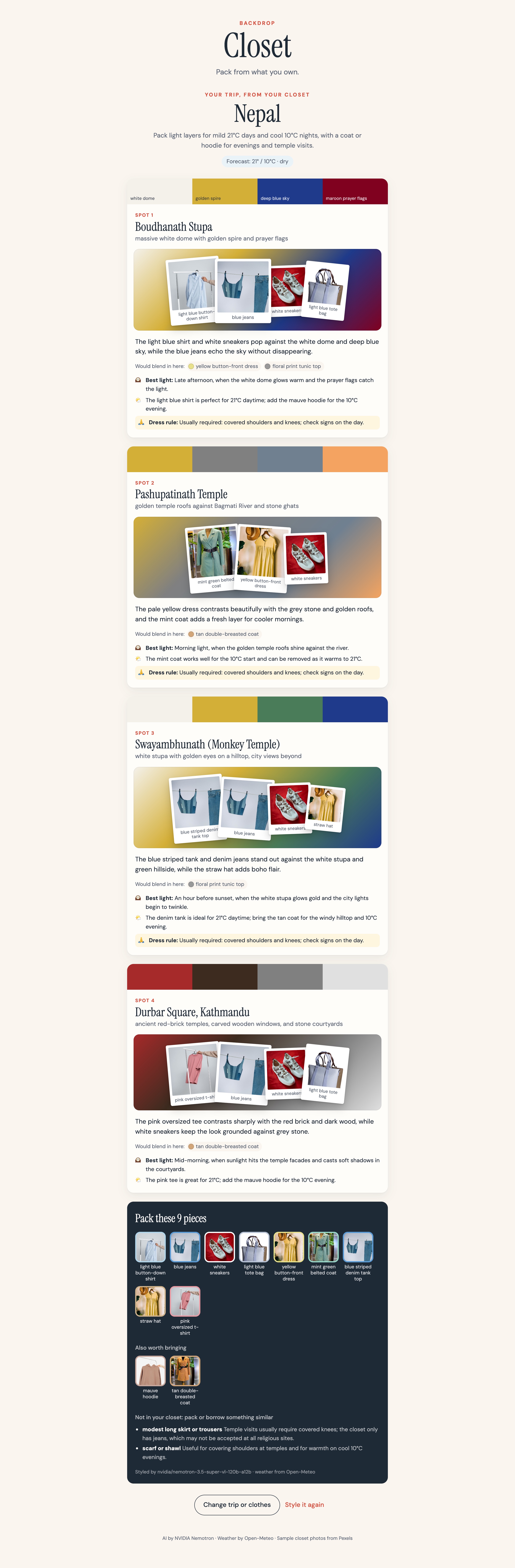
What it does Backdrop Closet helps travellers pack less and buy nothing new, while still looking good in their photos. It's useful for students, budget and carry-on travellers, friends on group trips, and couples on a honeymoon. Pick a destination and dates. Closet shows real weather for them. Upload photos of your clothes. AI lists every piece, its colour and its fabric, and you can fix anything. Get the top photo spots of the trip. Each comes with the backdrop's colours, an outfit from your closet that stands out against it, the pieces that would blend in, the best light, a weather tip and local dress rules. Get a short packing list of only what you'll wear, plus gaps you could fill by packing or borrowing. It never says "buy".
How we built it Frontend: plain HTML, CSS and JavaScript, with no framework. Photos are shrunk to 1024px and turned upright in the browser before upload, so even huge phone photos send quickly. Backend: Node.js serverless functions on Vercel. The NVIDIA API key lives only in Vercel's environment settings and never reaches the browser or the repo. NVIDIA API Catalog: Nemotron 3.5 Super VL reads each clothing photo and returns structured JSON with the name, type, colour, hex code and fabric. Nemotron 3 Ultra is the stylist. It takes the trip, the real weather and the closet, and returns the photo spots, outfits and tips as JSON. Open-Meteo: Geocoding finds real places. Forecast covers trips within 16 days. Historical Weather averages the same dates over the last 3 years for trips further ahead, labelled "typical".
Challenges we ran into Empty answers. Nemotron is a reasoning model and returned empty content until I turned off its "thinking" mode for these structured tasks. Messy JSON. Models sometimes repeated their JSON twice or added extra text, so I wrote a parser that extracts the first complete JSON object. Vercel's 60-second limit. Ultra can take 15–50 seconds. The stylist works within a time budget: it retries Ultra if time allows, then falls back to the faster Super VL. The AI inventing clothes. The server checks every outfit against the real closet and drops anything invented. If an outfit has no shoes, it adds a pair from the closet. Misread photos. A folded ribbed T-shirt was read as a corduroy jacket, so every piece is editable.
Accomplishments that we're proud of Outfits use only your real clothes, and the server enforces it rather than just trusting the prompt. The weather is honest: it comes from real data, never the model's guess, and "typical" is clearly labelled. It's respectful: no comments on bodies, and it never tells you to buy anything. It stays reliable when the AI is slow or busy, thanks to retries, a fallback model and a retry button on any photo. The full flow works live, with a one-tap sample closet for judges.
What we learned Reliable AI needs more than a prompt. Getting dependable, structured output from large models took clear rules, server-side checks, retries and a fallback model. Design around real limits. Time limits, free quotas and imperfect vision shaped the design as much as the features did. Weather is better as data. It was best handled by a real weather API, not the AI.
What's next for backdrop-closet Save your closet between trips, so you only photograph your clothes once. Outfits for couples and groups that look good together in photos. Cut-out clothing photos for cleaner flat-lays. Share a trip's postcards with friends. Production readiness: a shared rate limit store and paid NVIDIA hosting as it grows.
