-
-
thumbnail
Inspiration
Coding agents can produce a working change faster than a developer can form a durable mental model of it. Existing review tools mostly ask whether generated code is good. We wanted to ask a more human ownership question: can the person inheriting the change explain what the agent intended, what it actually changed, and which consequences they now own?
What it does
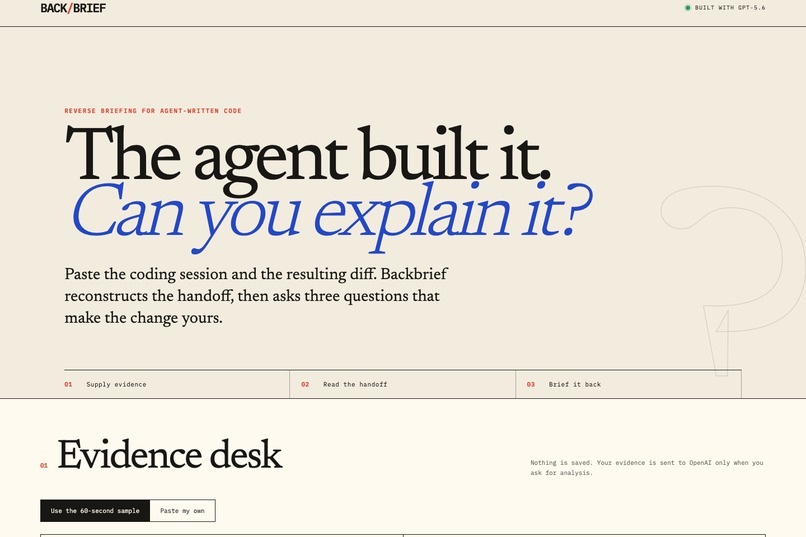
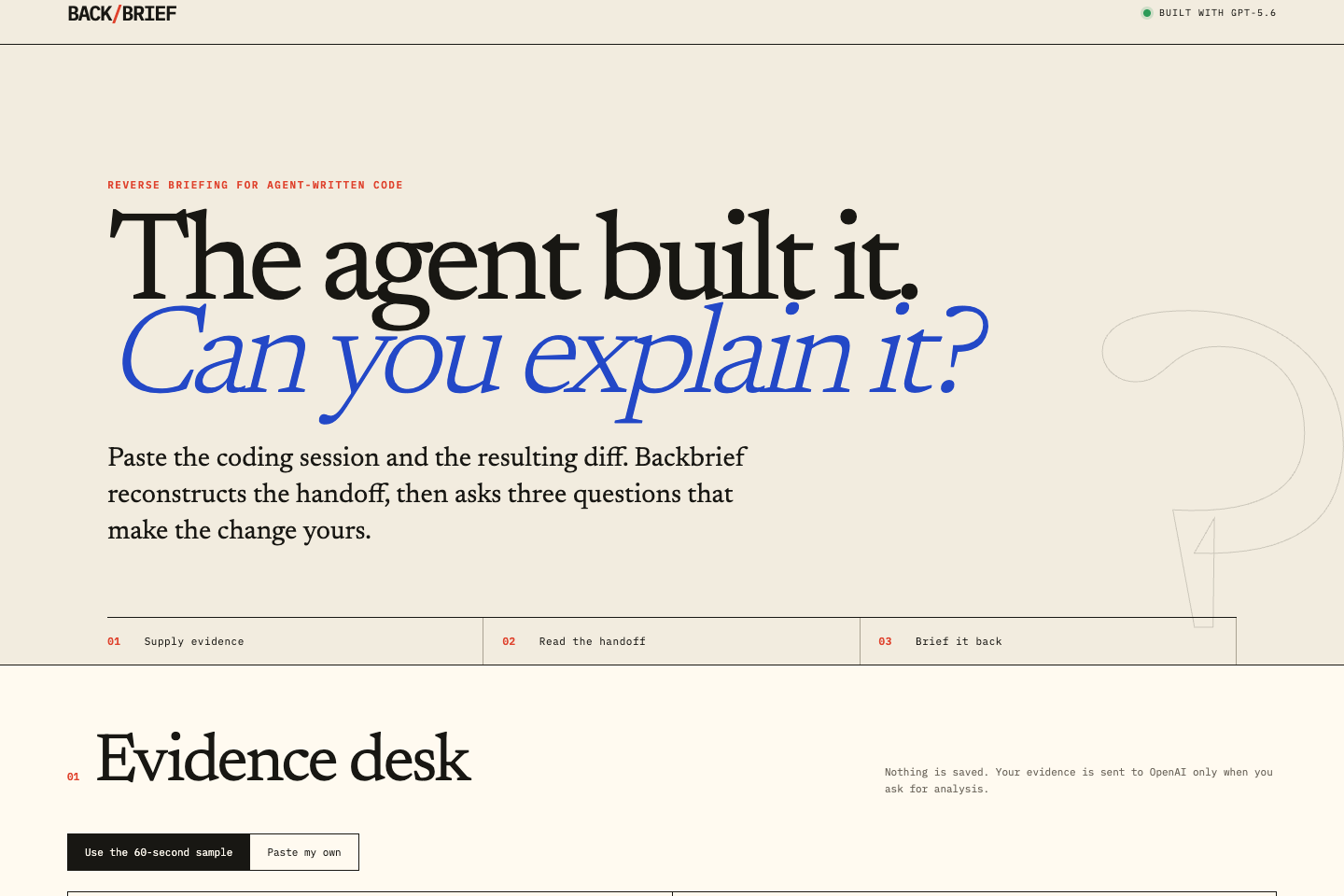
Backbrief accepts two artifacts: the agent session and the resulting git diff. GPT-5.6 turns them into a grounded handoff with separate intent, implementation, and consequences columns, each citing stable session or diff line references. It then runs a three-question reverse brief, one question at a time. The developer answers in their own words, receives concise teaching, and finishes with a recap they can carry forward.
Every evidence reference is interactive. Selecting it opens the exact original session or diff lines in an audit plate without leaving the handoff.
After the third question, the developer can download a self-contained HTML receipt containing the thesis, cited claims, their own explanations, and the coaching takeaways. It is generated entirely in the browser and deliberately excludes the raw session and diff.
The public app includes a fictional email-queue example, so judges can complete the full flow without an account, repository, API key, or local installation.
How we built it
Backbrief is a Next.js and TypeScript app with two stateless API routes powered
by GPT-5.6. A completed brief makes four OpenAI Responses API requests: one
grounded analysis and three coaching turns. Zod Structured Outputs constrain the
initial handoff and each coaching note. The server adds stable S1…Sn and
D1…Dn references before analysis, validates and size-bounds every boundary,
requests store: false, and returns generic errors that never echo private
evidence.
The raw session and diff are used only for initial analysis. The coaching call receives only the generated question, teaching point, and developer answer. There is no database, account system, analytics, or raw-input logging.
Codex was the primary development partner from blank repo to production. It helped research the rules and adjacent projects, narrow the product, write a falsifiable spec and API contract, drive red-green tests, implement the GPT and UI layers, run live-model and browser verification, scan the code, deploy the app, and package the submission.
Challenges
The hard problem was grounding without pretending to verify. Session text can state intent that the diff does not implement, while a diff can expose behavior the session never discussed. Stable evidence references and a strict structured schema let the model preserve that tension instead of collapsing it into a generic summary.
The second challenge was privacy and scope. Agent transcripts may contain sensitive context, so Backbrief explicitly gates model use, avoids application persistence and raw-input logging, bounds inputs, keeps raw evidence out of the coaching call, and explains that OpenAI's API data controls still apply.
Accomplishments
- A complete no-login teaching loop powered by real GPT-5.6 calls.
- Auditable evidence-cited handoffs with exact source lines one click away.
- Free-response coaching without scores, correctness labels, or merge verdicts.
- A portable, printable HTML receipt generated locally with no raw evidence.
- Edge-enforced rate limiting in front of the anonymous paid model routes.
- Twenty-eight passing behavioral tests plus lint, typecheck, and production build.
- Zero Semgrep findings and no detected lethal-trifecta co-location.
- Verified desktop and mobile flows on the production deployment.
What we learned
The most useful AI coding workflow is not more autonomy by default. It is a clear contract, observable evidence, and a human loop at the exact point where ownership changes hands. We also learned that a strong hackathon product often comes from removing adjacent features: OAuth, persistence, provider-specific importers, and scoring would all have weakened the core demo.
What's next
The next step is to measure whether developers actually complete all three questions and can explain the change later. Only then would we add direct Codex session import, repository-aware evidence selection, or team handoff exports. Backbrief will remain educational and non-gating.
Built With
- codex
- gpt-5.6
- openai

Log in or sign up for Devpost to join the conversation.