-
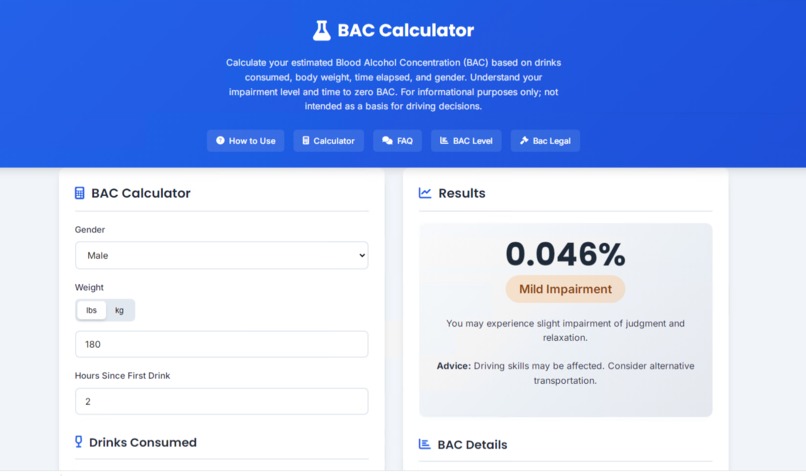
baclevelcalculator.com homepage
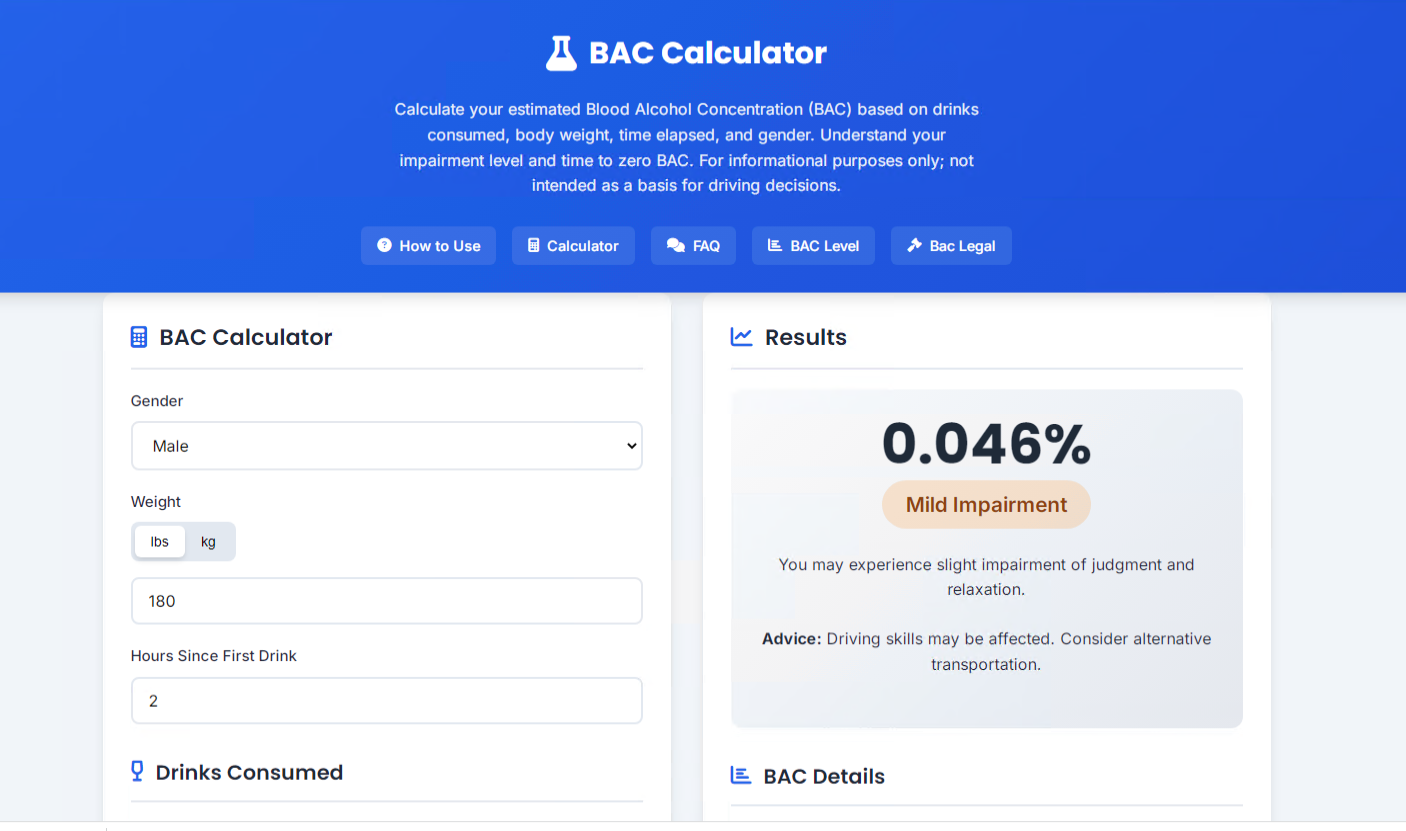
Inspiration
I've noticed many people underestimate how long alcohol stays in their system or rely on guesswork to determine if they're fit to drive. Existing online BAC calculators often feature cluttered interfaces, opaque algorithms, or poor performance on mobile devices. I'm committed to creating a clear and accessible educational tool that empowers anyone to estimate their blood alcohol concentration (BAC) based on scientific principles, while explicitly emphasizing that this is only an estimate and should never replace a breathalyzer or personal judgment.
What it does
The BAC Calculator allows users to:
Select gender, enter weight (lbs/kg), and specify the time since the first drink.
Add the number of standard drinks (beer, wine, spirits) or customize drinks by volume and alcohol content.
Instantly view estimated blood alcohol concentration (BAC) percentage, impairment level (sober to severely impaired), comparison to legal limits, and calculation details.
Understand the time required to reach 0% BAC, consult an alcohol concentration reference chart, and read FAQs explaining the underlying data science principles. All results include a critical disclaimer: Driving decisions should never be based solely on these estimates.
How I built it
I employed pure HTML, CSS, and JavaScript (without frameworks) to maintain lightweight pages and fast responsiveness. Core calculations are based on the Widmark formula, with a metabolic rate set at 0.015% per hour. A flexible beverage database and custom drink input feature were built, converting ounces or milliliters to grams of pure alcohol using ethanol density (0.789 g/mL). The design employs a fully responsive layout—adapting to screens ranging from desktop to 360 pixels—with optimized touch targets and font sizes. Structured data (JSON-LD) is integrated for SEO and rich snippets, while Open Graph meta tags enhance social sharing performance.
Challenges I ran into
Processing custom drink inputs proved challenging, as volume units (oz/ml) and alcohol by volume (ABV) required precise conversion before contributing to total alcohol content.
Ensuring unit switching (lb/kg) updates weight values without losing user-entered figures demanded rigorous state management.
Achieving layout adaptation on minimal screens while maintaining all interactive elements accessible involved multiple rounds of media query adjustments.
Crafting clear, non-misleading disclaimers is a delicate balancing act—avoiding scaring off users while explicitly highlighting the tool's limitations.
Accomplishments that I'm proud of
Reminding people not to drink and drive and to prioritize driving safety is not only taking responsibility for their own safety but also for the safety of others and the public.
What I learned
How to correctly apply the Widmark formula and account for the conversion difference between ounces and milliliters when calculating alcohol mass.
The importance of progressive enhancement: Even if JavaScript fails, the page should still display useful information, though the calculator itself is undoubtedly a significant enhancement.
How to use Schema.org markup to structure FAQ content, potentially enabling rich results in Google Search.
Building a truly responsive layout requires testing on real devices, not just resizing browser windows.
The value of a strong disclaimer—rather than misleading users into thinking they are safe to drive, clearly state the tool's limitations.
What's next for BAC Calculator
Cups Converter
Built With
- html+javascript+css

Log in or sign up for Devpost to join the conversation.