Baby AI: A Personal AI Companion That Grows With You
My vision was to create an AI that learns purely through human interaction. I was inspired by the tabula rasa concept—the idea of a blank slate mind that develops through experience.
Current AI systems are biased by their massive pre-training datasets, but what if you had an AI with a baby brain that learns only from you? An AI companion that grows with you, shaped by your unique interactions, becoming truly personal rather than a one-size-fits-all model.
While I couldn't achieve true zero-knowledge AI (Gemini 3 Flash Preview is pre-trained), I simulated this experience through careful prompt engineering. I instructed the model to ignore its vast knowledge base and only use information from our conversation history, creating the illusion of a learning baby brain.
This addresses the core problem: AI bias and data scarcity. Instead of relying on billions of parameters trained on internet data, Baby AI builds its knowledge graph from scratch based on what you teach it.
Technical Implementation
The technical implementation centers on spatial knowledge mapping.
When you teach Baby AI a concept like "The sky is blue," the system extracts entities (sky, blue) and their relationships using Gemini's JSON output mode.
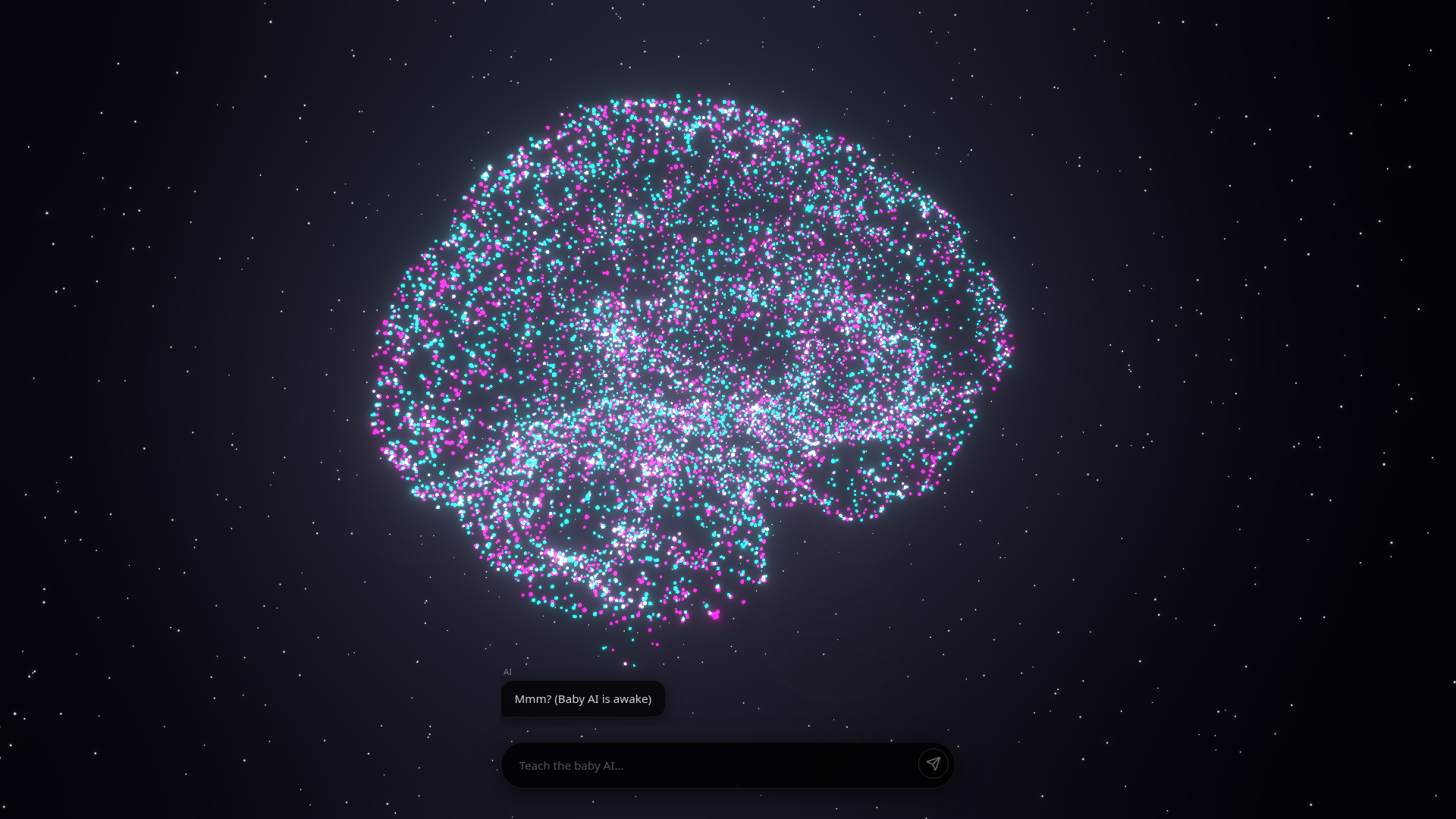
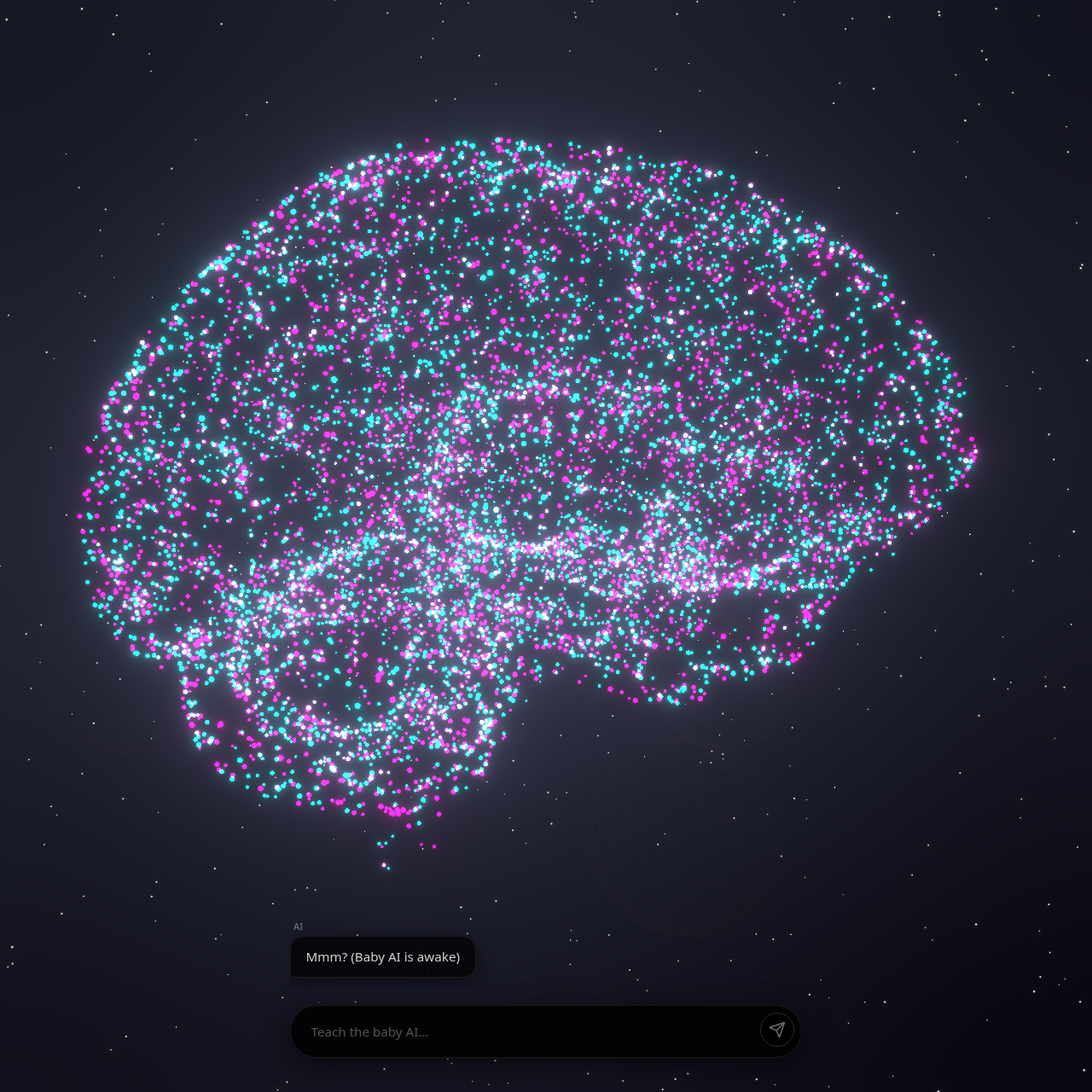
Each concept becomes a neuron (a glowing 3D vertex) positioned in anatomically-correct brain regions:
- Visual concepts → Visual Cortex
- Language → Broca’s Area
- Logic → Prefrontal Cortex
The position of each neuron is calculated using a semantic manifold algorithm:
( P_{neuron} = C_{region} + \epsilon )
Where:
- (C_{region}) is the center of the corresponding brain region
- (\epsilon) is a random jitter vector for organic clustering
These neurons are rendered as instanced meshes in React Three Fiber, enhanced with bloom post-processing effects, creating a holographic brain visualization.
Key Gemini 3 Features
Three critical Gemini 3 features make this possible:
Ultra-low latency (<500ms responses)
Ensures neurons spawn in real time, making the brain feel alive rather than sluggish.Structured JSON output
UsingresponseMimeType: "application/json"allows precise extraction of knowledge graphs—nodes, connections, and categories—which are mapped to 3D coordinates. Without this, parsing free-form text would be unreliable.Instruction adherence
Enables the blank slate simulation. Gemini consistently follows a complex 500-word system prompt that forces it to ignore pre-trained knowledge and rely only on conversation context.
Challenges
The biggest challenge was coordinate alignment—mapping abstract semantic concepts to physical XYZ positions in 3D space required constant fine-tuning.
Balancing visual effects like bloom and glow was also tricky:
- Too much → blurry
- Too little → boring
Future Vision
This hackathon project is a proof-of-concept for embodied AI.
Imagine a physical robot with a transparent brain—a machine that walks into a room, sees an object it doesn’t recognize, and asks:
“What’s that?”
You watch its 3D mind grow on a holographic display as it forms its very first memory.
Everyone would have their own AI companion, shaped by their unique experiences, with a mind you can literally see and understand.
Baby AI is the first step toward making AI not a mysterious black box, but a transparent partner you nurture and grow with.

Log in or sign up for Devpost to join the conversation.